A doctor note is a written document from a healthcare provider that confirms a patient was evaluated, treated, or advised to take certain health-related precautions. Depending on the situation, a doctor note may be used to explain an absence from work or school, recommend rest, document a return-to-work date, or communicate temporary activity restrictions.
Because employers, schools, and other organizations may have different documentation requirements, it is important to use a doctor note appropriately. A simple template can help organize the necessary information, but the medical information and certification should come from an authorized healthcare provider.
What Is a Doctor Note?
A doctor note, sometimes called a medical note, doctor’s note, medical excuse note, or medical certificate, is documentation provided by a healthcare professional for a specific patient-related purpose.
The exact format can vary. Some notes are brief letters on medical-office letterhead, while others use structured forms with patient information, dates, recommendations, and a provider signature.
A doctor note may confirm that a patient:
- Was seen or evaluated by a healthcare provider.
- Needed time away from work or school.
- Was advised to rest or limit certain activities.
- May return to work or school on a specified date.
- May return with temporary restrictions.
- Needs additional medical follow-up.
The purpose is generally to provide relevant documentation rather than to provide a complete medical record.
When Might Someone Need a Doctor Note?
A doctor note may be requested when an organization needs documentation supporting an absence or temporary restriction. The specific requirements depend on the employer, school, organization, and applicable laws.
Doctor Note for Work
Employees may be asked to provide medical documentation when they miss work because of an illness, injury, medical appointment, recovery period, or other health-related reason.
For certain qualifying situations under the U.S. Family and Medical Leave Act (FMLA), an employer may require medical certification from a healthcare provider. The U.S. Department of Labor explains that FMLA certification can include information such as when a serious health condition began, its expected duration, relevant medical facts, and whether the employee is unable to perform essential job functions.
Doctor Note for School
Schools may request medical documentation when a student misses classes because of illness, an appointment, an injury, or another health-related situation.
School policies vary, so students and parents should check the school’s attendance policy before requesting or submitting documentation. Some schools may require a specific form instead of a general medical note.
Return-to-Work or Return-to-School Documentation
A healthcare provider may also provide documentation indicating when a patient can resume normal activities or whether temporary restrictions are recommended.
For example, a note may state that a patient can return on a particular date or return with restrictions. The appropriate wording depends on the patient’s circumstances and the provider’s professional judgment.
What Should a Doctor Note Include?
There is no single universal format for every doctor note. However, a professional medical note generally contains enough information to identify the patient, healthcare provider, relevant dates, and purpose of the documentation.
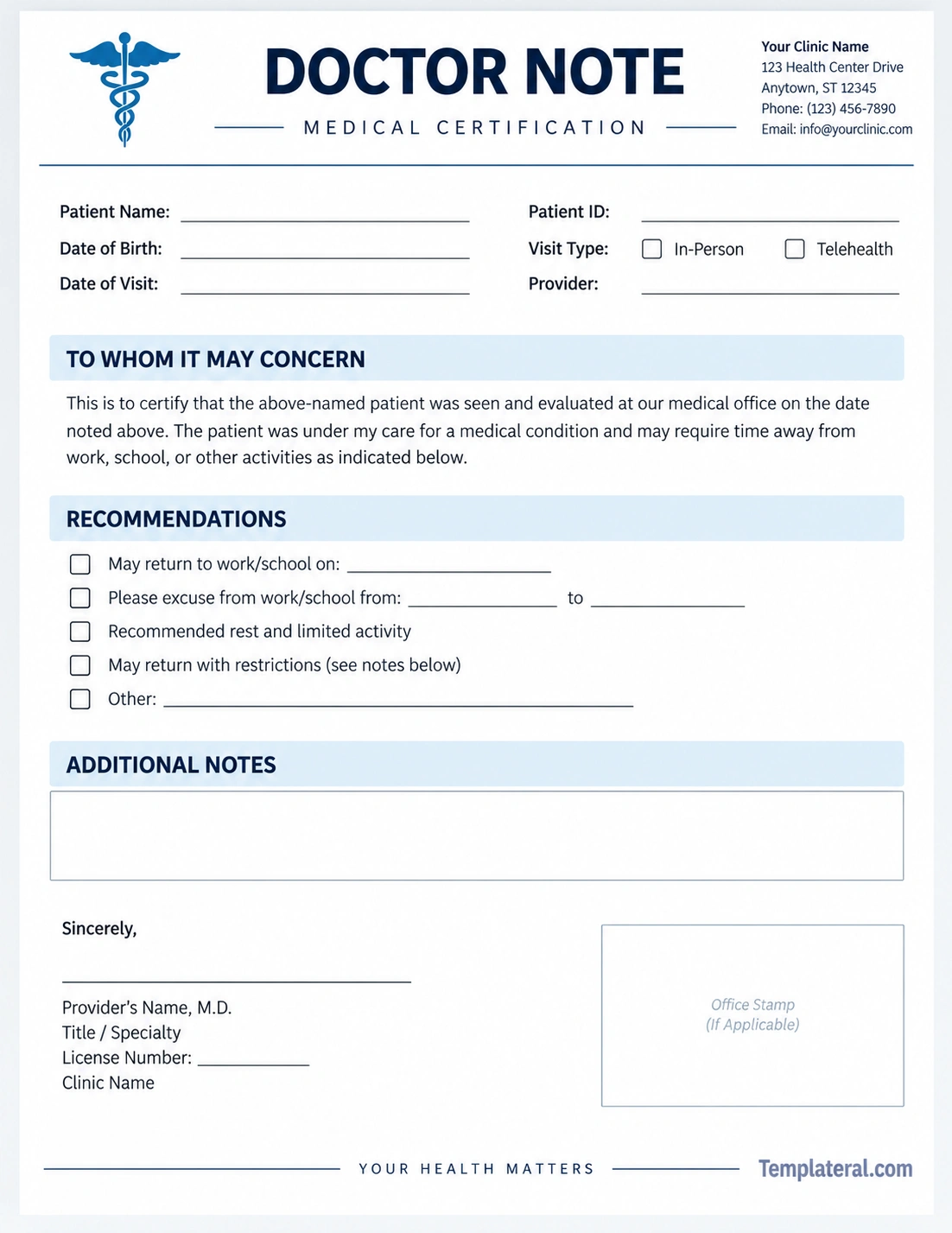
A basic doctor note template may include the following sections:
- Healthcare provider or clinic information: Name, address, telephone number, and other relevant contact details.
- Patient information: Patient name and, when appropriate, another identifier.
- Date of visit: The date the patient was seen or evaluated.
- Provider information: Name and professional title.
- Medical certification: A concise statement describing the relevant certification.
- Recommended absence: Dates or duration of time away from work or school when medically appropriate.
- Restrictions: Any relevant limitations or return-to-activity instructions.
- Additional notes: Space for information that is necessary for the specific situation.
- Signature: Provider signature and applicable professional information.
The amount of information should be appropriate for the purpose of the note. More information is not necessarily better, particularly when unnecessary medical details could expose private health information.
Doctor Note Template
A printable doctor note template can provide a convenient structure for organizing the information that a healthcare provider may need to complete. The template should be treated as a documentation aid rather than a substitute for professional medical certification.
Here is a printable example designed around common sections found in medical certification documents:
How to Use a Doctor Note Template
A template is most useful when it is completed with accurate information and reviewed by the appropriate healthcare provider.
1. Check the Organization’s Requirements
Before using a generic doctor note template, check whether the employer, school, insurance company, or other organization has its own required form.
Some organizations may require specific information or a particular certification format. For FMLA purposes, the U.S. Department of Labor states that certification can be provided in different formats, including healthcare-provider letterhead, although an employer may have its own form that meets the applicable requirements.
2. Have the Healthcare Provider Complete the Medical Information
Patients should not create or alter medical statements themselves. The healthcare provider should determine what information is appropriate based on the patient’s actual evaluation and circumstances.
A blank template can be prepared in advance, but medical conclusions, restrictions, dates, and certification statements should be supplied or approved by the appropriate healthcare professional.
3. Use Accurate Dates
Dates are especially important in medical documentation. The note should accurately identify the relevant visit date and, when applicable, the period of recommended absence or the expected return date.
Incorrect or inconsistent dates can create confusion for both the patient and the organization receiving the document.
4. Keep the Information Relevant
A doctor note generally does not need to reproduce a patient’s complete medical history. Include only the information that is appropriate and necessary for the stated purpose.
For example, U.S. Department of Labor guidance explains that an FMLA medical certification does not necessarily need to include a diagnosis. Instead, it should contain sufficient medical facts to establish the need for qualifying leave.
5. Review the Completed Document
Before submitting the note, check the spelling of the patient’s name, dates, provider information, recommendations, and signature. Make sure the document is complete and legible.
Doctor Note and Privacy
Medical information is sensitive, so a doctor note should contain only information appropriate for its intended recipient.
In the United States, HIPAA protects certain health information held by covered healthcare providers and health plans. HHS explains that the HIPAA Privacy Rule controls how covered healthcare providers and health plans may share protected health information with employers. Employers may ask an employee for a doctor’s note or other health information for certain purposes, but a healthcare provider generally cannot disclose information directly to an employer without the individual’s authorization unless an applicable law permits or requires the disclosure.
Privacy requirements can vary depending on the situation and other applicable laws. For employment-related documentation, it is useful to provide the minimum relevant information required for the particular purpose.
What a Doctor Note Should Not Do
A professional doctor note should document legitimate medical information rather than create a false explanation for an absence.
A template should not be used to:
- Invent a medical condition or diagnosis.
- Falsify a healthcare provider’s signature.
- Change the dates of an actual medical visit.
- Misrepresent medical restrictions.
- Impersonate a healthcare professional.
- Create documentation that falsely appears to have been issued by a clinic.
A printable template is appropriate as a formatting and organizational tool. The underlying medical certification should be genuine and completed by the appropriate healthcare professional.
Doctor Note vs. Medical Certification
The terms doctor note and medical certification are sometimes used interchangeably, but they can have different meanings depending on the context.
A basic doctor note may simply confirm that a patient was evaluated or should be excused from work or school. A medical certification may require more detailed information because it is being used to establish eligibility for a particular benefit, leave program, or accommodation.
For example, FMLA certification has specific information requirements under federal law. The U.S. Department of Labor also states that there is no single mandatory FMLA certification form, although optional forms are available.
Tips for Creating a Professional Doctor Note
If you are designing or preparing a doctor note template for legitimate administrative use, keep the document simple and professional.
- Use a clean, readable layout.
- Include clear patient and visit fields.
- Separate certification information from additional notes.
- Provide enough space for the provider’s signature.
- Include clinic contact information when appropriate.
- Use clear language instead of unnecessary medical jargon.
- Leave sensitive information out unless it is necessary.
- Check whether the recipient requires a specific form.
- Keep a copy of submitted documentation when appropriate.
Frequently Asked Questions About Doctor Notes
Can I use a doctor note template for work?
You can use a template as a structure for legitimate medical documentation, but the healthcare provider should complete or authorize the medical information. Your employer may also have a specific form or documentation policy that you need to follow.
Can a doctor note be used for school?
Yes, a healthcare provider may provide documentation for a student’s medical absence or restrictions when appropriate. However, school requirements differ, so check the applicable attendance policy before submitting a generic note.
Does a doctor note need a diagnosis?
Not always. The information required depends on why the documentation is being requested. For example, U.S. Department of Labor FMLA guidance states that a diagnosis is not required for FMLA medical certification, although sufficient medical facts must establish the need for qualifying leave.
Who should sign a doctor note?
The appropriate healthcare provider or authorized professional should sign or certify the medical documentation. The exact requirements may depend on the purpose of the document and applicable rules.
Can I edit a completed doctor note?
Patients should not alter medical statements, dates, signatures, or other information on a completed medical document. If something is incorrect, contact the healthcare provider or office and request a corrected document.
Conclusion
A doctor note can provide useful documentation when a patient needs to explain a medical absence, temporary restriction, or return to work or school. A well-designed doctor note template can make the documentation process more organized by providing clear fields for patient information, dates, recommendations, notes, and provider details.
However, the template itself does not establish that a medical condition exists. The medical information should be accurate, legitimate, and completed or authorized by the appropriate healthcare provider. Always check the requirements of the employer, school, or organization receiving the documentation, particularly when the note is being used for a formal leave or certification process.
Download: Doctor Note Template
