A missing poster is a printed notice used to share important information about a missing person, pet, or other individual who needs to be located. A clear poster can help distribute identifying details quickly and make it easier for people to recognize the subject and provide useful information to the appropriate contact.
A well-designed missing poster should be easy to read from a short distance and contain the most important information prominently. A photograph, name, identifying characteristics, date last seen, location, and reliable contact information are among the details commonly included.
Because missing-person situations can be sensitive and urgent, accuracy is especially important. Information should be verified before a poster is printed or distributed, and reports involving a missing person should be coordinated with the appropriate authorities.
What Is a Missing Poster?
A missing poster is a public information flyer designed to help communicate that a person or pet cannot currently be located. It provides a concise set of identifying details that may help someone recognize the subject.
The poster can be printed and distributed in appropriate locations, shared digitally, or used as a reference when communicating with organizations or community members.
A typical missing poster may include:
- A recent photograph.
- Full name or identifying name.
- Age or approximate age.
- Date the person or pet went missing.
- Last known location.
- Physical description.
- Clothing or identifying items, when relevant.
- Additional identifying information.
- Instructions for reporting information.
- Verified contact information.
Why Is a Clear Missing Poster Important?
People often scan public notices quickly, so important information needs to be easy to find. A cluttered poster can make it harder for someone to recognize the subject or identify the appropriate contact.
A well-organized missing poster makes the key details visually prominent while leaving enough space for additional information. Consistent formatting also helps readers understand which details are most important.
The goal is not to fill the page with as much information as possible. Instead, the goal is to communicate accurate, relevant information clearly.
What Should a Missing Poster Include?
The exact information will depend on the situation, but several elements are commonly useful.
1. Clear Heading
A prominent heading such as MISSING immediately communicates the purpose of the notice. The heading should be large enough to attract attention without overwhelming the rest of the content.
2. Recent Photograph
A recent, clear photograph is one of the most important parts of a missing poster. Choose an image that makes the person’s face or the pet’s appearance easy to recognize.
Avoid using heavily edited images that could make identification more difficult. If multiple photographs are available, choose images that provide useful visual information.
3. Name and Identifying Information
Include the person’s name or the pet’s name when appropriate. Depending on the situation, additional details may include age, height, weight, hair color, eye color, breed, markings, or other identifying characteristics.
4. Date and Location
Clearly state when the person or pet was last known to be present and the relevant location. Precise information should be verified before publication.
5. Additional Details
A dedicated section can provide other information that may help with identification. Examples may include distinctive clothing, accessories, physical characteristics, vehicle information, or identifying markings when appropriate.
6. Contact Information
The poster should provide a clear and reliable way to report information. Depending on the situation, this may be an official agency, organization, designated family contact, or another verified source.
For missing-person cases, follow the instructions of the relevant authorities rather than relying solely on a privately created poster.
How to Make a Missing Poster
Creating a missing poster is primarily an exercise in organizing information clearly. The following process can help produce a readable result.
Step 1: Gather Verified Information
Collect the details that should appear on the poster. Confirm names, dates, locations, descriptions, photographs, and contact information before designing the final version.
For a missing-person situation, coordinate information with the appropriate law enforcement agency or other relevant authority.
Step 2: Select a Suitable Photograph
Choose a recent and recognizable photograph. The image should be large enough to remain clear when printed.
Step 3: Create a Strong Heading
Place a simple heading near the top of the page. A bold heading helps readers immediately understand what the poster is about.
Step 4: Organize the Details
Group related information together. For example, personal characteristics can appear next to the photograph, while additional circumstances can be placed in a separate section.
Step 5: Highlight the Contact Method
Make the appropriate contact information easy to find. Readers should not have to search through several paragraphs to determine where to report useful information.
Step 6: Proofread Before Printing
Check every detail carefully. An incorrect phone number, date, name, or location could prevent useful information from reaching the right person.
Missing Poster Design Tips
A professional missing poster should prioritize clarity over decoration. Simple design choices can make the information easier to read.
- Use a large headline: Make the purpose of the poster immediately obvious.
- Use a clear photograph: Give the image enough space to remain recognizable.
- Choose readable fonts: Avoid decorative typefaces for important information.
- Create visual hierarchy: Make critical information more prominent than secondary details.
- Use sufficient contrast: Text should be easy to read against its background.
- Keep the layout organized: Use sections and spacing to prevent visual clutter.
- Emphasize verified contact information: Make the reporting method easy to locate.
- Check the printed result: Review the physical copy before producing multiple copies.
Missing Poster for a Person
A missing-person poster should be prepared carefully and responsibly. Include information that can genuinely assist with identification while avoiding unnecessary private information.
Important details may include a recent photograph, name, age, physical description, date last seen, last known location, clothing, and relevant identifying characteristics.
Information concerning an active missing-person case should be coordinated with the appropriate law enforcement agency. Official instructions should take priority over information created independently for public distribution.
Missing Poster for a Pet
A missing pet poster can be used to share information about a lost dog, cat, or other companion animal. Useful details may include a recent photograph, name, breed, color, size, distinctive markings, collar information, and the location where the pet was last seen.
Pet owners can also include instructions for contacting them or the appropriate animal-related organization if the animal is found.
What Information Should You Avoid?
A missing poster should provide enough information for recognition without unnecessarily exposing sensitive personal information.
Consider avoiding:
- Unnecessary financial information.
- Private account numbers.
- Passwords or security credentials.
- Unrelated personal records.
- Information that could create an unnecessary privacy or safety risk.
Only include information that is relevant to identification or to contacting the appropriate person or organization.
How to Use a Missing Poster Template
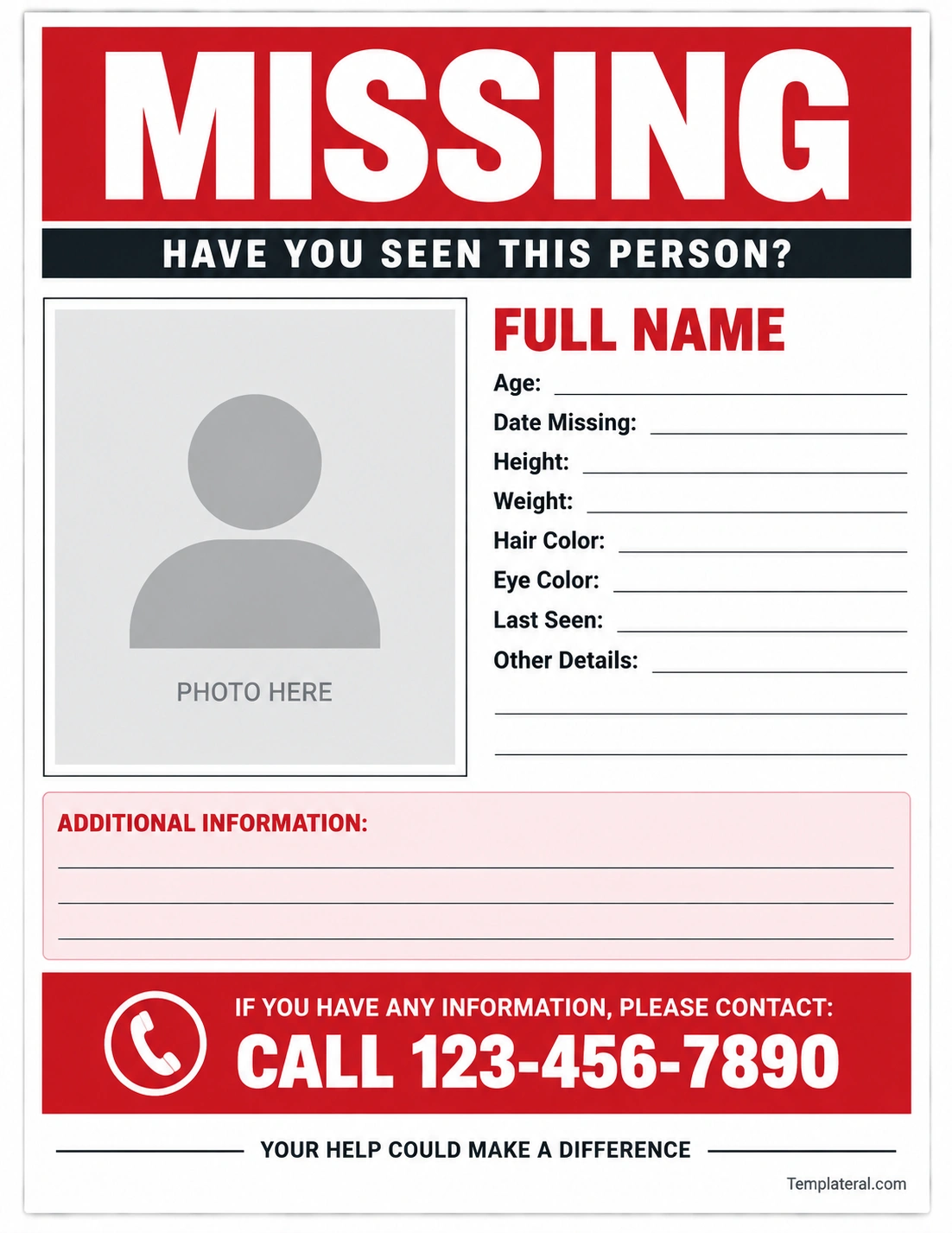
A missing poster template provides a ready-made structure for organizing the most important information. Instead of designing the page from scratch, you can replace the placeholder areas with accurate details and a suitable photograph.
A printable template can contain dedicated sections for the main heading, photograph, identifying characteristics, additional information, and contact details. This structure makes it easier to create a consistent and readable notice.
Before printing, review every field and remove information that does not apply. Make sure the final version contains only accurate and appropriate details.
Missing Poster Checklist
Use this checklist before distributing a missing poster:
- Clear and accurate heading
- Recent photograph
- Name or identifying name
- Age or approximate age, when appropriate
- Date last seen
- Last known location
- Physical description
- Clothing or identifying items, when relevant
- Distinctive characteristics
- Verified contact information
- Instructions for providing information
- Correct spelling and dates
- Readable text and image quality
- Final review before printing
Final Thoughts
A missing poster should communicate accurate information quickly and clearly. A strong layout combines a recognizable photograph with concise identifying details, relevant circumstances, and a reliable way to provide information.
Using a printable missing poster template can simplify the design process and provide a consistent structure for organizing important details. However, accuracy, privacy, and coordination with the appropriate authorities should always take priority when creating and distributing a missing-person notice.
When the information is carefully verified and presented in a clear format, a well-designed poster can serve as a useful communication tool for sharing important information with the community.
Download: Missing Poster Template
