A funeral booklet is a thoughtful way to honor a loved one’s life and guide family members and friends through a funeral or memorial service. It combines essential service details with personal memories, photographs, and meaningful messages in one keepsake that attendees can take home.
Whether you are preparing a traditional funeral program, a celebration of life booklet, or a memorial service pamphlet, the right design can make the process easier during a difficult time. With a clear layout and carefully chosen words, you can create a beautiful tribute that reflects the personality, values, and memories of the person being remembered.
This guide explains what to include in a funeral booklet, how to organize its pages, which design elements to choose, and how to create a professional memorial program that is easy to print and share.
What Is a Funeral Booklet?
A funeral booklet is a printed or digital publication that commemorates a deceased person and provides information about their funeral service. It is often distributed to attendees as they arrive at the ceremony.
Depending on the family’s preferences, a funeral booklet may include an obituary, photographs, the order of service, favorite quotations, religious readings, and messages of gratitude. Some families also include personal stories that celebrate the individual’s life and legacy.
Funeral booklets are sometimes called funeral programs, memorial booklets, funeral service programs, or celebration of life booklets. Although these terms are often used interchangeably, the content and presentation can vary according to the ceremony and cultural traditions.
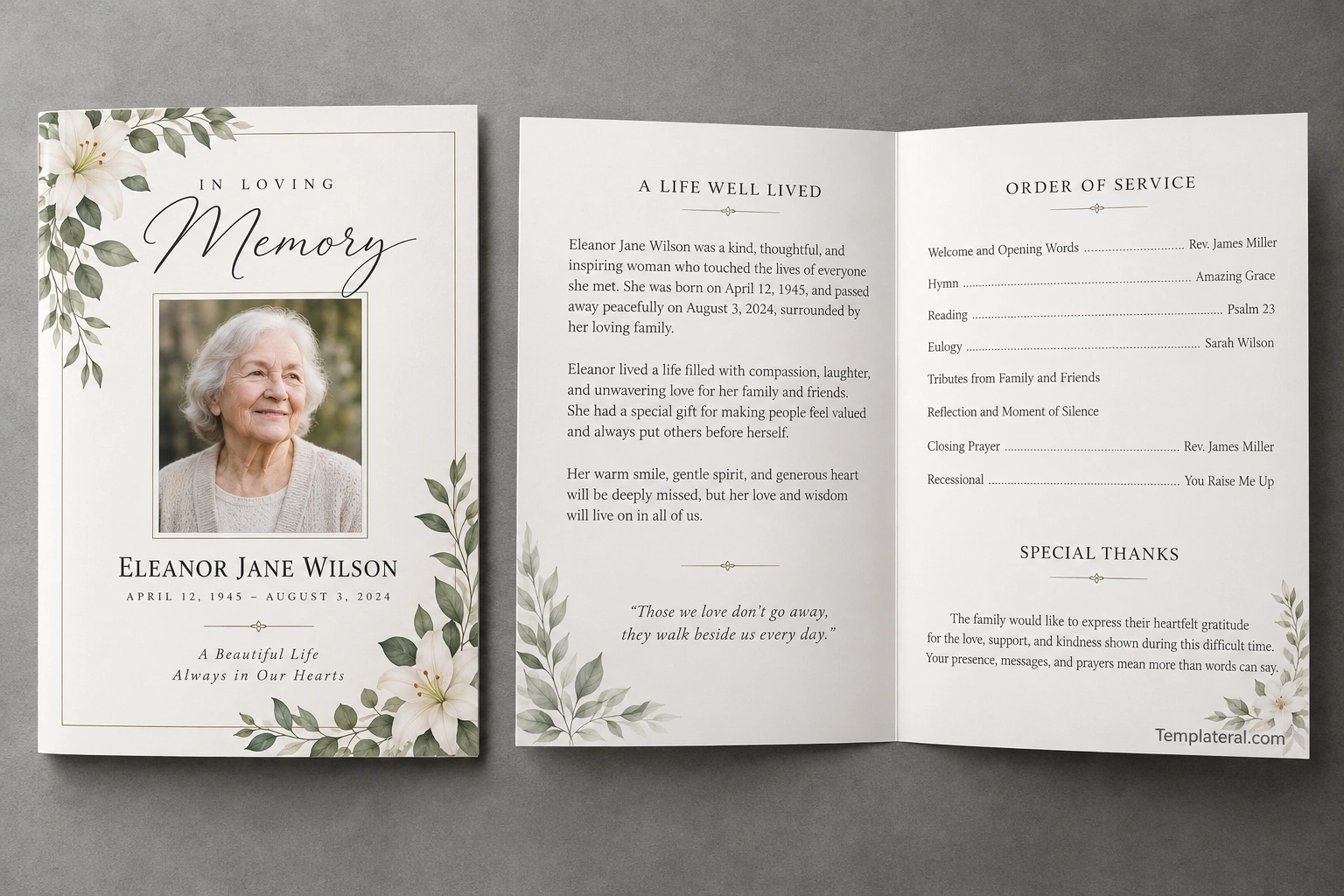
What to Include in a Funeral Booklet
A well-organized funeral booklet balances practical information with personal details. You do not need to include every possible section. Instead, choose the elements that best represent the person being remembered and meet the needs of the service attendees.
1. Cover Page
The cover establishes the tone of the entire booklet. Keep it simple, respectful, and easy to read.
Consider including the following details:
- The full name of the deceased.
- A favorite photograph or meaningful portrait.
- Birth and passing dates.
- The funeral or memorial service date.
- A short phrase, such as “Forever in Our Hearts” or “A Life Well Lived.”
Choose a photograph that reflects the person’s character and brings comfort to family and friends. A clean layout with subtle floral details, elegant typography, or a simple black-and-white palette can create a timeless appearance.
2. Order of Service
The order of service helps attendees follow the ceremony. List the events in the order they will take place, using short and understandable descriptions.
A typical funeral service program may include:
- Welcome and opening remarks.
- Opening prayer or hymn.
- Scripture reading, poem, or reflection.
- Eulogy or tribute.
- Musical selection.
- Family remembrances.
- Closing prayer or final words.
- Recessional or departure instructions.
Adapt this section to the actual ceremony. For example, a secular celebration of life may feature personal stories and favorite songs instead of traditional prayers or hymns.
3. Obituary or Life Story
The obituary is one of the most meaningful parts of a funeral booklet. It offers a brief account of the person’s life, highlighting important milestones, relationships, accomplishments, and personal qualities.
You might mention where the person grew up, their family, career, hobbies, community involvement, and the values they passed on to others. Focus on details that help readers understand who the person was beyond dates and achievements.
Keep the writing warm and personal. A short story about a beloved hobby, a generous act, or a family tradition can make the tribute feel more authentic than a long list of biographical facts.
4. Photographs and Personal Memories
Photographs help tell the story of a life. You can use a favorite portrait on the cover and add a few meaningful images inside the booklet.
Consider choosing photographs from different stages of life, including family gatherings, special celebrations, favorite activities, or memorable achievements. Use clear, high-resolution images that remain sharp when printed.
If space allows, add short captions identifying the people, places, or occasions shown in each photograph. Always check that the images are appropriate and that family members are comfortable with their inclusion.
5. Poems, Readings, and Favorite Quotes
A meaningful poem, religious passage, or personal quotation can express feelings that are difficult to put into words. Choose a reading that reflects the person’s beliefs, character, or outlook on life.
Some families prefer traditional religious texts, while others select an inspirational quotation, a favorite saying, or an original message written by a family member. Keep this section concise so that it complements the rest of the booklet.
6. Acknowledgment and Thank-You Message
A brief acknowledgment allows the family to thank those who offered support, attended the service, sent flowers, or provided meals and assistance.
For example, you could write: “The family sincerely thanks everyone for their kindness, prayers, and support during this difficult time. Your presence and thoughtful gestures have brought us comfort.”
Personalize the message whenever possible. A sincere expression of gratitude is often more meaningful than a long, formal statement.
How to Choose the Right Funeral Booklet Design
The best funeral booklet design reflects the person being remembered while remaining readable and practical. You can create an elegant result without using complicated layouts or excessive decoration.
Choose a Suitable Color Palette
Black and white is a classic option for a formal memorial program. It offers strong contrast, works well for home printing, and keeps the focus on the content.
Other suitable combinations include cream and gray, navy and white, soft green and ivory, or muted floral tones. For someone who loved nature or gardening, subtle botanical illustrations may provide a personal touch.
Choose colors that suit the occasion and the family’s preferences rather than relying on a single traditional style.
Select Readable Fonts
Typography affects both the appearance and usability of a funeral booklet. Use a refined serif font for headings and a simple, readable font for body text. A decorative script font can work for a name or a short phrase, but it should not be used for long paragraphs.
Maintain consistent heading styles, comfortable line spacing, and sufficient contrast between text and background. Avoid very small type, especially for older attendees who may find it difficult to read.
Pick the Right Size and Format
The booklet format determines how much information you can include and how the pages will be arranged.
- Single-page program: Suitable for a short service with a simple order of events.
- Bi-fold booklet: A practical option for a cover, service details, and a brief tribute.
- Tri-fold brochure: Useful when you want several compact panels for the biography, schedule, photographs, and acknowledgments.
- Multi-page booklet: Best for a detailed life story, several photographs, multiple readings, and an extended order of service.
Before choosing a format, consider the amount of content, printing costs, and whether the booklet will be distributed digitally or in person.
How to Create a Funeral Booklet Step by Step
Creating a funeral booklet becomes more manageable when you divide the work into a few practical steps. A template can help you organize the content without starting from a blank page.
Step 1: Gather the Information
Collect the person’s full name, dates, obituary details, service schedule, photographs, readings, and family acknowledgment. Confirm names, dates, spellings, and service locations before beginning the layout.
Step 2: Choose a Template
Select a funeral booklet template that matches the desired style and content. A ready-made design can save time by providing a consistent structure for headings, photographs, and text.
Look for an editable template that works with your preferred software, such as Microsoft Word, Google Docs, or a suitable graphic design application. Check that the template supports the final page size and printing format.
Step 3: Write and Organize the Content
Place the most important information first. Start with the cover, follow with the order of service, and arrange the biography, photographs, readings, and acknowledgment in a logical sequence.
Write in a warm, respectful tone. Short paragraphs, clear headings, and concise sentences make the booklet easier to read during the service.
Step 4: Customize the Design
Add the selected photographs, colors, fonts, and decorative elements. Leave enough white space around text and images so that each page feels balanced rather than crowded.
Use consistent margins and alignment throughout the document. If the booklet includes several pages, check that the content flows naturally from one page to the next.
Step 5: Proofread and Print
Review the complete booklet before printing. Ask another family member or trusted person to check the text, dates, names, service schedule, and image quality.
Export the finished design to PDF when possible to preserve its formatting across devices and printers. Check the print settings, page orientation, margins, and page order. For folded booklets, print a test copy first to confirm that the pages appear in the correct sequence.
Practical Tips for a Professional Funeral Program
A thoughtful funeral booklet does not need elaborate design features. Small details can make a significant difference in the final result.
- Keep the layout simple: Prioritize essential information and avoid unnecessary decorative elements.
- Use high-quality photographs: Choose clear images that reproduce well on paper.
- Check readability: Make sure the text is large enough and has sufficient contrast.
- Respect personal and cultural preferences: Match the wording, imagery, and readings to the individual’s beliefs and the family’s wishes.
- Confirm every detail: Verify service times, locations, names, dates, and the order of events.
- Allow time for revisions: Leave room for proofreading and a test print before distributing copies.
- Consider digital sharing: A PDF version can help relatives and friends who cannot attend in person.
Most importantly, focus on creating a genuine tribute. A few carefully chosen photographs and heartfelt words can be more powerful than an elaborate design.
Funeral Booklet Example and Template Ideas
If you are unsure how to begin, reviewing a sample funeral booklet can help you understand how the different sections fit together. Look for examples that show the cover, order of service, obituary, photographs, and acknowledgment in a clear and balanced layout.
You can adapt the design to suit different needs, such as a traditional religious service, a simple memorial gathering, or a celebration of life. Floral designs are suitable for a gentle, traditional appearance, while minimalist layouts can create a more contemporary tribute.
Before selecting a template, check whether it is editable, whether its fonts and images can be customized, and whether it is suitable for your intended printing method. Choose a design that makes it easy to replace sample information with accurate details about your loved one.
A well-designed funeral booklet template provides a helpful starting point, allowing you to spend more time choosing meaningful words and memories.
Frequently Asked Questions About Funeral Booklets
What is the difference between a funeral booklet and a funeral program?
A funeral program usually focuses on the order of service and essential ceremony information. A funeral booklet may contain these details along with a longer obituary, photographs, poems, personal memories, and acknowledgments. However, the terms are often used interchangeably.
How many pages should a funeral booklet have?
The number of pages depends on the amount of content. A single-page program or folded leaflet may be sufficient for a short ceremony, while a multi-page booklet works better for a detailed biography, several photographs, and additional readings. Choose a format that accommodates the content without overcrowding the pages.
What should be written on the cover of a funeral booklet?
The cover typically includes the deceased person’s full name, a photograph, birth and passing dates, the service date, and a short memorial phrase. Keep the information clear and the design respectful.
Can I create a funeral booklet in Microsoft Word?
Yes. Microsoft Word can be used to create a funeral booklet with text, photographs, headings, borders, and page layouts. Starting with an editable template can simplify the process. Save or export the finished document as a PDF before printing to help preserve the formatting.
What is the best paper for printing a funeral booklet?
For a professional appearance, choose good-quality matte or uncoated paper that is comfortable to read and handle. A slightly heavier paper can work well for the cover, while standard text paper is suitable for interior pages. The best choice depends on your printer, budget, and preferred finish.
Can a funeral booklet be shared digitally?
Yes. You can export the booklet as a PDF and share it with family members and friends by email, messaging applications, or a private online link. A digital version is especially useful for relatives who live far away or cannot attend the service.
What makes a good funeral booklet template?
A good funeral booklet template has a clear layout, readable typography, flexible sections, and space for photographs and personal messages. It should be easy to edit and suitable for the intended paper size and printing method. Choose a design that supports the tribute rather than distracting from it.
Conclusion
A funeral booklet is more than a guide to a service. It is a personal keepsake that brings together important details, cherished photographs, meaningful readings, and memories of a loved one’s life.
To create a thoughtful memorial program, begin with accurate information, choose a suitable template, organize the content clearly, and use a design that reflects the person’s character. Proofread every page and check the final print before distributing copies.
Whether you prefer a traditional funeral booklet, a minimalist memorial program, or a personalized celebration of life booklet, the goal is the same: to honor a loved one with care, dignity, and a lasting tribute.
Download: Funeral Booklet Template
