An Artist Biography tells the story behind an artist’s creative journey, artistic style, education, achievements, and professional experience. Whether you are a painter, illustrator, sculptor, photographer, or digital artist, a well-written biography helps people understand your work and connect with your artistic vision.
A professional artist bio can be used on a personal website, online portfolio, gallery profile, exhibition catalog, art marketplace, or social media page. It introduces your background while explaining what inspires your work and what makes your creative approach distinctive.
If you are wondering how to write an Artist Biography, this guide covers the essential elements, practical writing tips, and a sample biography you can use as inspiration. You will also learn how to adapt your artist profile for different audiences without losing your authentic voice.
What Is an Artist Biography?
An Artist Biography is a written introduction that explains who an artist is, what they create, and how their artistic practice has developed. It typically combines personal background, creative influences, professional experience, and notable accomplishments.
Unlike an artist statement, which focuses primarily on the meaning, ideas, and intentions behind an artist’s work, a biography emphasizes the artist’s background and professional journey.
A strong artist bio answers several important questions:
- Who is the artist?
- What type of art does the artist create?
- What themes, techniques, or influences shape the work?
- What education, experience, or exhibitions are relevant?
- What makes the artist’s creative journey distinctive?
The answers do not need to be lengthy. A clear, engaging biography can communicate an artist’s identity and experience in just a few well-organized paragraphs.
What to Include in an Artist Biography
The best artist biographies focus on relevant details rather than trying to tell an entire life story. Choose information that helps readers understand your artistic identity and professional development.
1. Artist Name and Creative Background
Start with your name and the type of art you practice. You may also mention your location or cultural background if it meaningfully influences your work.
For example, a contemporary painter might introduce themselves as an artist who explores nature, memory, and human emotion through layered colors and expressive brushwork.
2. Artistic Style and Medium
Describe your primary medium, techniques, and creative approach. Be specific about what you create instead of relying on broad descriptions such as passionate, talented, or creative.
- Medium: Painting, photography, sculpture, illustration, ceramics, or digital art.
- Style: Abstract, contemporary, minimalist, realistic, impressionist, or experimental.
- Themes: Nature, identity, culture, architecture, memory, or social issues.
- Techniques: Mixed media, watercolor layering, digital composition, or sculptural modeling.
Choose details that accurately represent your work. These descriptions help galleries, collectors, curators, and potential clients understand your artistic practice.
3. Education and Professional Training
Include relevant art degrees, workshops, mentorships, residencies, or specialized training when applicable. Formal education can demonstrate professional development, but it is not a requirement for a compelling artist biography.
If you are self-taught, you can explain how independent study, experimentation, or practical experience has shaped your skills and artistic perspective.
4. Exhibitions, Awards, and Achievements
Professional milestones can strengthen your artist profile by showing how your work has been presented or recognized. Depending on your experience, you may include solo exhibitions, group shows, grants, awards, publications, commissions, or gallery representation.
New artists do not need an extensive exhibition history. Focus on relevant accomplishments and avoid inventing credentials simply to make the biography appear more impressive.
5. Creative Influences and Artistic Goals
Explain what inspires your work and how those influences appear in your creative process. Your inspiration might come from the natural world, personal experiences, cultural traditions, historical art movements, or everyday surroundings.
A brief explanation of your artistic goals can also help readers understand what you hope to communicate through your work.
Artist Biography Example
The following fictional Artist Biography demonstrates how to combine personal background, artistic style, and professional experience into a cohesive introduction.
Sample Biography of a Visual Artist
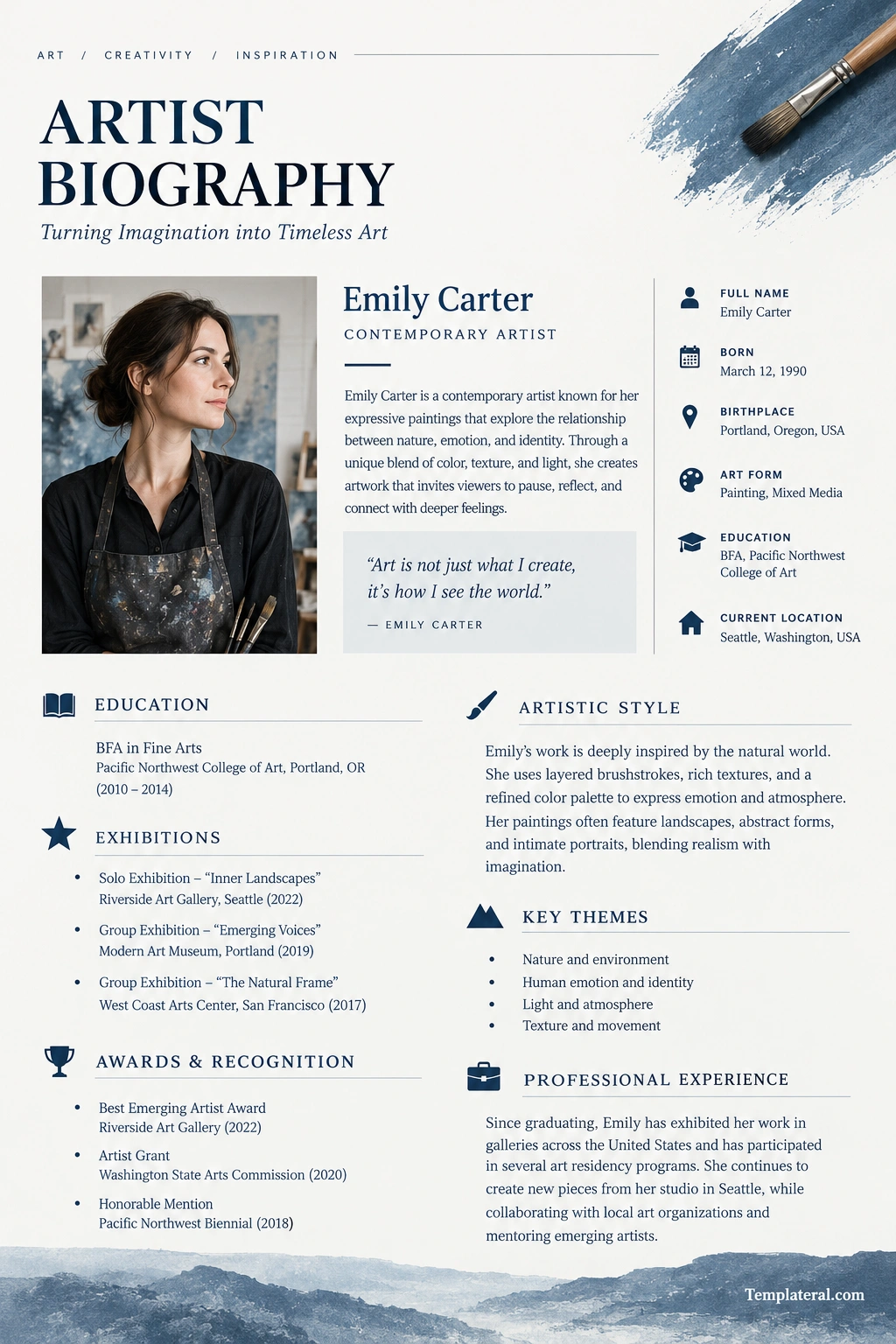
Emily Carter — Contemporary Visual Artist
Emily Carter is a fictional contemporary visual artist whose work explores the relationship between nature, emotion, and personal identity. Through expressive painting and mixed-media techniques, she creates compositions that combine rich textures, layered colors, and atmospheric details.
Her artistic approach is inspired by landscapes, changing light, and the subtle connections between people and their surroundings. By combining traditional painting methods with experimental materials, Carter develops artworks that encourage viewers to reflect on their own experiences and interpretations.
In this illustrative profile, Carter studied fine arts and developed her practice through independent projects, exhibitions, and continued experimentation. Her fictional career includes participation in group exhibitions and a growing body of contemporary landscape paintings.
Carter’s creative practice reflects an ongoing interest in visual storytelling and the emotional qualities of color, texture, and form. She continues to explore new techniques while developing a distinctive artistic voice.
This sample shows how an artist biography can communicate creative identity without becoming a long list of qualifications. Replace all fictional details with accurate information about the real artist before publication.
How to Write an Artist Biography Step by Step
Step 1: Define Your Audience
Before writing, consider where the biography will appear. A gallery website may require a formal professional introduction, while a personal portfolio can support a more conversational tone.
Think about what readers need to know and select information that serves that purpose.
Step 2: Gather Your Key Information
Prepare a short list of details before drafting your artist bio. Include your artistic medium, background, influences, relevant education, exhibitions, and achievements.
Organizing these details first makes it easier to write a coherent biography and prevents important information from being overlooked.
Step 3: Write a Strong Opening
Introduce yourself and your creative practice in the first sentence. State what kind of artist you are and briefly describe the focus of your work.
A specific opening is more effective than a generic statement about loving art. Give readers an immediate reason to understand your artistic identity.
Step 4: Explain What Makes Your Work Distinctive
Use the middle section to discuss your style, techniques, themes, and influences. Select a few meaningful details instead of describing every aspect of your practice.
Whenever possible, connect your artistic ideas to the actual work you produce. Concrete descriptions help readers visualize your approach.
Step 5: Add Relevant Career Highlights
Include education, exhibitions, awards, publications, or commissions that support your professional profile. If you are early in your career, emphasize projects, creative development, and artistic direction instead.
Keep the information accurate and relevant to the audience.
Step 6: Edit for Clarity and Length
Read the biography aloud to identify awkward sentences, repeated ideas, and unnecessary details. Use simple language and maintain a consistent point of view.
Most importantly, make sure the finished biography sounds authentic. Your goal is to communicate your creative identity, not to make your experience sound more impressive than it is.
How Long Should an Artist Biography Be?
The ideal length depends on where you plan to publish your biography. Different platforms require different levels of detail.
- Short artist bio: Approximately 50 to 100 words for social media, short introductions, and compact portfolio sections.
- Standard artist biography: Approximately 100 to 250 words for personal websites, online portfolios, and gallery profiles.
- Extended artist biography: Approximately 250 to 500 words for exhibition catalogs, professional submissions, and detailed artist profiles.
These are general guidelines rather than strict requirements. Follow any word limits provided by a gallery, competition, publisher, or organization.
Tips for Creating a Professional Artist Bio
Use these practical tips to make your biography more engaging and effective.
- Write in the third person when appropriate: Third-person writing is common for galleries and professional portfolios, although first person can work well for personal websites.
- Be specific: Describe your medium, subject matter, or techniques instead of using vague adjectives.
- Use an authentic voice: Let your real interests and creative approach shape the biography.
- Highlight relevant achievements: Select milestones that demonstrate your development as an artist.
- Keep paragraphs focused: Give each paragraph a clear purpose, such as background, artistic style, or professional experience.
- Update your biography regularly: Add meaningful exhibitions, projects, awards, and career developments when appropriate.
- Proofread carefully: Check names, dates, artwork titles, grammar, and spelling before publishing.
Artist Biography vs. Artist Statement
Although these two documents are related, they serve different purposes. Understanding the difference helps you prepare the right content for your portfolio or exhibition.
- Artist Biography: Explains who you are, your background, artistic development, education, and relevant achievements.
- Artist Statement: Explains the ideas behind your work, your creative process, your intentions, and the themes you explore.
For example, your biography might describe your experience as a watercolor painter, while your artist statement explains why you use watercolor to explore memory and changing landscapes.
Both documents can complement each other on a professional artist website, but they should not simply repeat the same information.
Frequently Asked Questions About Artist Biography
What should an Artist Biography include?
An Artist Biography should include your name, artistic medium, creative background, style, influences, and relevant professional achievements. Education, exhibitions, awards, and career highlights can also be included when they support your story.
How do I write an Artist Biography with no experience?
Focus on your artistic interests, creative process, techniques, influences, and goals. You do not need awards or gallery exhibitions to write a meaningful biography. Emphasize your current practice and genuine development as an artist.
Should an artist bio be written in first person or third person?
Third person is common for professional biographies, gallery websites, and exhibition catalogs. First person can be suitable for personal websites or informal introductions. Choose the style that fits your audience and remain consistent throughout the text.
Can I use an Artist Biography template?
Yes. An Artist Biography template can help organize your background, artistic style, education, exhibitions, and achievements. Use it as a starting point, then customize the content to reflect your individual experience and creative identity.
What is the difference between an artist bio and an artist resume?
An artist bio is a narrative introduction to your background and creative practice. An artist resume typically lists exhibitions, education, awards, publications, residencies, and other professional activities in a structured format.
Should I include my awards and exhibitions?
Yes, when they are relevant to your audience and accurately represent your experience. Established artists may highlight significant exhibitions and recognition, while emerging artists can focus on their creative development and recent projects.
How often should I update my Artist Biography?
Review your biography whenever your artistic direction, professional experience, or major achievements change. An annual review is a useful starting point, but update it sooner when an important development occurs.
Conclusion
A well-written Artist Biography introduces your creative identity, explains your artistic approach, and highlights the experiences that have shaped your work. By combining relevant background information with a clear description of your style and achievements, you can create a professional profile that readers find informative and memorable.
Start with a strong introduction, describe your artistic practice, and include career highlights that genuinely reflect your experience. Keep the language natural, the structure easy to follow, and the details accurate.
Whether you are preparing a gallery profile, building an online portfolio, or writing your first artist bio, a thoughtful biography can help you present your work with confidence and connect with the people who appreciate your art.
Download: Artist Biography Template
