A weekly itinerary is a simple way to organize your plans, appointments, activities, and priorities across an entire week. Instead of keeping everything in your head or relying on scattered notes, a weekly itinerary gives you one clear place to see what needs to happen and when.
Whether you are planning work commitments, school activities, errands, appointments, personal goals, or family responsibilities, a well-structured weekly itinerary can make your schedule easier to manage. It also helps you identify busy days, protect time for important tasks, and avoid unnecessary scheduling conflicts.
The key is to keep your weekly schedule practical. You do not need to plan every minute of every day. A useful itinerary should give you enough structure to stay organized while leaving room for unexpected changes.
In this guide, you will learn what a weekly itinerary is, what to include, how to create one, and how to use a printable weekly itinerary effectively.
What Is a Weekly Itinerary?
A weekly itinerary is a planning document that organizes activities and commitments throughout a seven-day period. It typically includes the days of the week, scheduled times, important tasks, appointments, and additional notes.
Unlike a simple to-do list, a weekly itinerary focuses not only on what you need to do but also on when you plan to do it. This makes it particularly useful when you have several appointments, deadlines, activities, or time-sensitive responsibilities.
A weekly itinerary can be used for many different purposes, including:
- Planning work meetings and appointments
- Organizing a school or study schedule
- Planning errands and household tasks
- Scheduling exercise and personal activities
- Managing family commitments
- Planning travel activities throughout a week
- Tracking important deadlines and events
- Creating a structured weekly routine
Why Use a Weekly Itinerary?
Planning an entire week in advance gives you a broader view of your schedule. Instead of focusing only on today’s tasks, you can see how your commitments fit together over several days.
See Your Week at a Glance
One of the biggest advantages of a weekly itinerary is visibility. Having Monday through Sunday on the same page makes it easier to identify busy periods, open time slots, and potential conflicts.
For example, if you have several appointments on Wednesday, you can see that before adding another commitment to the same day. This simple overview can help you distribute tasks more evenly across the week.
Prioritize Important Tasks
A weekly schedule can also separate important tasks from activities that can wait. By identifying your top priorities at the beginning of the week, you can make sure that essential work receives enough attention.
Consider choosing three to five major priorities rather than filling your schedule with an overwhelming number of goals.
Reduce Scheduling Conflicts
When appointments, meetings, errands, and personal activities are recorded in one place, conflicts are easier to spot. A weekly itinerary can therefore serve as a simple planning tool before you commit to new activities.
What to Include in a Weekly Itinerary
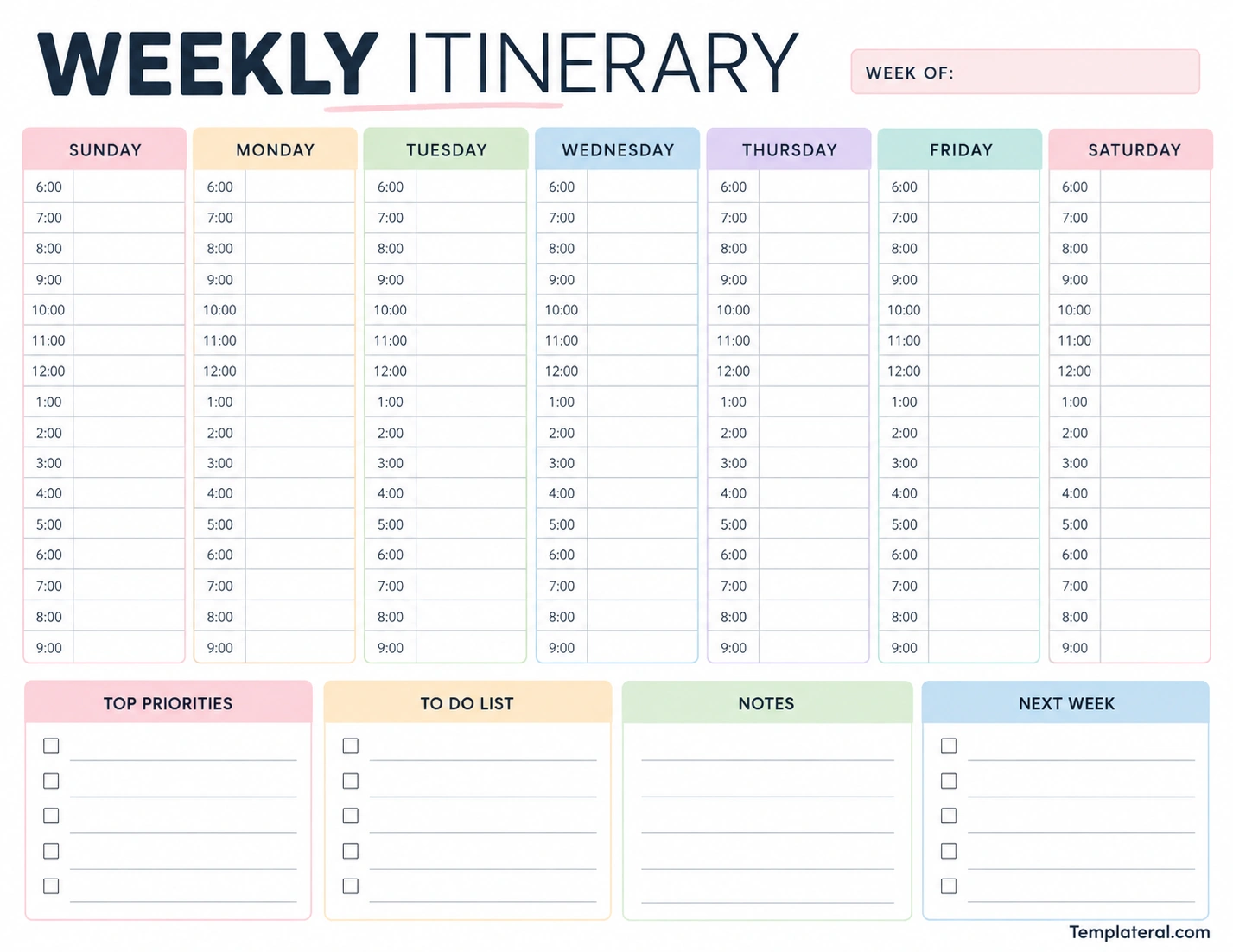
A good weekly itinerary does not need to be complicated. The most useful layouts usually contain a combination of scheduled activities, task lists, priorities, and space for notes.
Days and Dates
Start with all seven days of the week. Adding the actual dates can make the itinerary more useful, especially when you are planning a specific week or preparing for upcoming appointments.
Time Slots
If your schedule includes time-sensitive activities, use hourly or half-hourly time slots. This allows you to place appointments and activities directly into the schedule.
For a less structured routine, you can divide each day into broader sections such as morning, afternoon, and evening.
Top Priorities
Include a small priority section for the most important things you want to accomplish during the week. These could be work deadlines, school assignments, personal goals, or important errands.
To-Do List
A weekly to-do list is useful for tasks that need to be completed but do not necessarily have a specific time. Examples include grocery shopping, sending emails, cleaning, preparing documents, or making phone calls.
Notes
Leave some blank space for reminders and information that does not fit neatly into a scheduled time slot. This might include ideas, preparation notes, addresses, reminders, or things to remember for later.
How to Create a Weekly Itinerary
Creating a weekly itinerary is easier when you build it in a consistent order. Start with fixed commitments and then add flexible activities around them.
1. Start With Fixed Commitments
Begin by adding activities that already have a specific date or time. These might include meetings, classes, appointments, work shifts, or scheduled events.
Adding fixed commitments first gives you a realistic framework for the rest of the week.
2. Add Important Tasks
Next, add tasks that need to be completed during the week. If a task has a deadline, place it close to the appropriate date. If it can be completed at any time, keep it on your general to-do list.
3. Schedule Your Priorities
Look at your available time and decide when you will work on your most important tasks. Try to avoid putting too many demanding activities into the same day.
Breaking a large project into smaller sessions can make your weekly plan more realistic and easier to follow.
4. Add Personal Activities
A balanced weekly schedule should include more than work or school. Add time for exercise, hobbies, family activities, meal preparation, relaxation, and other personal commitments.
Including these activities in your itinerary makes them easier to protect from being pushed aside by less important tasks.
5. Leave Some Flexibility
Avoid filling every available space. Unexpected appointments, delays, urgent tasks, and changes in plans can happen during the week.
Leaving several open time blocks gives you room to adjust without completely disrupting your schedule.
Weekly Itinerary Ideas for Different Needs
A weekly itinerary can be customized depending on your lifestyle and planning needs. The basic structure can remain the same while the information inside it changes.
Work Weekly Itinerary
A work-focused itinerary can include meetings, project deadlines, calls, focused work sessions, administrative tasks, and follow-up activities.
Consider separating high-priority work from routine tasks so you can quickly identify what needs immediate attention.
Student Weekly Itinerary
Students can use a weekly itinerary to organize classes, study sessions, assignments, exams, projects, extracurricular activities, and personal commitments.
Adding study blocks before major deadlines can help prevent several assignments from accumulating at the end of the week.
Family Weekly Itinerary
For families, a weekly itinerary can bring multiple schedules together. Parents can record school activities, appointments, shopping trips, household responsibilities, and family events on the same page.
Travel Weekly Itinerary
A travel itinerary can organize activities by day and time, including sightseeing, transportation, reservations, meals, and free time. Keeping the schedule flexible is particularly important when traveling because transportation delays and unexpected opportunities can change your plans.
Tips for Making Your Weekly Schedule More Effective
A weekly itinerary works best when it is simple enough to use consistently. The following tips can help you create a planning system that is practical rather than overwhelming.
- Keep priorities limited: Choose a manageable number of major goals for the week.
- Group similar tasks: Complete similar errands or administrative tasks together when possible.
- Use realistic time estimates: Give important tasks enough time instead of assuming everything will be completed quickly.
- Protect open time: Keep some unscheduled blocks available for unexpected work.
- Review the itinerary daily: Spend a few minutes checking what is coming next.
- Move unfinished tasks: If something cannot be completed, deliberately reschedule it rather than simply carrying it mentally.
- Keep the layout simple: A clean schedule is easier to read and maintain.
Printable Weekly Itinerary vs. Digital Planning
Both printable and digital weekly planners can be useful. The better choice depends on how you prefer to organize information.
A printable weekly itinerary provides a physical overview that can be placed on a desk, wall, clipboard, or planner. Writing by hand can also make it easy to add quick notes or make changes throughout the day.
A digital itinerary, on the other hand, can be updated quickly and may provide reminders or synchronization across devices.
For many people, a combination works well. A digital calendar can manage appointments and reminders, while a printable weekly itinerary can provide a simple visual overview of priorities and daily tasks.
How to Use a Weekly Itinerary Every Week
The most important part of weekly planning is consistency. Creating an itinerary once is useful, but reviewing and updating it regularly makes the system much more effective.
Plan at the End or Beginning of the Week
Set aside 10 to 15 minutes to prepare your next weekly schedule. Review upcoming appointments, deadlines, tasks, and personal commitments before deciding how to organize your available time.
Review Your Schedule Each Morning
A quick morning review helps you understand what needs attention that day. You can also adjust the itinerary if an appointment changes or an unexpected task appears.
Review What Was Completed
At the end of the week, look at completed and unfinished tasks. This gives you useful information about how much work you can realistically fit into a typical week.
If the same tasks repeatedly move from one week to another, consider whether they should be broken into smaller steps, delegated, removed, or given a specific time block.
Final Thoughts on Weekly Itineraries
A weekly itinerary is a straightforward planning tool that can bring structure to a busy week. By combining appointments, time slots, priorities, tasks, and notes in one place, you can create a clearer picture of what needs to happen and when.
The best weekly schedule is not necessarily the most detailed one. It is the one that you can understand quickly, update easily, and use consistently. Start with your fixed commitments, add your most important tasks, leave room for flexibility, and review the plan regularly.
Whether you prefer a printable weekly itinerary or a digital schedule, a simple weekly planning routine can make your days more organized and help you approach each week with greater clarity.
Download: Weekly Itinerary Template
