Ruled paper is one of the simplest and most useful types of writing paper. It uses evenly spaced horizontal lines to help keep handwriting organized, aligned, and easy to read. From school assignments and class notes to journaling, letter writing, planning, and everyday lists, ruled paper provides a clean structure without limiting what you can write.
Also commonly called lined paper, ruled paper comes in many styles and sizes. Some versions include a vertical margin, while others use lines across the entire page. The spacing between lines can also vary depending on whether the paper is intended for young children, students, or adults.
Understanding the different types of ruled paper can help you choose the right format for writing, education, organization, and creative projects.
What Is Ruled Paper?
Ruled paper is paper printed with horizontal lines that provide a guide for handwriting. The lines help writers maintain consistent spacing and keep text straight across the page.
The word “ruled” refers to the lines printed on the paper. Although the terms ruled paper and lined paper are often used interchangeably, different types of ruled paper can have different spacing, margins, and line styles.
A basic sheet may contain only horizontal lines. Other designs may include a vertical margin, a header area, fields for a name and date, or special spacing designed for handwriting practice.
What Is Ruled Paper Used For?
Ruled paper is suitable for almost any activity that involves handwriting. Its simple layout makes it useful in both educational and everyday settings.
- School assignments: Write essays, homework, answers, and classwork.
- Note-taking: Record lectures, meetings, lessons, and important information.
- Journaling: Write daily thoughts, reflections, and personal entries.
- Letter writing: Draft personal or professional letters.
- Lists: Organize tasks, reminders, shopping lists, and ideas.
- Creative writing: Draft stories, poems, and other written projects.
- Handwriting practice: Improve letter formation, spacing, and writing consistency.
- Planning: Create organized notes, outlines, and project plans.
Types of Ruled Paper
Ruled paper is available in several formats. The most suitable type depends on the writer’s age, handwriting size, and intended use.
Wide Ruled Paper
Wide ruled paper has relatively large spaces between horizontal lines. The additional space makes it easier to write larger letters and is commonly useful for younger students or people who prefer more room between lines.
The larger spacing can also make the page easier to read when handwriting is naturally large.
College Ruled Paper
College ruled paper uses narrower line spacing than wide ruled paper. The closer lines allow more writing to fit on a page while still providing a clear handwriting guide.
It is commonly used by older students and adults for school notes, essays, study materials, and general writing.
Narrow Ruled Paper
Narrow ruled paper has even less space between lines. It is useful for fitting a large amount of writing onto a page when smaller handwriting is comfortable.
This format may be particularly helpful for detailed notes or situations where page space is limited.
Handwriting Practice Paper
Handwriting practice paper is designed specifically for developing writing skills. Depending on the age group, it may use wider lines, additional guide lines, dotted lines, or larger writing areas.
These features help learners practice consistent letter size, spacing, and alignment.
Ruled Paper With a Margin
Many traditional ruled paper templates include a vertical margin near the left side of the page. The margin provides a visual boundary between the writing area and the edge of the page.
The margin can also be useful for adding numbers, headings, symbols, or short notes. In school settings, it provides a consistent starting point for each line of writing.
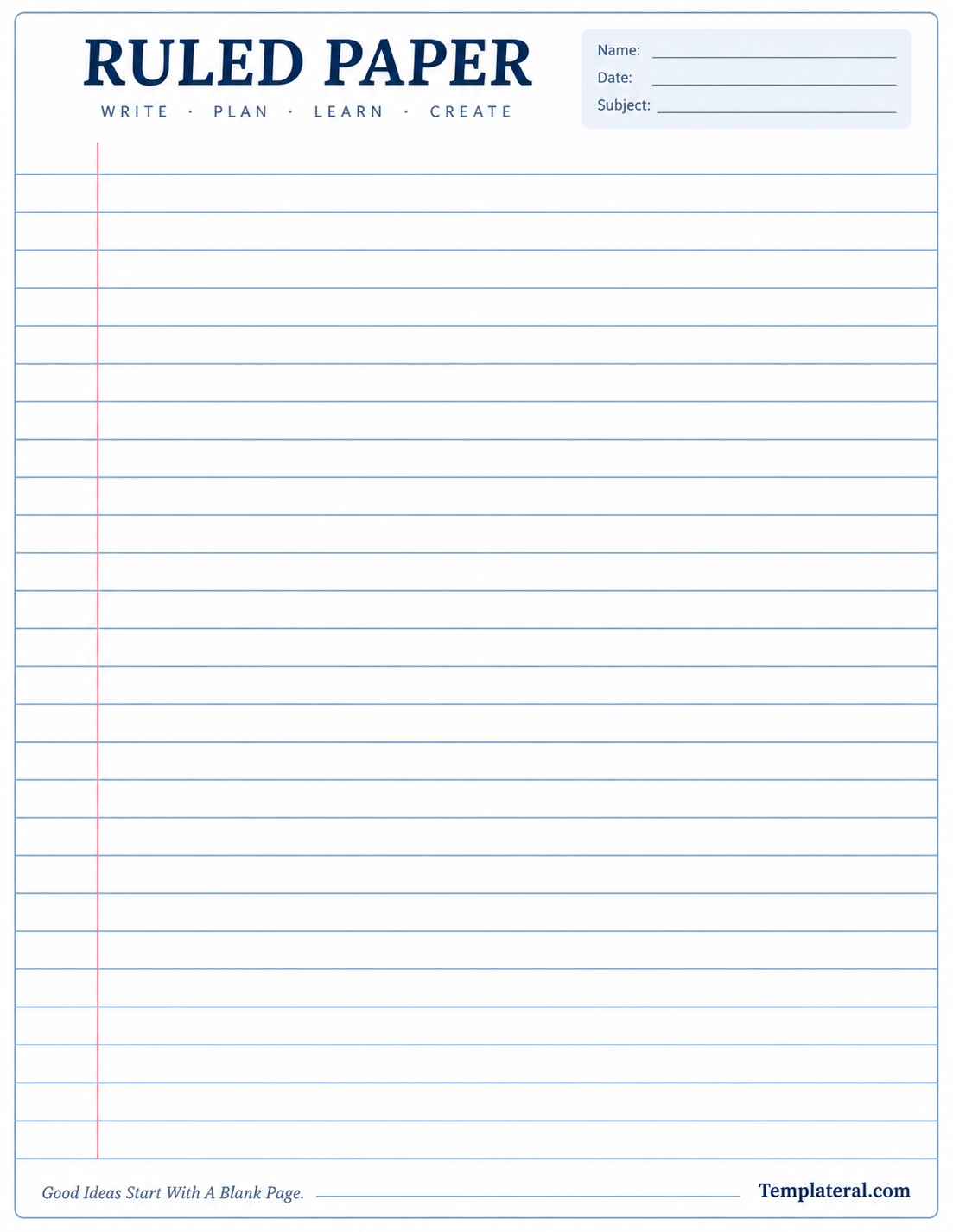
The printable template shown above combines horizontal ruling with a vertical margin, creating a simple writing surface suitable for notes, assignments, journaling, and everyday use.
Ruled Paper vs. Plain Paper
Plain paper provides a completely blank surface, which gives the writer maximum freedom but no visual guide for maintaining alignment.
Ruled paper adds horizontal structure. This makes it easier to keep handwritten text straight and evenly spaced.
Choose plain paper when you need to draw freely or create unrestricted layouts. Choose ruled paper when your primary activity involves handwriting and you want a guide to keep your text organized.
Ruled Paper vs. Graph Paper
Ruled paper and graph paper both provide visual guides, but they serve different purposes.
Ruled paper primarily uses horizontal lines and is designed for writing. Graph paper uses horizontal and vertical lines to create a grid, making it more suitable for mathematics, diagrams, measurements, technical sketches, and spatial planning.
- Ruled paper: Best for handwriting, notes, essays, journaling, and lists.
- Graph paper: Best for mathematical graphs, diagrams, measurements, and structured drawings.
Benefits of Printable Ruled Paper
A printable ruled paper template gives you a convenient writing surface whenever you need one. Instead of keeping a separate notebook for every purpose, you can print individual pages as needed.
Some advantages include:
- Convenient: Print a new page whenever you need additional writing space.
- Flexible: Use the same template for notes, assignments, lists, or journaling.
- Organized: Horizontal lines help maintain consistent handwriting alignment.
- Customizable: Choose different line spacing and page layouts for different needs.
- Practical for classrooms: Teachers can print worksheets and writing pages for students.
- Useful at home: Keep a few blank pages available for notes and everyday tasks.
How to Choose the Right Ruled Paper
The best ruled paper depends on who will use it and what they need to write.
Consider the Writer’s Age
Young children generally benefit from larger writing spaces because they are still developing handwriting control. Older students and adults may prefer narrower spacing that allows more information to fit on each page.
Consider Handwriting Size
If you naturally write with large letters, wide ruled paper may be more comfortable. If your handwriting is small, college ruled or narrow ruled paper may provide a more efficient layout.
Consider the Purpose
Think about how the paper will be used. A simple lined page may be ideal for journaling, while a page with a header area and fields for a name and date may work better for classroom assignments.
How to Use Ruled Paper for School
Students can use ruled paper for a wide range of academic activities. The horizontal lines provide a consistent writing guide and help keep answers organized.
For assignments, students can add their name, date, subject, and title at the top of the page before beginning the main work. Numbered lines or bullet points can then be used to organize answers and notes.
Teachers can also use printable ruled paper for writing exercises, short-answer worksheets, journal prompts, and classroom activities.
Using Ruled Paper for Notes
Ruled paper is particularly effective for taking notes because the lines create natural spaces for each sentence or idea.
To make handwritten notes easier to review, consider using headings and subheadings. Leave a small amount of space between major topics and use bullet points when recording several related ideas.
You can also reserve the left margin for keywords, page references, or quick reminders.
Using Ruled Paper for Journaling
Journaling does not require a complicated template. A clean sheet of lined paper can provide enough structure for daily writing while leaving the content completely open-ended.
You can add the date and a short title at the top before writing. The remaining lines can be used for reflections, observations, goals, ideas, or personal notes.
Tips for Printing Ruled Paper
When printing a ruled paper template, a few simple settings can help produce a clean and usable page.
- Choose the correct paper size: Select US Letter or another intended size before printing.
- Check the margins: Make sure the printer does not cut off the lines around the edges.
- Review scaling: If exact spacing matters, avoid unnecessary scaling.
- Use the correct orientation: Portrait orientation is generally suitable for traditional writing pages.
- Test the page: Print one copy first if you need a specific line spacing or margin arrangement.
How to Make Handwritten Notes More Organized
Ruled paper provides the structure, but a few writing habits can make the finished page even easier to read.
- Write a clear heading: Identify the topic at the top of the page.
- Add the date: Dates make notes easier to organize later.
- Use consistent spacing: Keep a similar amount of space between sections.
- Separate topics: Use headings or blank lines to distinguish major subjects.
- Keep handwriting aligned: Use the printed lines as a consistent baseline.
- Use the margin: Add keywords or short references without interrupting the main notes.
Ruled Paper for Teachers and Classrooms
Printable ruled paper can be a useful classroom resource because teachers can provide students with consistent writing pages without requiring a specialized notebook.
It can be used for essays, vocabulary exercises, reading responses, creative writing, classroom reflections, spelling practice, and short-answer assignments.
Different line spacing can also be selected according to the students’ age and handwriting development.
Ruled Paper for Everyday Use
You do not need to be a student to benefit from lined paper. A blank ruled page can be useful for everyday organization at home or work.
Use it for to-do lists, meeting notes, phone messages, project ideas, reminders, recipes, planning notes, or quick drafts. Because the format is simple, you can adapt it to almost any writing task.
Final Thoughts
Ruled paper remains a practical writing tool because it provides just enough structure without restricting what you can write. The simple horizontal lines help keep handwriting aligned, organized, and readable.
Wide ruled paper can provide extra space for larger handwriting, while college ruled and narrow ruled formats allow more information to fit on a page. A margin can add another useful organizational element, particularly for schoolwork and structured notes.
Whether you need a page for homework, journaling, note-taking, creative writing, planning, or everyday reminders, a clean printable ruled paper template provides a simple and flexible solution.
Download: Ruled Paper Template
