Envelope format refers to the proper way to arrange an envelope’s sender information, recipient address, postage, and other mailing details. Using a clear and consistent format helps make an envelope easy to read and reduces the risk of delivery problems.
Whether you are sending a personal letter, business correspondence, invitation, greeting card, application, or official document, knowing where to place each piece of information is important. A properly formatted envelope should clearly identify the recipient while providing a return address and appropriate postage when required.
The good news is that addressing an envelope does not need to be complicated. Once you understand the basic layout, you can apply the same structure to most standard envelopes.
What Is an Envelope Format?
An envelope format is the standard arrangement used when addressing an envelope for mailing. It determines where the sender’s return address, recipient’s mailing address, postage stamp, and other information should appear.
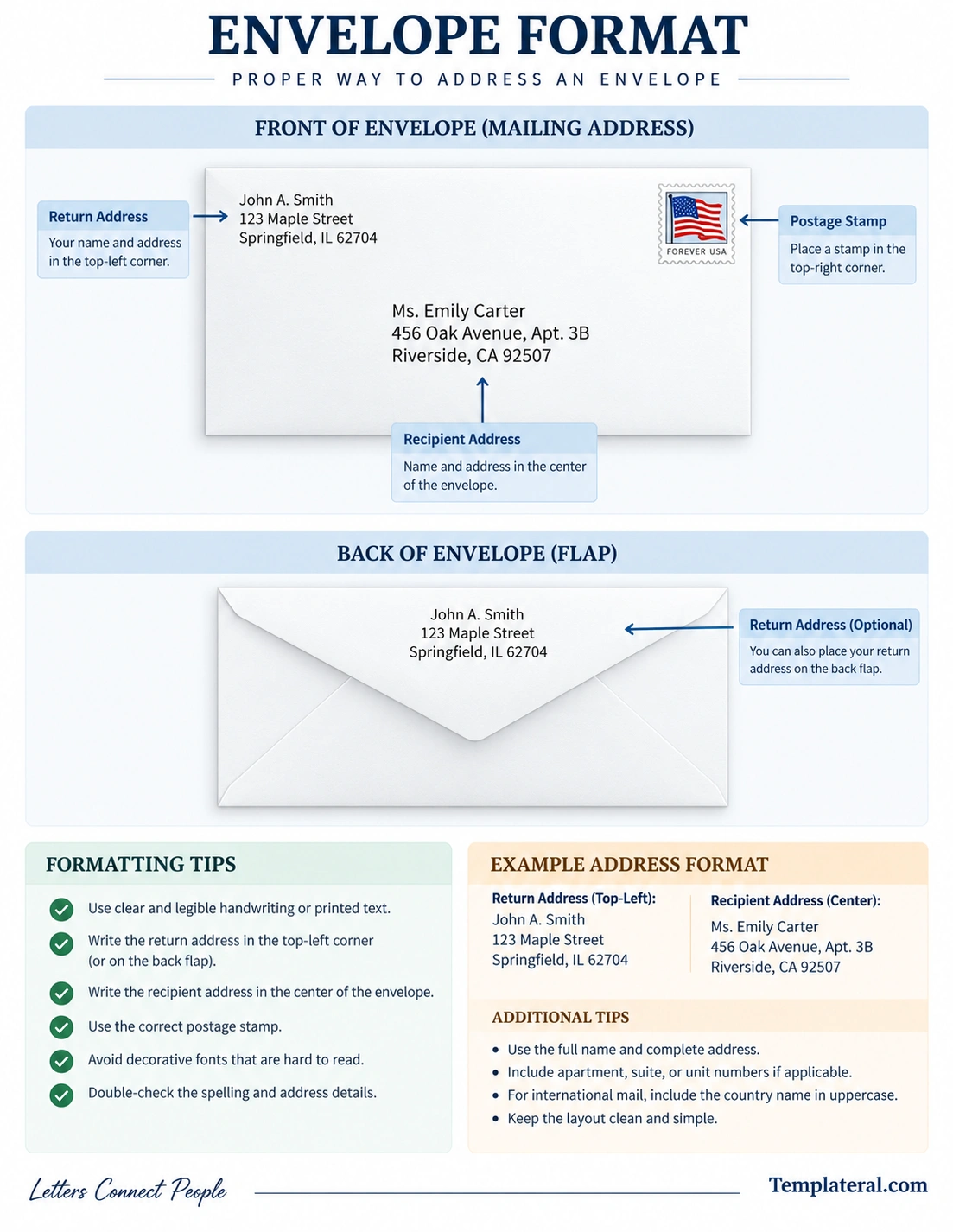
For a typical mailing envelope, the recipient’s address is placed prominently on the front, usually near the center. The return address is commonly placed in the upper-left corner, while postage is generally placed in the upper-right corner.
This straightforward arrangement creates a recognizable mailing layout and makes the important information easier to process.
Basic Parts of an Envelope
Before addressing an envelope, it helps to understand the main areas used for mailing information.
- Return address: Identifies the sender and provides an address where the item can potentially be returned.
- Recipient address: Identifies the person, organization, or location receiving the mail.
- Postage: Indicates that the appropriate mailing fee has been paid.
- Envelope flap: The back portion used to seal the envelope.
- Additional mailing information: May include apartment numbers, suite numbers, attention lines, or other delivery details.
Where Does the Return Address Go?
The return address is traditionally placed in the upper-left corner of the front of the envelope. It identifies the sender and can help return the mail if it cannot be delivered.
A basic return address usually includes:
- Sender’s name
- Street address
- Apartment, suite, or unit number when applicable
- City, state, and ZIP code
For example, a simple return address might look like this:
John A. Smith
123 Maple Street
Springfield, IL 62704
Keep the return address relatively compact and easy to read. Avoid placing it so close to the edge that it could be cut off or become difficult to scan.
Can the Return Address Go on the Back?
Depending on the mailing situation and postal requirements, a return address may also be placed on the back flap of an envelope. However, for a simple standard mailing layout, placing it in the upper-left corner of the front is a clear and familiar approach.
Where Does the Recipient Address Go?
The recipient address is the most important part of the envelope format. It should be placed prominently on the front of the envelope, generally in the central area.
A standard recipient address may include:
- Recipient’s name
- Company or organization name, when applicable
- Street address
- Apartment, suite, or unit number
- City, state, and ZIP code
For example:
Ms. Emily Carter
456 Oak Avenue, Apt. 3B
Riverside, CA 92507
Use the complete mailing address whenever possible. Missing apartment numbers, incorrect ZIP codes, or incomplete street information can create delivery problems.
Where Does the Stamp Go?
For a standard envelope, the postage stamp is generally placed in the upper-right corner of the front of the envelope.
Keep the stamp away from the recipient’s address and avoid covering other important mailing information. If you are using a postage label rather than a traditional stamp, follow the applicable mailing service’s placement instructions.
How to Format an Envelope
Addressing an envelope becomes easier when you follow the same basic sequence every time.
1. Write the Return Address
Place the sender’s name and address in the upper-left corner of the envelope. Use a readable font or handwriting and include all relevant address information.
2. Add the Recipient Address
Write the recipient’s full name and mailing address in the center portion of the envelope. Keep the address aligned and easy to read.
3. Add the Postage
Place the appropriate stamp or postage label in the upper-right area.
4. Check the Address
Before sealing or mailing the envelope, check the spelling of the recipient’s name, street address, city, state, ZIP code, and any apartment or suite number.
5. Seal the Envelope
Once the information has been checked, insert the letter or document and securely seal the envelope.
Envelope Format for Personal Letters
Personal letters generally use a simple envelope format. The sender’s return address can be placed in the upper-left corner, while the recipient’s address is placed in the center.
For a personal letter, you may address the recipient using their preferred name or title. The overall layout should remain clean and legible even if the letter itself has a more personal tone.
A simple personal envelope might include:
- Sender’s name and address in the upper-left corner
- Recipient’s name and address in the center
- Postage in the upper-right corner
Envelope Format for Business Letters
Business correspondence generally benefits from a professional and easy-to-read envelope format. The recipient’s name should be written accurately, especially when the letter is being sent to a particular department or individual.
When appropriate, you can include a company or organization name between the recipient’s name and street address.
For example:
Sarah Johnson
ABC Design Studio
250 Market Street, Suite 400
San Francisco, CA 94105
If the letter needs to reach a particular department or person, an attention line or department name may be included according to the organization’s preferred addressing convention.
Envelope Format for Formal Letters
Formal correspondence should use a clean and professional envelope layout. This is especially important for applications, official documents, business communication, legal correspondence, and other important letters.
Use the recipient’s correct title when appropriate, and make sure the address is complete. Avoid decorative handwriting or fonts that could make the address difficult to read.
A formal envelope should prioritize clarity over decoration.
How to Address an Envelope to a Company
When sending a letter to a company, include the recipient’s name or department when known, followed by the company name and complete mailing address.
For example:
Michael Brown
Northstar Consulting
800 Main Street
Denver, CO 80202
If you do not know the name of a specific recipient, you can use an appropriate department or job title when suitable for the purpose of the correspondence.
How to Format an Apartment or Suite Address
Apartment, suite, floor, building, or unit information should be included as part of the recipient’s address when applicable. Leaving out this information may make delivery more difficult, particularly in large residential or commercial buildings.
For example:
Emily Carter
456 Oak Avenue, Apt. 3B
Riverside, CA 92507
For a business address, a suite number may appear after the street address:
ABC Consulting
100 Business Plaza, Suite 250
Chicago, IL 60601
Envelope Format for International Mail
International mail requires additional address information because the item is traveling between countries. In addition to the recipient’s name and local address, the destination country should be clearly identified.
A typical international address may include:
- Recipient’s name
- Street address and unit information
- City or locality
- Postal code
- Country name
International addressing conventions can differ between countries, so check the requirements of the postal service handling the shipment before mailing important documents.
Common Envelope Formatting Mistakes
Small mistakes can make an envelope harder to process or deliver. Review the following details before sending your mail.
- Missing ZIP or postal code: Include the applicable postal code.
- Incorrect address: Double-check street numbers and names.
- Missing apartment or suite number: Include unit information when necessary.
- Unreadable handwriting: Use clear handwriting or printed text.
- Incorrect postage: Make sure the postage is appropriate for the size, weight, and destination.
- Poor placement: Keep the return address, recipient address, and postage in their expected areas.
- Excessive decoration: Avoid designs that interfere with address visibility or mailing requirements.
Tips for a Professional Envelope Format
A professional envelope should be simple, organized, and easy to read. The following practices can improve the appearance and usability of your envelope.
- Use clear text: Choose a readable font or neat handwriting.
- Keep the recipient address centered: Give the main mailing address enough visual space.
- Use consistent alignment: Keep address lines aligned with one another.
- Include complete information: Do not omit relevant unit or postal details.
- Proofread before mailing: Verify names and addresses carefully.
- Keep the design simple: The mailing information should remain the most prominent content.
Using an Envelope Format Template
An envelope format template can make addressing envelopes easier, especially when you regularly prepare personal, business, school, or official correspondence.
A visual template provides a quick reference for understanding where each element belongs. The printable template shown above illustrates the front and back of an envelope, including the return address, recipient address, postage location, and practical formatting tips.
You can use the template as a reference when addressing an envelope by hand or when preparing a digital envelope layout for printing.
Envelope Format for Invitations
Invitations often require a polished presentation, but the mailing information should still remain clear. The recipient’s name and address should be easy to identify, while decorative elements should not interfere with the mailing layout.
For formal invitations, verify titles, names, apartment numbers, and postal information carefully before addressing the envelope.
How to Prepare an Envelope Before Mailing
Before placing an envelope in the mail, perform a quick final check:
- Confirm the recipient’s full name.
- Verify the street address.
- Check the city, state, and ZIP code.
- Confirm apartment, suite, or unit information.
- Check the return address.
- Make sure the postage is appropriate.
- Ensure the envelope is securely sealed.
- Remove or cover any old mailing labels if reusing an envelope where permitted.
Final Thoughts
Understanding the correct envelope format makes sending letters and documents easier and more professional. The basic layout is straightforward: place the return address in the upper-left area, put the recipient’s complete mailing address in the central area, and place postage in the upper-right corner.
The exact requirements can vary depending on the destination, mailing service, and type of correspondence, so important or international mail should always be checked against the relevant postal guidelines.
For everyday letters, business correspondence, invitations, and official documents, a clean envelope format provides a simple way to keep mailing information organized, readable, and easy to process.
Download: Envelope Format Template
