Tournament brackets are one of the easiest ways to organize a competitive event and show how participants advance from one round to the next. A well-designed bracket makes it simple to see who plays whom, which participants move forward, and who ultimately reaches the championship match.
Whether you are organizing a school competition, sports event, gaming tournament, office activity, or community contest, a tournament bracket can provide a clear structure for the entire event. With the right format, participants can quickly understand the schedule and organizers can keep track of results without complicated paperwork.
There are several types of tournament brackets, including single elimination, double elimination, round robin, and hybrid formats. The best format depends on the number of participants, available time, and the type of competition you are organizing.
What Are Tournament Brackets?
Tournament brackets are visual charts used to organize matches or games in a competitive event. Participants are placed into predetermined positions, and the results of each match determine who advances to the next round.
A typical bracket starts with an initial round and progresses through several stages until only one participant or team remains. The final match usually determines the tournament champion.
The bracket provides a visual overview of the competition. Instead of keeping a separate list of matches and results, organizers can record everything directly on the bracket.
How Do Tournament Brackets Work?
The basic concept is simple. Participants are placed into the first round, matches are played, and winners advance. The process continues until the final round.
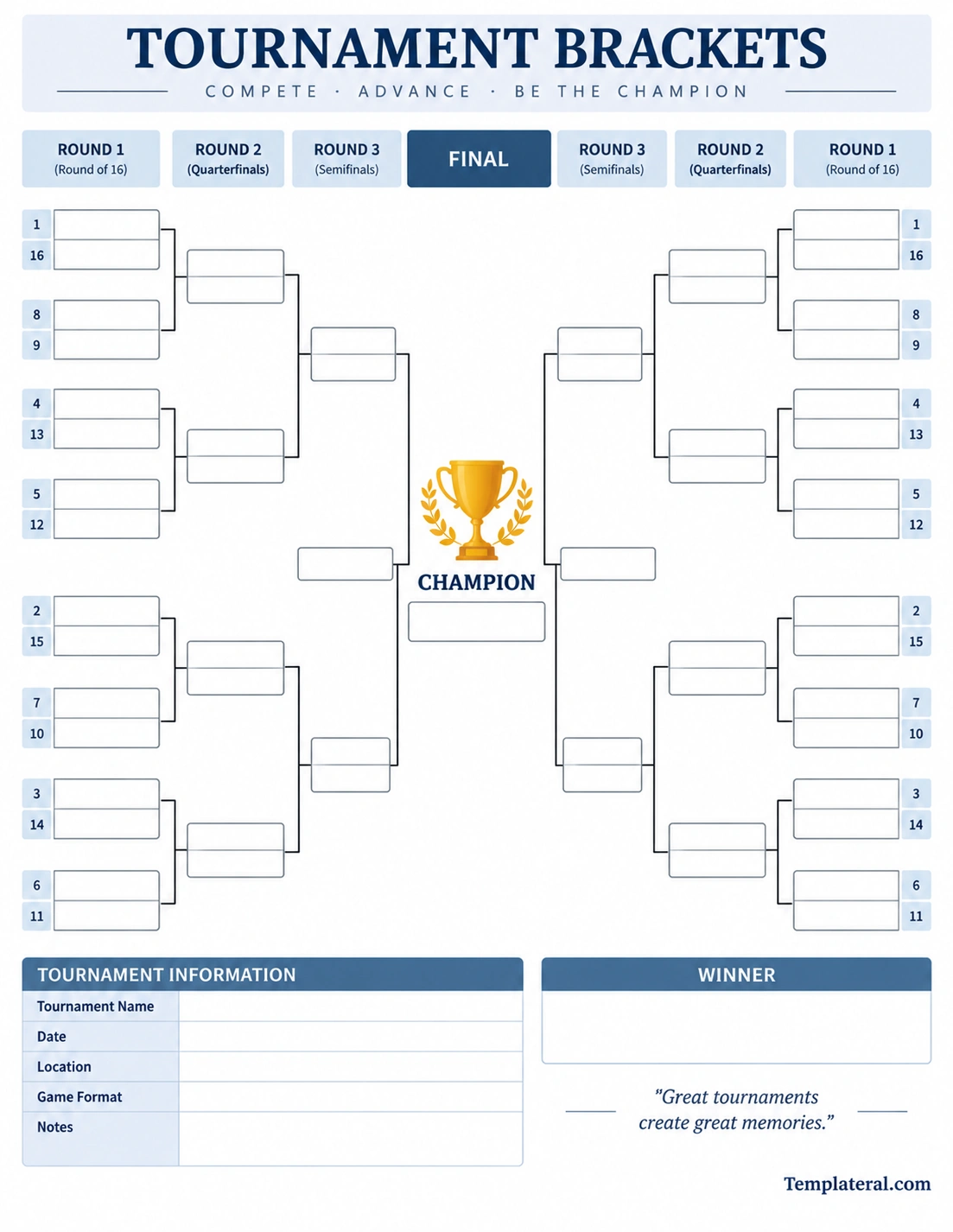
For example, a 16-team single-elimination tournament begins with eight first-round matches. The eight winners advance to four quarterfinal matches. Four winners then advance to two semifinal matches, followed by one championship match.
This structure means that every round reduces the number of remaining participants until one winner is left.
Round 1
The first round contains all participating teams or players. Depending on the tournament size, this could be a round of 4, 8, 16, 32, or more.
Quarterfinals
The winners from the first round advance to the quarterfinals when the tournament format includes this stage. The number of remaining participants is reduced again.
Semifinals
The semifinal round determines which participants will compete in the championship match. At this stage, only a small number of competitors remain.
Final
The final is the championship match between the remaining competitors. The winner is typically recorded as the tournament champion.
Types of Tournament Brackets
Different competition formats require different bracket structures. Understanding the main types can help you select a format that fits your event.
Single Elimination Bracket
A single elimination bracket is one of the simplest tournament formats. A participant is eliminated after losing a match, so the winner continues to the next round.
This format is popular because it is straightforward and requires relatively few matches. It can work particularly well when organizers have limited time or facilities.
The main structure is:
- Participants enter the first round.
- Winners advance.
- Losers are eliminated.
- The process continues through each round.
- The final winner becomes the champion.
Double Elimination Bracket
A double elimination bracket gives participants more than one opportunity to remain in the competition. Typically, a participant must lose twice before being eliminated.
This format generally uses a winners bracket and a losers bracket. It requires more matches and more planning than a single-elimination tournament, but it can provide additional competitive opportunities.
Round Robin Tournament
In a round robin tournament, participants play against multiple or all other participants in the group. Results are then used to determine standings.
This format is useful when organizers want participants to have several matches instead of being eliminated after one loss.
Hybrid Tournament Format
A hybrid tournament combines two or more formats. For example, an event might begin with round-robin groups and then move into a single-elimination playoff bracket.
This approach can provide multiple initial matches while still producing a straightforward knockout stage.
How to Create a Tournament Bracket
Creating a tournament bracket does not have to be complicated. A simple process can help you build an organized competition from the beginning.
1. Determine the Number of Participants
Start by counting the number of teams or players. Knowing the participant count helps determine the appropriate bracket size.
Single-elimination brackets are especially straightforward when the number of participants is a power of two, such as 4, 8, 16, 32, or 64. If the number does not fit neatly into the bracket, organizers can use byes so selected participants advance without playing in the first round.
2. Choose the Tournament Format
Decide whether the event will use single elimination, double elimination, round robin, or another format.
Consider the available time, number of participants, number of courts or playing areas, and desired number of games per participant.
3. Place Participants Into the Bracket
Enter each team or player into a starting position. Participants can be assigned randomly or placed according to a predetermined seeding system.
4. Add Match Results
After each match, record the result and advance the winner to the appropriate next-round position.
5. Continue Until the Final
Keep updating the bracket after every round. Eventually, the remaining participants will meet in the final match.
6. Record the Champion
Once the final is complete, enter the winning participant or team in the champion section of the bracket.
What Is Seeding in a Tournament?
Seeding is the process of assigning participants specific positions within a tournament bracket. Seeds may be determined randomly, by rankings, by previous results, or according to the rules established by the organizer.
For example, a 16-team bracket may number participants from 1 through 16. The organizer can then use those seed numbers to determine the initial matchups.
Seeding can be useful when an event has established rankings or when organizers want to structure the opening round according to predetermined criteria.
What Are Byes in Tournament Brackets?
A bye allows a participant to advance to the next round without playing in the current round. Byes are often necessary when the number of participants does not create an even bracket.
For example, if 10 teams enter a single-elimination tournament, the organizer may need to structure the first round so that some teams receive byes while the remaining teams play preliminary matches.
When using byes, make sure they are clearly marked on the tournament bracket so participants understand how the first round works.
How Many Games Are in a Single-Elimination Tournament?
For a standard single-elimination tournament with no byes, the total number of matches is one fewer than the number of participants because every match eliminates one participant.
For example:
- 4 participants: 3 total matches
- 8 participants: 7 total matches
- 16 participants: 15 total matches
- 32 participants: 31 total matches
- 64 participants: 63 total matches
This makes single elimination relatively easy to schedule when compared with formats in which participants play multiple matches.
How to Use a Printable Tournament Bracket
A printable tournament bracket can be particularly useful for events where organizers want a physical record of matchups and results.
Before the tournament begins, fill in the tournament name, date, location, game format, and participant names. Then record each result as the competition progresses.
The printable bracket shown above provides dedicated spaces for multiple rounds, the final, tournament information, and the eventual winner. It can be used as a quick reference at the event or retained as a record after the tournament ends.
Tips for Organizing Tournament Brackets
A well-planned bracket can make the event easier to manage. Use the following tips when preparing your tournament.
- Confirm the participant count: Make sure the bracket matches the actual number of teams or players.
- Choose the format early: Different formats require different numbers of matches and different scheduling approaches.
- Label rounds clearly: Use labels such as Round 1, Quarterfinals, Semifinals, and Final.
- Keep results visible: Update the bracket as soon as matches finish.
- Plan for byes: Decide how uneven participant numbers will be handled before the event begins.
- Allow enough time: Consider match length, breaks, and possible delays.
- Keep a backup: Maintain a digital or additional physical copy if the bracket is important.
- Record the champion: Complete the winner section once the final match is finished.
Tournament Brackets for Different Events
Tournament brackets are not limited to traditional sports. The same basic structure can be adapted to many competitive activities.
- Basketball tournaments
- Soccer tournaments
- Volleyball tournaments
- Tennis tournaments
- Badminton tournaments
- Table tennis tournaments
- Esports competitions
- Board game tournaments
- School competitions
- Community events
The basic bracket concept remains the same: organize participants, record match results, advance winners, and identify the final champion.
Digital vs. Printable Tournament Brackets
Both digital and printable brackets have practical advantages. Digital brackets are convenient when results need to be updated remotely or shared with many participants. Printable brackets are useful when organizers want a physical display or a simple worksheet that can be updated by hand.
A printable template can also serve as a backup even when the primary tournament bracket is maintained digitally. Having a physical copy can make it easier to track results during an event.
Common Tournament Bracket Mistakes to Avoid
Small organizational mistakes can create confusion during a tournament. Review the bracket before the competition begins and check that all matchups and participant names are correct.
- Incorrect participant count: Make sure every participant has a place in the tournament.
- Unclear seeding: Confirm that seed numbers are assigned consistently.
- Missing byes: Clearly identify any participants who advance without playing.
- Unlabeled rounds: Make the progression from one round to the next easy to follow.
- Incomplete results: Update the bracket after each match.
- Scheduling conflicts: Make sure participants have enough time between matches when necessary.
Final Thoughts
Tournament brackets provide a simple visual system for organizing competitive events. From a small school competition to a larger sports or gaming tournament, a well-structured bracket can make matchups, results, and progression much easier to understand.
Start by determining the number of participants and choosing an appropriate tournament format. Then organize the initial matchups, establish seeding when needed, plan for byes, and record results as the event progresses.
A clean printable tournament bracket can make the entire process easier by putting matchups, rounds, and the championship result in one organized place. With a little preparation, you can create a tournament structure that is simple to follow from the opening round all the way to the final.
Download: Tournament Bracket Template
