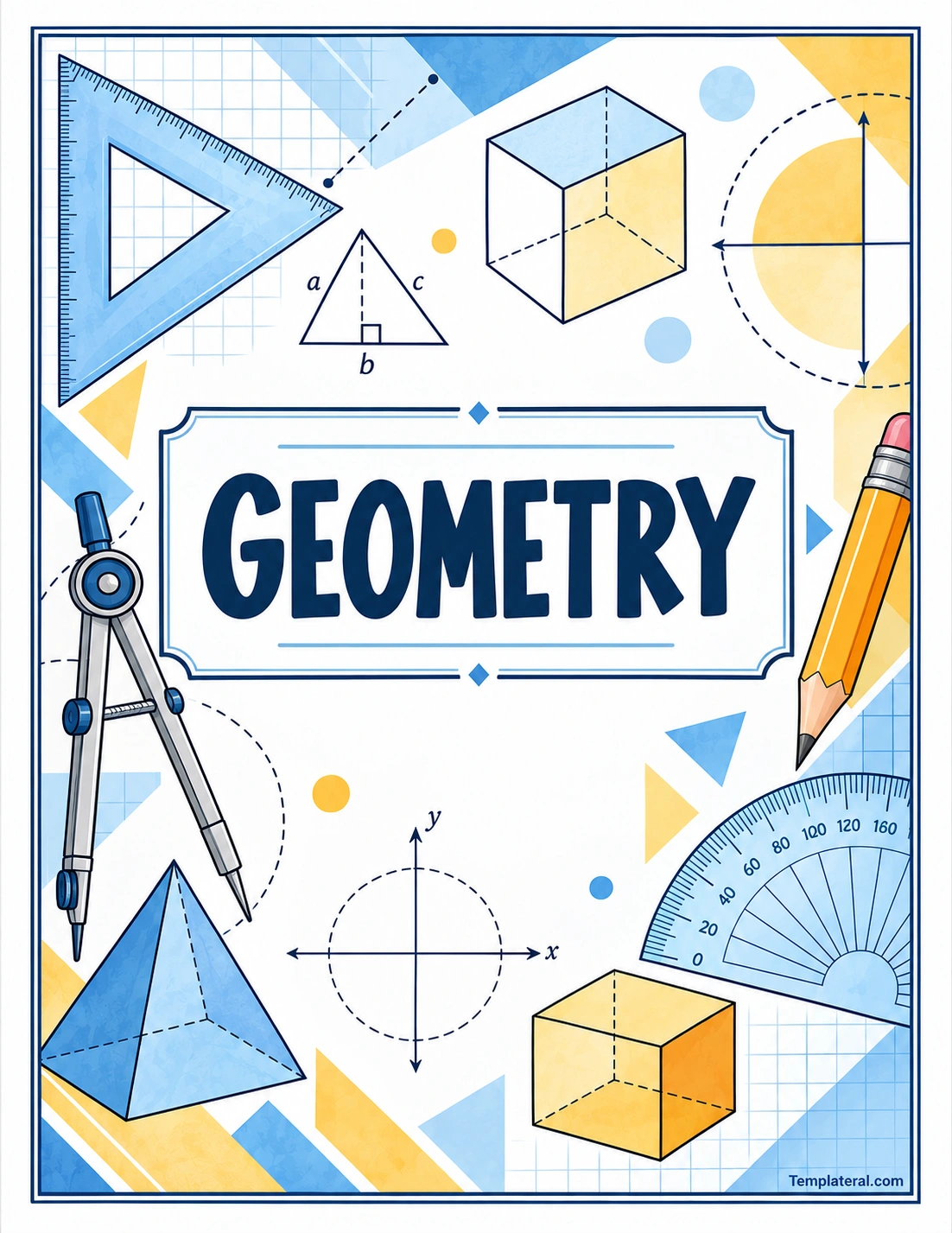
A Geometry Binder Cover is a simple way to organize and personalize your math binder. Whether you are studying angles, triangles, circles, coordinates, transformations, or three-dimensional shapes, a printable geometry cover can give your school binder a clean and recognizable appearance.
A well-designed geometry binder cover can also make your class materials easier to identify. Instead of using a plain binder, you can choose a design featuring geometric shapes, rulers, compasses, graphs, polygons, and other mathematics-inspired elements.
If you are looking for a clean and professional geometry binder cover template, a printable design can be an easy solution. You can print it on standard US Letter paper and place it inside the clear front sleeve of a three-ring binder.
What Is a Geometry Binder Cover?
A geometry binder cover is a printable page designed to identify and decorate a binder used for geometry class. It usually features the word “Geometry” along with visual elements related to mathematics and geometric concepts.
A geometry cover can be used for school notes, worksheets, homework, quizzes, projects, and other class materials. Because the cover sits inside the binder’s front sleeve, it can also be replaced whenever you want a different design.
A printable geometry binder cover is useful for keeping materials organized while making it easier to recognize your math binder among several school subjects.
Common materials that can be stored in a geometry binder include:
- Geometry class notes
- Homework and assignments
- Geometry worksheets
- Practice problems
- Formula sheets
- Diagrams and constructions
- Quizzes and test reviews
- Geometry projects
Why Use a Geometry Binder Cover?
A binder cover may seem like a small detail, but it can make everyday school organization easier. A clear subject label helps you identify the correct binder quickly, especially when you use several binders for different classes.
Make Your Math Binder Easy to Identify
A large “Geometry” title immediately tells you what is inside the binder. This is especially helpful when several binders have similar colors or designs.
Create a More Organized Study System
A dedicated geometry binder can keep notes, assignments, formulas, and practice materials in one place. A clear cover provides a simple visual starting point for your organization system.
Add Personality to Your School Supplies
Geometry does not have to look boring. A printable cover can include triangles, circles, polygons, coordinate grids, rulers, compasses, or other mathematical elements while maintaining a clean and professional appearance.
Geometry Binder Cover Design Ideas
There are many different approaches to creating a geometry-themed binder cover. You can choose a design based on your grade level, personal style, or the topics you are currently studying.
Geometric Shapes Binder Cover
Geometric shapes are a natural choice for a geometry binder. Triangles, squares, rectangles, circles, hexagons, and other polygons can create an educational and visually appealing design.
A combination of different shapes can also represent the variety of concepts covered in geometry class.
Compass and Ruler Design
A compass and ruler are recognizable tools used in geometric constructions. Adding these elements can give a binder cover a traditional mathematics classroom appearance.
Coordinate Grid Design
A coordinate grid works particularly well for students learning about the coordinate plane, slope, transformations, distance, and graphing. Grid lines can also provide a structured visual background without overwhelming the page.
Triangle Geometry Design
Triangles are among the most important figures in geometry. A triangle-themed cover can include angle markings, side labels, altitude lines, or different triangle classifications such as equilateral, isosceles, and right triangles.
3D Geometry Design
Students studying solid geometry may prefer a cover featuring cubes, pyramids, prisms, cylinders, cones, or other three-dimensional figures. These illustrations can make the connection to spatial geometry immediately clear.
What to Include on a Geometry Binder Cover
A good binder cover does not need to contain a lot of information. Keeping the design simple usually makes the main title easier to read.
Consider including these details:
- Subject: Add “Geometry” as the main title.
- Name: Include a blank area for the student’s name.
- Class: Add the class period or section if useful.
- Teacher: Include the teacher’s name when needed.
- Grade: Add the student’s grade level if desired.
Leaving some blank space is useful because students can add their information by hand after printing the cover.
How to Use a Printable Geometry Binder Cover
Using a geometry binder cover is simple. After choosing your preferred design, print the page and place it in the front sleeve of your binder.
For the best results, use a standard US Letter page measuring 8.5 x 11 inches. Before printing, check that the printer is set to the correct paper size and that the design is not being unnecessarily cropped or enlarged.
Once the page has been printed, you can add your name, class period, or other information in the available space. Then place the finished cover inside the transparent front pocket of your binder.
Tips for Printing a Geometry Binder Cover
A few simple printing adjustments can help your geometry cover look cleaner and more professional.
- Choose US Letter paper: Use 8.5 x 11 inch paper for a standard printable school binder cover.
- Check the orientation: Use portrait orientation when the template is designed vertically.
- Review the print preview: Check the edges before printing to make sure important elements are not cropped.
- Use good-quality paper: Slightly thicker paper can make the printed cover feel more durable.
- Check the printer scale: Use the correct scale so the design maintains its intended proportions.
- Keep the page flat: Avoid folding the cover before placing it inside the binder sleeve.
How to Personalize Your Geometry Binder Cover
Personalizing a geometry binder cover template can make it more practical for everyday school use. You do not need to change the entire design. A few small details are usually enough.
Add Your Name
Your name is the most useful piece of information to add. It helps distinguish your binder from those belonging to classmates.
Add Your Class Period
If you have multiple math classes or use different binders throughout the day, adding your class period can make identification even easier.
Add a Geometry Topic
You can also add a topic such as “Triangles,” “Circles,” “Transformations,” or “Coordinate Geometry” if you are using the binder for a specific unit.
How to Organize a Geometry Binder
A great cover works best when the materials inside the binder are organized as well. Creating clear sections can make it easier to find notes and study before an assessment.
Class Notes
Keep daily lessons, examples, definitions, and important explanations in one section. This section can become a useful reference when reviewing older geometry concepts.
Homework
Use another section for current and completed assignments. Keeping homework separate from class notes can make it easier to find unfinished work.
Formulas and Theorems
Store important formulas, postulates, properties, and theorems together. A dedicated reference section can be particularly useful before quizzes and exams.
Geometry Practice
Keep extra practice problems and review worksheets in a separate section. This allows you to quickly find exercises when preparing for an upcoming test.
Tests and Projects
Completed tests, projects, and major assignments can be stored toward the back of the binder. Keeping these materials can help you review mistakes and understand which concepts need additional practice.
Who Can Use a Geometry Binder Cover?
A printable geometry binder cover can be useful for students at different educational levels. Middle school students can use simple designs while learning foundational geometry concepts. High school students can choose more detailed designs for subjects such as Euclidean geometry, coordinate geometry, trigonometry, or solid geometry.
College students can also use a clean geometry binder cover for lecture notes, problem sets, formulas, and study materials. Teachers may use geometry covers for lesson plans, classroom worksheets, assessment materials, or curriculum binders.
The design can be adapted to suit different learning environments, including traditional classrooms, homeschooling, tutoring, and independent study.
Geometry Binder Cover Ideas for Students
If you want to create a more personalized mathematics binder, consider matching the cover with the topics inside. For example, a triangle-focused cover can complement a binder section devoted to triangle properties, while a coordinate-grid design can work well for coordinate geometry.
You can also use different binder covers for different math subjects. A geometry cover can be paired with separate designs for algebra, calculus, statistics, or other courses. This creates a consistent visual organization system across your school supplies.
Frequently Asked Questions About Geometry Binder Covers
What is a Geometry Binder Cover?
A Geometry Binder Cover is a printable page used to decorate and identify a binder containing geometry notes, worksheets, assignments, formulas, and other mathematics materials.
What size should a geometry binder cover be?
A standard printable geometry binder cover is generally designed for US Letter paper, which measures 8.5 x 11 inches. This size is commonly used for school binders in the United States.
Can I personalize a Geometry Binder Cover?
Yes. You can add your name, class period, teacher’s name, grade level, or a specific geometry topic. A blank area on the cover makes handwriting or digital personalization easy.
What should I put on a geometry binder cover?
The main title should identify the subject as “Geometry.” You can also add your name, class information, and geometry-related illustrations such as triangles, circles, rulers, compasses, grids, or three-dimensional shapes.
Can high school students use a Geometry Binder Cover?
Yes. A geometry binder cover is suitable for middle school, high school, college, tutoring, homeschooling, and other educational settings.
Can teachers use a Geometry Binder Cover?
Yes. Teachers can use printable geometry covers for lesson-plan binders, classroom resources, worksheets, tests, project materials, and other teaching documents.
How can I make my geometry binder more organized?
Divide the binder into sections for class notes, homework, formulas, practice worksheets, tests, and projects. Using labeled dividers can make individual topics easier to find.
Conclusion
A Geometry Binder Cover is an easy way to make a math binder more organized, recognizable, and visually appealing. A clean design featuring geometric shapes, coordinate grids, rulers, compasses, triangles, or three-dimensional figures can clearly communicate the subject while keeping the page professional.
Whether you are organizing middle school geometry, high school mathematics, college notes, or classroom materials, a printable geometry cover can be a useful addition to your binder. Choose a design that fits your style, add your personal information, print it on US Letter paper, and place it inside the binder’s front sleeve.
With a clear cover and organized sections inside, your geometry binder can become a practical resource for keeping notes, assignments, formulas, and study materials together throughout the school year.
Download: Geometry Binder Cover Template
