A travel itinerary is a simple way to organize the details of a trip before you leave. It can include travel dates, destinations, activities, transportation, accommodation, reservations, important contacts, and notes. Instead of keeping travel information scattered across emails, booking confirmations, and notes on your phone, an itinerary brings the most important details together in one convenient place.
A well-planned itinerary does not mean every minute of a vacation has to be scheduled. In fact, a good travel plan should leave enough room for flexibility. The goal is to know where you need to be, what you want to see, and how you will get there while still having time to enjoy unexpected experiences.
Whether you are planning a weekend getaway, family vacation, business trip, road trip, or international adventure, a printable travel itinerary template can make the planning process easier and more organized.
What Is a Travel Itinerary?
A travel itinerary is a structured plan that outlines the important details of a trip. It usually organizes information by date or day, making it easy to understand what is planned and where you need to be.
A basic itinerary may include:
- Destination and travel dates
- Daily activities
- Arrival and departure times
- Transportation details
- Hotel or accommodation information
- Places and attractions to visit
- Restaurant or activity reservations
- Emergency contact information
- Important notes and reminders
- Packing checklist
The amount of detail depends on the type of trip. A short weekend trip may only require a simple schedule, while a multi-city international vacation may need a more detailed itinerary.
Why Create a Travel Itinerary?
Planning an itinerary before traveling can reduce confusion and help you make better use of your available time. It also gives you a central reference for important travel information.
Some of the main benefits include:
- Better organization: Keep travel information in one place.
- Time management: See how much time is available for activities.
- Easier transportation planning: Organize flights, trains, rental cars, and other transportation.
- Reservation tracking: Record hotel and activity confirmation details.
- Less stress: Know the basic plan before arriving at your destination.
- Better preparation: Identify documents, items, and reservations you need before departure.
- Greater flexibility: A clear schedule makes it easier to identify which activities can be changed.
What to Include in a Travel Itinerary
A useful travel itinerary should contain the information that is most relevant to your particular trip. You do not need to include every possible detail.
Trip Information
Start with the basic information about your trip. Include the destination, travel dates, purpose of the trip, and names of the travelers when appropriate.
This section provides a quick overview and makes the itinerary easier to identify, especially when you have multiple trips planned.
Daily Schedule
The daily schedule is usually the main part of an itinerary. Organize activities by day and include approximate times, locations, and notes.
For example, a daily plan might include:
- Morning departure
- Breakfast location
- Main attraction or activity
- Lunch
- Afternoon activity
- Return to accommodation
- Evening plans
Using approximate time blocks instead of scheduling every minute can make the itinerary easier to follow and more realistic.
Accommodation Details
Record your hotel, vacation rental, hostel, or other accommodation information. Useful details include the property name, address, dates, contact information, and reservation number.
Having these details readily available can be particularly useful when arriving at a destination or contacting the property.
Transportation Details
Transportation information can include flights, trains, buses, rental cars, transfers, or other methods of transportation.
Consider recording:
- Date and time
- Departure location
- Arrival location
- Transportation method
- Reservation or confirmation number
- Important notes
Places to Visit
List attractions, landmarks, museums, parks, restaurants, beaches, or other places you want to visit. You can also include opening hours or reservation requirements when relevant.
Grouping attractions by location can help reduce unnecessary travel between different parts of a city or destination.
How to Make a Travel Itinerary
Creating an itinerary does not have to be complicated. Start with the fixed parts of your trip and then build the flexible activities around them.
- Step 1: Choose your destination. Determine where you are going and which areas you want to explore.
- Step 2: Confirm your travel dates. Record your departure and return dates.
- Step 3: Add transportation. Enter confirmed flight, train, bus, rental car, or transfer information.
- Step 4: Add accommodation. Record where you will stay and the relevant reservation details.
- Step 5: List your priorities. Identify the attractions and activities that matter most to you.
- Step 6: Organize activities by location. Group nearby destinations together when possible.
- Step 7: Add realistic time blocks. Allow enough time for transportation, meals, rest, and unexpected delays.
- Step 8: Add important notes. Include reservations, contact information, opening hours, and other useful reminders.
- Step 9: Review the complete plan. Check for scheduling conflicts and unnecessary travel.
How Detailed Should a Travel Itinerary Be?
The ideal level of detail depends on the traveler and the type of trip. An itinerary should provide enough structure to be useful without becoming difficult to follow.
For a relaxed vacation, you may only need a few activities per day. For a business trip, however, you may need exact meeting times, addresses, transportation arrangements, and contact information.
A good rule is to make fixed commitments highly detailed while leaving flexible activities more open.
Travel Itinerary for a Weekend Trip
A weekend trip usually does not require a complicated planning document. A simple itinerary can cover the most important information for Friday, Saturday, and Sunday.
For example, you might organize the trip around:
- Departure and arrival
- Hotel check-in and check-out
- Two or three main attractions
- Meal plans
- Transportation between locations
- Return journey
Because a short trip has limited time, grouping activities by location can be especially helpful.
Travel Itinerary for a Road Trip
A road trip itinerary can be organized around destinations and driving segments rather than flights. Include the starting point, planned stops, overnight locations, and estimated driving periods.
Useful information may include:
- Departure and arrival locations
- Planned driving routes
- Overnight accommodations
- Fuel or charging stops
- Rest stops
- Attractions along the route
- Estimated arrival times
- Alternative plans for delays
A road trip plan should remain flexible because traffic, weather, road conditions, and unexpected stops can change the schedule.
Travel Itinerary for International Trips
International travel often involves more logistics than domestic travel. Your itinerary can help keep important information together and make it easier to manage different transportation arrangements.
Consider including:
- Flight details
- Airport information
- Accommodation addresses
- Transportation between airports and hotels
- Passport and travel document reminders
- Travel insurance information
- Emergency contacts
- Local transportation details
- Important reservation numbers
Keep copies of essential travel documents separately from your main itinerary when appropriate. An itinerary should support your travel preparations, not replace required documents.
How to Organize Activities Efficiently
One of the most useful features of an itinerary is the ability to organize activities logically. Instead of choosing destinations randomly, look at their locations and plan activities that are relatively close to one another on the same day.
For example, if three attractions are located in the same neighborhood, visiting them on the same day may reduce unnecessary transportation time.
You can also consider:
- Opening and closing hours
- Peak visitor periods
- Travel time between activities
- Reservation requirements
- Meal breaks
- Rest periods
- Weather conditions
This approach creates a practical itinerary instead of a schedule that looks good on paper but is difficult to complete.
Leave Room for Flexibility
One of the most common itinerary mistakes is planning too many activities. Travel rarely goes exactly according to schedule, so it is useful to leave some unplanned time.
Build flexibility into your itinerary by avoiding back-to-back activities throughout the entire day. Allow extra time for transportation, meals, queues, navigation, and unexpected delays.
You can also create a list of optional activities. If you have extra time, choose one of them. If the day becomes busy, simply leave them for another visit.
Travel Itinerary vs. Travel Schedule
The terms travel itinerary and travel schedule are sometimes used interchangeably, but they can have slightly different meanings.
A travel schedule often focuses primarily on dates and times. An itinerary can be broader and include destinations, activities, accommodation, transportation, contact information, notes, and other trip details.
In practice, a travel itinerary can contain a schedule as one of its main sections.
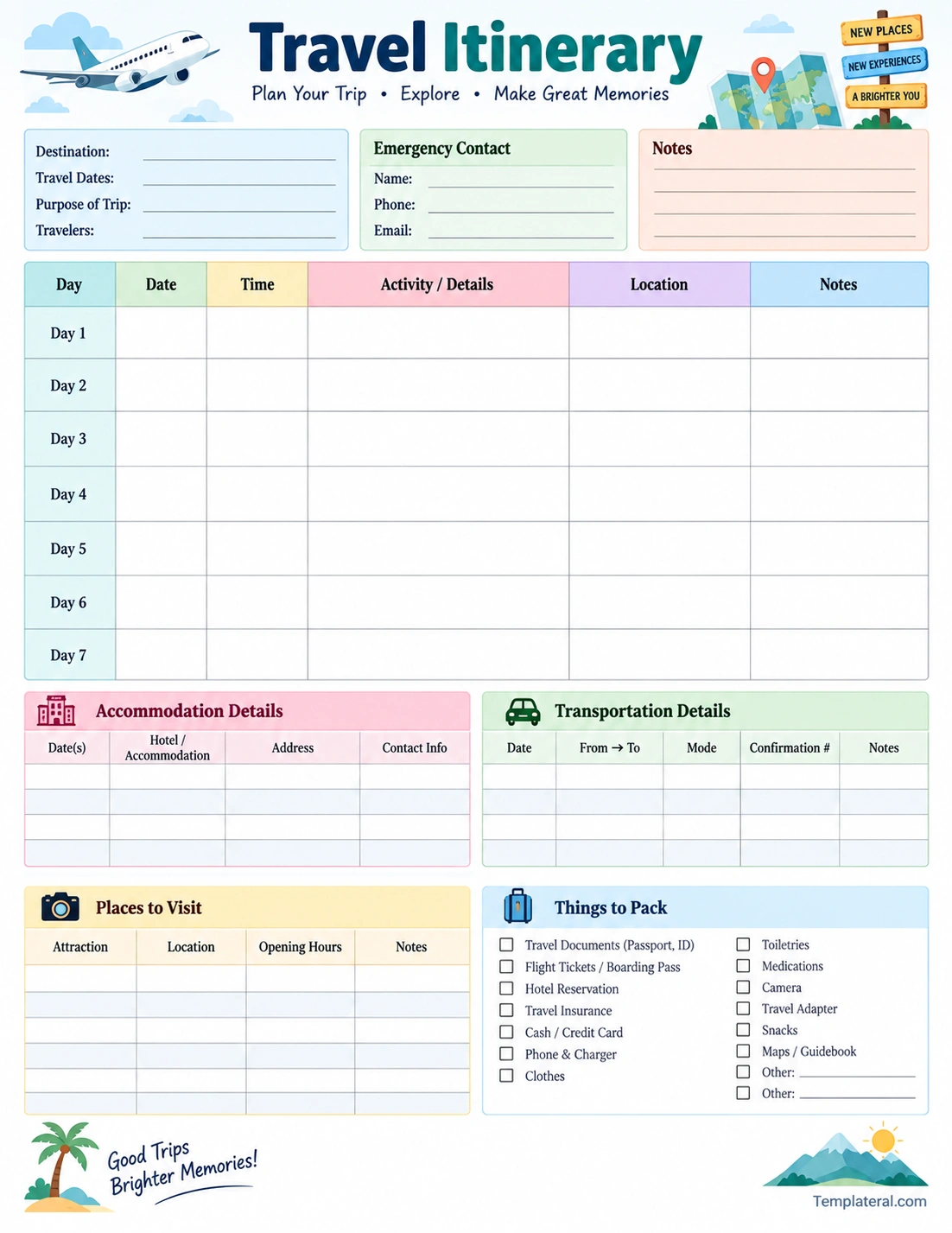
Using a Printable Travel Itinerary Template
A printable travel itinerary template can save time because the basic structure is already prepared. Instead of designing a planning sheet from scratch, you can simply fill in the information for your trip.
A well-designed template can include sections for:
- Destination and travel dates
- Emergency contact information
- Daily activities
- Accommodation
- Transportation
- Places to visit
- Notes
- Packing checklist
Printable templates are also useful when you prefer having a physical reference. You can keep a copy with your travel documents or use it during the planning process before transferring important information to your preferred digital system.
Travel Itinerary Planning Tips
Small planning decisions can make an itinerary significantly more practical.
- Start with fixed reservations: Add flights, trains, hotel bookings, and timed activities first.
- Group nearby activities: Reduce unnecessary travel by organizing destinations by location.
- Do not overbook your days: Leave room for meals, rest, and unexpected changes.
- Use realistic travel times: Consider traffic, airport procedures, parking, and walking time.
- Keep important information accessible: Record reservation numbers and contact details in a convenient location.
- Have backup options: Identify alternative activities if weather or other circumstances affect your original plan.
- Review before departure: Check dates, times, addresses, and reservations before beginning your trip.
What to Pack Before Your Trip
Travel planning should also include a basic packing checklist. The items you need will depend on your destination, trip length, activities, and personal requirements.
A general checklist may include:
- Passport or identification
- Travel tickets and boarding passes
- Accommodation confirmation
- Travel insurance information
- Clothing
- Toiletries
- Medication or personal essentials
- Phone and charger
- Travel adapter when required
- Camera or other travel equipment
- Maps or guidebook
Adding a packing section to your travel itinerary can help connect trip planning with pre-departure preparation.
Common Travel Itinerary Mistakes
Even a detailed itinerary can become less useful if it is overloaded or poorly organized. Avoid these common mistakes when creating your travel plan.
Planning Every Minute
A schedule with no free time can become stressful. Leave reasonable gaps between activities.
Ignoring Travel Time
Activities may look close together on a map but take significant time to reach. Include transportation time when planning your day.
Adding Too Many Attractions
Trying to visit every attraction can make the trip exhausting. Prioritize the places that are most important to you and treat the rest as optional.
Forgetting Reservations
Some attractions, restaurants, tours, and transportation services require advance reservations. Record these commitments clearly in your itinerary.
Not Checking the Details
Before leaving, verify important dates, times, addresses, reservation numbers, and transportation information. Small errors can cause unnecessary problems during a trip.
Conclusion
A travel itinerary is a practical tool for organizing the essential details of a trip. By combining transportation, accommodation, activities, destinations, reservations, notes, and preparation checklists in one place, you can create a clearer picture of your travel plans.
The best itinerary is not necessarily the most detailed one. It should be realistic, easy to understand, and flexible enough to accommodate changes. Start with fixed travel arrangements, add your most important activities, organize destinations by location, and leave enough free time to enjoy the journey.
Whether you are planning a weekend getaway, road trip, family vacation, business journey, or international adventure, a printable travel itinerary template can provide a simple structure for turning your travel ideas into an organized plan.
Download: Travel Itinerary Template
