An interest letter is a professional letter used to express your interest in an opportunity, organization, position, program, or potential collaboration. Unlike a traditional application letter, a letter of interest can be sent even when there is no specific job opening or formal application deadline.
A well-written interest letter introduces who you are, explains why you are interested, highlights relevant qualifications, and opens the door for a future conversation. It can be useful when you want to connect with an employer, inquire about potential opportunities, express interest in a program, or introduce yourself to an organization.
The most effective interest letters are concise, specific, and focused on the value you can bring. Rather than simply saying that you are interested, your letter should explain what attracted you to the opportunity and why your background makes you a relevant candidate.
What Is an Interest Letter?
An interest letter is a formal written message that communicates your interest in a particular opportunity or organization. It is sometimes called a letter of interest, expression of interest letter, or prospecting letter.
In a professional setting, an interest letter may be used to contact a company about possible employment opportunities that have not been publicly advertised. It can also be used for internships, volunteer opportunities, academic programs, partnerships, professional networking, and other situations where you want to introduce yourself and establish a connection.
The purpose is generally to start a conversation rather than immediately complete a formal application process.
When Should You Write an Interest Letter?
An interest letter can be appropriate when you have a specific reason for contacting someone but there is no standard application process available.
You might write one when:
- You are interested in working for a particular company.
- You want to inquire about future job opportunities.
- You are interested in an internship or volunteer position.
- You want to express interest in an academic or professional program.
- You are interested in collaborating with an organization.
- You want to introduce yourself to a potential professional contact.
- You want to explore opportunities that may become available in the future.
The letter should have a clear purpose. A vague message that only says you would like to work with an organization is less useful than one that identifies a specific area, role, program, or type of opportunity.
Interest Letter vs. Cover Letter
An interest letter and a cover letter are similar because both can introduce your qualifications and professional goals. However, they are normally used in different circumstances.
Cover Letter
A cover letter is usually written in response to a specific job posting or application. It connects your experience and skills directly to the requirements of an advertised position.
Interest Letter
An interest letter is generally more exploratory. You can send it when there is no specific position advertised or when you want to ask about potential opportunities within an organization.
For example, a cover letter might say that you are applying for a specific marketing manager position. An interest letter could instead explain that you are interested in future marketing opportunities with the company and would like to learn whether your background may be relevant to upcoming openings.
What to Include in an Interest Letter
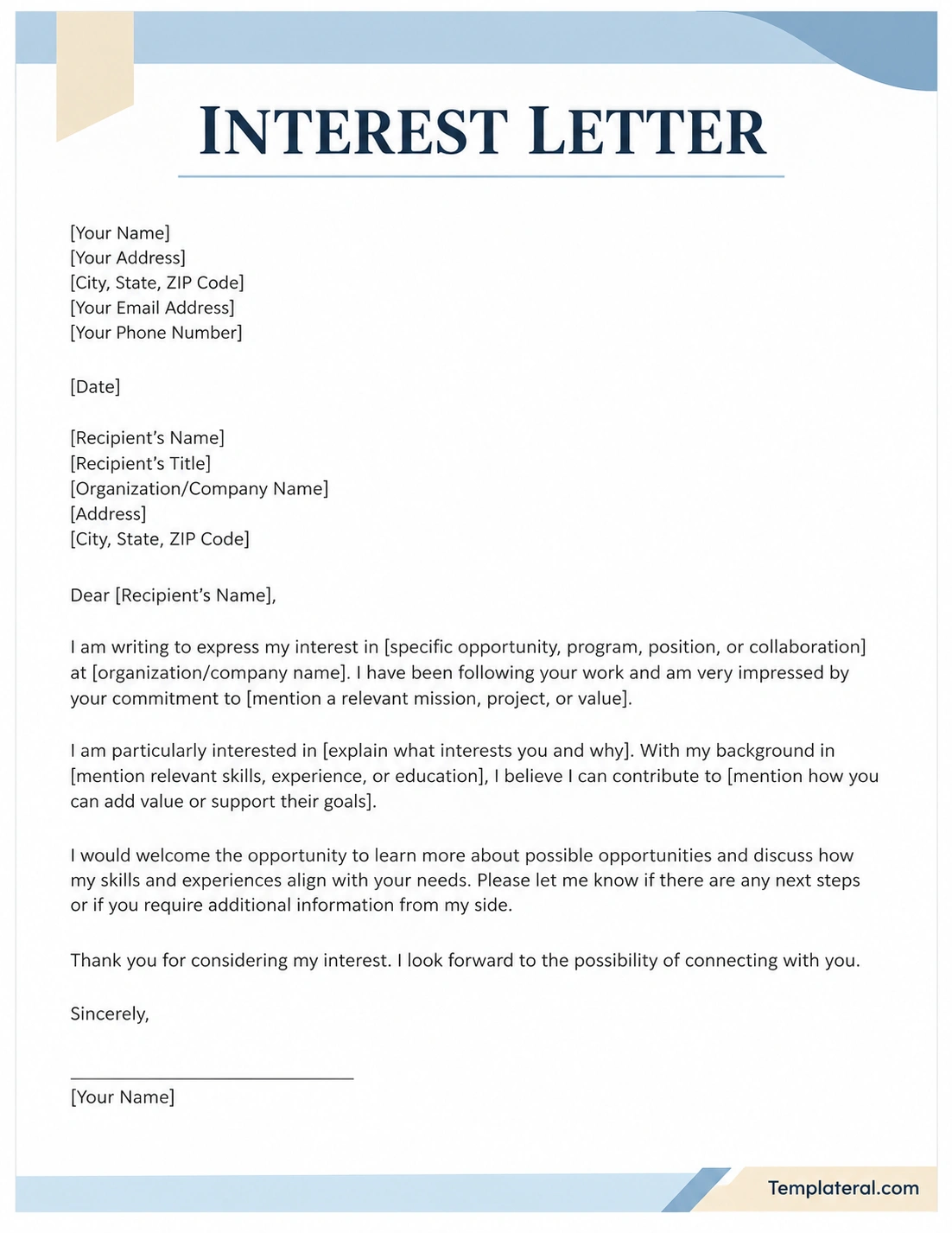
A professional interest letter should provide enough information to explain your purpose without becoming unnecessarily long. A clear structure makes the message easier for the recipient to read.
Your Contact Information
Begin with your name and relevant contact information. Depending on the format and situation, this may include your mailing address, email address, and phone number.
Date
Add the date on which you are sending the letter. This is particularly important for a formal printed letter.
Recipient Information
Whenever possible, address the letter to a specific person. Include the recipient’s name, title, organization, and relevant address information.
Professional Greeting
Use a professional greeting such as Dear Ms. Johnson or Dear Mr. Smith. If you cannot identify the appropriate person, use a professional general greeting rather than an overly casual opening.
Opening Paragraph
The opening paragraph should immediately explain why you are writing. Mention the specific opportunity, organization, department, program, or area that interests you.
Relevant Background
The middle section should briefly explain your qualifications. Focus on experience, skills, education, achievements, or interests that are genuinely relevant to the recipient.
Call to Action
Close by expressing your interest in learning more or discussing potential opportunities. Make it easy for the recipient to understand what you hope will happen next.
Professional Closing
Finish with a professional closing such as Sincerely or Best regards, followed by your name.
How to Write an Interest Letter Step by Step
Writing an interest letter becomes easier when you approach it as a short professional introduction rather than a generic application.
1. Research the Organization
Before writing, learn about the company, organization, school, program, or individual you are contacting. Look for information about its work, goals, services, projects, or current priorities.
This research allows you to make the letter more specific and demonstrates that your interest is genuine.
2. Identify Your Purpose
Decide exactly why you are contacting the recipient. Are you looking for employment, an internship, a partnership, an academic opportunity, or simply information about future opportunities?
A clear purpose will make the rest of the letter easier to write.
3. Explain Why You Are Interested
Do not rely on general statements such as “I am very interested in your company.” Explain what specifically attracted your attention.
For example, you might mention an organization’s particular project, mission, product, area of research, or professional reputation. The goal is to connect your interest with something concrete.
4. Highlight Relevant Qualifications
Choose two or three qualifications that relate directly to the opportunity. These might include professional experience, technical skills, education, certifications, projects, or relevant accomplishments.
Keep this section focused. An interest letter is not meant to repeat your entire resume.
5. Explain the Potential Value You Offer
Where appropriate, explain how your background could contribute to the organization or opportunity. Focus on relevant abilities rather than making broad claims about your value.
6. Request a Conversation or Next Step
End with a reasonable next step. You might ask whether there are current or upcoming opportunities, offer to provide additional information, or express your interest in discussing the possibility further.
Interest Letter Example Structure
A simple interest letter can follow this structure:
- Header: Your name and contact information
- Date: The date the letter is sent
- Recipient: Recipient’s name, title, and organization
- Greeting: A professional salutation
- Introduction: The reason for writing
- Interest: Why the opportunity or organization interests you
- Qualifications: Relevant skills, experience, or education
- Next step: A request for information or conversation
- Closing: A professional sign-off and your name
This structure can be adapted for employment inquiries, internships, academic opportunities, volunteer positions, and professional networking.
Tips for Writing an Effective Interest Letter
Keep It Concise
A strong interest letter generally does not need to be several pages long. Focus on the information that helps the recipient understand who you are, why you are contacting them, and why your background may be relevant.
Personalize the Letter
Avoid sending exactly the same letter to every organization. Personalize the introduction and explain why you are specifically interested in that organization or opportunity.
Focus on Relevance
Choose qualifications that support the purpose of your letter. A short list of relevant achievements is usually more effective than a long list of unrelated skills.
Use Professional Language
Keep the tone confident, polite, and professional. Avoid excessive enthusiasm, informal language, or unsupported claims.
Proofread Carefully
Spelling and grammar errors can distract from your message. Before sending your interest letter, check names, job titles, organization names, dates, contact information, and formatting.
Common Mistakes to Avoid
Even a well-qualified person can weaken an interest letter by making the message too generic or difficult to understand.
- Using a generic message: Explain why you are interested in this particular organization or opportunity.
- Writing too much: Keep the letter focused on your strongest and most relevant information.
- Repeating your resume: Use the letter to provide context rather than copying every resume detail.
- Making unsupported claims: Use specific examples when describing your experience or achievements.
- Forgetting the purpose: Make it clear why you are contacting the recipient.
- Using an unclear call to action: Tell the recipient what type of response or next step you are hoping for.
- Failing to proofread: Correct errors before sending the final letter.
How Long Should an Interest Letter Be?
An interest letter should generally be long enough to communicate your purpose and relevant qualifications without overwhelming the reader. For many situations, one page is sufficient.
Instead of trying to reach a specific word count, prioritize clarity and relevance. If the recipient can quickly understand who you are, why you are interested, and what you bring to the table, the letter is doing its job.
How to End an Interest Letter
The final paragraph should maintain a professional and positive tone. Briefly restate your interest, indicate your willingness to provide additional information, and suggest a reasonable next step.
For example, you can express interest in discussing potential opportunities or ask the recipient to contact you if a suitable opportunity becomes available.
Avoid sounding demanding. An interest letter is often an introduction, so the goal is to establish a professional connection rather than pressure the recipient for an immediate decision.
When to Send an Interest Letter
The timing depends on the purpose of the letter. If you are interested in a particular organization, sending an interest letter before a relevant opportunity is publicly advertised may help introduce you to the appropriate contact.
For internships, academic programs, and seasonal opportunities, it can be useful to research typical application periods and contact organizations early enough to allow time for a response.
For networking purposes, an interest letter can also be sent after learning about someone’s work, attending a professional event, or discovering an organization whose activities align with your interests.
Final Thoughts on Interest Letters
An interest letter is a useful professional communication tool when you want to introduce yourself and explore an opportunity that may not have a formal application process. The strongest letters are specific, concise, and focused on a genuine reason for making contact.
Start by identifying your purpose, research the recipient or organization, explain why you are interested, and highlight the qualifications that are most relevant. Finish with a clear but respectful next step and carefully proofread the final version.
With a simple structure and thoughtful personalization, an interest letter can provide a professional introduction and create an opportunity for a meaningful conversation.
Download: Interest Letter Template
