A Secret Santa form makes it easier to organize a fun and organized gift exchange. Instead of asking participants individually about their interests, gift preferences, or things they would rather avoid, everyone can provide the information in one simple form.
Whether you are organizing a Secret Santa exchange at work, school, with friends, or among family members, a well-designed form can make the entire process easier. Participants can share helpful gift ideas without revealing too much about themselves, while the organizer can collect the information needed to create a smooth gift-giving experience.
A useful Secret Santa form should be simple enough to complete quickly but detailed enough to give the gift giver useful clues. In this guide, you will learn what a Secret Santa form is, what information to include, how to organize the exchange, and how to create a printable form participants can actually use.
What Is a Secret Santa Form?
A Secret Santa form is a worksheet used to collect information from participants in a Secret Santa gift exchange. It can include basic details such as a participant’s name, gift preferences, hobbies, favorite things, dislikes, and suggested spending limits.
The purpose is to help the person assigned to each participant choose a suitable gift without having to guess what the recipient might enjoy.
A Secret Santa questionnaire can be distributed as a printed worksheet, digital document, online form, or simple questionnaire. The format can vary depending on the size and type of gift exchange.
Why Use a Secret Santa Form?
Secret Santa exchanges are meant to be fun, but choosing a gift for someone you do not know particularly well can sometimes be difficult. A gift preference form provides useful clues while keeping the exchange organized.
Make Gift Shopping Easier
Participants can list hobbies, favorite colors, preferred snacks, interests, or specific gift ideas. This gives the assigned gift giver a starting point rather than requiring them to guess.
Avoid Unwanted Gifts
A form can also include a section for things participants do not need or would prefer to avoid. This is particularly helpful when the group has different preferences, dietary considerations, or hobbies.
Keep the Exchange Organized
For larger groups, collecting everyone’s information in advance makes it easier for the organizer to manage the exchange. A standardized form ensures that each participant provides roughly the same type of information.
Make Participation Simple
A printable Secret Santa form can be handed out during a meeting, classroom activity, or family gathering. Participants can complete it in a few minutes and return it to the organizer.
What Should Be Included in a Secret Santa Form?
The best Secret Santa forms focus on information that can genuinely help someone choose a gift. You do not need to ask dozens of questions. A few well-selected sections are usually enough.
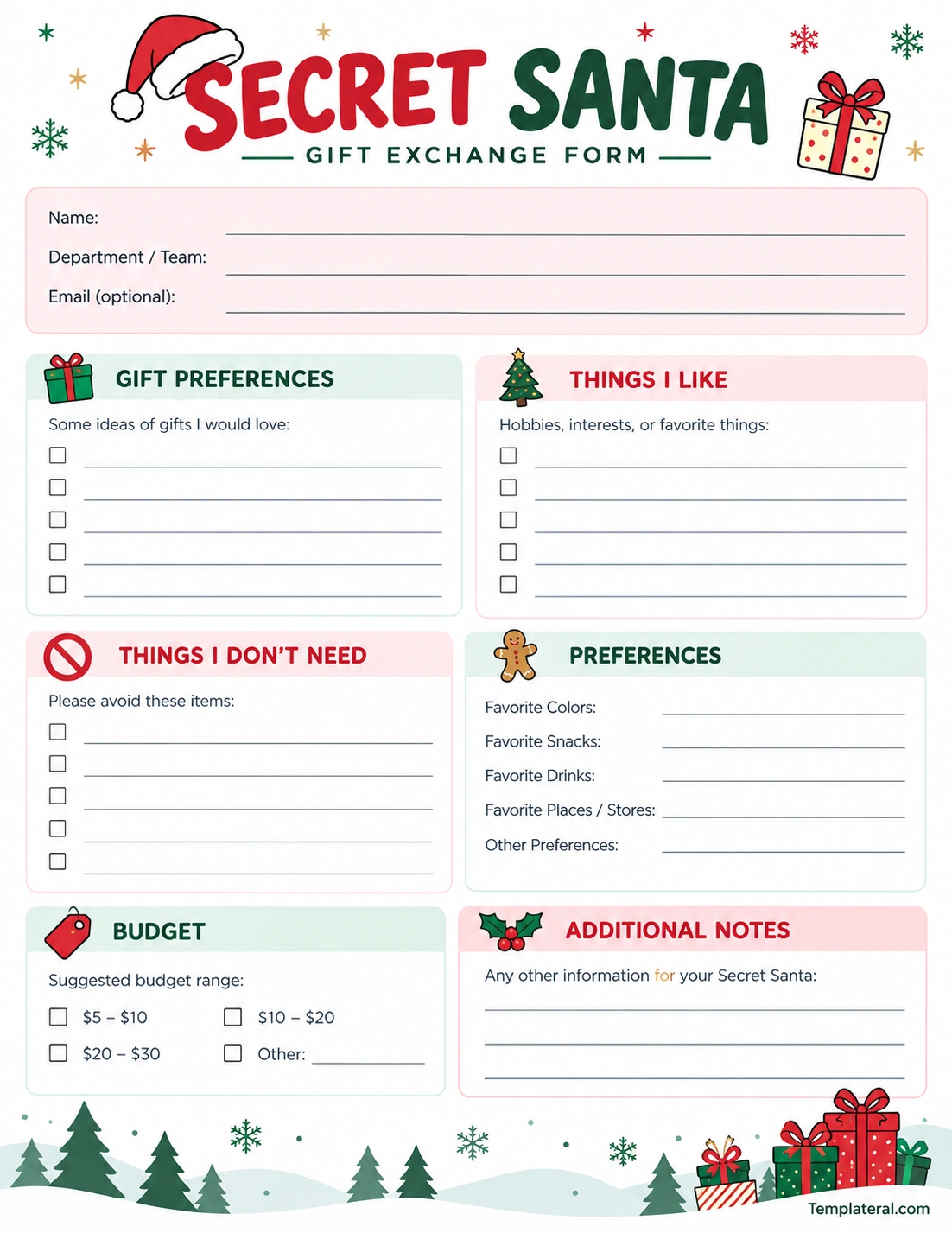
Name and Basic Information
Start with the participant’s name. Depending on the group, you may also include optional information such as a department, team, email address, or classroom.
Keep personal information limited to what is actually needed for the exchange.
Gift Preferences
Give participants several lines where they can list gift ideas or categories they enjoy. Examples might include books, stationery, cooking accessories, hobbies, games, or other appropriate gifts.
Hobbies and Interests
Knowing someone’s hobbies can provide much more useful information than a simple list of preferred products. Someone who enjoys gardening, reading, baking, sports, crafts, or music can give their Secret Santa a direction for choosing a thoughtful gift.
Things to Avoid
A “Things I Don’t Need” or “Please Avoid” section can help prevent unsuitable gifts. Participants can mention categories they do not use, already own, or simply do not prefer.
Favorite Things
Consider including questions about favorite colors, snacks, drinks, stores, hobbies, or other general preferences. These small details can provide useful inspiration.
Budget
If the organizer has established a spending limit, the form can include the agreed budget. A clear budget helps ensure that participants have similar expectations about the exchange.
Additional Notes
Finally, leave a small section for anything else participants think their Secret Santa should know. This can be useful for special preferences or additional gift suggestions.
How to Organize a Secret Santa Exchange
A Secret Santa exchange does not have to be complicated. With a few simple steps, you can create a system that works for a small group or a larger organization.
1. Decide Who Will Participate
Create a final list of participants before assigning Secret Santa partners. Make sure everyone understands that participation is voluntary if the event is not mandatory.
2. Set the Gift Budget
Choose a reasonable spending limit before the exchange begins. A clearly communicated budget helps prevent participants from having very different expectations.
3. Distribute the Forms
Give each participant a Secret Santa questionnaire to complete. Encourage them to provide enough information to be helpful without making their answers so specific that the gift becomes obvious.
4. Assign Each Person
Once everyone has completed the form, randomly assign each participant to another person. The organizer should keep the assignments private if the goal is to maintain the surprise.
5. Share the Relevant Information
Give each gift giver the completed form for the person they were assigned. Be careful not to accidentally reveal the assignments to other participants.
6. Set the Exchange Date
Choose a clear date, location, and time for exchanging gifts. Giving participants plenty of notice makes it easier for everyone to purchase or prepare a gift.
Secret Santa Form Ideas for Different Groups
The questions on a Secret Santa form can be adjusted depending on who is participating.
Secret Santa Form for Work
A workplace form can focus on general hobbies, favorite snacks, colors, interests, and gift ideas. Keep the questions professional and avoid requesting unnecessary personal information.
A work Secret Santa form may include:
- Name and department
- Favorite hobbies
- Favorite snacks or drinks
- Preferred colors
- Gift ideas
- Things to avoid
- Suggested budget
Secret Santa Form for Students
A school or student exchange can use simple questions about favorite activities, games, books, colors, sports, hobbies, and snacks. Keep the form age-appropriate and follow any school rules regarding gift exchanges.
Secret Santa Form for Friends
Friends can use a more casual questionnaire. Questions about favorite entertainment, hobbies, food, collections, or current interests can make the exchange more personal.
Secret Santa Form for Family
Family exchanges can use the form to collect practical gift preferences. This can be especially useful when family members live in different places and may not know each other’s current interests.
Tips for Creating a Better Secret Santa Questionnaire
A good questionnaire should provide useful information without turning the gift exchange into a complicated survey.
- Keep it short: Use only questions that can genuinely help with gift selection.
- Use clear sections: Separate gift ideas, likes, dislikes, and personal preferences.
- Include open-ended questions: Give participants space to add information that the standard questions may miss.
- Include a budget: Make the spending limit clear to everyone.
- Allow optional answers: Participants should not have to answer questions that are not relevant to them.
- Protect privacy: Only share each participant’s information with the person who needs it.
- Keep the form printable: Use a clean layout with enough writing space.
Printable Secret Santa Form vs. Digital Form
Both printable and digital Secret Santa forms can work well. The right choice depends on the group and how the exchange is being organized.
Printable Form
A printable Secret Santa form is convenient for classrooms, office meetings, family gatherings, and in-person events. Participants can complete the worksheet by hand and return it directly to the organizer.
A printed worksheet can also be useful when the exchange is part of a holiday event where participants are already meeting in person.
Digital Form
A digital questionnaire is convenient when participants are remote or when the organizer needs to collect responses from a large group. It can also make sorting and storing responses easier.
For a small in-person group, however, a simple printable form may be all that is necessary.
How to Keep Secret Santa Actually Secret
The surprise is one of the most enjoyable parts of a Secret Santa exchange. The organizer should therefore establish a simple process for protecting assignments and questionnaire responses.
- Keep the assignment list private.
- Give each participant only the information they need.
- Avoid placing participant names and assignments where others can see them.
- Remind participants not to reveal their assigned person.
- Store completed forms securely until the exchange is finished.
- If using digital forms, limit access to the organizer or appropriate participants.
These simple precautions can help preserve the surprise until the gift exchange takes place.
What Makes a Good Secret Santa Gift Preference Form?
A useful Secret Santa form balances structure with flexibility. Participants should have enough prompts to provide useful clues but enough blank space to add their own ideas.
The most useful sections usually cover four areas: what the person likes, what they might want, what they would rather avoid, and any additional information that could help with gift selection.
The form should also be visually easy to scan. Clearly labeled sections, checkboxes, and writing lines make it easier for participants to complete the questionnaire and for gift givers to review the answers later.
Final Thoughts on Secret Santa Forms
A Secret Santa form is a simple tool that can make a holiday gift exchange more organized and enjoyable. By collecting gift ideas, hobbies, favorite things, dislikes, and budget information in advance, participants have useful guidance without removing the surprise.
Whether you are organizing a workplace exchange, classroom activity, family tradition, or gathering with friends, the best form is one that is simple, clear, and easy to complete.
Start with basic participant information, add a few helpful preference questions, include the agreed spending limit, and leave space for additional notes. With a well-organized questionnaire and clear exchange rules, your Secret Santa event can be easier to manage from start to finish.
Download: Secret Santa Form
