An Employment Biography is a professional summary that describes a person’s work history, career experience, education, skills, achievements, and professional goals. It provides readers with a concise overview of someone’s career journey and explains how their experience has contributed to their current professional position.
An employment biography can be useful for job applications, professional portfolios, company websites, employee profiles, speaker introductions, business presentations, and career documents. Unlike a traditional resume, it can present career information in a more narrative and readable format.
A strong employment biography should do more than list previous jobs. It should explain the person’s professional background, highlight relevant accomplishments, and show the skills and experience that make the individual valuable in their field.
What Is an Employment Biography?
An Employment Biography is a written summary of a person’s professional life. It typically combines information about employment history with education, professional skills, achievements, career interests, and future goals.
While a resume usually uses short entries and bullet points to communicate qualifications quickly, an employment biography can provide more context. It can explain how a person’s career developed and how different experiences contributed to their professional growth.
An employment biography may be short enough to fit on a single page or expanded into several paragraphs for a professional website or portfolio. The appropriate length depends on the intended audience and purpose.
Why Is an Employment Biography Important?
A well-written employment biography helps readers understand a professional beyond a list of job titles. It can communicate experience, expertise, accomplishments, and career direction in a more personal format.
An effective employment biography can help you:
- Introduce your professional background
- Summarize your career journey
- Highlight important work experience
- Showcase relevant skills
- Present career achievements
- Explain your professional interests
- Build credibility with employers or clients
- Create a consistent professional profile
It can also be useful when someone needs a quick introduction to your professional experience without reading an entire resume.
What Should Be Included in an Employment Biography?
The content of an employment biography can vary depending on the person’s industry, career level, and purpose. However, several sections provide a strong foundation.
- Full name
- Current profession or job title
- Professional summary
- Education
- Work experience
- Professional skills
- Key achievements
- Certifications or training
- Career goals
- Professional interests
You do not need to include every job or accomplishment. Select information that is relevant to your current career and supports the purpose of the biography.
How to Write an Employment Biography
Writing an employment biography is easier when you organize your career information before drafting the final text. Start with the most important facts and then develop them into a clear professional story.
1. Start With Your Professional Identity
Begin by stating your name and current professional role. A short professional summary can immediately tell readers what you do and what type of experience you have.
For example, a marketing professional might describe themselves as an experienced digital marketing specialist with expertise in content strategy, brand development, and online campaigns.
Keep the opening concise. The purpose is to establish your professional identity rather than provide your entire career history in the first paragraph.
2. Describe Your Education
Education is an important part of many employment biographies. Include degrees, institutions, professional training, certifications, or specialized programs that are relevant to your career.
If your education directly influenced your professional direction, briefly explain that connection. This provides more context than simply listing a degree and school.
3. Summarize Your Work Experience
Work experience is usually the central part of an employment biography. Begin with your current or most recent position and work backward through the most relevant roles.
For each position, consider including:
- Job title
- Company or organization
- Employment period
- Primary responsibilities
- Important projects
- Notable results or accomplishments
Focus on meaningful experience rather than describing every routine responsibility. Readers are generally more interested in the value you created and the skills you developed.
4. Highlight Professional Skills
Identify the skills that are most relevant to your career. These may include technical abilities, communication skills, leadership capabilities, project management, analytical skills, creative skills, or industry-specific expertise.
Whenever possible, connect skills to real professional experience. Instead of simply saying that you have strong project management skills, explain how you used those skills to coordinate projects, meet deadlines, or improve results.
5. Include Key Achievements
Achievements make an employment biography more compelling because they demonstrate the results of your work.
Consider including accomplishments such as:
- Successful projects
- Performance improvements
- Awards or recognition
- Successful product launches
- Revenue or efficiency improvements
- Leadership accomplishments
- Major client or organizational contributions
Whenever appropriate, use measurable results. Numbers can provide useful context and make accomplishments easier to understand.
6. Explain Your Career Goals
A career biography can also describe where you want your professional journey to go next. Your goals might involve developing new expertise, moving into leadership, changing industries, working on larger projects, or contributing to a particular type of organization.
Career goals should be realistic and connected to your existing experience. A clear connection between past achievements and future objectives makes the biography more coherent.
Employment Biography vs. Resume
An employment biography and a resume both communicate professional experience, but they serve different purposes.
A resume is usually designed for quick review. It presents employment history, education, skills, and accomplishments in a structured format that allows employers to identify qualifications quickly.
An employment biography can be more narrative. Instead of simply listing positions, it can explain how a professional developed over time and what experiences shaped their career.
The two documents can complement each other. A resume can provide detailed career information, while an employment biography can offer a more readable professional introduction.
Employment Biography Example
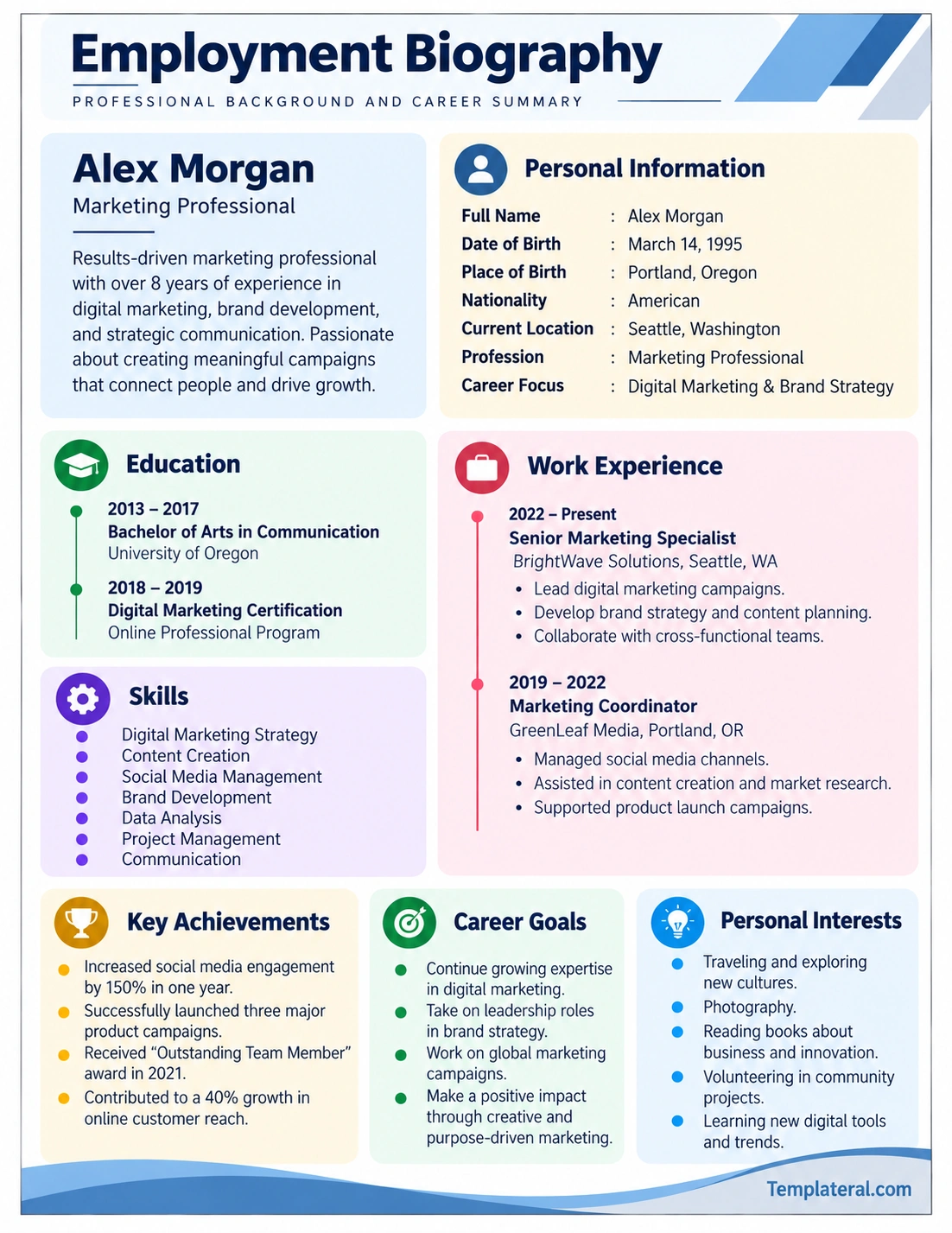
Consider a fictional marketing professional named Alex Morgan. Alex has several years of experience in digital marketing, brand development, content strategy, and strategic communication.
An employment biography might explain that Alex earned a degree in communications before completing additional digital marketing training. Alex began as a marketing coordinator, where responsibilities included social media management, content development, and market research.
After developing additional experience, Alex moved into a senior marketing position and began leading larger campaigns and collaborating with cross-functional teams. Key achievements might include improving social media engagement, supporting successful product launches, and contributing to increased customer reach.
Alex’s career goals could include developing greater expertise in brand strategy, taking on leadership responsibilities, and working on larger international marketing campaigns.
This example demonstrates how an employment biography can connect education, work history, skills, achievements, and future goals into one professional story.
How to Make an Employment Biography More Professional
A professional biography should be clear, specific, and relevant. Avoid filling the page with generic statements that could apply to almost anyone.
Use Specific Language
Replace vague phrases such as “worked on many projects” with specific descriptions of the projects and your contribution to them.
For example, instead of saying that you “helped improve marketing,” explain that you developed a content strategy that increased audience engagement or supported a successful product launch.
Focus on Results
Responsibilities explain what you were expected to do, while achievements explain what you accomplished. Whenever possible, emphasize the results of your work.
Keep the Tone Professional
Use confident but accurate language. Avoid excessive exaggeration or claims that cannot be supported by your actual experience.
Keep Information Relevant
An employment biography should focus primarily on professional information. Personal interests can be included when they add personality or are relevant to the intended audience, but they should not overwhelm the career information.
Employment Biography for Job Seekers
Job seekers can use an employment biography as a supplementary professional document. It can be useful for personal websites, online portfolios, networking materials, professional introductions, or career presentations.
When preparing a biography for employment purposes, focus on experience that relates to the type of position you want. You do not necessarily need to describe every job you have ever held.
For career changes, explain transferable skills and relevant accomplishments. This can help readers understand how previous experience connects to your new professional direction.
Employment Biography for Company Websites
Businesses often publish employee biographies on company websites. These biographies can introduce executives, managers, specialists, consultants, team members, or other professionals.
A company biography may include the person’s current position, professional background, education, areas of expertise, notable achievements, and professional interests.
Keep the tone consistent with the company’s brand. A corporate website may require a formal style, while a creative organization may prefer a warmer and more conversational biography.
Employment Biography for Professional Portfolios
A professional portfolio can use an employment biography as an introduction to the work displayed on the site. The biography gives visitors context before they review projects, case studies, samples, or accomplishments.
For creative professionals, designers, writers, marketers, developers, photographers, and consultants, the biography can connect professional experience with the type of work shown in the portfolio.
Tips for Creating an Effective Employment Biography
- Start with your strongest professional information: Make your current role and expertise clear immediately.
- Prioritize relevant experience: Focus on work that supports your current career direction.
- Use measurable achievements: Include numbers or results when they add meaningful context.
- Show professional growth: Explain how your responsibilities or expertise developed over time.
- Use active language: Choose strong verbs such as managed, developed, created, launched, led, improved, and coordinated.
- Proofread carefully: Check names, dates, job titles, grammar, and spelling.
- Update it regularly: Review your biography when you change positions, gain new skills, or achieve important milestones.
Common Employment Biography Mistakes
Writing It Like a Complete Resume
An employment biography should not simply copy every line from your resume. Select the most meaningful information and connect it into a coherent professional narrative.
Using Too Much Generic Language
Words such as hardworking, motivated, professional, and team player can be useful, but they are stronger when supported by specific examples.
Listing Responsibilities Without Results
Responsibilities tell readers what you did. Achievements show the impact of your work. Try to include both when describing important positions.
Making the Biography Too Long
More information does not automatically create a better biography. Remove outdated or irrelevant details and focus on information that supports your current professional identity.
Failing to Update the Biography
An outdated biography can create inconsistencies between your current career and your professional profile. Review it regularly to keep your information accurate.
Frequently Asked Questions About Employment Biography
What is an Employment Biography?
An Employment Biography is a professional summary describing a person’s career background, work experience, education, skills, achievements, and career goals. It can be used for professional profiles, portfolios, company websites, and career-related documents.
What should an Employment Biography include?
An Employment Biography commonly includes a professional introduction, education, work history, skills, accomplishments, certifications, career goals, and relevant professional interests.
What is the difference between an Employment Biography and a resume?
A resume generally presents career information in a concise, structured format for quick review. An employment biography can provide more narrative context by explaining a person’s professional development, experience, accomplishments, and career direction.
How long should an Employment Biography be?
The ideal length depends on its purpose. A short professional biography may contain several paragraphs, while a detailed employment biography can be longer. The most important consideration is relevance rather than a specific word count.
Can an Employment Biography be used for a job application?
Yes. An employment biography can supplement a resume or application by providing a concise overview of professional experience. However, it should be tailored to the position and should not replace application materials when specific documents are required.
Should an Employment Biography include personal information?
Only include personal information that is relevant and appropriate for the intended audience. Professional biographies should generally prioritize career-related information and avoid unnecessary sensitive or private details.
How often should I update my Employment Biography?
It is useful to review an employment biography whenever you start a new position, gain an important certification, complete a major project, receive an award, or reach another significant career milestone.
Conclusion
An Employment Biography provides a professional and readable way to explain your career journey. By combining your education, work experience, skills, achievements, and career goals, you can create a profile that gives readers a clear understanding of your professional background.
The strongest employment biographies focus on relevant information, use specific examples, highlight meaningful results, and show professional growth. Whether you are a job seeker, business professional, employee, consultant, or portfolio creator, a well-written biography can strengthen the way you present your experience.
Start with your current professional identity, organize your most relevant career experiences, highlight measurable achievements, and finish with your professional goals. Keep the information accurate and updated, and your employment biography can become a useful part of your professional profile.
Download: Employment Biography Template
