A consent form to travel with a minor is a written document used to show that a parent or legal guardian gives permission for a child to travel with another adult. It can be useful when a minor travels with one parent, a relative, a teacher, a coach, or another authorized adult.
Traveling with a child can involve more documentation than traveling alone. Depending on the destination, citizenship, custody situation, and transportation provider, parents or guardians may be asked to provide documents showing the child’s identity and evidence that the accompanying adult has permission to travel with the child.
A properly organized consent letter can make the travel documentation easier to understand. However, a consent form should be treated as supporting documentation rather than a replacement for a passport, visa, custody order, or other documents that may be required for a particular trip.
What Is a Consent Form to Travel With a Minor?
A consent form to travel with a minor is a written authorization from a parent or legal guardian allowing a child to travel with another person. The document generally identifies the child, the person providing consent, the accompanying adult, and the planned travel.
The form may be used for domestic or international travel, depending on the circumstances. International travel can involve additional documentation requirements, so travelers should check the requirements of the destination country and relevant transportation provider before departure.
A typical minor travel consent form may include:
- Child’s full name and date of birth
- Parent or legal guardian information
- Contact information for the consenting parent or guardian
- Accompanying adult’s full name and relationship to the child
- Travel destination
- Departure and return dates
- Purpose of the trip
- Consent and authorization statement
- Parent or legal guardian signature
- Date of signature
Why Might a Minor Travel Consent Form Be Useful?
A written consent document can help clarify the relationship between a child, the accompanying adult, and the parent or guardian who has provided permission.
Provides Written Authorization
The primary purpose of the form is to document that the parent or legal guardian has authorized the planned travel. This can be particularly useful when the child is traveling without one or both parents.
Provides Important Travel Information
A well-organized form can place essential information in one location. Details such as the child’s identity, destination, travel dates, and accompanying adult can be easy to reference when necessary.
Helps Organize Travel Documents
A consent form can be kept together with other travel documents. Depending on the trip, these may include identification documents, passports, visas, custody documents, or other supporting records.
Can Clarify the Accompanying Adult’s Role
When a child travels with someone other than a parent, the form can identify that person and state the scope of the parent’s authorization.
Consent Form to Travel With a Minor Template
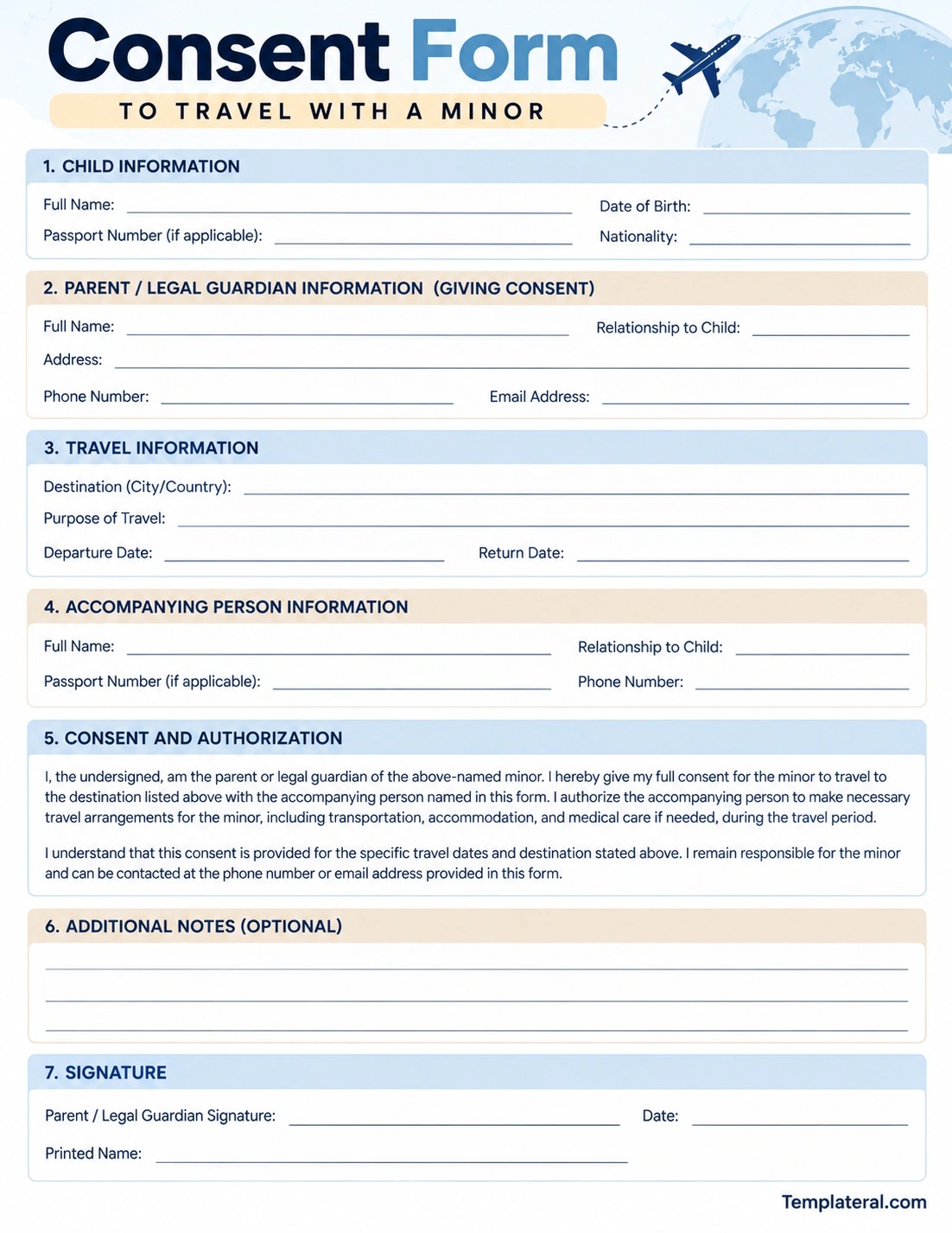
A consent form to travel with a minor template provides a structured starting point for documenting travel authorization. A printable template can make it easier to organize the necessary information before a trip.
The template below includes sections for child information, parent or legal guardian information, travel details, accompanying person information, consent language, additional notes, and a signature.
What Should a Minor Travel Consent Form Include?
The information included in a travel consent form should clearly identify the people involved and describe the intended trip. The exact requirements can vary, so the form should be adapted to the circumstances of the travel.
Child Information
Begin with the child’s identifying information. This commonly includes the child’s full legal name and date of birth. Depending on the circumstances, additional identification information may also be appropriate.
Parent or Legal Guardian Information
The person providing consent should be clearly identified. Include the parent’s or legal guardian’s full name and reliable contact information.
Travel Information
Describe the planned trip as clearly as possible. Useful information may include the destination, purpose of travel, departure date, and expected return date.
Accompanying Adult Information
Identify the adult who will travel with the minor. Include the person’s full name, relationship to the child, and appropriate contact or identification information.
Consent Statement
The authorization section should clearly state that the parent or legal guardian gives permission for the minor to travel with the named accompanying adult. The wording should accurately reflect the permission being granted.
Signature and Date
The parent or legal guardian should sign and date the document according to the applicable requirements. Some situations may require additional formalities, such as notarization or supporting documentation.
How to Fill Out a Consent Form to Travel With a Minor
Completing the form carefully is important because inconsistent names, dates, or travel details can make supporting documentation harder to understand.
1. Enter the Child’s Legal Information
Use the child’s legal name as it appears on relevant identification or travel documents. Check spelling carefully before signing the form.
2. Identify the Parent or Guardian
Enter the full name and contact information of the parent or legal guardian providing consent. If more than one person has legal authority concerning the child, consider whether additional authorization or documentation is appropriate.
3. Add the Travel Details
Enter the destination and planned travel dates. If the trip involves multiple destinations, provide enough information to make the intended itinerary clear.
4. Identify the Accompanying Adult
Enter the full legal name of the person who will accompany the child. Include the relationship to the child and other requested information.
5. Review the Authorization
Read the consent statement carefully. Make sure it accurately describes the permission being given and matches the actual travel arrangements.
6. Sign and Date the Form
Complete the signature section after reviewing all information. Keep the signed document with the child’s other travel documentation.
When Might a Child Travel Consent Letter Be Needed?
The circumstances surrounding the trip can affect whether additional documentation is useful or required.
Child Traveling With One Parent
A child may travel with only one parent while the other parent remains at home. In some circumstances, written consent from the non-traveling parent may be requested or useful, particularly for international travel.
Child Traveling With a Relative
Grandparents, aunts, uncles, and other relatives may sometimes travel with a minor. A written authorization can document that the parent or legal guardian is aware of and has authorized the trip.
Child Traveling With a School or Sports Group
School trips, competitions, camps, and youth activities may involve travel with teachers, coaches, or other responsible adults. Organizations may have their own permission forms and documentation requirements.
Child Traveling With a Family Friend
When a child travels with a family friend or another adult who is not a parent, clearly identifying the accompanying person in the authorization can help explain the travel arrangement.
Domestic and International Travel Considerations
The documentation needed for a minor can depend on where the child is traveling. Domestic travel and international travel should not automatically be treated as having the same requirements.
For international trips, travelers should check the current requirements of the destination country, the country of departure, and the relevant airline or transportation provider. Border authorities may have their own documentation requirements, and these requirements can change.
A consent form should therefore be considered one part of a broader travel-documentation checklist rather than a universal travel document.
Should a Minor Travel Consent Form Be Notarized?
Whether notarization is appropriate or required depends on the circumstances and the requirements of the relevant authorities or organizations.
Some travelers may choose to have a signature notarized as an additional formality, while other situations may not require notarization. Do not assume that notarization is always mandatory or that it automatically satisfies every country’s requirements.
Before traveling, verify the current documentation requirements with the appropriate government authority, embassy or consulate, border authority, airline, or other relevant organization.
Supporting Documents to Consider
A consent letter is generally not a substitute for the child’s required travel identification. Depending on the trip, additional documents may be relevant.
- Passport or other accepted travel identification
- Visa or entry authorization, when applicable
- Birth certificate or other proof of relationship, when appropriate
- Custody or guardianship documents, when applicable
- Copies of relevant parent or guardian identification
- Travel itinerary or booking information
- Additional documentation requested by the destination or carrier
The appropriate documents depend on the individual circumstances. Travelers should verify requirements before departure rather than relying solely on a general template.
Tips for Preparing a Minor Travel Consent Form
A few simple preparation steps can make the document easier to use and review.
- Use legal names: Make sure names are consistent with the child’s and adults’ identification documents.
- Check all dates: Confirm that departure and return dates match the actual travel plans.
- Describe the destination clearly: Include enough information to identify where the child is traveling.
- Use reliable contact information: Provide a phone number or email address where the consenting parent or guardian can be reached.
- Keep copies: Consider keeping copies of the completed form and relevant supporting documents.
- Check current requirements: Verify documentation requirements before the trip, especially for international travel.
- Review the form before signing: Check names, dates, destinations, and authorization language for accuracy.
Common Mistakes to Avoid
Small errors can make an important document less useful. Review the form carefully before it is signed.
Using Inconsistent Names
Avoid nicknames or informal versions of names when official documents use a different legal name. Consistency can make identification easier.
Leaving Travel Dates Unclear
When the authorization relates to a specific trip, clearly state the planned travel period where appropriate.
Forgetting Contact Information
Include reliable contact information for the parent or guardian providing consent so that the person can be reached if necessary.
Assuming One Form Works Everywhere
Requirements can differ depending on the country, destination, custody circumstances, and transportation provider. A generic template should not be assumed to satisfy every requirement.
Waiting Until the Day of Travel
Preparing documentation at the last minute can make it difficult to address unexpected requirements. Review the documentation well before departure.
How to Use a Printable Consent Form
A printable consent form can be completed by hand after printing or prepared digitally before printing, depending on the format and requirements of the organization or authority that will review it.
After completing the form, review every section carefully. Keep the signed original or appropriate copy with the person responsible for the child during the trip, and retain another copy when practical.
If the trip involves international borders, additional legal or custody considerations, or unusual circumstances, obtain guidance from the appropriate official authority or qualified legal professional.
Important Note About Travel Consent Forms
A consent form is a general documentation tool and should not be treated as legal advice. Requirements for minors traveling across borders can vary significantly based on nationality, destination, custody arrangements, and other circumstances.
Before using a template for an actual trip, verify the current requirements with the relevant government authority, embassy or consulate, border agency, airline, or other transportation provider. If there is a custody dispute or another complicated legal circumstance, professional legal advice may be appropriate.
Final Thoughts
A consent form to travel with a minor can provide a clear written record that a parent or legal guardian has authorized a child’s planned travel with another adult. A well-organized form can identify the child, consenting parent or guardian, accompanying adult, destination, travel dates, and authorization details.
Using a printable consent form template can make the preparation process more organized, but the template should always be reviewed against the requirements that apply to the specific trip. In particular, international travel may involve additional documentation that cannot be covered by a generic form.
Prepare the document carefully, check all information for accuracy, gather the child’s other required travel documents, and verify current requirements before departure. This approach helps ensure that the consent form is used as appropriate supporting documentation rather than as a substitute for required travel or legal documents.
Download: Consent Form to Travel With a Minor
