A Lean Business Canvas is a practical one-page business planning tool that helps entrepreneurs turn business ideas into clear, actionable plans. Instead of writing a lengthy business plan, you can use this simple framework to identify customer problems, develop solutions, define your value proposition, and understand how your business will generate revenue.
Created by Ash Maurya in 2010, the Lean Canvas was adapted from Alexander Osterwalder’s traditional Business Model Canvas. It was designed specifically for startups and entrepreneurs who need a faster way to evaluate business opportunities, test assumptions, and reduce the risks of launching a new product or service.
Whether you are starting a small business, developing a startup, or exploring a new product idea, a Lean Business Canvas gives you a structured overview of the most important parts of your business model. In this guide, you will learn how the framework works, understand its nine building blocks, and discover how to complete your own canvas using a printable template.
What Is a Lean Business Canvas?
A Lean Business Canvas is a one-page business planning framework that organizes important business information into nine interconnected sections. These sections help entrepreneurs understand their target customers, identify market problems, develop solutions, and evaluate the financial and operational aspects of a business idea.
Unlike a traditional business plan, which may require dozens of pages, the Lean Canvas keeps everything on a single worksheet. This makes it easier to review, update, and communicate your business strategy.
The framework is particularly useful for early-stage businesses because it encourages entrepreneurs to focus on their most important assumptions before investing significant time and money in product development.
Rather than assuming that a business idea will succeed, you can use the canvas to identify what needs to be tested and validated with real customers.
The 9 Building Blocks of the Lean Business Canvas
The Lean Canvas consists of nine sections. Each block represents an essential part of your business model and helps you examine whether your idea has the potential to become a sustainable business.
1. Problem
The Problem block identifies the most important challenges your target customers experience. A successful business often begins by solving a problem that people genuinely want addressed.
Start by listing the top three problems your potential customers face. Focus on problems that are frequent, frustrating, expensive, or difficult to solve with existing alternatives.
For example, a meal-planning startup might identify these problems:
- Busy professionals do not have enough time to plan daily meals.
- People struggle to find affordable and healthy recipes.
- Grocery shopping becomes inefficient without a clear shopping list.
Understanding these problems gives you a foundation for developing a relevant product or service.
2. Customer Segments
The Customer Segments block defines the specific groups of people or businesses you want to serve. Instead of targeting everyone, identify the customers who are most likely to experience the problems you want to solve.
Consider factors such as age, occupation, interests, location, purchasing behavior, and business size when relevant.
For example, a meal-planning application might target busy working professionals, young families, and health-conscious individuals.
You can also identify early adopters. These are customers who are especially interested in your solution and may be willing to try an early version of your product.
3. Unique Value Proposition
The Unique Value Proposition explains why customers should choose your product or service instead of competing alternatives.
It should communicate the main benefit your business provides in a clear and compelling way. Avoid vague statements that could describe almost any company.
For example, a meal-planning service might use the following value proposition:
“Plan healthy weekly meals in minutes with affordable recipes and automatic grocery lists.”
A strong value proposition connects your solution directly to the problems your customers want to solve.
4. Solution
The Solution block describes the main features or services you will provide to address the problems identified earlier.
At the beginning, focus on the simplest possible solution rather than designing a product with too many features. This approach helps you avoid spending resources on functionality that customers may not need.
For example, a basic meal-planning application could include:
- Weekly meal-planning tools.
- A searchable recipe collection.
- Automatic grocery shopping lists.
These features provide a starting point for testing whether customers find the proposed solution useful.
5. Channels
The Channels block explains how your business will reach potential customers and deliver its products or services.
Think about where your target audience spends time and which communication channels are most appropriate for reaching them.
Common business channels include:
- Search engines and organic SEO.
- Social media platforms.
- Email marketing and newsletters.
- Content marketing and blogs.
- Online marketplaces.
- Partnerships and referrals.
Choose channels based on your customers’ habits rather than trying to use every available marketing platform.
6. Revenue Streams
The Revenue Streams block identifies how your business will earn money. It helps you understand how customers will pay for the value you provide.
Depending on your business model, potential revenue streams may include:
- One-time product purchases.
- Monthly or annual subscriptions.
- Service fees and consulting charges.
- Licensing and royalties.
- Commission-based income.
- Advertising revenue.
For example, a meal-planning application could generate revenue through premium subscriptions or paid access to additional features.
Consider your customers’ willingness to pay when selecting a pricing model. A revenue idea is only useful if customers are willing to spend money on your solution.
7. Cost Structure
The Cost Structure block outlines the major expenses required to build, operate, and grow your business.
Identifying these costs helps you understand how much money you need to launch and maintain your operations.
Typical business expenses include:
- Product development and maintenance.
- Website hosting and software subscriptions.
- Marketing and advertising.
- Employee salaries and contractor fees.
- Equipment and office expenses.
- Customer support and operational costs.
Include both fixed and variable expenses where appropriate. This will help you evaluate whether your expected revenue can support the business over time.
8. Key Metrics
The Key Metrics block identifies the numbers you will monitor to measure business performance.
Instead of tracking every available statistic, focus on measurements that show whether your business is making progress toward its main objectives.
Depending on your business model, useful metrics may include:
- Number of new customers.
- Monthly recurring revenue.
- Customer acquisition cost.
- Customer retention rate.
- Conversion rate.
- Monthly active users.
For example, a subscription-based application might monitor new subscriptions, monthly recurring revenue, and customer churn.
Choose metrics that help you make better business decisions rather than simply collecting numbers.
9. Unfair Advantage
The Unfair Advantage block identifies something that gives your business a meaningful competitive edge and is difficult for competitors to copy or purchase.
Examples may include:
- Exclusive partnerships or distribution agreements.
- Proprietary technology or intellectual property.
- A strong and trusted community.
- Unique industry knowledge or expertise.
- Exclusive access to valuable resources.
Not every new business has an unfair advantage immediately. If you cannot identify one yet, leave the section open and revisit it as your business develops.
Lean Business Canvas vs. Business Model Canvas
The Lean Business Canvas and Business Model Canvas are both one-page strategic planning tools. However, they have different areas of emphasis.
The Business Model Canvas, developed by Alexander Osterwalder and Yves Pigneur, provides a broader view of how a business creates, delivers, and captures value. Ash Maurya adapted this framework into Lean Canvas to place greater emphasis on startup risks, customer problems, and solutions.
Here are the main differences:
- Primary focus: Lean Canvas emphasizes problems, solutions, and startup assumptions, while Business Model Canvas focuses on the overall business model.
- Key partnerships: Business Model Canvas includes Key Partnerships, while Lean Canvas replaces this block with Problem.
- Customer relationships: Business Model Canvas includes Customer Relationships, while Lean Canvas introduces Unfair Advantage.
- Startup validation: Lean Canvas is particularly useful for testing early-stage business ideas and identifying market risks.
- Business planning: Business Model Canvas provides a broader framework for analyzing established business models and organizational activities.
Neither framework is universally better. The right choice depends on your planning objectives and the stage of your business.
Free Lean Business Canvas Printable Template
If you want to organize your business idea without creating a worksheet from scratch, a printable Lean Business Canvas template can make the process much easier.
A ready-made canvas provides nine clearly labeled sections where you can write down your business assumptions, customer problems, proposed solutions, marketing channels, and financial considerations.
The template below features a clean, modern layout with a professional design. It includes dedicated spaces for all nine Lean Canvas building blocks, making it suitable for entrepreneurs, startup founders, students, and small business owners.
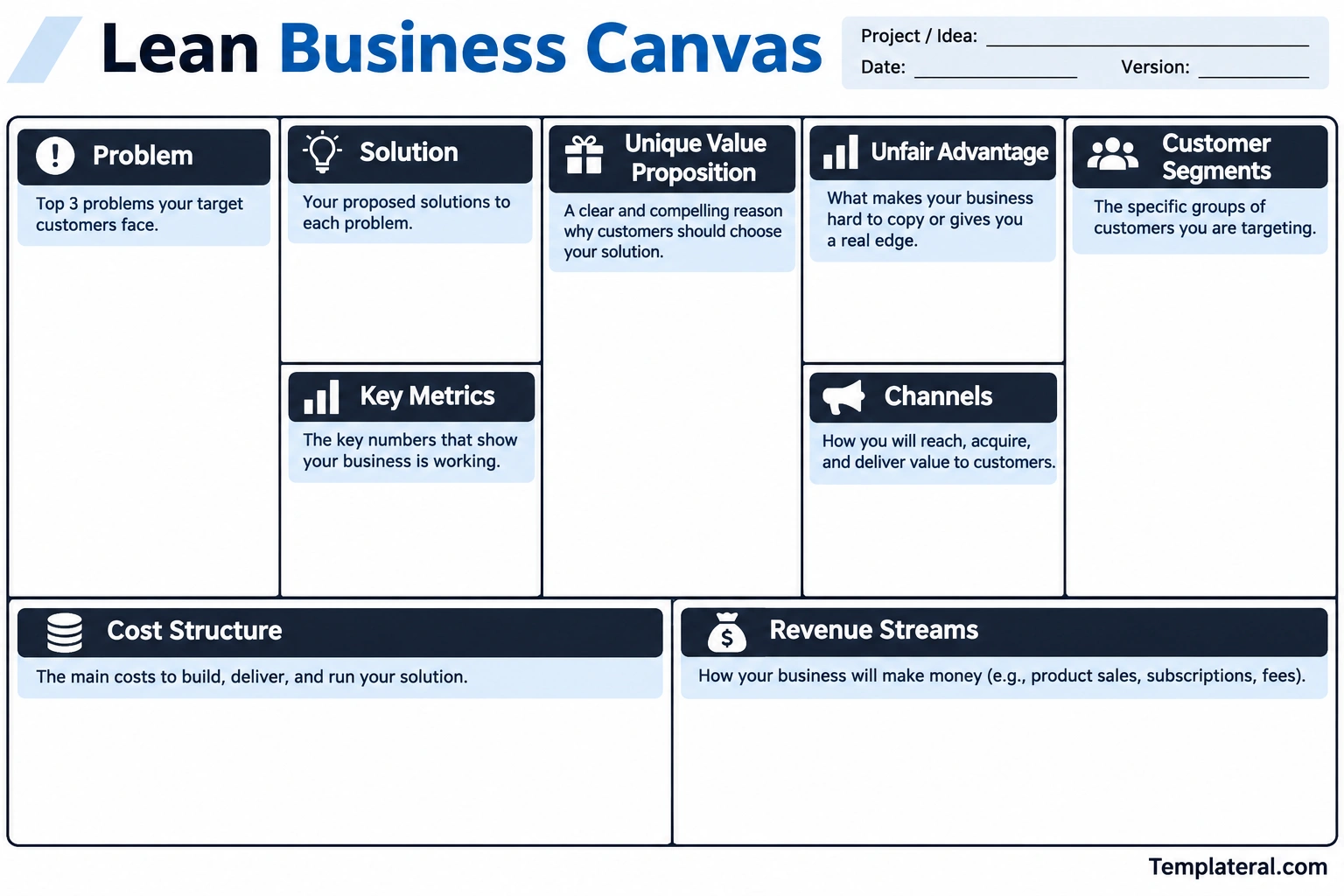
You can print the worksheet and complete each section by hand or use its layout as a reference when creating a digital business planning document.
How to Fill Out a Lean Business Canvas
Completing a Lean Canvas does not require advanced business planning experience. The key is to keep your answers simple, specific, and based on what you currently know about your customers and market.
Step 1: Start with the Customer Problem
Identify the main problems your target customers experience. Research customer feedback, conduct interviews, and examine existing alternatives before making assumptions.
Step 2: Define Your Customer Segments
Describe the people or businesses most likely to experience those problems. Be specific about your initial target audience rather than trying to serve everyone.
Step 3: Develop Your Value Proposition
Write one clear statement explaining why your product or service matters. Focus on the most important benefit customers will receive.
Step 4: Outline Your Solution
List the essential features or services that address the problems you identified. Keep the initial solution simple and avoid unnecessary complexity.
Step 5: Identify Your Channels
Choose practical ways to reach your target customers. Consider organic search, social media, email marketing, partnerships, and direct sales.
Step 6: Estimate Revenue and Costs
Identify how your business will generate income and list the major expenses required to operate it. Use realistic estimates and update them as you collect more information.
Step 7: Select Your Key Metrics
Choose a small number of meaningful measurements that will help you evaluate customer acquisition, engagement, retention, and financial performance.
Step 8: Identify Your Unfair Advantage
Consider what makes your business difficult to imitate. If you do not have a clear advantage yet, identify opportunities to develop one over time.
Step 9: Test and Update Your Assumptions
Your first Lean Canvas is a starting point, not a final business plan. Test your assumptions with potential customers, analyze the results, and update the worksheet whenever you learn something important.
When Should You Use a Lean Business Canvas?
The Lean Canvas is particularly useful when you need to evaluate a business idea quickly or make important decisions before investing in a full product or service.
Consider using it in these situations:
- Starting a new business: Organize your initial idea and identify the most important business assumptions.
- Launching a startup: Evaluate customer problems, potential solutions, and market opportunities.
- Developing a new product: Understand who the product serves and what makes it valuable.
- Planning a side business: Explore whether a small business idea has realistic revenue potential.
- Evaluating a business opportunity: Compare different ideas before committing resources.
- Working with a team: Create a shared overview of business priorities and strategic assumptions.
Common Mistakes to Avoid When Using Lean Canvas
Although the Lean Canvas is simple, entrepreneurs can make several mistakes when completing it. Avoiding these problems will help you create a more useful business planning document.
Making Assumptions Without Customer Research
Do not assume that customers have a problem simply because you think they do. Speak with potential customers, review existing solutions, and gather evidence before making important decisions.
Targeting Too Many Customer Segments
Trying to serve everyone can make your product positioning and marketing strategy unclear. Begin with a specific customer group and expand when you understand its needs.
Listing Too Many Product Features
A long list of features can distract you from solving the main customer problem. Prioritize the smallest useful solution and improve it based on customer feedback.
Ignoring Business Costs
A business idea may attract customers but still struggle financially if operating expenses are too high. Estimate your costs carefully and review them regularly.
Treating the Canvas as a One-Time Exercise
Your business assumptions will change as you learn more about customers and competitors. Review your Lean Canvas regularly and update sections when new evidence becomes available.
Frequently Asked Questions About Lean Business Canvas
What is a Lean Business Canvas used for?
A Lean Business Canvas is used to summarize and evaluate a business idea on one page. It helps entrepreneurs identify customer problems, define solutions, understand revenue opportunities, and test important business assumptions.
Who created the Lean Business Canvas?
The Lean Canvas was created by Ash Maurya in 2010. It was adapted from Alexander Osterwalder’s Business Model Canvas to better address the needs of startups and early-stage entrepreneurs.
How many sections are in a Lean Canvas?
A Lean Canvas contains nine building blocks: Problem, Customer Segments, Unique Value Proposition, Solution, Channels, Revenue Streams, Cost Structure, Key Metrics, and Unfair Advantage.
Is Lean Canvas the same as Business Model Canvas?
No. Both frameworks use nine sections to describe a business model, but they have different purposes. Lean Canvas emphasizes customer problems, solutions, and startup risks, while Business Model Canvas focuses on the broader structure of how a business creates and delivers value.
Can I use Lean Canvas for a small business?
Yes. The Lean Canvas is useful for small businesses, startups, freelancers, online businesses, and entrepreneurs exploring new opportunities. It can help organize an idea before developing a more detailed business plan.
Can I use Lean Canvas for an existing business?
Yes. Existing businesses can use Lean Canvas to evaluate new products, explore additional customer segments, improve their business model, or test new revenue opportunities.
What is the difference between Lean Canvas and a traditional business plan?
A traditional business plan is usually a detailed document covering market research, operations, financial projections, and business strategy. Lean Canvas is a shorter, one-page framework designed to summarize key assumptions and encourage faster business model testing.
Is there a free Lean Business Canvas template?
Yes. You can use a printable Lean Business Canvas template to organize all nine sections of your business model. A printable worksheet is especially useful for brainstorming, business planning sessions, and startup discussions.
Should I complete all nine Lean Canvas sections at once?
You can complete an initial version in one sitting, but you do not need to have every answer immediately. Start with your strongest assumptions, identify information gaps, and update the canvas as you gather more evidence.
Turn Your Business Idea into a Clear Plan
A Lean Business Canvas provides a simple and effective way to organize business ideas, understand customer needs, and evaluate whether a product or service has the potential to succeed.
By working through its nine building blocks, you can identify important business assumptions, explore revenue opportunities, estimate operating costs, and develop a clearer strategy before committing significant resources.
Whether you are launching a startup, developing a new product, or planning a small business, a printable Lean Business Canvas template can help you turn scattered ideas into a structured business model.
Start with one page, focus on your customers’ real problems, and keep improving your canvas as you learn more about the market. A strong business model begins with understanding what customers need and finding a practical way to deliver that value.
Download: Lean Business Canvas Template
