A Student Biography is a short written profile that introduces a student by describing important information about their background, education, interests, achievements, personality, and future goals. It can be used for school assignments, student portfolios, classroom introductions, yearbooks, presentations, scholarship applications, and other educational activities.
Writing a student biography gives students an opportunity to think about who they are, what they have accomplished, what they enjoy learning, and what they hope to achieve in the future. It can also help teachers and classmates learn more about a student’s interests and experiences.
A good student biography does not need to be complicated. With a clear structure and relevant details, students can create a profile that is informative, personal, and easy to read.
What Is a Student Biography?
A Student Biography is a written introduction that provides information about a student’s life, school experience, interests, accomplishments, and aspirations. It can be as short as a few sentences or developed into several paragraphs depending on the assignment.
A student biography is different from a simple list of school information. Instead of only stating a student’s grade and school, it can explain their personality, favorite subjects, activities, accomplishments, and plans for the future.
The purpose is to give readers a meaningful introduction to the student while keeping the information appropriate for the intended audience.
Why Write a Student Biography?
Writing a biography can be a valuable learning activity for students. It encourages them to reflect on their experiences and practice organizing information into a logical structure.
A student biography can help students:
- Introduce themselves to classmates and teachers
- Practice writing skills
- Reflect on personal experiences
- Recognize academic and extracurricular achievements
- Identify interests and strengths
- Think about future goals
- Create material for a student portfolio
- Prepare for scholarship or application writing
For teachers, biographies can also provide a simple way to learn more about students’ interests, backgrounds, and aspirations.
What Should Be Included in a Student Biography?
The exact content depends on the student’s age and the purpose of the assignment. However, several sections can provide a useful foundation.
- Student’s name
- Age or grade level
- School
- Hometown or general background
- Personal introduction
- Educational experience
- Favorite subjects
- Interests and hobbies
- Extracurricular activities
- Achievements
- Skills and strengths
- Future goals
You do not need to include every category in every biography. Choose information that is relevant to the assignment and appropriate for the student’s age.
How to Write a Student Biography
A student biography becomes easier to write when you organize the information before turning it into paragraphs. Start with basic facts and then add details that show the student’s personality, interests, accomplishments, and goals.
1. Introduce Yourself
Begin with your name and a short introduction. You can mention your grade level, school, hometown, or an interesting fact about yourself.
For example, a student might write that they are a ninth-grade student who enjoys creative projects, technology, and learning about different cultures.
The opening should give readers a quick understanding of who you are without including too many details.
2. Describe Your Education
Education is an important part of a student biography. Include your current school and grade level. Depending on the assignment, you can also mention previous schools, favorite classes, special programs, clubs, or educational activities.
Consider explaining which subjects you enjoy and why. A simple explanation can make the biography more personal.
3. Talk About Your Interests and Hobbies
Interests and hobbies help readers learn about your personality outside the classroom. You might enjoy sports, reading, music, drawing, gaming, technology, cooking, science, volunteering, or other activities.
Instead of simply listing hobbies, consider explaining what you enjoy about them. This gives the reader a better sense of your personality.
4. Include Your Achievements
Achievements can include academic awards, sports accomplishments, creative projects, volunteer activities, competitions, leadership roles, or completed courses.
Not every achievement needs to be a major award. Completing a challenging project, helping a community organization, joining a school team, or learning a new skill can also be meaningful accomplishments.
5. Describe Your Strengths
Think about qualities that help you succeed at school or in other activities. Your strengths might include creativity, organization, persistence, teamwork, communication, curiosity, leadership, problem-solving, or time management.
Try to support your strengths with examples. For instance, instead of simply saying that you are organized, explain how you use a study schedule to manage assignments and extracurricular activities.
6. Share Your Future Goals
Future goals are an important part of many student biographies. You can describe what you hope to study, what career you might pursue, or what personal skills you want to develop.
Your goals do not have to be completely decided. Students can have several interests and change their plans as they learn more about themselves.
Student Biography Example
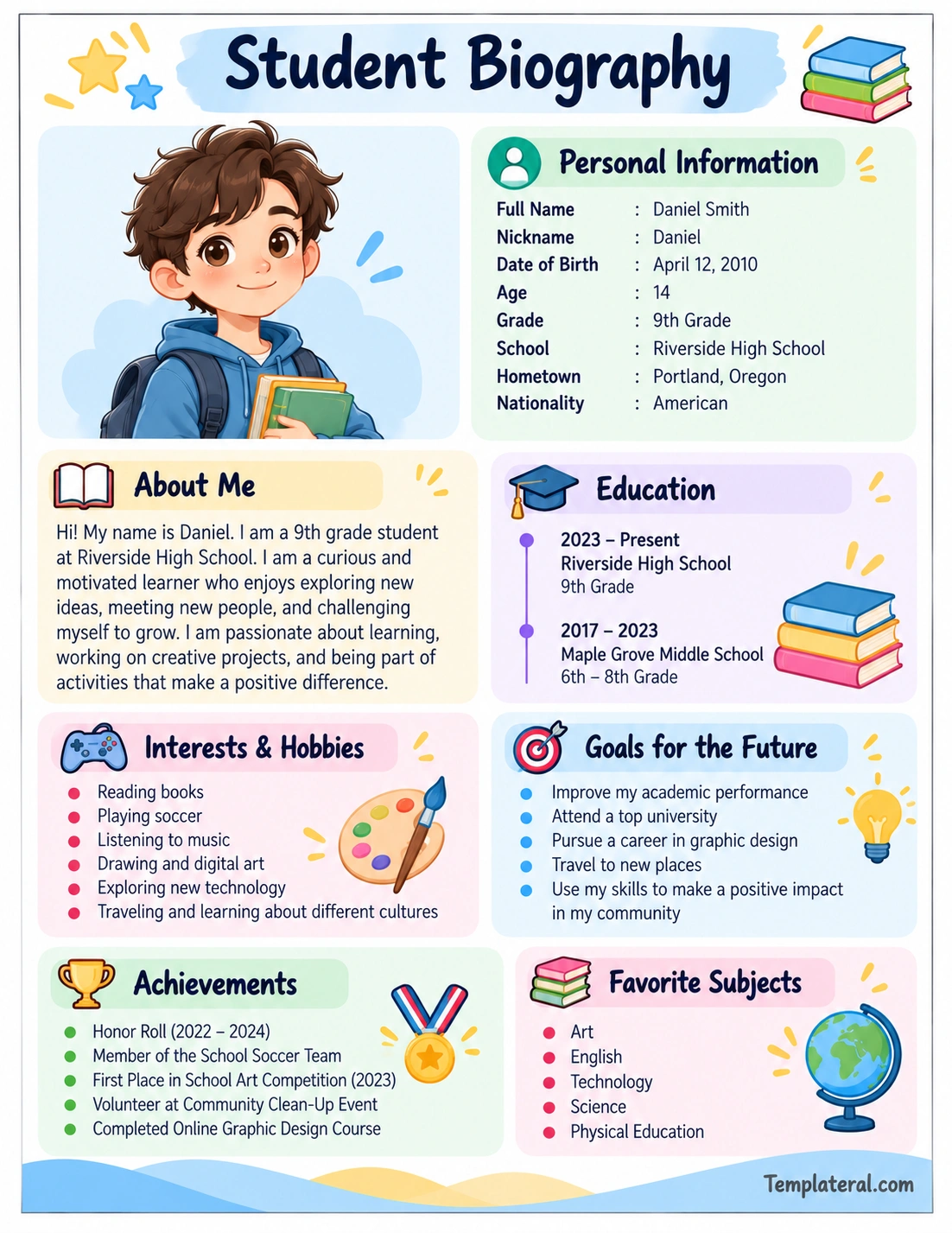
Consider a fictional student named Daniel Smith. Daniel is a ninth-grade student who enjoys learning, creative projects, technology, and sports.
His biography might explain that he is a curious and motivated student who enjoys exploring new ideas and challenging himself. He attends Riverside High School and has developed an interest in art, technology, English, and science.
Outside the classroom, Daniel enjoys reading, playing soccer, listening to music, drawing, and exploring new technology. He has also participated in school activities and community projects.
Daniel’s future goals include improving his academic performance, attending a good university, exploring graphic design as a career, and using his skills to contribute to his community.
This example demonstrates how personal information, education, interests, achievements, and goals can be combined into a complete student profile.
Student Biography for School Assignments
A student biography is often used as a classroom writing assignment. Teachers may ask students to introduce themselves through a short biography at the beginning of a school year or during a language arts activity.
Students can start by answering simple questions before writing the final paragraphs:
- What is my name?
- What grade am I in?
- What school do I attend?
- What subjects do I enjoy?
- What are my hobbies?
- What activities do I participate in?
- What have I accomplished?
- What are my strengths?
- What are my goals?
Once the questions are answered, students can organize their responses into a beginning, middle, and conclusion.
Student Biography for a Portfolio
A student portfolio can include a biography as an introduction to the student’s work. The biography can help teachers, parents, admissions staff, or other readers understand the person behind the assignments and projects.
For a portfolio, focus on academic interests, important projects, accomplishments, extracurricular activities, skills, and future plans.
The biography can be updated as the student progresses through school. New achievements, courses, interests, and goals can be added over time.
Student Biography for a Scholarship Application
Some scholarship applications require students to provide personal information, achievements, academic interests, community involvement, or future plans. A well-organized student biography can help students prepare for these types of applications.
When writing for a scholarship, focus on experiences that demonstrate effort, leadership, community involvement, academic interest, or personal growth.
Use specific examples instead of relying on general statements. Explain what you accomplished, what you learned, and how the experience influenced your goals.
Student Biography for a Yearbook
A yearbook biography can be shorter and more personal than a formal student profile. Students may include their name, grade, favorite subjects, hobbies, memorable school experiences, activities, and future plans.
Because a yearbook is often read by classmates, the writing can have a friendly and positive tone while remaining appropriate for a school publication.
First Person or Third Person?
Most student biographies are naturally written in the first person because students are describing themselves. First-person writing uses words such as I, my, and me.
For example, a student might write, “I enjoy science because I like discovering how things work.”
Third-person writing uses the student’s name and pronouns such as he, she, or they. This style may be appropriate when a teacher, school, or organization is writing the biography on behalf of the student.
Either style can work. The important thing is to follow the instructions for the assignment and remain consistent throughout the biography.
Tips for Writing a Better Student Biography
- Start with simple facts: Begin with your name, grade, school, and basic background.
- Show your personality: Include interests, hobbies, and qualities that make you unique.
- Use specific examples: Explain achievements and experiences rather than simply listing them.
- Keep it organized: Move logically from your introduction to education, interests, achievements, and goals.
- Be honest: Write about real experiences and accomplishments.
- Use age-appropriate language: Choose words and sentence structures that match the assignment and audience.
- Proofread your work: Check spelling, grammar, punctuation, names, and dates.
- Keep private information private: Avoid sharing sensitive information that is not necessary for the assignment.
Common Student Biography Mistakes
Including Too Many Unrelated Details
A biography should provide useful information about the student. Avoid filling the page with details that do not help the reader understand your background, interests, achievements, or goals.
Only Listing Facts
A strong biography is more than a collection of facts. Add short explanations that show why a subject, hobby, achievement, or goal matters to you.
Using Generic Statements
Statements such as “I am a good student” are more effective when supported by examples. Explain how you demonstrate responsibility, curiosity, persistence, or another personal quality.
Forgetting the Audience
A biography written for a teacher may have different requirements from one written for a scholarship, portfolio, or yearbook. Always consider who will read the biography.
Not Proofreading
Spelling and grammar mistakes can distract readers from your ideas. Always review the final version before submitting or publishing it.
Frequently Asked Questions About Student Biography
What is a Student Biography?
A Student Biography is a written profile that introduces a student and describes relevant information such as their education, interests, hobbies, achievements, strengths, and future goals.
How long should a Student Biography be?
The length depends on the assignment. A short student biography may contain one or two paragraphs, while a detailed profile or portfolio biography can be longer. Focus on meaningful information rather than trying to reach a specific word count.
What should I include in a Student Biography?
Common information includes your name, grade, school, educational interests, hobbies, activities, achievements, strengths, and future goals. Choose details that are relevant to the purpose of the biography.
Should a Student Biography be written in first person?
Usually, yes. First-person writing is natural when students are introducing themselves. However, third-person writing can also be used when a teacher or organization is writing the profile.
Can a Student Biography be used in a portfolio?
Yes. A student biography can provide an introduction to a portfolio and help readers understand the student’s academic interests, accomplishments, activities, and future goals.
Can students use a Student Biography template?
Yes. A template can help students organize their ideas before writing the final biography. It can provide useful categories such as personal information, education, interests, achievements, and goals.
What is the difference between a Student Biography and an autobiography?
A student biography is a profile describing a student’s life and experiences. An autobiography is a broader account of a person’s life written by that person. A student biography is often shorter and focused on information relevant to school or personal introduction.
Conclusion
A Student Biography is a useful way for students to introduce themselves while reflecting on their education, interests, accomplishments, strengths, and future goals. It can be used for classroom assignments, portfolios, yearbooks, scholarship preparation, and many other educational purposes.
The best student biographies are clear, organized, personal, and relevant to their audience. Start with basic information, describe your educational experience, share your interests and achievements, and finish by explaining your goals for the future.
Most importantly, use the biography as an opportunity to tell your story. Specific experiences and genuine interests will make the writing more meaningful than a simple list of facts.
Download: Student Biography Template
