A baseball scorekeeping sheet is a useful tool for recording everything that happens during a baseball game. It provides a structured way to track players, innings, hits, runs, outs, and other important details throughout the game. Whether you are a coach, parent, player, student, or volunteer scorekeeper, having a clear score sheet can make keeping track of a game much easier.
Baseball scorekeeping can seem complicated when you first see all the boxes, symbols, and abbreviations used on a traditional scorecard. However, the basic process becomes easier once you understand what each section represents and how to record common plays.
A printable baseball scorekeeping sheet gives you a convenient place to organize the information before, during, and after a game. It can also serve as a useful reference for reviewing player performance and the final result.
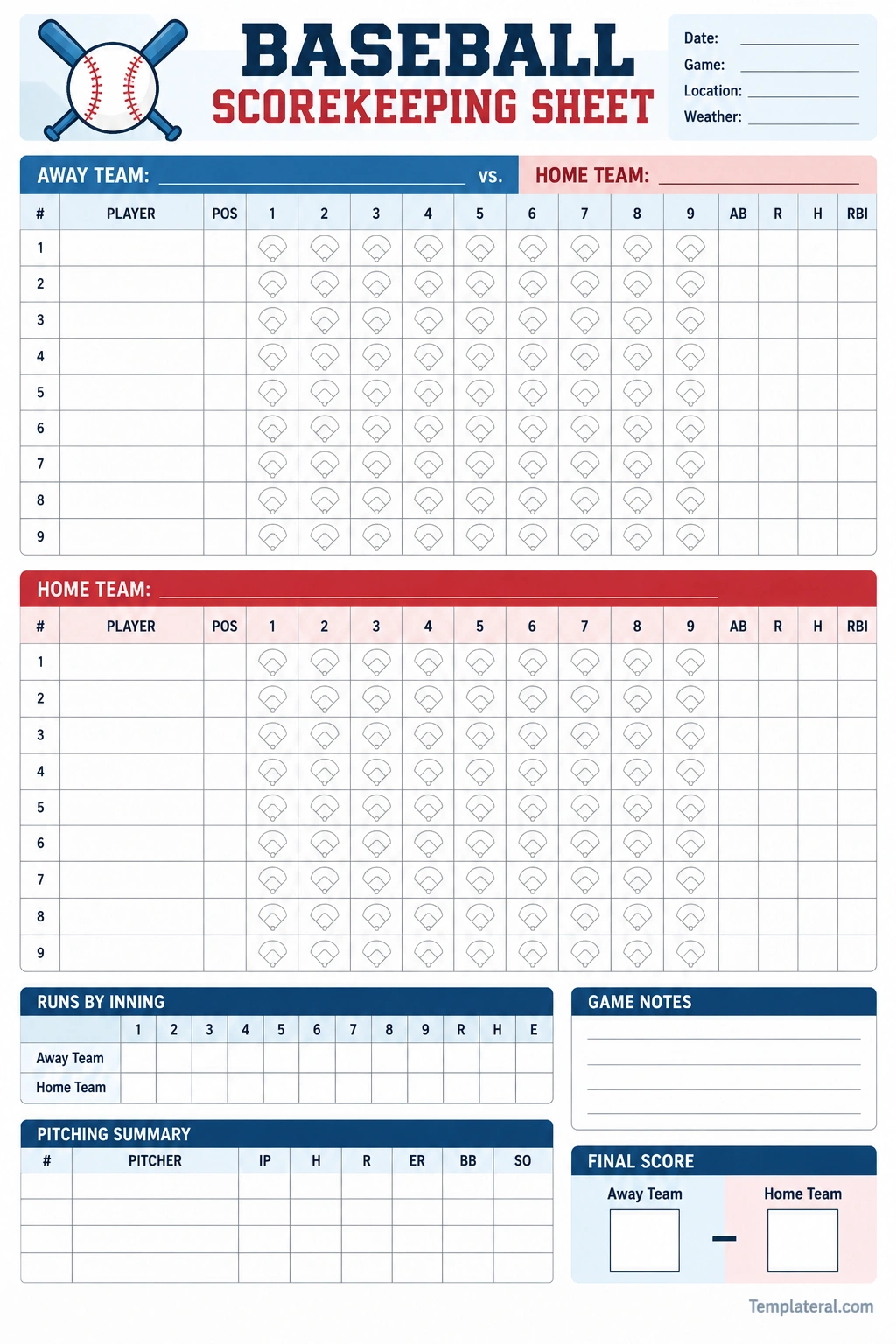
What Is a Baseball Scorekeeping Sheet?
A baseball scorekeeping sheet is a form used to document the events and results of a baseball game. The sheet normally includes spaces for player names, batting order, positions, innings, and statistical information.
During a game, the scorekeeper records what happens each time a batter comes to the plate. Depending on the scoring system being used, this can include hits, walks, strikeouts, outs, runs, and other outcomes.
At the end of the game, the completed score sheet provides a record of how the game unfolded. It can also be used to calculate or verify basic statistics.
Why Use a Baseball Scorekeeping Sheet?
Keeping a written score provides more information than simply recording the final score. A properly completed scorecard creates a play-by-play record that can be reviewed later.
A scorekeeping sheet can help you:
- Track the batting order
- Record each player’s plate appearances
- Document runs by inning
- Track hits and other offensive results
- Record outs and defensive plays
- Keep a record of pitching information
- Confirm the final score
- Review how the game developed
For youth baseball and recreational leagues, a simple printable score sheet can also make scorekeeping easier for parents and volunteers who are learning the process.
Parts of a Baseball Scorekeeping Sheet
Different scorecards can use different layouts, but most baseball scorekeeping forms contain several common sections.
Game Information
The top of the sheet may include spaces for information such as the date, teams, location, game number, and other details.
Player and Batting Information
The player section normally lists the batting order. A typical score sheet includes a row for each position in the lineup and columns for the innings.
Inning Boxes
Each batter typically has a space for recording what happened during each plate appearance. These boxes allow the scorekeeper to build a record of the game inning by inning.
Runs by Inning
A runs-by-inning section summarizes how many runs each team scored in each inning. It makes it easy to see when the scoring occurred and compare the two teams.
Batting Statistics
Some scorekeeping sheets include columns for statistics such as at-bats, runs, hits, and runs batted in. The exact statistics may vary depending on the level of play and the purpose of the scorecard.
Pitching Information
A more detailed baseball score sheet may also include a pitching section. This can provide space to record innings pitched, hits allowed, runs, earned runs, walks, and strikeouts.
Game Notes
A notes section gives the scorekeeper room to record substitutions, unusual plays, observations, or other information that does not fit neatly into the main scoring grid.
How to Use a Baseball Scorekeeping Sheet
If you are new to baseball scorekeeping, start by completing the basic game information before the first pitch. Then enter the players in their batting order.
Step 1: Enter the Game Details
Write down the date, teams, location, and any other information requested by the scorecard.
Step 2: Record the Lineups
Enter the players in the correct batting order. Include their jersey numbers and defensive positions when the sheet provides space for them.
Step 3: Follow Each Plate Appearance
When a batter comes to the plate, use the appropriate scoring notation or a simple description of the result. Continue recording the outcome until the plate appearance is complete.
Step 4: Record Runs and Outs
When a player reaches home plate, record the run according to the scorekeeping system you are using. Make sure the appropriate out is also documented when an out occurs.
Step 5: Update the Inning Summary
At the end of each half-inning, record the team’s total runs for that inning in the runs-by-inning section.
Step 6: Check the Score
Periodically compare the individual scoring boxes with the inning totals. This can help catch mistakes before they become difficult to correct.
Common Baseball Scorekeeping Symbols
Traditional baseball scorekeeping uses abbreviations and symbols to record plays quickly. The exact notation can vary between scorekeepers, leagues, and scoring systems, so it is helpful to follow the conventions used by your organization.
Some commonly recognized abbreviations include:
- K: Strikeout
- BB: Base on balls or walk
- H: Hit
- HR: Home run
- R: Run
- RBI: Run batted in
- SB: Stolen base
- CS: Caught stealing
- IP: Innings pitched
- ER: Earned runs
- SO: Strikeouts recorded by a pitcher
Some scorekeepers also use position numbers to identify defensive players. For example, the pitcher is commonly represented by 1, the catcher by 2, and the first baseman by 3. These traditional position numbers can help identify which defensive player was involved in a play.
Baseball Position Numbers for Scorekeeping
Position numbers are commonly used in baseball scoring to identify defensive players involved in plays.
- 1: Pitcher
- 2: Catcher
- 3: First baseman
- 4: Second baseman
- 5: Third baseman
- 6: Shortstop
- 7: Left fielder
- 8: Center fielder
- 9: Right fielder
These numbers are especially useful when recording defensive plays. For example, a ground ball handled by the shortstop can be documented using the appropriate position number.
How to Record Common Baseball Plays
Understanding common plays is one of the most important parts of learning how to use a baseball scorekeeping sheet.
Single
A single is recorded when a batter reaches first base safely because of a base hit. A commonly used notation is 1B.
Double
A double allows the batter to reach second base safely on a hit. It is commonly represented by 2B.
Triple
A triple allows the batter to reach third base safely on a hit and is commonly represented by 3B.
Home Run
A home run is commonly recorded as HR. The batter receives a run, and other runners on base may also score.
Walk
A walk, or base on balls, allows the batter to reach first base after receiving the required number of balls. It is commonly recorded as BB.
Strikeout
A strikeout occurs when the batter is retired after the required strikes. The abbreviation K is commonly used to represent a strikeout.
Fielding Out
When a defensive player records an out, scorekeepers can use position numbers to document which players were involved. The notation depends on the type of play and the scoring system being followed.
How to Keep Baseball Scores Accurately
Accuracy is more important than speed when you are learning to keep score. With experience, the process becomes faster and more natural.
Stay Focused on Every Pitching Sequence
Try to follow the game continuously. Looking away for even a short time can make it difficult to determine what happened during a play.
Record Plays Immediately
Write down the result as soon as possible rather than relying on memory. This is particularly important when several runners are moving during the same play.
Use Consistent Notation
Choose a scoring system and use it consistently throughout the game. If you are working with an official league scorebook, follow the notation instructions provided by the league.
Check the Inning Totals
At the end of each half-inning, verify the number of runs and outs. Regular checks can help identify errors while the details are still fresh.
Leave Room for Corrections
Do not write so heavily or fill every available space that corrections become difficult. A clean scorecard is easier to review later.
Baseball Scorekeeping for Youth Baseball
Youth baseball games often rely on coaches, parents, or volunteers to keep the score. A simple baseball scorekeeping sheet can make this responsibility less intimidating for beginners.
For youth games, focus on the information required by the league rather than trying to record every possible statistic. Before the game begins, check whether the league has specific rules for scorekeeping, substitutions, batting order, pitch counts, or other records.
A simple sheet can provide enough space to track:
- Player names
- Batting order
- Innings
- Runs
- Hits
- Outs
- Pitching information
- Final score
Printable Baseball Scorekeeping Sheet Benefits
A printable scorekeeping sheet is convenient because it can be prepared before the game and used without relying on a phone, tablet, or computer.
Printable forms can be particularly useful when:
- You are keeping score at a youth baseball game
- You need a simple backup scorecard
- You want a physical game record
- You are teaching students or beginners how to score baseball
- You want to review the game after it ends
- You need several blank score sheets for a season
Keeping several blank copies available can also help when a game requires a replacement sheet or when multiple people need their own record.
What to Look for in a Baseball Scorekeeping Template
Not every scorekeeping form has the same layout. Choose a template based on the level of detail you need.
Clear Player Rows
Each batter should have enough room for a name, jersey number, position, and plate appearances.
Enough Inning Columns
Make sure the scorecard provides enough columns for the expected length of the game. A youth game and a standard nine-inning game may require different layouts.
Easy-to-Read Sections
Separate batting, pitching, inning totals, and notes sections can make the form easier to use during a fast-moving game.
Room for Notes
A notes area can be useful for substitutions, unusual plays, lineup changes, or other information.
Common Baseball Scorekeeping Mistakes
New scorekeepers often make mistakes simply because they are trying to learn the notation while following a fast-moving game. Knowing the most common problems can help prevent them.
- Forgetting to record the batting order
- Missing an out during a complicated play
- Recording a play several minutes after it happened
- Using inconsistent abbreviations
- Forgetting to update the inning score
- Failing to record substitutions
- Confusing hits with errors
- Not checking the final score against the inning totals
Baseball Scorekeeping Tips for Beginners
If you are using a score sheet for the first time, you do not need to memorize every scoring symbol before the game starts. Begin with the basic structure and gradually learn additional notation.
- Review the score sheet before the first pitch.
- Write the lineup clearly and in the correct order.
- Keep a reference for common scoring abbreviations nearby.
- Record each play immediately.
- Ask the official scorer or coach about league-specific rules when necessary.
- Check your totals after every inning.
- Use pencil if corrections are likely to be necessary.
With practice, you will become more comfortable recognizing plays and recording them quickly.
Frequently Asked Questions About Baseball Scorekeeping Sheets
What is a baseball scorekeeping sheet?
A baseball scorekeeping sheet is a form used to record the events of a baseball game, including players, batting appearances, innings, runs, hits, outs, pitching information, and the final score.
How do you keep score in baseball?
To keep score in baseball, enter the lineups before the game, record the result of each plate appearance, document defensive plays and outs, track runs, and update inning totals throughout the game. The exact notation may vary depending on the scoring system being used.
What numbers are used for baseball positions?
The traditional baseball position numbers are 1 for pitcher, 2 for catcher, 3 for first baseman, 4 for second baseman, 5 for third baseman, 6 for shortstop, 7 for left field, 8 for center field, and 9 for right field.
What does K mean on a baseball score sheet?
K is commonly used to represent a strikeout on a baseball score sheet. Scorekeeping conventions can vary, so follow the notation system required by the league or organization.
What should a baseball scorecard include?
A baseball scorecard commonly includes team and game information, player names, batting order, inning-by-inning scoring boxes, runs, hits, and other statistics. More detailed scorecards may also include pitching information and game notes.
Can I use a printable baseball scorekeeping sheet for youth baseball?
Yes. A printable baseball scorekeeping sheet can be useful for youth baseball games, particularly when parents, coaches, or volunteers need a simple way to record the game. Always check the specific requirements of the league.
Conclusion
A baseball scorekeeping sheet provides an organized way to record the action of a baseball game from the first inning through the final out. By recording the lineup, plate appearances, defensive plays, runs, hits, and other important information, a scorekeeper creates a useful record that can be reviewed after the game.
For beginners, the key is to start with the basic structure and learn common scoring symbols gradually. Using a clear printable scorekeeping template, recording plays immediately, and checking totals throughout the game can make the process much easier.
Whether you are keeping score for youth baseball, recreational baseball, or another level of play, a well-organized scorekeeping sheet can help you stay focused on the game and maintain an accurate record of what happened on the field.
Download: Baseball Scoring Spreadsheet Template
