A chemistry balancing chemical equations worksheet is a useful way for students to practice one of the most important skills in introductory chemistry. Balancing chemical equations helps students understand that atoms are rearranged during a chemical reaction rather than created or destroyed.
A chemical equation uses chemical formulas and coefficients to represent a reaction. The substances that participate in the reaction are called reactants, while the substances formed by the reaction are called products. Reactants appear on the left side of the equation, products appear on the right, and an arrow separates the two sides.
Learning how to balance equations can seem difficult at first, especially when an equation contains several compounds. However, with a systematic method and regular practice, students can become much more comfortable identifying atoms, choosing coefficients, and checking their final answers.
What Is a Balanced Chemical Equation?
A balanced chemical equation has the same number of atoms of each element on both sides of the equation. This follows the law of conservation of mass, which states that matter is not created or destroyed during an ordinary chemical reaction.
For example, consider the reaction between hydrogen and oxygen:
2H2 + O2 → 2H2O
There are four hydrogen atoms and two oxygen atoms on the left side. On the right side, the coefficient 2 in front of H2O gives four hydrogen atoms and two oxygen atoms. Therefore, the equation is balanced.
The numbers placed in front of chemical formulas are called coefficients. These numbers are changed when balancing an equation. The small numbers written within chemical formulas are called subscripts and should not be changed when balancing an equation.
Why Do Students Need to Balance Chemical Equations?
Balancing equations is more than a worksheet exercise. It helps students understand the quantitative relationship between reactants and products in a chemical reaction.
Balancing chemical equations is important because it helps students:
- Understand the conservation of atoms
- Identify the ratio between reactants and products
- Interpret chemical reactions correctly
- Prepare for stoichiometry problems
- Calculate amounts of substances involved in reactions
- Recognize common chemical reaction patterns
- Develop systematic problem-solving skills
For this reason, practicing with a chemistry balancing chemical equations worksheet can help build a strong foundation for later chemistry topics.
Parts of a Chemical Equation
Before attempting a balancing problem, students should understand the basic parts of a chemical equation.
Reactants
Reactants are the substances that participate in a chemical reaction. They are written on the left side of the equation.
For example, in the equation below, hydrogen and oxygen are the reactants:
2H2 + O2 → 2H2O
Products
Products are the substances produced by the chemical reaction. They are written on the right side of the equation.
In the example above, water is the product.
Coefficients
Coefficients are whole numbers placed before chemical formulas. They tell you how many molecules, formula units, or representative units of a substance are involved.
For example:
2H2O
The coefficient 2 means that there are two units of H2O.
Subscripts
Subscripts are small numbers written within a chemical formula. They indicate how many atoms of a particular element are present in one unit of the substance.
For example, H2O contains two hydrogen atoms and one oxygen atom.
When balancing equations, do not change subscripts. Changing a subscript changes the identity of the substance.
How to Balance Chemical Equations
The easiest way to learn balancing is to follow the same process each time. A consistent method reduces mistakes and makes more complicated equations easier to manage.
Step 1: Write the Correct Chemical Equation
Make sure the chemical formulas for the reactants and products are correct before you begin balancing. A coefficient cannot fix an incorrect chemical formula.
Step 2: Count Each Type of Atom
Count the number of atoms of every element on both sides of the equation. Creating a small counting table can make this step easier.
For example:
H2 + O2 → H2O
Before balancing, there are two hydrogen atoms on each side, but two oxygen atoms on the left and only one oxygen atom on the right.
Step 3: Add Coefficients
Place coefficients in front of the formulas to make the number of atoms equal on both sides.
For the example above:
2H2 + O2 → 2H2O
Now both elements have the same number of atoms on each side.
Step 4: Check Every Element
Do not stop after balancing one element. Recount every element to make sure the entire equation is balanced.
Step 5: Simplify the Coefficients
Use the smallest possible whole-number coefficients. If every coefficient can be divided by the same number, simplify them.
Tips for Using a Chemistry Balancing Chemical Equations Worksheet
A worksheet becomes more useful when students approach each problem systematically rather than guessing coefficients randomly.
Start With the Most Complex Compound
When appropriate, begin with an element that appears in only one compound on each side. Compounds containing several different elements can sometimes provide a useful starting point.
Leave Hydrogen and Oxygen Until Later
In many equations, hydrogen and oxygen appear in several compounds. Balancing other elements first can make the final steps easier. However, this is a helpful strategy rather than an absolute rule for every equation.
Use Small Coefficients First
Start by testing simple whole-number coefficients. Avoid unnecessarily large numbers until you have determined what the equation requires.
Keep an Atom Count
Write down the number of atoms on each side as you work. This is especially useful for equations containing three or more elements.
Check Your Work
Always perform a final atom count. An equation can look balanced while still containing an error.
Common Types of Chemical Equations to Practice
A good balancing chemical equations worksheet can contain several types of reactions. Practicing different reaction patterns helps students recognize how substances combine and rearrange.
Synthesis Reactions
In a synthesis reaction, two or more substances combine to form a single product.
A general example is:
A + B → AB
Decomposition Reactions
A decomposition reaction involves one compound breaking down into two or more products.
A general example is:
AB → A + B
Single Replacement Reactions
In a single replacement reaction, one element replaces another element in a compound.
A general form is:
A + BC → AC + B
Double Replacement Reactions
A double replacement reaction involves the exchange of components between two compounds.
A general form is:
AB + CD → AD + CB
Combustion Reactions
Combustion reactions involving hydrocarbons commonly react with oxygen to produce carbon dioxide and water. These equations are useful practice because they require students to balance carbon, hydrogen, and oxygen carefully.
Example of Balancing a Chemical Equation
Consider this unbalanced equation:
C3H8 + O2 → CO2 + H2O
First, balance carbon. There are three carbon atoms on the left, so place a coefficient of 3 before CO2.
C3H8 + O2 → 3CO2 + H2O
Next, balance hydrogen. There are eight hydrogen atoms on the left, so place a coefficient of 4 before H2O.
C3H8 + O2 → 3CO2 + 4H2O
There are now ten oxygen atoms on the right. Therefore, place a coefficient of 5 before O2.
C3H8 + 5O2 → 3CO2 + 4H2O
Finally, check each element. There are three carbon atoms, eight hydrogen atoms, and ten oxygen atoms on both sides. The equation is balanced.
How to Practice With a Balancing Equations Worksheet
Students can get more value from a worksheet by progressing from simple equations to more challenging problems.
- Begin with simple equations: Practice reactions containing two elements.
- Move to three-element equations: Add compounds with more complex formulas.
- Practice different reaction types: Include synthesis, decomposition, replacement, and combustion reactions.
- Write atom counts: Record the number of each element before and after balancing.
- Check every answer: Verify every element before moving to the next problem.
Regular practice is generally more effective than trying to memorize a single shortcut for every chemical equation.
Common Mistakes When Balancing Chemical Equations
Students often make similar mistakes when working on balancing equations. Recognizing these errors can make practice more productive.
Changing Subscripts
One of the most important rules is not to change subscripts. For example, changing H2O into H2O2 does not balance the equation. It creates a different chemical substance.
Forgetting Coefficients
Sometimes students correctly identify the needed ratio but forget to place the coefficient in front of a formula. Always check the entire equation after making changes.
Balancing Only One Element
An equation is not balanced simply because one element has equal numbers on both sides. Every element must be checked.
Using Fractions Without Converting Them
Fractions can occasionally appear during balancing methods. If fractional coefficients are used, convert the final equation to the smallest whole-number coefficients when appropriate.
Failing to Recheck the Equation
A final atom count is essential. Rechecking can catch arithmetic mistakes and coefficients that were accidentally changed during later steps.
How a Printable Chemistry Worksheet Can Help
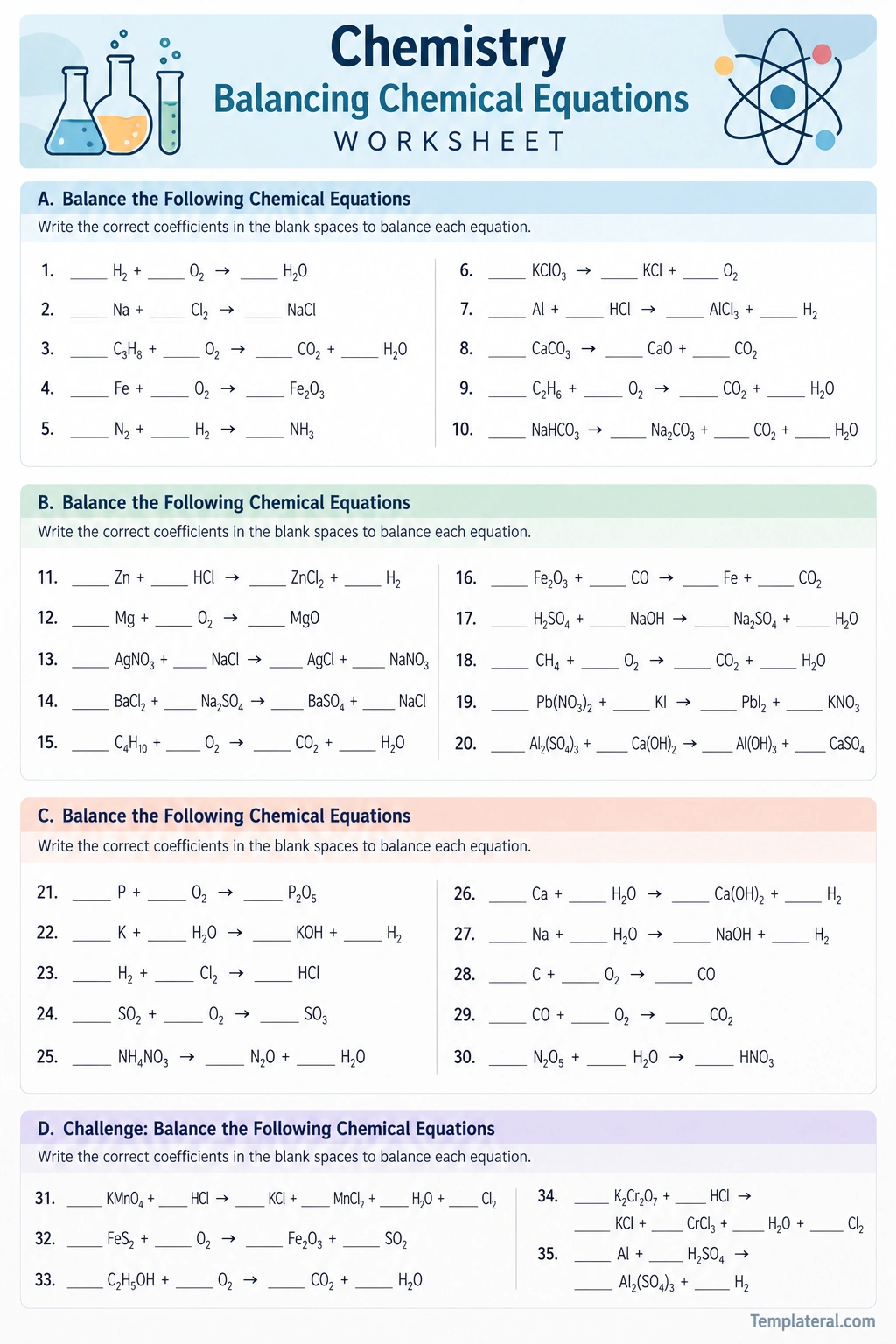
A printable chemistry balancing chemical equations worksheet gives students a dedicated space to practice coefficient placement and atom counting. A clean worksheet can also help teachers provide structured exercises for classroom work, homework, review, or independent study.
A useful worksheet may include:
- Clear instructions
- Numbered chemical equations
- Blank spaces for coefficients
- Simple and challenging problems
- Different types of chemical reactions
- Enough writing space for calculations
- A separate answer key when appropriate
Students can work through the problems one at a time and use the final atom count as a self-checking method.
Balancing Chemical Equations Worksheet for Different Skill Levels
Not every student needs the same level of difficulty. Teachers can adjust worksheet problems according to the students’ current chemistry skills.
Beginner Practice
Begin with equations containing simple elements and compounds. The goal is to help students understand coefficients, subscripts, reactants, products, and atom counting.
Intermediate Practice
Introduce equations with several compounds and three or more elements. Students can begin working with different reaction types.
Advanced Practice
More advanced worksheets can include equations with polyatomic ions, complex compounds, and reactions that require several balancing steps.
Difficulty should increase gradually so students can develop the underlying method rather than relying on guesswork.
Frequently Asked Questions About Balancing Chemical Equations Worksheets
What is a chemistry balancing chemical equations worksheet?
A chemistry balancing chemical equations worksheet is a practice sheet containing chemical equations that students balance by adding the correct coefficients. It is commonly used to practice conservation of atoms and chemical reaction notation.
What is the easiest way to balance a chemical equation?
A reliable approach is to count the atoms of each element, add coefficients to make the numbers equal, and then check every element. Starting with elements that appear in fewer compounds can often make the process easier.
Can you change subscripts when balancing an equation?
No. Subscripts are part of a chemical formula and changing them changes the identity of the substance. Balancing should be done by changing coefficients placed in front of chemical formulas.
Why must chemical equations be balanced?
Chemical equations must be balanced because the same number of atoms of each element must be represented on both sides of the reaction. This reflects the conservation of matter during a chemical reaction.
What should I do after balancing an equation?
Count every type of atom on both sides of the equation and confirm that the numbers match. Then check that the coefficients are in the smallest whole-number ratio when appropriate.
Is a balancing chemical equations worksheet useful for beginners?
Yes. A worksheet can provide structured practice and help beginners learn how coefficients affect the number of atoms represented in a chemical equation.
Conclusion
Learning to balance chemical equations becomes easier when students use a consistent process. Start by identifying the reactants and products, count the atoms of each element, add coefficients without changing chemical formulas, and then check every element before considering the equation complete.
A chemistry balancing chemical equations worksheet provides practical space to develop these skills through repeated practice. By starting with simple equations and gradually working toward more complex reactions, students can build confidence and improve their understanding of chemical reactions.
Whether used in the classroom, for homework, or for independent review, a well-organized balancing equations worksheet can be a useful resource for mastering one of the fundamental skills in chemistry.
Download: Chemistry Balancing Chemical Equations Worksheet
