An essay outline is a simple plan that organizes the main ideas, supporting details, and structure of an essay before the actual writing begins. Instead of starting with a blank page, an outline gives you a clear roadmap for developing your introduction, body paragraphs, and conclusion.
Whether you are writing a persuasive essay, argumentative essay, expository essay, research paper, or school assignment, creating an outline can make the writing process more organized and manageable. It can also help you keep your ideas connected and prevent important points from being overlooked.
A well-designed essay outline does not need to contain complete paragraphs. In many cases, short phrases, sentences, keywords, and supporting notes are enough to establish the direction of the entire essay.
What Is an Essay Outline?
An essay outline is a structured plan that shows how the ideas in an essay will be arranged. It typically begins with the introduction, continues through the main body paragraphs, and ends with the conclusion.
The outline allows writers to determine what each paragraph should accomplish before spending time writing the complete essay. It can also make it easier to identify missing evidence, repetitive ideas, or sections that do not support the main argument.
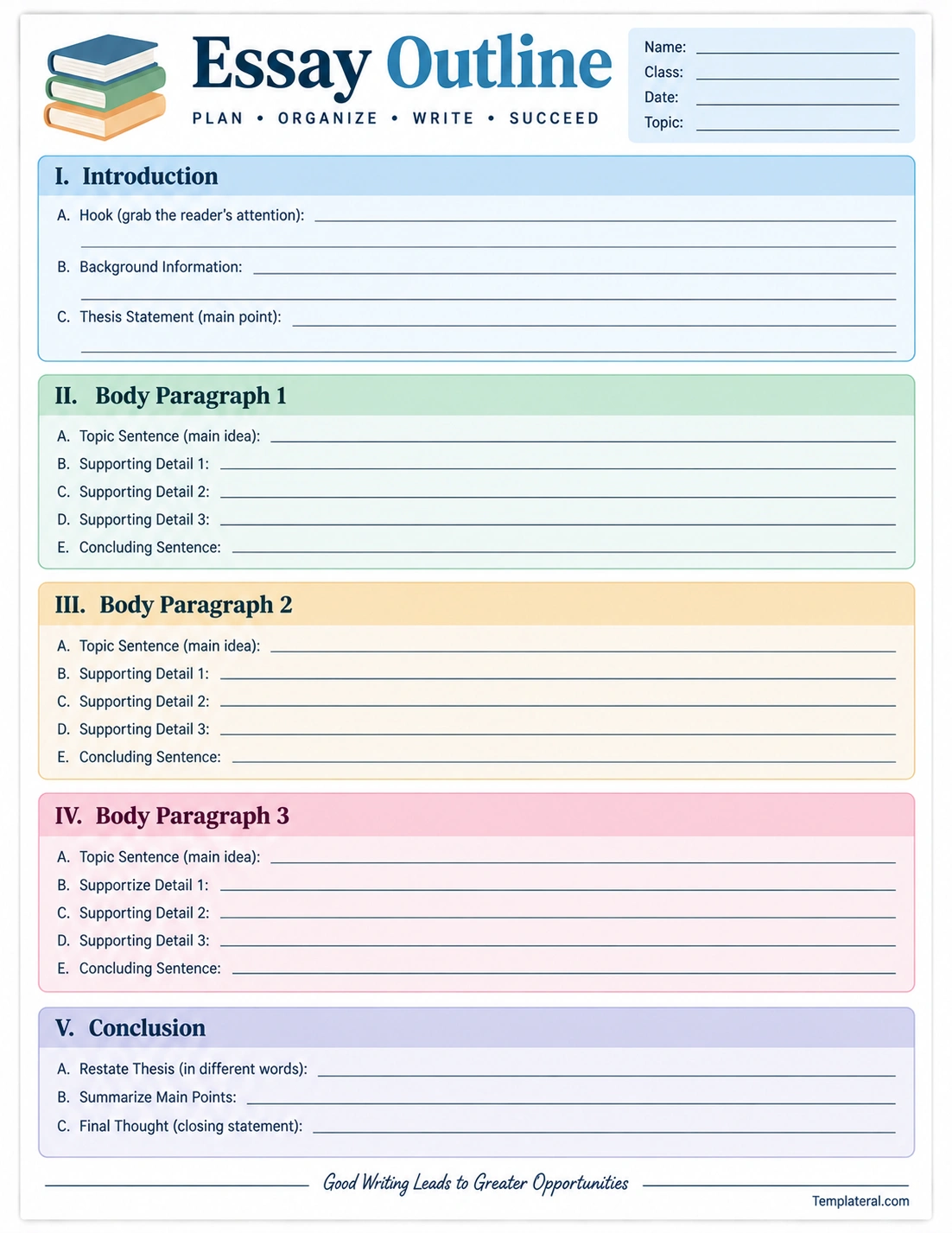
A basic essay outline often looks like this:
- Introduction: Hook, background information, and thesis statement.
- Body Paragraph 1: First main point and supporting evidence.
- Body Paragraph 2: Second main point and supporting evidence.
- Body Paragraph 3: Third main point and supporting evidence.
- Conclusion: Restated thesis, summary of key points, and final thought.
Why Is an Essay Outline Important?
Writing an outline before an essay can save time and improve the overall organization of the final paper. It allows you to think about the structure before focusing on individual sentences and paragraphs.
An essay outline can help you:
- Organize ideas logically.
- Develop a clear central argument.
- Create a stronger thesis statement.
- Keep each paragraph focused on one main idea.
- Identify supporting evidence before writing.
- Avoid unnecessary repetition.
- Maintain a logical flow from one point to the next.
- Make the writing process less overwhelming.
For students, an outline can also provide a useful way to check whether an essay addresses all parts of an assignment before the final draft is written.
Basic Parts of an Essay Outline
Although essay structures can vary depending on the assignment, most traditional essays contain three major parts: an introduction, body paragraphs, and a conclusion.
Introduction
The introduction introduces the topic and prepares the reader for the main argument or purpose of the essay. Your outline can identify the specific elements you want to include.
A typical introduction may contain:
- Hook: An opening statement designed to attract attention.
- Background information: Context that helps the reader understand the topic.
- Thesis statement: The central claim, argument, or main idea of the essay.
Body Paragraphs
The body of the essay develops the main ideas introduced by the thesis. Each paragraph should generally focus on a specific point that contributes to the overall purpose of the essay.
A body paragraph outline can include:
- Topic sentence.
- Supporting point.
- Evidence or example.
- Explanation or analysis.
- Concluding or transition sentence.
Conclusion
The conclusion brings the essay together without simply repeating the introduction word for word. It can restate the thesis in different language, summarize the major points, and leave the reader with a final thought.
How to Write an Essay Outline
Creating an outline is easier when you work from the overall purpose of the essay toward the smaller supporting details.
1. Understand the Assignment
Before creating your outline, carefully read the assignment instructions. Determine the required topic, essay type, length, number of sources, formatting requirements, and any specific questions that must be answered.
Understanding the assignment first helps ensure that your outline remains focused on the actual task.
2. Choose Your Main Topic
Identify the central topic of your essay. If the topic is broad, narrow it to a specific question, issue, or perspective that can realistically be covered within the required length.
3. Develop a Thesis Statement
Your thesis statement provides direction for the essay. It should communicate the main point or argument that the body paragraphs will develop.
Once you have a working thesis, ask yourself whether each planned body paragraph directly supports it. If a point does not contribute to the thesis, consider removing it or changing the structure.
4. List Your Main Points
Write down the major ideas you want to discuss. At this stage, focus on the most important points rather than trying to write complete paragraphs.
For example, an essay about the benefits of reading might organize its body around vocabulary development, critical thinking, and concentration.
5. Add Supporting Details
Under each main point, add examples, facts, explanations, quotations, research findings, or other evidence that can support the idea.
Adding these details before drafting helps you determine whether each main point has enough material to become a strong paragraph.
6. Arrange Ideas in a Logical Order
Review your main points and determine the most logical sequence. Depending on the essay, ideas might be organized from general to specific, chronological order, cause and effect, problem and solution, or strongest to weakest argument.
7. Review the Complete Outline
Read the outline from beginning to end. Check whether the introduction leads naturally into the body, whether the body paragraphs support the thesis, and whether the conclusion provides an appropriate ending.
Types of Essay Outlines
Different assignments may require different approaches to outlining. The best format depends on the complexity of the essay and the writer’s planning style.
Topic Outline
A topic outline uses short words or phrases to represent the main ideas. It is useful when you already understand the subject and want a quick overview of the essay.
For example:
- Introduction
- Benefits of exercise
- Physical health
- Mental well-being
- Daily routine
- Conclusion
Sentence Outline
A sentence outline uses complete sentences to describe the content of each section. This format requires more preparation but can be helpful for complex essays or research assignments.
Alphanumeric Outline
An alphanumeric outline organizes information using headings and subheadings such as Roman numerals, capital letters, numbers, and lowercase letters. It creates a clear hierarchy between major ideas and supporting details.
Essay Outline for Different Types of Essays
The basic structure of an outline can be adapted to different essay types.
Argumentative Essay Outline
An argumentative essay outline generally focuses on a clear claim supported by evidence and reasoning. Depending on the assignment, it may also include opposing viewpoints and a response to those viewpoints.
- Introduction and thesis
- Main argument
- Supporting evidence
- Additional argument
- Counterargument and response
- Conclusion
Persuasive Essay Outline
A persuasive essay outline focuses on convincing the reader to accept a particular position or take a specific action. Strong evidence and explanations should support the central position.
Expository Essay Outline
An expository essay explains a topic using facts, examples, descriptions, or analysis. The outline should arrange information in a way that makes the subject easy for the reader to understand.
Compare and Contrast Essay Outline
A compare and contrast essay examines similarities, differences, or both. The outline can organize the discussion by individual subjects or by specific comparison points.
Tips for Creating a Better Essay Outline
A useful outline should make writing easier rather than create unnecessary work. Keep the planning process focused on the information you actually need.
- Keep the thesis visible: Refer back to your thesis while developing each main point.
- Use consistent structure: Organize similar levels of information in a consistent way.
- Keep paragraphs focused: Avoid putting unrelated ideas into the same body paragraph.
- Add evidence early: Note important examples or sources before drafting.
- Use transitions: Consider how one main point will connect to the next.
- Remove weak points: Eliminate ideas that do not contribute to the main purpose.
- Leave room for changes: An outline is a planning tool, not a permanent contract.
Common Essay Outline Mistakes
Even a simple outline can become ineffective if it contains too much information or lacks a clear structure.
Common mistakes include:
- Creating an outline without understanding the essay prompt.
- Writing a thesis that is too broad or unclear.
- Including ideas that do not support the thesis.
- Adding too many unrelated points to one paragraph.
- Listing evidence without explaining how it supports the argument.
- Repeating the same idea in multiple sections.
- Spending so much time outlining that there is not enough time for drafting and revision.
How to Use an Essay Outline Template
An essay outline template provides a ready-made structure for organizing the major parts of an essay. Instead of creating headings and sections from scratch, you can enter your ideas directly into the appropriate areas.
A printable template can include sections for the introduction, thesis statement, multiple body paragraphs, supporting details, and conclusion. This makes it useful for classroom assignments, homework, writing practice, research papers, and independent study.
To use an essay outline template effectively, start by entering the essay topic and basic assignment information. Next, develop the thesis and add the major points you want to discuss. Finally, add supporting details and evidence beneath each point before beginning the first draft.
Essay Outline Checklist
Before starting your essay, use this checklist to review your outline:
- Is the essay topic clearly defined?
- Does the outline have a clear thesis statement?
- Does each body paragraph have one main idea?
- Does each main idea support the thesis?
- Have you included relevant supporting details?
- Is the information arranged in a logical order?
- Are transitions between major ideas clear?
- Does the conclusion connect back to the main argument?
- Have unnecessary or repeated ideas been removed?
- Is there enough evidence to support the main points?
Final Thoughts
An essay outline is a practical planning tool that can make the writing process more organized and focused. By identifying the thesis, main points, supporting evidence, and conclusion before drafting, you can create a clearer path from your initial idea to the finished essay.
The most effective outline is not necessarily the longest one. A simple structure that clearly shows what each paragraph needs to accomplish can be enough to guide the entire writing process. Whether you use a topic outline, sentence outline, or printable essay outline template, taking a few minutes to plan can make the actual writing much easier.
Download: Essay Outline Template
