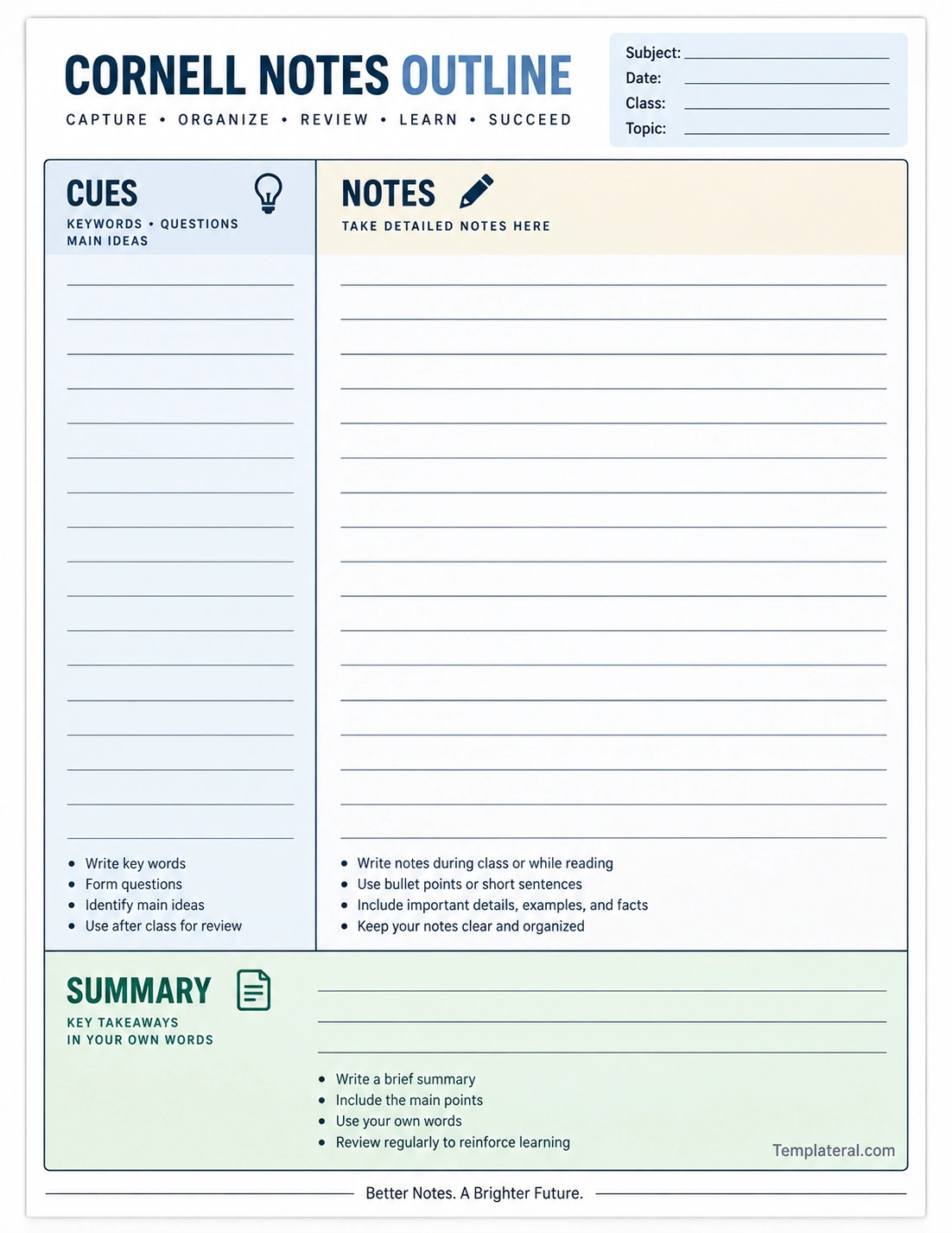
A Cornell notes outline is a structured note-taking format that helps students organize information, identify important ideas, and review lessons more effectively. Instead of writing everything in one large block of notes, the Cornell method divides the page into dedicated sections for notes, cues, and a summary.
This simple structure makes it easier to record information during class, identify key concepts afterward, and review material before a quiz, test, or exam. A Cornell notes outline can also be useful for reading assignments, lectures, meetings, research, and self-study.
Using a printable template makes the process even easier because the major sections are already organized on the page. You can focus on understanding the material instead of spending time drawing columns and dividing the worksheet yourself.
What Is a Cornell Notes Outline?
A Cornell notes outline is a note-taking worksheet based on the Cornell Note-Taking System. The page is divided into sections that give each type of information a specific place.
The main notes area is used to record information during a lecture, reading session, or study activity. A narrower cue column is used for keywords, questions, and important ideas. The bottom section is reserved for a short summary written after the notes have been completed.
This organization creates a natural study system. Instead of simply recording information, you also identify important concepts and summarize what you learned.
The Three Main Sections of Cornell Notes
The traditional Cornell format consists of three primary areas. Understanding the purpose of each section is important for using the method effectively.
1. Notes Section
The large notes section takes up most of the page. This is where you record the main information from a lecture, textbook, presentation, video, or other learning material.
Rather than writing every word, focus on important concepts, explanations, examples, definitions, facts, and supporting details. Short sentences, abbreviations, symbols, and bullet points can make note-taking faster and easier to review.
2. Cue Section
The cue section is the narrower column alongside the main notes. It can be used for keywords, questions, vocabulary, formulas, or major concepts.
After taking notes, return to this section and identify the information that would help you remember or test yourself on the material.
3. Summary Section
The summary section appears at the bottom of the page. After completing the notes and cue sections, write a short explanation of the main ideas in your own words.
Writing a summary forces you to process the information rather than simply reread it. It can also make future review sessions much faster.
How to Use a Cornell Notes Outline
The Cornell method works best when you use the different sections at different stages of learning.
Step 1: Prepare the Page
Before beginning a lecture or reading assignment, fill in basic information such as the subject, date, class, and topic. This makes your notes easier to organize later.
Step 2: Take Notes
Use the large notes section to record important information while listening to a lecture or reading. Concentrate on the main ideas rather than attempting to capture every sentence.
- Write important facts and definitions.
- Record examples that explain difficult concepts.
- Use abbreviations when appropriate.
- Organize related information together.
- Use bullet points for lists and supporting details.
- Leave enough space for additional information when needed.
Step 3: Add Cues and Questions
After the class or study session, review your notes and add keywords or questions to the cue column. These cues should help you recall the information without immediately looking at the full notes.
Step 4: Write a Summary
Finish by writing a brief summary at the bottom of the page. Explain the main concept in your own words and focus on the most important information.
Step 5: Review Regularly
Use the cue column to quiz yourself. Cover the notes section and try to answer each question or explain each keyword from memory. Then uncover the notes to check your answer.
Benefits of Using a Cornell Notes Outline
A Cornell notes outline provides more structure than traditional free-form note-taking. The format encourages students to interact with their notes rather than simply storing information on a page.
- Improves organization: Information is separated into clear, easy-to-follow sections.
- Encourages active recall: Cue questions provide prompts for testing your memory.
- Supports summarization: The summary section encourages you to identify the main ideas.
- Makes review easier: Important concepts can be located quickly.
- Reduces unnecessary writing: The structure encourages concise notes.
- Works for different subjects: The method can be adapted to science, history, mathematics, literature, and many other subjects.
Cornell Notes Outline for Different Subjects
The Cornell format can be adapted to suit different types of academic material. The information placed in each section will depend on the subject.
Science
For science classes, use the notes section for concepts, processes, observations, and examples. The cue section can contain important vocabulary, formulas, or questions about scientific processes.
History
History notes can include dates, events, people, causes, effects, and important historical developments. Questions in the cue section can help you remember why an event happened and what consequences followed.
Mathematics
For mathematics, record formulas, procedures, worked examples, and problem-solving steps in the notes section. The cue section can contain formulas, problem types, or questions about when a particular method should be used.
Literature
Literature notes can include themes, characters, important passages, literary devices, settings, and interpretations. Cue questions can help you review major themes and relationships between characters or events.
Cornell Notes vs. Traditional Notes
Traditional notes often consist of a continuous list of information. While this approach can work, it may make important ideas harder to locate during review.
A Cornell notes outline creates a deliberate separation between detailed information, recall prompts, and summaries. This gives the notes an additional study function instead of treating them only as a record of what was discussed.
The Cornell method does not require students to abandon their preferred note-taking style. You can still use bullets, abbreviations, diagrams, numbered lists, and short sentences inside the main notes section.
Tips for Creating Better Cornell Notes
Focus on Main Ideas
Do not try to write down every word from a lecture. Identify the concepts that explain the subject and record supporting details that are useful for understanding them.
Use Your Own Words
Paraphrasing information can make it easier to understand and remember. Instead of copying a definition word for word, try to explain the idea using language that makes sense to you.
Turn Notes Into Questions
Good cue questions can transform a worksheet into a study tool. Ask questions such as “Why does this happen?”, “What is the difference between these concepts?” or “What are the main steps in this process?”
Keep the Layout Clean
A crowded page can be difficult to review. Use headings, spacing, indentation, bullets, and concise phrases to keep the information organized.
Review Before the Test
Do not wait until the night before an exam. Short, regular review sessions can help reinforce information over time. Use the cue column to test yourself and the summary section to refresh the main concepts.
How a Cornell Notes Template Can Help
A Cornell notes template provides a ready-made structure for the Cornell method. Instead of drawing the cue, notes, and summary sections manually, you can immediately begin recording information.
A printable Cornell notes worksheet can be particularly useful for students who prefer handwriting their notes. It can be printed for individual lessons, organized in a binder, or used as a reusable reference for developing a consistent study routine.
Digital versions can also be used with tablets and note-taking applications. The important part is not the physical format but the organization of information into notes, cues, and a summary.
Cornell Notes Review Technique
One of the most useful features of the Cornell method is that the same page can become a self-testing worksheet after the notes are completed.
Start by covering the main notes section. Read one cue or question at a time and attempt to answer it from memory. Then check the notes to see whether your answer is accurate.
If you cannot answer a question, mark it for additional review. Repeat the process until you can explain the major concepts without depending heavily on the original notes.
Cornell Notes Checklist
Use this checklist to make sure your notes are complete and useful:
- Have you written the subject, date, and topic?
- Did you record the major ideas rather than every sentence?
- Are important terms and concepts easy to identify?
- Have you added useful questions or keywords to the cue section?
- Did you write the summary in your own words?
- Can you answer the cue questions without looking at the notes?
- Have you reviewed the page after completing it?
- Is the page organized enough to use for future study?
Final Thoughts
A Cornell notes outline turns ordinary note-taking into a more organized learning and review process. By separating detailed notes, recall cues, and summaries, the method gives students a simple structure for capturing information and studying it later.
The key is to use each section for its intended purpose. Record useful information in the notes area, create questions and keywords in the cue column, and summarize the main ideas at the bottom. With regular review, a Cornell notes worksheet can become both a record of learning and an effective study tool.
Download: Cornell Notes Outline Template
