Balancing chemistry formulas is an essential skill for understanding chemical reactions. A balanced chemical equation shows that the same number of atoms of each element is present on both sides of the equation. This reflects the law of conservation of mass, which states that matter is not created or destroyed during a chemical reaction.
At first, balancing chemical equations can seem confusing because changing one coefficient may affect several elements at once. However, the process becomes much easier when you follow a consistent method. By identifying each element, counting its atoms, and adjusting coefficients systematically, you can balance many equations without changing the chemical formulas themselves.
What Does Balancing Chemistry Formulas Mean?
Balancing chemistry formulas usually refers to adjusting the coefficients in a chemical equation so that every element has the same number of atoms on the reactant and product sides.
Consider the equation for hydrogen reacting with oxygen to form water:
H2 + O2 → H2O
This equation is not balanced because there are two oxygen atoms on the left but only one oxygen atom on the right. There are also two hydrogen atoms on the left and two on the right.
By placing coefficients in front of the formulas, the equation becomes:
2H2 + O2 → 2H2O
Now both sides contain four hydrogen atoms and two oxygen atoms. The equation is balanced.
Why Is Balancing Chemical Equations Important?
Balanced equations provide an accurate representation of a chemical reaction. They show the correct relative amounts of reactants and products and provide the foundation for quantitative chemistry calculations.
Balancing is important because it helps you:
- Represent chemical reactions accurately.
- Apply the law of conservation of mass.
- Determine the relative amounts of substances involved in a reaction.
- Perform stoichiometric calculations.
- Understand chemical reaction relationships.
- Check whether a written chemical equation is complete and consistent.
A balanced equation is therefore more than a formatting exercise. It provides information about the proportions in which substances participate in a chemical reaction.
The Difference Between Subscripts and Coefficients
One of the most important rules when balancing chemistry formulas is knowing the difference between a subscript and a coefficient.
What Is a Subscript?
A subscript is the small number written within a chemical formula. It tells you how many atoms of an element are present in one molecule or formula unit.
For example, H2O contains two hydrogen atoms and one oxygen atom. The subscript 2 belongs to hydrogen.
You should not change subscripts when balancing an equation. Changing a subscript changes the identity of the chemical substance.
What Is a Coefficient?
A coefficient is a number placed in front of a chemical formula. It tells you how many units of that substance are involved in the reaction.
For example:
3H2O
The coefficient 3 means there are three water molecules. Because each water molecule contains two hydrogen atoms and one oxygen atom, the expression contains six hydrogen atoms and three oxygen atoms in total.
When balancing an equation, adjust coefficients, not subscripts.
Steps for Balancing Chemistry Formulas
A systematic process can make balancing chemical equations much easier. Use the following steps when working through an equation.
1. Write the Correct Chemical Formulas
Before balancing anything, make sure the formulas for all reactants and products are correct. A coefficient can balance an equation, but it cannot correct an incorrect chemical formula.
2. Count the Atoms of Each Element
Make an atom count for each element on both sides of the equation. Write down the totals so you can easily identify which elements are unbalanced.
For example, in:
Fe + O2 → Fe2O3
There is one iron atom and two oxygen atoms on the left. The product contains two iron atoms and three oxygen atoms.
3. Start With an Element That Is Not Balanced
Choose an element whose number of atoms differs between the two sides. Add a coefficient to one of the formulas to bring its atom count closer to equality.
It is often helpful to begin with an element that appears in only one reactant and one product. Leave elements such as hydrogen and oxygen until later when they occur in several compounds.
4. Continue Adjusting Coefficients
After balancing one element, check the remaining elements. Continue adding coefficients until every element has the same number of atoms on both sides.
5. Use the Smallest Whole Numbers
Once the equation is balanced, reduce the coefficients to the smallest possible whole-number ratio. This creates the standard simplified form of the equation.
6. Check Your Work
Count every element again. A chemical equation is balanced only when the number of atoms of each element is identical on both sides.
Balancing Chemistry Formulas Example: Hydrogen and Oxygen
Let’s work through a basic example:
H2 + O2 → H2O
First, count the atoms. There are two hydrogen atoms and two oxygen atoms on the reactant side. The product contains two hydrogen atoms and one oxygen atom.
Oxygen is not balanced, so place a coefficient of 2 before water:
H2 + O2 → 2H2O
There are now four hydrogen atoms on the right, so place a coefficient of 2 before H2:
2H2 + O2 → 2H2O
The equation now contains four hydrogen atoms and two oxygen atoms on each side. It is balanced.
Balancing Chemistry Formulas Example: Nitrogen and Hydrogen
Consider the formation of ammonia:
N2 + H2 → NH3
The reactant side contains two nitrogen atoms, while the product initially contains one. Place a coefficient of 2 before NH3:
N2 + H2 → 2NH3
There are now six hydrogen atoms on the right. Place a coefficient of 3 before H2:
N2 + 3H2 → 2NH3
There are two nitrogen atoms and six hydrogen atoms on both sides. The equation is balanced.
Balancing Combustion Equations
Combustion equations involving hydrocarbons can initially appear more complicated because they often contain carbon, hydrogen, and oxygen. A useful approach is to balance carbon first, hydrogen second, and oxygen last.
For example:
CH4 + O2 → CO2 + H2O
Carbon is already balanced because there is one carbon atom on each side. Hydrogen is balanced by placing a coefficient of 2 before water:
CH4 + O2 → CO2 + 2H2O
There are now four oxygen atoms on the product side, so place a coefficient of 2 before O2:
CH4 + 2O2 → CO2 + 2H2O
Carbon, hydrogen, and oxygen are now balanced.
Using a Balancing Chemistry Formulas Worksheet
A printable balancing chemistry formulas worksheet can make practice more organized. Instead of solving equations directly in a textbook, students can use dedicated spaces to write coefficients, count atoms, and check their answers.
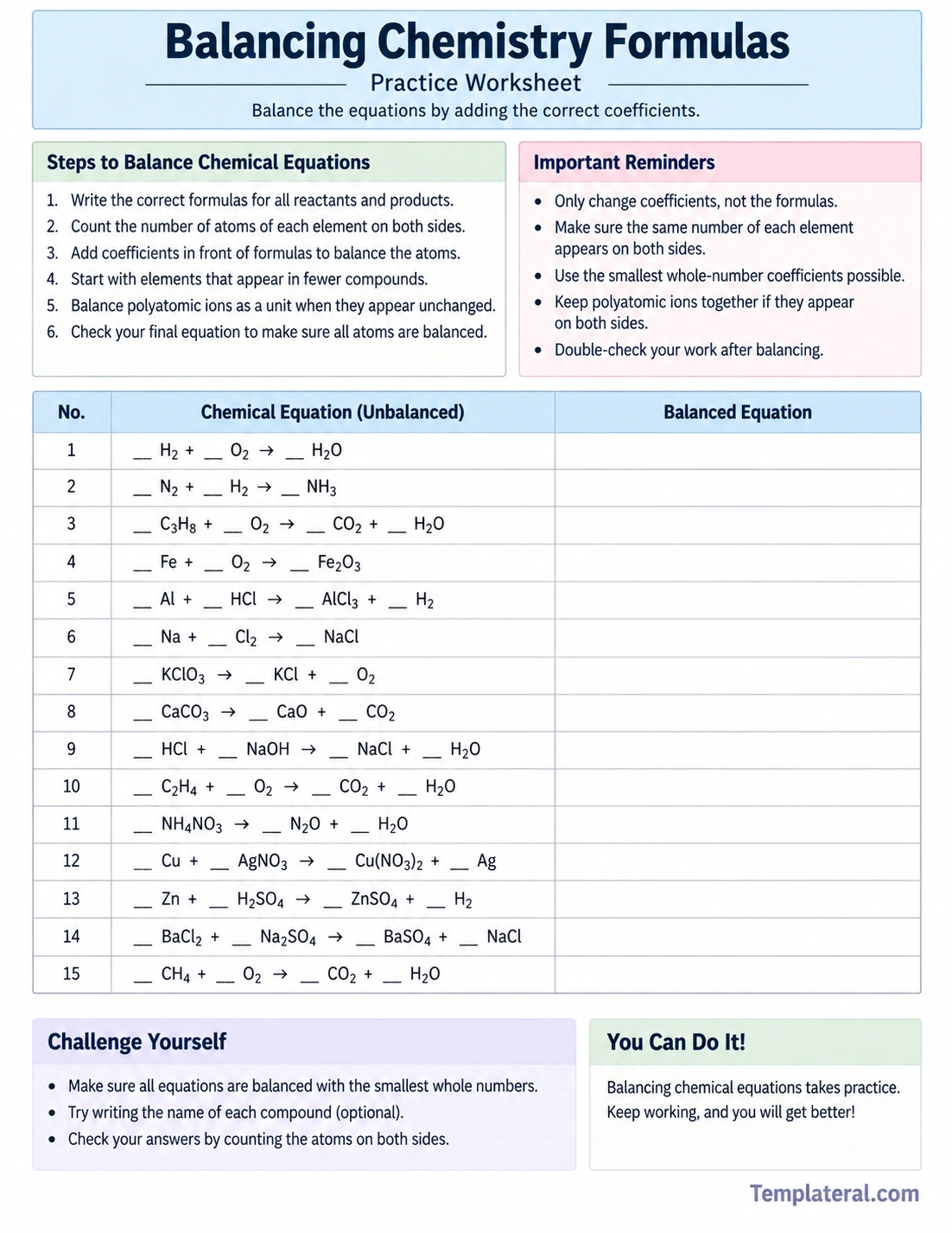
A worksheet can also be useful for repeated practice. Start with simple equations containing two or three elements, then progress to equations involving more compounds and polyatomic ions.
Common Mistakes When Balancing Chemical Equations
Several mistakes occur frequently when students first learn how to balance equations. Recognizing them can make the process easier.
Changing Subscripts
Never change a subscript simply to make the atom counts match. Doing so changes the chemical substance rather than balancing the original reaction.
Forgetting to Recount Atoms
Adding one coefficient can change the number of atoms of several elements. Always recount the entire equation after making a change.
Using Incorrect Chemical Formulas
Balancing cannot fix an incorrect formula. Verify the chemical formulas before beginning the balancing process.
Using Fractions Without Simplifying
Fractions can sometimes appear during balancing, but the final equation is normally expressed using the smallest whole-number coefficients. If fractions are introduced, multiply all coefficients by the appropriate number to remove them.
Stopping Too Early
An equation is not balanced simply because one element matches. Every element must have the same atom count on both sides.
Tips for Balancing Equations More Efficiently
With practice, you can become faster and more accurate at balancing chemical equations. These strategies can help:
- Write an atom inventory: Count every element before changing coefficients.
- Balance complicated compounds first: Elements appearing in fewer compounds are often easier to handle.
- Leave hydrogen and oxygen until later: They frequently appear in multiple compounds.
- Keep polyatomic ions together: If an unchanged polyatomic ion appears on both sides, treat it as a unit when appropriate.
- Use whole-number coefficients: Simplify the final ratio whenever possible.
- Recheck everything: Perform a final atom count before considering the equation complete.
Practice Equations for Balancing
Regular practice is one of the best ways to become comfortable with balancing equations. Try solving these examples by adding coefficients without changing the chemical formulas.
- H2 + O2 → H2O
- N2 + H2 → NH3
- Fe + O2 → Fe2O3
- Na + Cl2 → NaCl
- KClO3 → KCl + O2
- CaCO3 → CaO + CO2
- HCl + NaOH → NaCl + H2O
- CH4 + O2 → CO2 + H2O
For each equation, first identify the elements involved, count the atoms, adjust the coefficients, and then perform a final check.
How to Check Whether a Chemical Equation Is Balanced
The final verification is simple but important. Make a list of every element appearing in the equation and count its atoms on both sides.
For example, if an equation contains carbon, hydrogen, and oxygen, verify carbon first, hydrogen second, and oxygen third. If all three totals match, the equation is balanced.
You should also check that the coefficients are expressed in the smallest whole-number ratio. This prevents an equation from being technically balanced but unnecessarily large.
Conclusion
Balancing chemistry formulas becomes much easier when you use a consistent process. Start with correct chemical formulas, count the atoms of every element, adjust coefficients rather than subscripts, and check the complete equation at the end.
The most important rule to remember is that balancing an equation changes the number of molecules or formula units involved, not the identity of the substances themselves. With regular practice and a clear worksheet, students can develop a reliable method for balancing equations involving simple compounds, combustion reactions, and more complex chemical systems.
A printable balancing chemistry formulas worksheet can provide a convenient way to practice these skills, review common rules, and build confidence one equation at a time.
