A questions and answers format provides a simple way to organize questions together with their corresponding answers. It can be used for study guides, interviews, worksheets, surveys, quizzes, FAQ documents, classroom activities, meeting notes, and many other situations where information needs to be presented in a clear question-and-answer structure.
A well-organized Q&A format makes information easier to read because each question is directly connected to its answer. Instead of presenting information as a long block of text, the format creates a clear structure that helps readers quickly find specific questions and responses.
Whether you are preparing a school worksheet, creating an interview questionnaire, documenting a discussion, or building a frequently asked questions page, choosing the right questions and answers format can make the finished document more useful and easier to understand.
What Is a Questions and Answers Format?
A questions and answers format is a structured method of presenting information through a series of questions followed by their corresponding answers. Each question introduces a specific topic, while the answer provides the requested information, explanation, or response.
The format can be as simple as a numbered list of questions and answers or as detailed as a multi-section worksheet with space for written responses.
For example, a basic Q&A structure might look like this:
- Question: What is the main purpose of the project?
- Answer: The project is designed to improve the efficiency of the current process.
- Question: When should the project be completed?
- Answer: The planned completion date is the end of the quarter.
This simple structure makes the relationship between each question and answer immediately clear.
Why Use a Questions and Answers Format?
A question-and-answer layout is useful because it separates individual pieces of information into easy-to-follow sections. Readers do not have to search through long paragraphs to find a particular response.
Some common benefits include:
- Easy to read: Questions and responses are visually separated.
- Easy to organize: Each topic can have its own question and answer.
- Easy to review: Readers can quickly scan the questions to find specific information.
- Flexible: The format can be adapted for education, work, research, interviews, or personal use.
- Printable: A structured Q&A worksheet can be printed and completed by hand.
- Easy to update: Individual questions can be added, removed, or revised without changing the entire structure.
Common Uses for a Questions and Answers Format
Questions and answers can be used in many different environments. The best layout depends on the purpose of the document and the type of information being collected.
Study Guides
Students can use a Q&A format to turn important topics into review questions. Each question can focus on a definition, concept, formula, event, or other key piece of information.
This approach can also make self-testing easier because the question can be reviewed before looking at the answer.
Classroom Worksheets
Teachers can use questions and answers worksheets for lessons, reading comprehension activities, review exercises, or classroom discussions.
A printable worksheet with dedicated spaces for questions and answers gives students a clear structure for recording their responses.
Interviews
An interview question-and-answer format can help organize prepared questions and responses. It can be particularly useful when recording an interview for an article, research project, or internal document.
Frequently Asked Questions
FAQ documents are another common application of the Q&A structure. Each frequently asked question is followed by a concise answer that addresses the reader’s concern.
Meetings and Discussions
A Q&A format can also be used to document questions raised during a meeting and the answers or decisions provided during the discussion.
Research and Surveys
Researchers can organize interview questions, participant responses, or research prompts using a structured question-and-answer layout.
Basic Questions and Answers Format
A basic questions and answers format does not need to be complicated. A simple document can include a title followed by numbered questions and their corresponding answers.
A practical structure may include:
- Document title
- Topic or subject
- Date
- Question 1
- Answer 1
- Question 2
- Answer 2
- Question 3
- Answer 3
- Additional notes
Numbering each question is especially helpful when a document contains several questions because it allows readers to refer to a specific item easily.
How to Create a Questions and Answers Format
Creating a useful Q&A document starts with identifying the purpose of the questions and determining how much space each response requires.
1. Define the Purpose
First, determine why you are creating the document. A study worksheet may need short-answer spaces, while an interview record may require larger areas for detailed responses.
2. Choose the Questions
Write questions that directly support the purpose of the document. Avoid adding unnecessary questions simply to make the worksheet longer.
Good questions should be specific enough that the respondent understands what information is expected.
3. Organize the Questions Logically
Arrange the questions in an order that makes sense. For educational materials, this might mean moving from basic concepts to more advanced topics. For an interview, questions may follow the natural flow of the conversation.
4. Provide Enough Answer Space
Consider how much information each question requires. A question requiring a one-sentence response needs less space than a question asking for a detailed explanation.
5. Add Supporting Fields
Depending on the purpose, you may want to include fields for the topic, date, name, subject, class, project, or other identifying information.
6. Include a Notes Section
A notes area can be useful for information that does not fit directly into one of the question-and-answer sections.
How to Write Better Questions
The quality of the questions has a major effect on the usefulness of the final document. Clear questions generally produce clearer answers.
When writing questions, consider these tips:
- Keep each question focused on one main idea.
- Use clear and straightforward language.
- Avoid unnecessary wording.
- Use specific questions when detailed information is required.
- Arrange related questions together.
- Avoid questions that can easily be misunderstood.
- Match the question difficulty to the intended audience.
How to Write Effective Answers
Answers should directly address the question that comes before them. A response does not always need to be long. In many cases, a short and precise answer is more useful than a lengthy explanation.
Be Direct
Start with the information that answers the question. Additional explanation can follow when necessary.
Include Relevant Details
Provide enough information to make the answer understandable without adding unrelated details.
Use Consistent Language
If the document contains many questions, use a consistent style for the answers. This makes the completed worksheet easier to scan and review.
Questions and Answers Format for Students
A Q&A worksheet can be an effective study tool because it encourages students to actively recall information instead of simply rereading notes.
For example, a student can create questions from a textbook chapter and write the answers underneath each question. The worksheet can then be used for review before a test or assignment.
Useful student applications include:
- Chapter review worksheets
- Reading comprehension
- Vocabulary practice
- Science review questions
- History study guides
- Interview assignments
- Class discussion preparation
- Exam preparation
Questions and Answers Format for Interviews
For interviews, the format can be used to separate each interviewer’s question from the participant’s response. This makes the material easier to edit, review, and convert into a final article or report.
A useful interview Q&A document may include the interviewer’s name, participant information, date, topic, questions, responses, and additional notes.
Long answers may require additional writing space, so a flexible printable template is helpful when responses are being recorded by hand.
Questions and Answers Format for FAQ Documents
Frequently asked questions work particularly well with a question-and-answer structure. Each question can function as a heading, followed by a concise explanation.
When creating an FAQ document, group similar questions together and place the most useful information near the beginning. Keep individual answers focused so readers can quickly find the information they need.
Printable Questions and Answers Worksheet
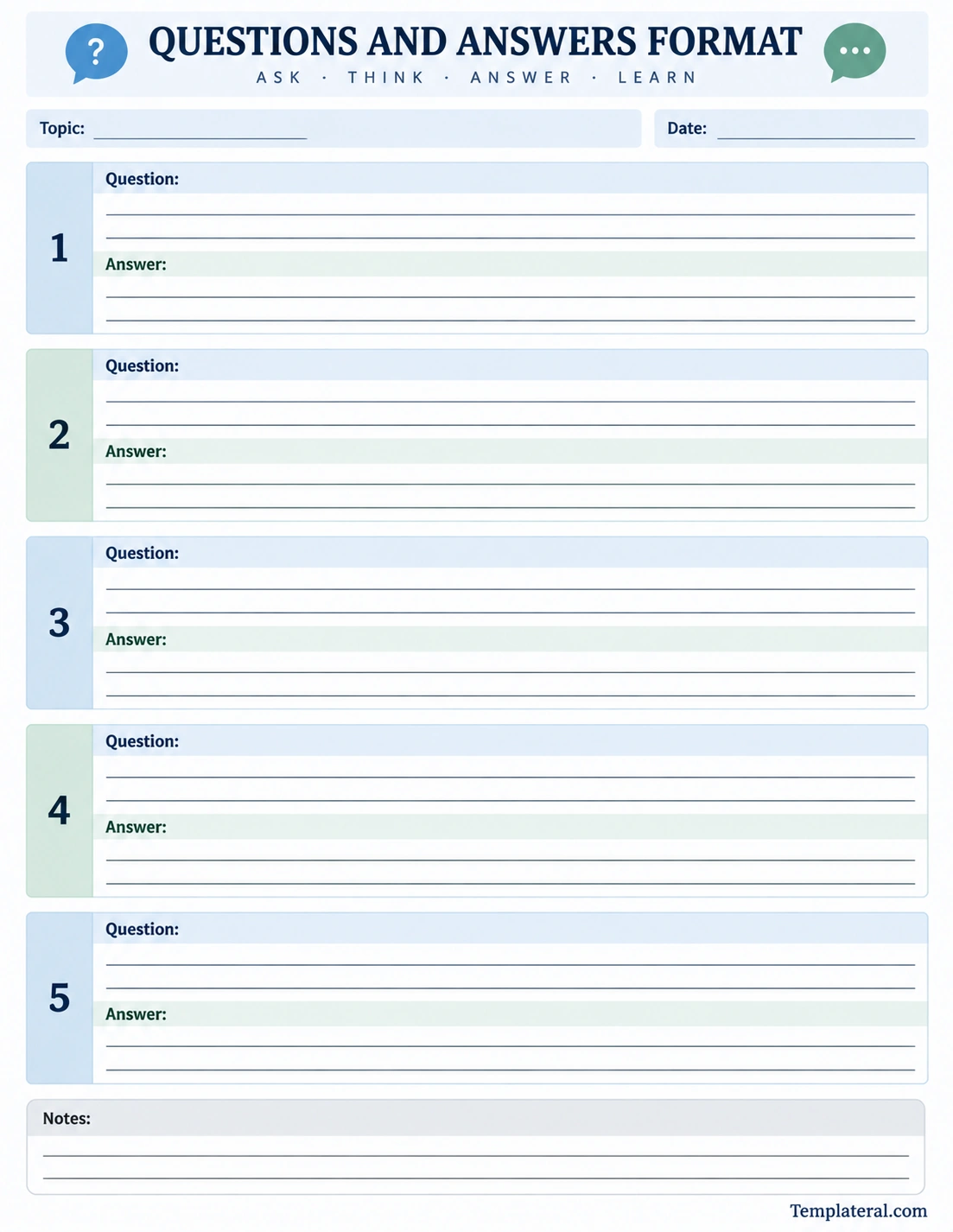
A printable questions and answers worksheet provides a ready-to-use structure for recording questions and responses by hand. It can be useful when working away from a computer or when handwritten notes are preferred.
A practical printable template may include numbered Q&A sections, topic and date fields, and a separate notes area. The layout should provide enough writing space without making the page unnecessarily crowded.
When printing a worksheet, choose a clear print setting and check that the lines and section headings are easy to see. A standard US Letter page is convenient for common home, school, and office printers.
Questions and Answers Format vs. Traditional Notes
Traditional notes usually record information in a continuous structure, while a Q&A format organizes information around specific questions.
Traditional notes can be useful for capturing a lecture, meeting, or discussion in chronological order. A Q&A format can be more useful when the goal is to connect individual questions directly to their answers.
The right format depends on the purpose. Some documents may even benefit from using both approaches, with a Q&A section followed by additional notes.
Tips for Designing a Clear Q&A Template
A good questions and answers template should be simple enough to use without additional instructions.
- Use clear labels for “Question” and “Answer.”
- Number each question consistently.
- Leave enough space for handwritten responses.
- Use readable headings and section divisions.
- Keep decorative elements minimal.
- Include a topic or title field when useful.
- Add a date field for documents that may be reviewed later.
- Provide a notes area for additional information.
Final Thoughts
A questions and answers format is a flexible and practical way to organize information. By placing each question directly with its corresponding answer, the format makes documents easier to read, review, complete, and reference.
It can be adapted for study guides, classroom worksheets, interviews, FAQs, surveys, research, meetings, and personal note-taking. A printable questions and answers template can make the process even easier by providing clearly labeled sections and dedicated writing space.
Whether you are creating a worksheet for students or organizing questions for a professional project, keep the questions focused, provide enough room for useful answers, and arrange the information in a logical order. A simple structure can make a Q&A document much more effective and convenient to use.
Download: Questions And Answers Worksheet Template
