Graph paper is a versatile type of paper printed with a regular grid of horizontal and vertical lines. The evenly spaced squares make it easier to draw accurate shapes, organize information, plot mathematical data, create diagrams, sketch designs, and work with measurements.
Unlike ordinary lined paper, graph paper provides both horizontal and vertical guides. This simple grid makes it useful for students, teachers, designers, engineers, architects, artists, and anyone who needs a structured surface for drawing or planning.
Whether you need graph paper for math homework, coordinate graphs, geometry, technical drawings, handwriting practice, or creative projects, choosing the right grid size can make your work much easier.
What Is Graph Paper?
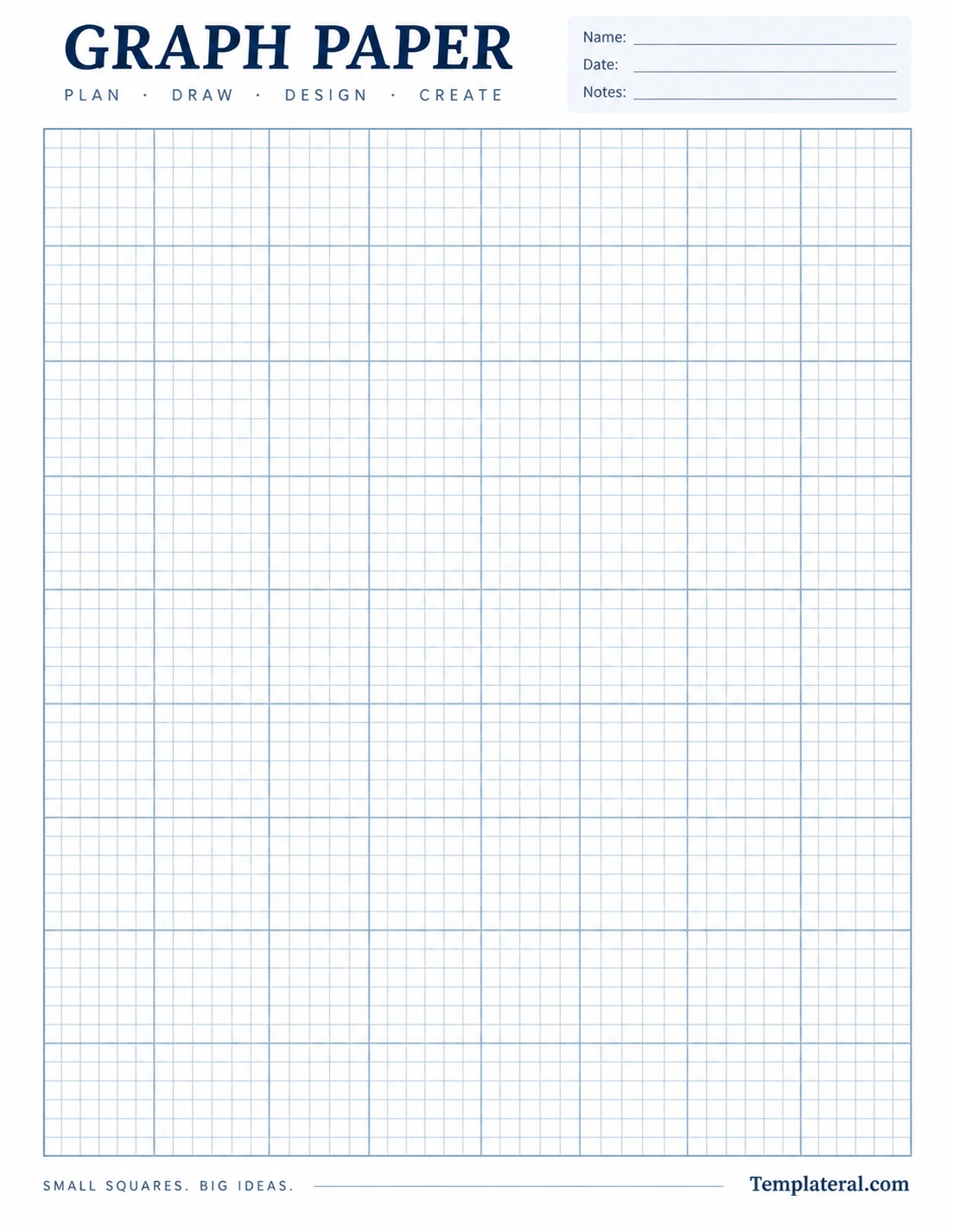
Graph paper is paper covered with a pattern of evenly spaced lines that form a series of squares. The grid provides a visual reference that helps users position points, maintain proportions, measure distances, and organize handwritten information.
The size of the squares can vary. Common versions include small grids for detailed mathematical work and larger grids for diagrams, sketches, and planning. Some graph paper uses darker lines at regular intervals to create larger blocks within the smaller grid.
A basic sheet may contain nothing more than a rectangular grid, while specialized graph paper can include numbered axes, coordinate systems, polar grids, logarithmic scales, or other mathematical features.
What Is Graph Paper Used For?
The simple grid makes graph paper useful for a surprisingly wide range of activities. It is especially valuable whenever accuracy, alignment, or consistent spacing matters.
- Mathematics: Plot equations, create coordinate graphs, and solve geometry problems.
- Geometry: Draw shapes, measure sides, and explore transformations.
- Science: Plot experimental results and create data charts.
- Architecture: Sketch room layouts, floor plans, and basic building concepts.
- Engineering: Create technical sketches and organize measurements.
- Art: Practice geometric drawing, pixel art, and proportional sketches.
- Design: Plan layouts, patterns, and visual compositions.
- Planning: Organize ideas, maps, schedules, and structured notes.
- Education: Help students understand coordinates, scale, measurement, and spatial relationships.
Types of Graph Paper
Not all graph paper has the same grid or purpose. Selecting the right type depends on what you want to draw, calculate, or organize.
Standard Square Graph Paper
Standard square graph paper is the most familiar type. It consists of evenly spaced horizontal and vertical lines that create square cells.
This format works well for general mathematics, geometry, diagrams, sketches, handwriting, and planning. It is also a good all-purpose choice when you are not sure which specialized grid you need.
Small Grid Graph Paper
Small grid graph paper has closely spaced squares that provide greater precision. It is useful when you need to plot detailed data, create accurate drawings, or work with small measurements.
Students may use a small grid for coordinate geometry, graphing functions, and detailed mathematical exercises.
Large Grid Graph Paper
Large grid paper has wider spaces between the lines. The larger cells provide more room for writing, diagrams, and simple sketches.
This type can be particularly useful for younger students or activities where detailed plotting is not necessary.
Quadrant Graph Paper
Quadrant graph paper is designed for coordinate-plane work. It typically includes horizontal and vertical axes that divide the page into sections, making it easier to plot positive and negative coordinates.
This format is commonly used for algebra, geometry, functions, and coordinate graphing.
Isometric Graph Paper
Isometric graph paper uses angled lines rather than a traditional square grid. The pattern creates a three-dimensional visual effect and is useful for technical sketches, geometry, product concepts, and three-dimensional drawings.
Choosing the Right Graph Paper Grid Size
The grid size can make a significant difference in how easy a worksheet is to use. Consider the level of detail and the size of the objects you need to draw.
- Small squares: Best for detailed graphs, precise measurements, and technical work.
- Medium squares: A practical choice for general math, diagrams, and everyday planning.
- Large squares: Useful for younger students, large handwriting, simple diagrams, and basic sketches.
If the purpose of the page is mainly mathematical, smaller squares can provide better precision. For general writing and drawing, a larger grid may be more comfortable.
How to Use Graph Paper for Math
Graph paper is particularly useful for visualizing mathematical concepts. The grid provides consistent reference points that can make abstract calculations easier to understand.
Plotting Coordinates
When plotting coordinates, each square can represent a specific unit. After establishing the scale, you can mark points according to their horizontal and vertical values.
For example, a grid may use one square to represent one unit. A point with an x-coordinate of 4 and a y-coordinate of 3 can then be located by moving four units horizontally and three units vertically.
Graphing Equations
Graph paper can also be used to plot equations and observe how values change. The regular grid makes it easier to identify points and connect them accurately.
Drawing Geometric Shapes
The squares provide a convenient reference for drawing rectangles, triangles, polygons, and other shapes. You can use the grid to estimate or count side lengths and compare proportions.
Using Graph Paper for Drawing and Design
Graph paper is not limited to mathematics. Designers and artists can use a grid as a simple framework for creating organized sketches.
Planning Floor Plans
A graph paper sheet can serve as a basic planning surface for a room layout. Each square can represent a fixed measurement, allowing walls, furniture, doors, and other features to be positioned with consistent proportions.
Creating Pixel Art
Because each square functions like a small cell, graph paper is naturally suited to pixel-style drawings. You can shade individual squares to create letters, icons, patterns, or simple illustrations.
Sketching Patterns
The grid can help maintain symmetry and spacing when designing repeating patterns. You can experiment with shapes and motifs while using the lines as visual guides.
Benefits of Using Printable Graph Paper
Printable graph paper is convenient because you can produce a fresh worksheet whenever you need one. Instead of purchasing a specialized notebook, you can print a page with the grid size and layout that best fits your project.
Some advantages include:
- Easy access: Print a new sheet whenever you need one.
- Flexible use: Use the same basic grid for math, drawing, planning, or design.
- Cost-effective: A printable template can be reused digitally and printed as needed.
- Clean layout: A consistent grid helps keep work organized.
- Customizable: Different grid sizes can be selected for different activities.
- Convenient for classrooms: Teachers can provide students with worksheets suited to specific assignments.
Tips for Printing Graph Paper
When printing graph paper, maintaining the intended proportions of the grid is important. If the printer automatically scales the page, the squares may become slightly larger or smaller than expected.
- Check the paper size: Use the intended paper format, such as US Letter, when appropriate.
- Review print settings: Look for scaling options before printing.
- Use actual size when necessary: This helps preserve the intended grid dimensions.
- Check the margins: Make sure the printable area fits within your printer’s margins.
- Print a test page: For measurement-sensitive work, verify the grid size before printing multiple copies.
Graph Paper for Students
Students can use graph paper for many subjects beyond basic graphing exercises. It can help make mathematical work more structured and easier to review.
For younger learners, larger squares provide more room for writing numbers and drawing shapes. Older students may prefer smaller grids for coordinate geometry, algebra, statistics, and technical diagrams.
Teachers can also use printable graph paper as a flexible classroom resource. A blank grid can be adapted for graphing assignments, geometry exercises, measurement activities, or visual problem-solving tasks.
Graph Paper for Planning and Organization
The regular grid can also turn an otherwise blank page into a structured planning surface. You can use the squares to divide areas, estimate proportions, or create simple visual layouts.
For example, graph paper can be used to sketch a garden layout, organize a workspace, plan a room, map a small project, or create a basic schedule. The grid provides structure without forcing you to follow a complicated template.
Graph Paper vs. Lined Paper
Lined paper is primarily designed to help keep handwriting aligned horizontally. Graph paper provides both horizontal and vertical references, making it more suitable for visual and spatial tasks.
Choose lined paper when your main goal is writing paragraphs, lists, or notes. Choose graph paper when you need to draw, measure, plot, align, or organize information within a two-dimensional space.
How to Make the Most of a Graph Paper Template
Before using a printable graph paper template, consider what you want to accomplish. The intended use can help you determine the appropriate grid size and whether you need additional labels or reference information.
- For math: Choose a grid that provides enough precision for the assignment.
- For sketches: Select a grid that gives you enough space for the entire drawing.
- For floor plans: Establish a scale before drawing.
- For pixel art: Use a small, consistent grid.
- For classroom activities: Choose a grid size that matches the students’ writing and drawing needs.
Final Thoughts
Graph paper is a simple but highly useful tool for mathematics, education, drawing, planning, design, and technical work. Its regular grid provides visual structure while still leaving plenty of freedom for users to create their own diagrams, calculations, sketches, and layouts.
The best graph paper depends on the task. Small grids offer greater precision, while larger grids provide more space for writing and simple drawings. A standard square grid is a practical all-purpose option, while specialized formats such as quadrant and isometric graph paper are useful for specific applications.
With a clean printable graph paper template, you can have a structured workspace ready whenever you need it for school, work, design, or creative projects.
Download: Graph Paper TemplateGraph Paper Template
