Meeting minute notes are a practical way to record what was discussed, what decisions were made, and what needs to happen next. Well-organized meeting notes help teams remember important details without having to rely on memory or search through scattered messages and documents.
Whether you are taking notes during a team meeting, project meeting, client meeting, staff meeting, or committee discussion, a consistent format can make the process much easier. Instead of writing down every word that is said, effective meeting minutes focus on the information people will need after the meeting.
A good meeting notes template can also help you capture attendees, agenda topics, key discussion points, decisions, action items, deadlines, and plans for the next meeting.
What Are Meeting Minute Notes?
Meeting minute notes are a written record of the most important information discussed during a meeting. They provide a reference that participants can use to review decisions, responsibilities, deadlines, and follow-up tasks.
Unlike a word-for-word transcript, meeting minutes usually summarize the important points rather than recording every statement. The goal is to create a clear and useful record that someone can understand even if they were not present at the meeting.
A typical set of meeting notes may include:
- Meeting title: The name or purpose of the meeting.
- Date and time: When the meeting took place.
- Location or platform: Where the meeting was held.
- Attendees: People who participated in the meeting.
- Agenda: Topics planned for discussion.
- Discussion points: Important information shared during the meeting.
- Decisions: Agreements or conclusions reached by the group.
- Action items: Tasks that need to be completed after the meeting.
- Due dates: Deadlines associated with action items.
- Next meeting: Details about the next scheduled discussion.
Why Are Meeting Minute Notes Important?
Meetings can generate a large amount of information in a short period of time. Without written notes, important decisions and responsibilities can easily be forgotten or misunderstood.
Clear meeting minutes provide a shared reference for everyone involved. They can help team members understand what was agreed upon and what they are expected to do next.
They Keep Everyone Aligned
Meeting notes give participants the same written reference. If people remember a discussion differently, the notes can help clarify the main points and documented decisions.
They Track Action Items
One of the most useful parts of meeting minutes is the action item section. Recording the task, responsible person, and due date makes follow-up much easier.
They Create Accountability
When responsibilities are clearly documented, team members can see who is responsible for each task and when it should be completed.
They Provide a Record for Future Reference
Older meeting notes can be useful when a team needs to understand why a decision was made or review the progress of a long-term project.
What Should Be Included in Meeting Minute Notes?
A useful meeting notes format should capture enough information to explain the meeting without becoming unnecessarily long.
Meeting Details
Start with basic information such as the meeting title, date, time, location, facilitator, and note taker. These details make the document easier to identify later.
Attendees
Record the names of participants and, when useful, their role or department. You may also include a separate section for people who were invited but unable to attend.
Agenda Items
List the main topics that were planned for discussion. Numbering the agenda items can make it easier to connect each discussion with its corresponding notes and decisions.
Discussion Notes
Summarize the most important points rather than attempting to record every sentence. Focus on information that affects decisions, projects, responsibilities, deadlines, or future actions.
Decisions and Outcomes
Clearly identify decisions made during the meeting. Separating decisions from general discussion makes the final notes much easier to scan.
Action Items
Record each task, the person responsible for completing it, and the expected due date. If appropriate, include a status such as not started, in progress, or completed.
How to Take Effective Meeting Notes
Taking good notes does not mean writing down everything people say. Instead, listen for information that will matter after the meeting.
1. Review the Agenda Before the Meeting
Look at the meeting agenda before the discussion begins. Knowing the planned topics allows you to prepare headings in advance and organize your notes as the meeting progresses.
2. Prepare the Meeting Notes Template
Have a consistent template ready before the meeting starts. Pre-filled sections for attendees, agenda items, discussion points, decisions, and action items reduce the amount of formatting you need to do while listening.
3. Focus on Key Information
Listen for decisions, important facts, concerns, questions, assignments, deadlines, and changes to existing plans. These details are generally more useful than recording casual conversation.
4. Record Decisions Clearly
When the group reaches a decision, write it down clearly. Avoid vague phrases that could create confusion later.
5. Capture Action Items Immediately
Whenever someone is assigned a task, record the task and responsible person immediately. Add a due date whenever one is established.
6. Review Your Notes Before the Meeting Ends
If time allows, quickly review the action items and decisions with the group. This gives participants an opportunity to correct misunderstandings before the meeting is finished.
Meeting Minutes vs. Meeting Notes
The terms meeting minutes and meeting notes are often used interchangeably, but they can describe slightly different approaches.
Meeting minutes generally refer to a more formal record of a meeting. They may be used by organizations, committees, boards, or teams that need an official record of discussions and decisions.
Meeting notes can be more informal and flexible. They may be used by an individual or team to capture useful information, reminders, decisions, and action items.
The appropriate format depends on the purpose of the meeting and the organization’s requirements.
Simple Meeting Minute Notes Format
A straightforward format can make meeting documentation easier to maintain. Consider organizing your notes into the following sections:
- Meeting Information — title, date, time, location, facilitator, and note taker.
- Attendees — names and roles of participants.
- Agenda — topics to be discussed.
- Discussion Notes — key points for each topic.
- Decisions and Outcomes — conclusions reached during the meeting.
- Action Items — tasks, owners, and deadlines.
- Next Meeting — date, time, location, and main focus.
- Additional Notes — other useful information.
Tips for Writing Clear Meeting Minutes
Good meeting documentation should be easy to read and easy to act on. A few simple habits can significantly improve the quality of your notes.
- Use short sentences: Keep individual notes concise and focused.
- Use headings: Separate different discussion topics so readers can scan the document quickly.
- Use bullet points: Bullets are useful for multiple discussion points or decisions.
- Identify speakers when necessary: Include a person’s name when knowing who made a statement or commitment is important.
- Highlight decisions: Make final decisions easy to locate.
- Track owners: Every action item should have a clearly identified person or team responsible for it.
- Include deadlines: A task without a deadline can easily be overlooked.
- Avoid unnecessary detail: Focus on information that has practical value.
How to Organize Action Items
Action items are often the most important part of meeting minutes because they turn discussion into measurable follow-up work.
A simple action item table can include four key pieces of information:
- Action item: What needs to be done?
- Assigned to: Who is responsible?
- Due date: When should it be completed?
- Status: What is the current progress?
For example, instead of writing “Marketing team will work on the campaign,” a more useful note would identify the specific task, responsible person or team, and expected completion date.
When Should Meeting Notes Be Shared?
Meeting notes are generally most useful when they are distributed while the discussion is still fresh. Review the notes after the meeting to correct obvious errors, clarify incomplete information, and make sure action items are understandable.
Once finalized, share the notes with the relevant participants. This gives everyone an opportunity to confirm decisions and responsibilities and helps reduce misunderstandings.
Using a Printable Meeting Minute Notes Template
A printable meeting minute notes template can be useful when you prefer handwriting notes or want a structured worksheet available during meetings. A well-designed template provides dedicated spaces for the information you are most likely to need.
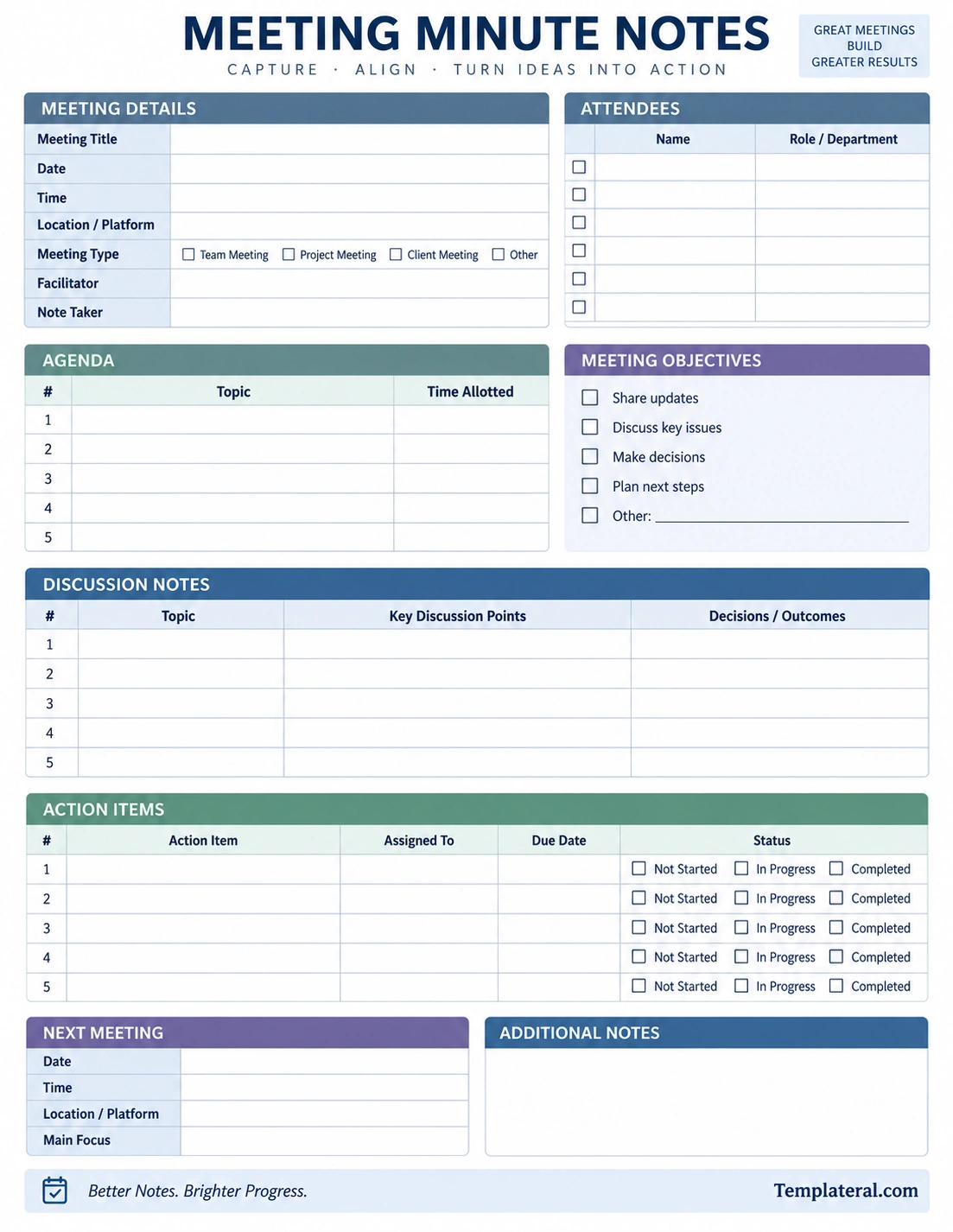
The printable template shown above includes sections for meeting details, attendees, agenda items, objectives, discussion notes, decisions, action items, the next meeting, and additional notes.
You can print a blank copy before each meeting and complete it by hand. Alternatively, the structure can serve as a model for creating a digital meeting minutes document.
Common Mistakes to Avoid
Even a simple meeting notes system can become ineffective if the information is too vague or difficult to follow.
- Writing everything word for word: This can make the notes unnecessarily long and difficult to review.
- Ignoring decisions: General discussion is less useful if final decisions are not clearly recorded.
- Leaving action items incomplete: Tasks should identify who is responsible and, when possible, when they are due.
- Waiting too long to organize notes: Important details can become harder to remember.
- Using inconsistent formats: A standard meeting notes template makes information easier to find across multiple meetings.
- Failing to clarify unclear information: If an important point is ambiguous, ask for clarification before the meeting ends when possible.
Final Thoughts on Meeting Minute Notes
Effective meeting minute notes do more than document what happened during a meeting. They create a practical record of decisions, responsibilities, deadlines, and next steps.
The key is to focus on information that people will actually use after the meeting. A consistent structure containing meeting details, attendees, agenda topics, discussion points, decisions, and action items can make note-taking faster and follow-up more organized.
Whether you prefer handwritten notes, a digital document, or a printable worksheet, using a repeatable meeting notes format can help your team stay aligned and turn productive conversations into clear actions.
Download: Meeting Minute Notes Template
