An actor resume is an essential document for actors who want to present their training, performance experience, skills, and professional background to casting directors, agents, production companies, and theater organizations. Unlike a standard business resume, an acting resume is specifically designed to highlight performance-related experience and information that can help casting professionals understand an actor’s background.
Whether you are an experienced performer or creating your first acting resume, the goal is to make your qualifications easy to review. A well-organized resume can complement your headshot and help present your experience in a professional, concise format.
Creating an actor resume can seem challenging when you do not have extensive credits. However, you can build a strong resume by focusing on relevant training, theater experience, student productions, special skills, workshops, and other performance-related activities.
What Is an Actor Resume?
An actor resume is a specialized resume that summarizes an actor’s professional experience, acting credits, training, special skills, and relevant performance information. It is commonly submitted alongside an actor headshot when applying for auditions, roles, agencies, productions, and casting opportunities.
Unlike a conventional job resume, an acting resume does not need to focus on unrelated employment history. Instead, it should emphasize information that is relevant to performing and casting.
Depending on the actor’s background, an acting resume may include:
- Film credits
- Television credits
- Theater productions
- Commercial work
- Voice acting experience
- Acting training
- Special performance skills
- Dance and musical abilities
- Languages and accents
- Relevant certifications
- Professional representation
What Should an Actor Resume Include?
A professional actor resume template typically contains several sections that make an actor’s qualifications easy to scan. The exact sections can vary depending on the actor’s experience and the type of production being targeted.
1. Name and Professional Contact Information
Start with your professional name and essential contact information. Your name should be easy to see at the top of the resume.
Depending on your situation, your header may include a professional email address, phone number, website, agent or manager information, and location. Avoid including unnecessary personal information.
2. Acting Credits
Acting credits are usually the most important part of an experienced performer’s resume. Organize credits into categories such as film, television, theater, commercials, voiceover, or other relevant work.
For each credit, include useful information such as the production title, role, production company, director, network, or year when appropriate.
3. Training
Acting training can demonstrate preparation even when an actor has limited professional credits. Include acting schools, workshops, coaches, theater programs, scene study, voice training, movement training, or other relevant education.
4. Special Skills
The special skills section can be valuable because casting professionals may look for specific abilities when selecting performers. Include skills that you can genuinely perform at the level you claim.
Examples may include:
- Stage combat
- Dance
- Singing
- Musical instruments
- Improvisation
- Sports
- Accents and dialects
- Languages
- Horseback riding
- Swimming
- Driving skills
- Voiceover techniques
5. Representation
If you are represented by an acting agency or manager, you may include professional representation information according to the requirements of the agency and casting submission.
If you are not represented, you generally do not need to create a fictional representation section. Keep the resume focused on accurate information.
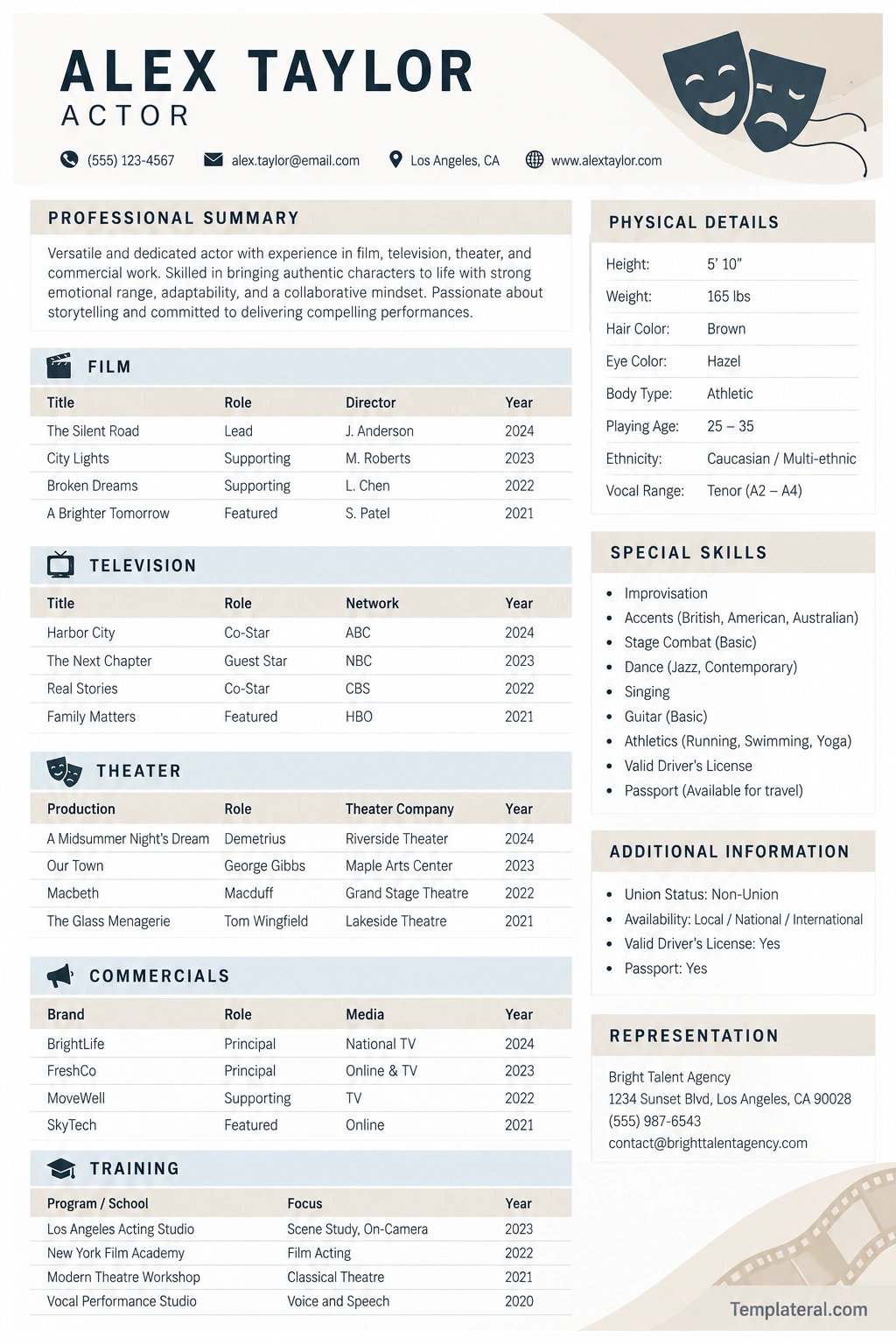
How to Write an Actor Resume
Writing an acting resume becomes easier when you organize your information according to what casting professionals are most likely to need. Start with your strongest and most relevant information, then remove details that do not contribute to your professional presentation.
Start With Your Most Relevant Experience
If you have substantial acting experience, prioritize your most relevant credits. You do not necessarily need to list every production you have ever participated in.
For example, if you are applying for a television role, television credits may be particularly useful to highlight. If you are auditioning for theater, relevant stage experience and theatrical training may deserve greater attention.
Use Clear Categories
Separate your experience into recognizable categories such as Film, Television, Theater, Commercials, Voiceover, or Training.
Clear categories allow someone reviewing the resume to find relevant information quickly.
Keep Descriptions Concise
An acting resume should not read like a collection of lengthy job descriptions. Casting professionals generally need to understand your role, production, and relevant credentials quickly.
Use concise entries and consistent formatting throughout the document.
Actor Resume Format
A clean actor resume format makes the document easier to read and creates a professional presentation. A simple structure is usually more effective than a resume filled with decorative elements.
A basic format might look like this:
- Header: Professional name and contact information
- Film: Film titles, roles, directors, and relevant details
- Television: Shows, roles, networks, and relevant details
- Theater: Productions, roles, and theater companies
- Commercials: Brands, roles, and media types
- Training: Schools, programs, workshops, and areas of study
- Special Skills: Verified performance and practical skills
- Additional Information: Relevant professional details
- Representation: Agency or management information when applicable
Actor Resume for Beginners
If you are creating an actor resume with no experience, do not assume that you have nothing worth including. Beginners can use relevant education, workshops, student productions, community theater, school performances, and other legitimate experience.
For example, an aspiring actor might include:
- Acting classes
- Scene study workshops
- Student films
- School theater productions
- Community theater
- Improvisation classes
- Dance training
- Vocal training
- Relevant special skills
The most important rule is to remain accurate. Do not invent professional credits or exaggerate your experience simply to make the resume appear more impressive.
Example Beginner Actor Resume Structure
A beginner might structure the resume with training near the top, followed by available performance credits and special skills. If there are only a few credits, the document can still look professional when the information is organized clearly.
As your career develops, you can gradually replace less significant experience with stronger professional credits.
Actor Resume for Film and Television
For film and television submissions, organize credits so that casting professionals can quickly identify your previous screen experience.
A useful format may include:
- Production title
- Role
- Director or production company
- Network or platform when relevant
- Year when useful
Keep the formatting consistent across every entry. Inconsistent spacing, capitalization, or date formatting can make an otherwise strong resume look unfinished.
Actor Resume for Theater
Theater resumes can place greater emphasis on stage productions, roles, theater companies, directors, and relevant performance training.
For each production, consider including the production title, character or role, theater company, and director or other relevant production information.
Stage experience can also demonstrate skills such as live performance, memorization, movement, vocal projection, improvisation, and ensemble work.
What Are Special Skills on an Actor Resume?
Special skills on an actor resume are abilities that may be useful for particular roles or productions. This section can help casting professionals identify performers who meet specific requirements.
However, only include skills you can perform confidently and honestly. If you list a language, musical instrument, sport, accent, or physical skill, be prepared to demonstrate it if requested.
Instead of writing a broad statement such as “good at sports,” provide specific skills such as tennis, swimming, basketball, gymnastics, or another activity you genuinely know.
How Long Should an Actor Resume Be?
For most actors, a concise one-page resume is a practical format. The objective is to communicate relevant information efficiently rather than creating a long professional biography.
If you have a substantial career history, prioritize the most relevant and notable credits instead of attempting to include every project. A focused resume is generally easier to review than one containing excessive information.
Actor Resume Mistakes to Avoid
A polished acting resume should be accurate, readable, and professionally formatted. Avoid these common mistakes:
- Including false credits: Only list real experience.
- Using an overly decorative design: Keep the document easy to scan.
- Including irrelevant work history: Prioritize acting-related information.
- Listing unverified skills: Only include skills you can genuinely demonstrate.
- Using inconsistent formatting: Keep fonts, spacing, headings, and dates consistent.
- Adding excessive personal information: Include only information relevant to professional casting and submission requirements.
- Writing long paragraphs: Use concise entries and clear categories.
- Failing to proofread: Check spelling, grammar, names, production titles, and contact information.
Tips for Making an Actor Resume Stand Out
Customize It for the Opportunity
When appropriate, emphasize experience and skills that are relevant to the production or role. A resume prepared for a theater audition may look different from one submitted for a commercial casting opportunity.
Use Professional Formatting
Choose readable fonts, consistent spacing, clear headings, and an organized layout. Avoid unnecessary graphics that distract from your credits and qualifications.
Keep Information Current
Update your acting resume as you gain new credits, complete additional training, or develop new skills. Remove outdated or less relevant information when necessary.
Coordinate Your Resume With Your Headshot
An actor resume is commonly used alongside a professional headshot. Keep your professional identity and contact information consistent across your submission materials.
Actor Resume Template: What to Look For
A useful actor resume template should provide enough structure to organize your experience without forcing every actor into exactly the same format.
Look for a template that includes space for:
- Professional name and contact information
- Film and television credits
- Theater experience
- Commercial work
- Acting training
- Special skills
- Additional professional information
- Representation details when applicable
The template should also be easy to edit and print. A simple, professional layout helps ensure that the focus remains on your acting background rather than on unnecessary design elements.
Final Thoughts on Creating an Actor Resume
A strong actor resume gives casting professionals a concise overview of your acting experience, training, skills, and relevant professional background. The best resume is not necessarily the one with the most information. It is the one that presents accurate and relevant information in a clear, professional format.
Whether you are an experienced performer or preparing your first acting resume, start with your strongest relevant experience, organize it into clear categories, and keep the design simple. Include only skills and credits that accurately represent your background, and update the document as your career develops.
Using an actor resume template can make the process easier by providing a structured starting point. With a clean layout and carefully selected information, you can create a professional resume that effectively supports your acting submissions and audition materials.
Download: Actor Resume Template
