A curriculum vitae, commonly called a CV, is a professional document that presents your education, work experience, skills, qualifications, and other relevant achievements. It is often used when applying for academic positions, research opportunities, professional roles, scholarships, internships, and jobs where a detailed professional background is useful.
A well-organized CV helps employers, recruiters, academic institutions, and other organizations quickly understand your background. The most effective curriculum vitae is not simply a list of everything you have done. Instead, it presents the most relevant information clearly, logically, and professionally.
Whether you are creating your first CV or updating an existing one, using a structured curriculum vitae template can make the process easier and help ensure that important sections are not overlooked.
What Is a Curriculum Vitae?
A curriculum vitae is a detailed summary of a person’s professional and academic background. The Latin phrase means “course of life,” which reflects the document’s purpose of presenting the development of your education, career, qualifications, and professional accomplishments.
Unlike a short resume, a CV may contain more detailed information, particularly for academic, scientific, medical, research, and specialized professional applications. The appropriate length and content depend on the country, industry, position, and purpose of the document.
A typical CV may include contact information, a professional profile, education, employment history, research experience, publications, certifications, professional memberships, skills, awards, and other relevant achievements.
What Is the Difference Between a CV and a Resume?
The terms CV and resume are sometimes used interchangeably, but their meaning can vary depending on location and context.
A resume is generally a concise document tailored to a specific job. A curriculum vitae can provide a more comprehensive record of academic and professional experience.
In some countries, however, employers use the term CV for what is essentially a standard job application resume. Therefore, it is important to follow the terminology and application instructions used by the employer or organization.
When an application specifically requests a CV, review the requirements carefully before deciding how much information to include.
What to Include in a Curriculum Vitae
The contents of a CV should reflect your experience and the purpose of the application. Some sections are standard, while others are appropriate only for certain careers.
Contact Information
Begin with your name and essential professional contact details. Depending on the application, this can include your phone number, professional email address, city and state, LinkedIn profile, portfolio, or professional website.
Use an email address that looks professional and make sure all contact information is current.
Professional Summary
A professional summary provides a short introduction to your background and areas of expertise. It should highlight your most relevant qualifications rather than simply stating that you are looking for a job.
For example, an experienced marketing professional might mention years of experience, areas of specialization, and significant strengths in a few concise sentences.
Work Experience
List relevant employment experience in reverse chronological order, beginning with your most recent position. Include the job title, organization, location, and dates of employment.
Under each position, use concise bullet points to describe important responsibilities and accomplishments. Whenever possible, emphasize results rather than listing routine duties.
Education
Include your degrees, institutions, fields of study, and relevant dates. Recent graduates may provide additional academic information such as honors, relevant coursework, academic projects, or a strong GPA when appropriate.
Skills
Include skills that are relevant to the position or professional field. Depending on your career, these may include technical skills, software knowledge, languages, research methods, communication abilities, project management, or specialized professional skills.
Certifications and Licenses
Professional certifications and licenses can demonstrate specialized knowledge or qualifications. Include the certification name, issuing organization, and relevant date or credential information when appropriate.
Publications and Research
Academic and research-focused CVs may include publications, conference presentations, research projects, grants, laboratory experience, or other scholarly contributions.
Awards and Honors
Include significant academic, professional, or industry awards when they strengthen your application. Focus on accomplishments that demonstrate expertise, recognition, or contribution to your field.
Curriculum Vitae Template
A curriculum vitae template provides a structured starting point for organizing your professional information. Instead of designing the document from scratch, you can work through established sections and replace the placeholder content with your own information.
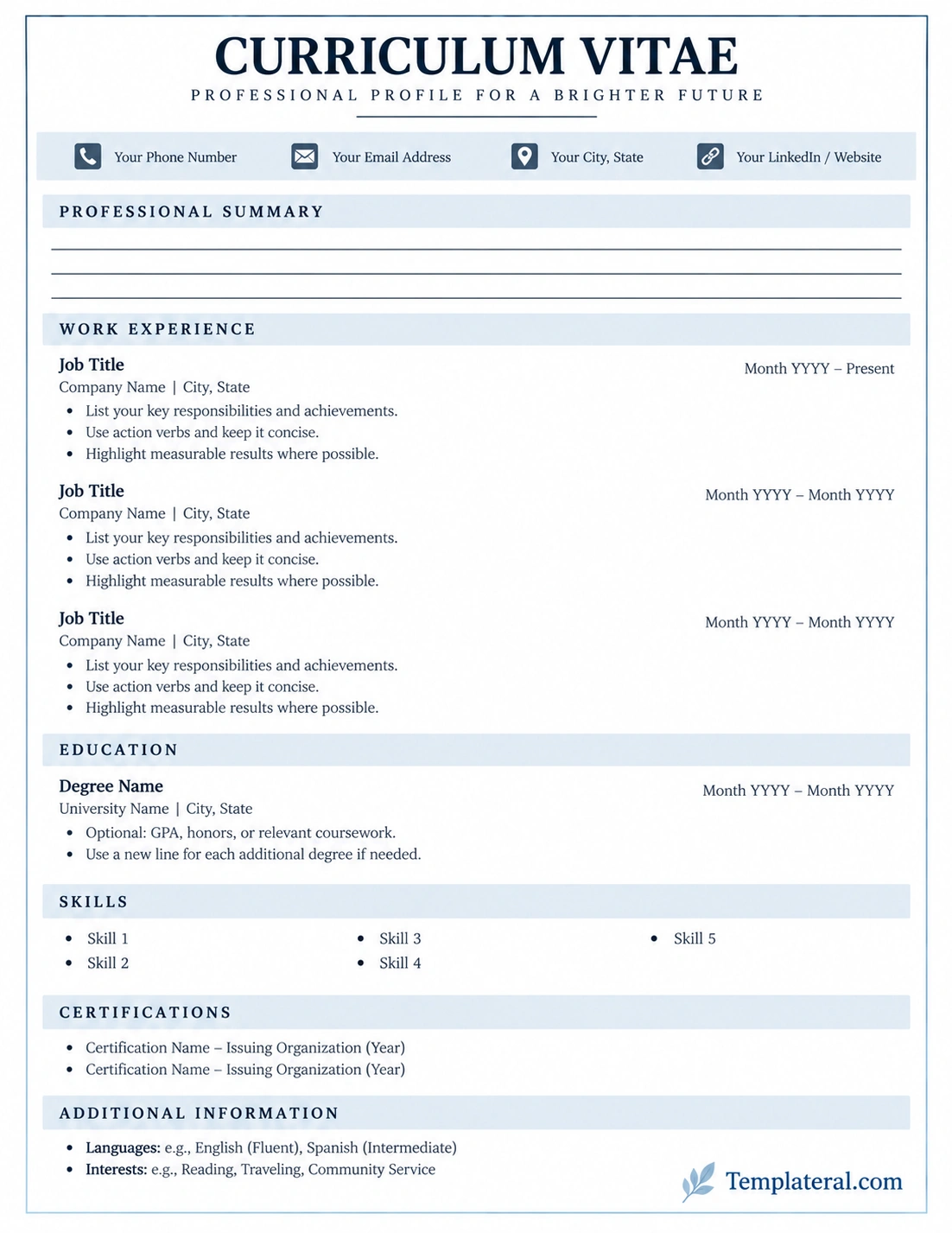
How to Write a Curriculum Vitae
Creating a strong CV becomes easier when you work through each section systematically. Start by collecting your information before worrying too much about formatting.
Gather Your Professional Information
Collect your employment history, education details, certifications, skills, awards, publications, professional memberships, and other relevant information. Having everything available makes it easier to determine which details belong in the final document.
Choose Relevant Information
You do not necessarily need to include every activity you have ever completed. Prioritize information that demonstrates qualifications relevant to the position, institution, or opportunity.
Write Accomplishment-Focused Descriptions
When describing professional experience, focus on meaningful contributions and outcomes. Strong descriptions can explain what you did, how you contributed, and what result your work produced.
Use Clear Formatting
Keep headings, dates, spacing, fonts, and bullet points consistent. A clean structure allows readers to locate important information quickly.
Proofread Carefully
Spelling, grammar, formatting, and incorrect dates can make an otherwise strong CV appear careless. Review the document several times and, if possible, ask another person to check it before submitting.
How to Format a Professional CV
Professional CV formatting should prioritize readability. The design does not need to be complicated or highly decorative. Clear section headings and consistent spacing are usually more useful than excessive graphics or visual elements.
- Use clear section headings: Make major sections easy to identify.
- Keep formatting consistent: Use the same style for comparable information throughout the document.
- Make dates easy to find: Consistent date placement helps readers understand your career progression.
- Use readable fonts: Choose professional fonts with comfortable spacing.
- Use bullet points: Break long descriptions into concise, scannable statements.
- Maintain sufficient white space: Avoid overcrowding the page with unnecessary information.
How Long Should a Curriculum Vitae Be?
There is no single ideal length for every curriculum vitae. The appropriate length depends on your experience, professional field, application requirements, and geographic context.
An early-career applicant may have a relatively short CV because there are fewer qualifications to document. An experienced researcher, professor, physician, or specialist may require several pages to present publications, research, teaching experience, professional activities, and other accomplishments.
Rather than adding information simply to make the document longer, focus on providing relevant and useful details. If an organization specifies a page limit, follow that requirement carefully.
Curriculum Vitae for Students and Recent Graduates
Students and recent graduates may not have extensive professional experience, but they can still create an effective CV by emphasizing education, projects, internships, research, volunteer activities, certifications, leadership experience, and relevant skills.
Academic projects can be particularly useful when they demonstrate abilities related to the opportunity. Students applying for research positions may also highlight laboratory work, presentations, papers, academic achievements, and relevant coursework.
The goal is to show evidence of knowledge, skills, initiative, and relevant experience rather than trying to imitate the CV of someone with many years of professional experience.
Curriculum Vitae for Academic and Research Positions
Academic and research CVs often require more detailed information than standard employment documents. Depending on the field and application, sections may include teaching experience, research interests, publications, conference presentations, grants, fellowships, academic service, professional memberships, and awards.
Organize these sections logically and use consistent citation formatting for publications and presentations. If an institution provides specific CV instructions, use those requirements as the primary guide.
Tips for Improving Your Curriculum Vitae
A good CV should communicate your qualifications efficiently. The following practices can help make your document clearer and more relevant.
- Tailor your CV: Adjust the emphasis and order of information according to the opportunity.
- Lead with relevant strengths: Place important qualifications where they are easy to find.
- Use specific language: Replace vague statements with concrete descriptions of your experience.
- Quantify accomplishments when appropriate: Numbers can make professional results more specific.
- Remove outdated information: Keep the document focused on useful and relevant qualifications.
- Use action verbs: Words such as developed, managed, analyzed, coordinated, designed, and researched can make descriptions more direct.
- Check every date: Employment and education dates should be accurate and consistent.
- Keep a master CV: Maintain a detailed version that can be adapted for different applications.
Common Curriculum Vitae Mistakes
Including Too Much Unrelated Information
A long list of unrelated activities can make important qualifications harder to find. Focus on information that supports your professional profile and the purpose of the application.
Using the Same CV for Every Application
Different positions may prioritize different qualifications. A research position, for example, may require more emphasis on publications and research experience, while another role may prioritize professional achievements and technical skills.
Writing Long Blocks of Text
Large paragraphs can make a CV difficult to scan. Use concise descriptions and bullet points where appropriate so readers can identify important information quickly.
Using an Unprofessional Email Address
Your email address is part of your professional contact information. Use a simple address that clearly identifies you rather than an informal nickname or unrelated phrase.
Ignoring Application Instructions
Always check whether the employer, university, organization, or program has specific requirements for document format, length, file type, naming conventions, or requested sections.
How to Keep Your CV Updated
Updating your curriculum vitae regularly is easier than rebuilding it every time you apply for an opportunity. Add significant achievements as they occur, including new positions, certifications, publications, projects, awards, presentations, and professional memberships.
Keep a comprehensive master document containing your complete professional history. When applying for a specific position, create a tailored version using the most relevant information from that master document.
This approach reduces the risk of forgetting important accomplishments and makes future applications much faster to prepare.
Using a Printable Curriculum Vitae Template
A printable CV worksheet can be useful during the preparation stage, especially when you want to organize information before creating a final digital document. You can use the worksheet to list employment history, education, skills, certifications, and accomplishments in one place.
Once the information has been reviewed and organized, transfer the relevant details into your preferred document format. Keeping a printable worksheet can also provide a convenient reference when updating your CV later.
Final Checklist Before Submitting a CV
Before sending your curriculum vitae, take a final review of both the content and presentation.
- Confirm your name and contact information are correct.
- Check employment and education dates for accuracy.
- Make sure the most relevant qualifications are easy to find.
- Review spelling, grammar, and punctuation.
- Check that headings and formatting are consistent.
- Remove unnecessary or outdated information.
- Confirm that required sections are included.
- Follow the organization’s file and submission requirements.
- Save the final document using a professional file name.
Conclusion
A curriculum vitae is an important professional document that brings together your education, experience, skills, accomplishments, and qualifications. A well-structured CV allows readers to understand your background while making it easier to identify information relevant to an opportunity.
The best approach is to start with accurate information, organize it into clear sections, emphasize relevant achievements, and maintain consistent formatting. Whether you are a student, recent graduate, experienced professional, researcher, or academic, a well-prepared curriculum vitae can provide a clear record of your professional development.
Using a curriculum vitae template can simplify the preparation process by providing an organized framework for your information. Once your master CV is complete, you can update it regularly and adapt it to suit different applications and professional goals.
