A Personal Biography is a short written account that introduces a person by describing important details about their background, education, experiences, interests, achievements, and goals. It can be used for school assignments, portfolios, introductions, professional profiles, applications, or personal projects.
Writing a biography does not have to be complicated. A good personal biography simply presents meaningful information in a clear and organized way. The writer can choose the details that best explain who they are, what they have experienced, and what they hope to accomplish in the future.
Whether you are writing a biography about yourself or preparing a personal biography template for a student, having a clear structure can make the process much easier.
What Is a Personal Biography?
A Personal Biography is a written description of a person’s life, background, experiences, and accomplishments. Unlike a simple list of facts, a biography connects important details to create a clearer picture of the person.
A personal biography may be only a few sentences long or several paragraphs, depending on its purpose. A school assignment may require information about family background, education, hobbies, and future goals. A professional biography may focus more on education, career experience, skills, accomplishments, and professional interests.
The most effective biography includes information that is relevant to the intended reader. There is no need to include every detail about a person’s life.
What Should Be Included in a Personal Biography?
The content of a personal biography depends on the purpose and audience. However, several sections can provide a useful starting point.
- Full name
- Birth information
- Personal or family background
- Education
- Career or work experience
- Important skills
- Achievements
- Interests and hobbies
- Goals and future plans
Choose the sections that are appropriate for the assignment or situation. A student biography, for example, may place more emphasis on education and interests, while a professional biography may highlight career experience and achievements.
How to Write a Personal Biography
Writing a biography becomes easier when the information is organized before the actual paragraphs are written. Start by collecting the most important facts and then turn those facts into a natural story.
1. Start With Basic Information
Begin with essential information such as your name and, when appropriate, your date and place of birth. You can also mention your current location or general background if it is relevant.
A basic introduction might explain who you are and provide a short overview of your background. Avoid including unnecessary private information, especially when the biography will be published online.
2. Describe Your Background
The background section explains experiences that helped shape who you are. Depending on the purpose of the biography, this might include your hometown, family background, childhood experiences, interests, or important events.
You do not need to describe every stage of your childhood. Instead, choose details that help explain your personality, interests, values, or later accomplishments.
3. Explain Your Education
Education is an important part of many personal biographies. Mention schools, colleges, training programs, courses, or other educational experiences that are relevant to your story.
You can also explain how your education influenced your interests or career direction. This makes the biography more informative than simply listing school names.
4. Describe Your Career Journey
If the biography is intended for a professional audience, describe important work experiences and career milestones. Explain what you have learned and how your experiences have contributed to your development.
For a student biography, this section can instead describe volunteer activities, school projects, internships, leadership experiences, or other meaningful activities.
5. Highlight Skills and Achievements
Include skills and accomplishments that demonstrate your abilities. These can include academic achievements, professional accomplishments, creative work, leadership experience, certifications, awards, or community activities.
Whenever possible, explain why an achievement was meaningful. A short explanation can provide more context than a simple list of awards.
6. Add Interests and Hobbies
Personal interests can make a biography feel more natural and memorable. You might mention reading, sports, music, art, travel, technology, cooking, volunteering, or other activities you genuinely enjoy.
Choose interests that help readers understand your personality. You do not need to list every hobby you have.
7. Finish With Future Goals
A strong personal biography can end by describing future plans or aspirations. Explain what you hope to learn, achieve, create, or contribute in the future.
Future goals are especially useful in student biographies, scholarship assignments, portfolios, and personal development activities.
Personal Biography Examples by Purpose
The structure of a biography can change depending on where it will be used. Understanding the purpose makes it easier to decide what information to include.
Personal Biography for Students
A student biography can focus on education, interests, accomplishments, favorite subjects, extracurricular activities, and future goals. The writing should be easy to understand and appropriate for the student’s age.
For younger students, a biography worksheet can provide prompts such as name, birthday, school, hobbies, favorite activities, achievements, and future dreams.
Personal Biography for a Portfolio
A portfolio biography should introduce the person while highlighting relevant skills, education, experience, projects, and accomplishments. It should be concise and focused on information that supports the purpose of the portfolio.
Personal Biography for a Professional Profile
A professional biography typically emphasizes career experience, expertise, education, professional achievements, and areas of interest. It can be written in either first person or third person depending on where it will appear.
Personal Biography for a School Assignment
A school biography assignment may require students to reflect on their background, education, hobbies, accomplishments, and future plans. A structured worksheet can help students organize their thoughts before writing the final version.
First Person or Third Person?
One important choice when writing a personal biography is deciding whether to use first-person or third-person writing.
First person uses words such as I, me, and my. This style sounds personal and direct, making it useful for personal websites, introductions, student assignments, and autobiographical writing.
Third person uses the person’s name and pronouns such as he, she, or they. This style can sound more formal and is commonly used for professional profiles, speaker introductions, websites, and organizational publications.
The most important rule is consistency. Choose one perspective and maintain it throughout the biography.
Tips for Writing a Better Personal Biography
A good biography should be informative without becoming a long list of unrelated facts. The following tips can make the final writing clearer and more engaging.
- Keep the information relevant: Include details that support the purpose of the biography.
- Use a natural writing style: Write as if you are introducing yourself to a real reader.
- Be specific: Replace vague statements with meaningful examples whenever possible.
- Keep the structure organized: Move logically from background to education, experience, achievements, and goals.
- Show personality: Include appropriate interests, values, or experiences that make the biography distinctive.
- Proofread carefully: Check grammar, spelling, punctuation, names, and dates before publishing.
- Respect privacy: Avoid publishing sensitive personal information that does not need to be public.
How to Use a Personal Biography Template
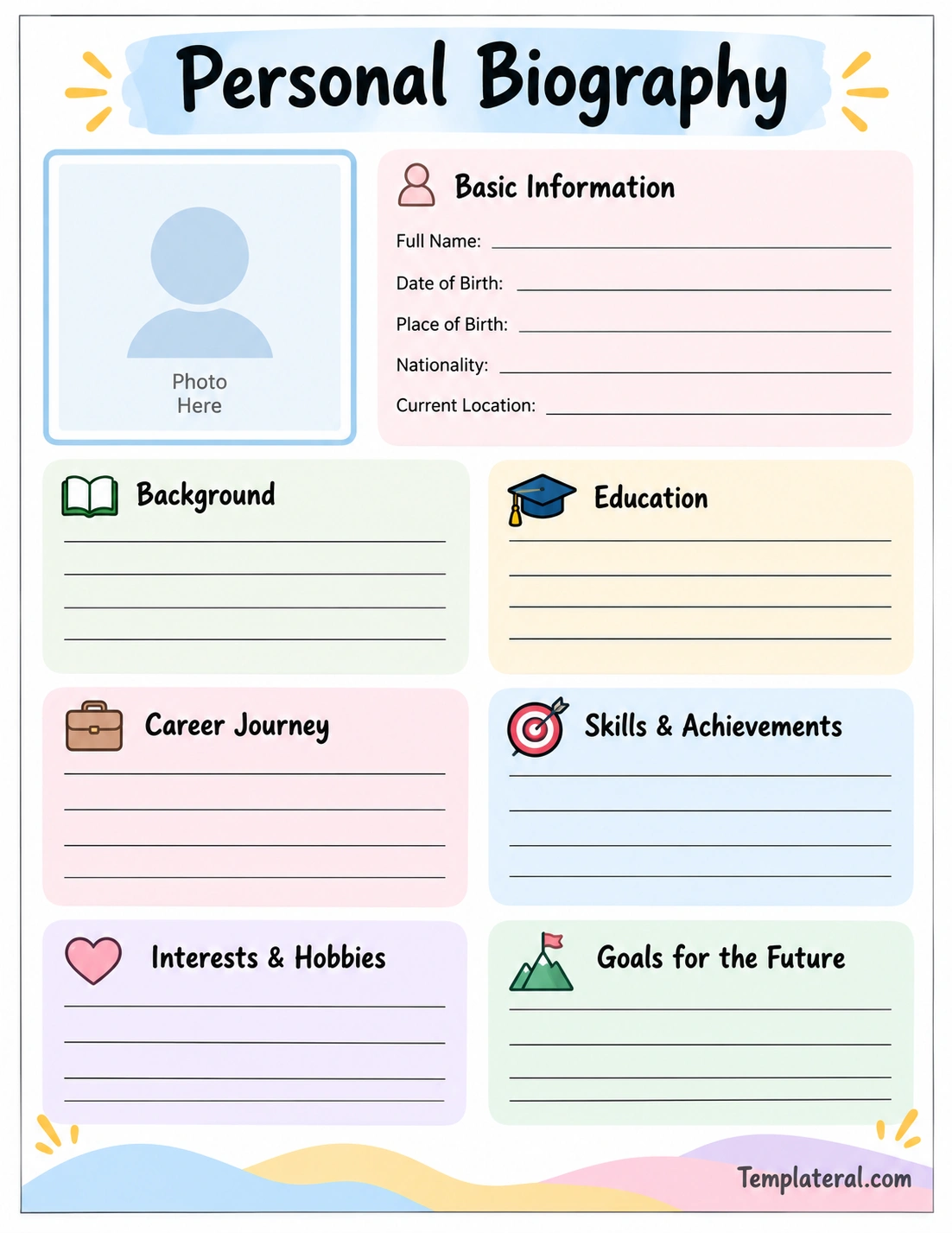
A Personal Biography template can make the writing process easier by providing dedicated spaces for different categories of information. Instead of starting with a completely blank page, the writer can work through each section one at a time.
Start with the easiest sections, such as your name, education, interests, and hobbies. Then move to more reflective sections, such as your background, achievements, and future goals.
Once all sections have been completed, review the information and decide which details should appear in the final biography. A worksheet can be used as a planning tool even when the final biography will eventually be written as paragraphs.
Personal Biography Template for Students
A biography template can be particularly helpful for students who are learning how to organize personal information into a structured piece of writing.
A simple student biography worksheet may include:
- My name
- My birthday
- Where I am from
- My school
- My favorite subjects
- My hobbies
- My skills
- My accomplishments
- My future goals
Teachers can use these prompts as a classroom writing activity. Students can first complete the worksheet and then use their answers to write a longer personal biography.
Common Mistakes to Avoid
Even a simple biography can become difficult to read when it contains too much information or lacks a clear structure.
Including Too Many Details
A biography does not need to document every event in a person’s life. Focus on the details that are most meaningful or relevant to the purpose.
Writing Only a List of Facts
Dates, schools, jobs, and accomplishments are useful, but a biography should ideally connect those facts. Explain how experiences influenced your interests, skills, or goals.
Using Generic Statements
Statements such as “I am a hard worker” can be strengthened by giving a specific example that demonstrates your work ethic or achievement.
Forgetting the Audience
A biography written for a classroom assignment may sound very different from one written for a professional website. Always consider who will read the biography and why.
Frequently Asked Questions About Personal Biography
What is a Personal Biography?
A Personal Biography is a written introduction that describes important aspects of a person’s life, such as their background, education, experiences, interests, achievements, skills, and future goals.
How long should a Personal Biography be?
The ideal length depends on its purpose. A short introduction may only require a few sentences, while a school assignment or detailed profile may require several paragraphs. Focus on useful information rather than trying to reach a specific word count.
What should I include in a Personal Biography?
Common sections include basic information, background, education, career or experience, skills, achievements, interests, hobbies, and future goals. Only include information that is appropriate for the intended audience.
Should a Personal Biography be written in first person?
It can be. First-person writing is often appropriate when you are introducing yourself directly. However, third-person writing may be preferred for professional profiles, websites, speaker introductions, and formal publications.
Can students use a Personal Biography template?
Yes. A Personal Biography template can help students organize their ideas before turning them into complete paragraphs. It is especially useful for classroom writing assignments and personal introduction activities.
What is the difference between a biography and an autobiography?
A biography is generally written about a person by someone else, while an autobiography is written by the person about their own life. A personal biography can describe a person’s life in a concise format and may be written in either first or third person depending on its purpose.
Conclusion
A Personal Biography provides a clear and meaningful way to introduce yourself and explain the experiences that have shaped you. By organizing information into sections such as background, education, career, skills, interests, achievements, and future goals, you can create a biography that is easy to read and genuinely informative.
Whether you are preparing a student assignment, classroom worksheet, professional profile, portfolio, or personal introduction, starting with a structured template can make the writing process much easier. Choose relevant details, use a natural voice, and make sure every section contributes something useful to your story.
Download: Personal Biography Template
