An army time chart makes it easy to understand and convert between the standard 12-hour clock and the 24-hour clock. Instead of using AM and PM, army time uses four digits to show the hour and minute. This format can make schedules easier to read and can reduce confusion between morning and evening times.
Although it is commonly called military time, the 24-hour clock is also used in many professional, transportation, emergency, international, and operational settings. Once you understand the basic conversion rules, reading an army time chart becomes quick and straightforward.
What Is Army Time?
Army time is a way of expressing time using the 24-hour clock. A time is normally written as four digits, with the first two digits representing the hour and the last two representing the minutes.
For example, 7:30 AM becomes 0730, while 7:30 PM becomes 1930. The use of 24-hour notation removes the need for AM or PM.
The day begins at 0000 and continues through 2359. After 2359, the clock returns to 0000 for the beginning of the next day.
Army Time vs. Standard Time
The standard 12-hour clock divides the day into two periods: AM and PM. The 24-hour clock uses a continuous sequence from 0000 through 2359.
- 12-hour clock: Uses AM and PM.
- 24-hour clock: Uses numbers from 00 through 23 for the hour.
- Army time: Commonly writes the time as four digits, such as 1430.
Army Time Chart: 12-Hour to 24-Hour Conversion
The easiest way to learn army time is to compare familiar AM and PM times with their 24-hour equivalents. The following chart provides a quick reference for the full hours of the day.
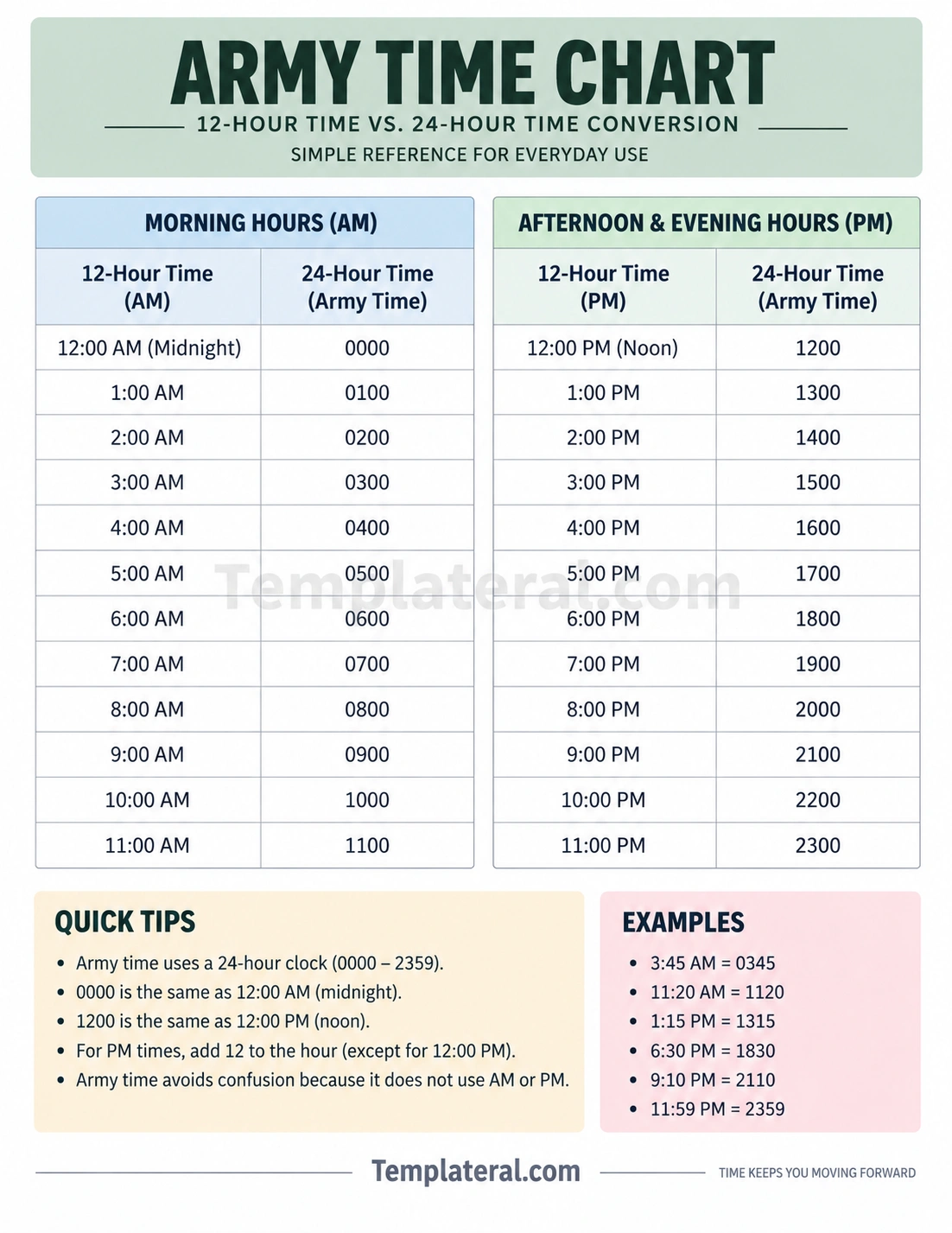
Morning Army Time
Most morning times are simple to convert because the hour stays the same. The main difference is that the hour is written using two digits.
- 12:00 AM = 0000
- 1:00 AM = 0100
- 2:00 AM = 0200
- 3:00 AM = 0300
- 4:00 AM = 0400
- 5:00 AM = 0500
- 6:00 AM = 0600
- 7:00 AM = 0700
- 8:00 AM = 0800
- 9:00 AM = 0900
- 10:00 AM = 1000
- 11:00 AM = 1100
Afternoon and Evening Army Time
PM conversions are slightly different. For most PM hours, add 12 to the standard hour. For example, 2:00 PM becomes 1400 because 2 + 12 = 14.
- 12:00 PM = 1200
- 1:00 PM = 1300
- 2:00 PM = 1400
- 3:00 PM = 1500
- 4:00 PM = 1600
- 5:00 PM = 1700
- 6:00 PM = 1800
- 7:00 PM = 1900
- 8:00 PM = 2000
- 9:00 PM = 2100
- 10:00 PM = 2200
- 11:00 PM = 2300
How to Read an Army Time Chart
Reading an army time chart is easier when you separate the four digits into two parts. The first two digits indicate the hour, and the last two digits indicate the minutes.
For example, consider 1845. The first two digits, 18, represent the hour. The last two digits, 45, represent the minutes. Therefore, 1845 means 6:45 PM.
Another example is 0920. The 09 represents the hour and 20 represents the minutes, so the time is 9:20 AM.
What Does the First Two Digits Mean?
The first two digits represent the hour on a 24-hour scale. The possible hour values range from 00 to 23.
- 00 = midnight hour
- 01–11 = morning hours
- 12 = noon hour
- 13–23 = afternoon and evening hours
What Does the Last Two Digits Mean?
The final two digits represent the minutes. They range from 00 through 59.
For example, 1545 means 15 hours and 45 minutes. Since 15 is greater than 12, subtract 12 from the hour: 15 − 12 = 3. Therefore, 1545 is 3:45 PM.
How to Convert Standard Time to Army Time
Converting standard time to army time only requires a few simple steps.
Converting AM Times
For times from 1:00 AM through 11:59 AM, keep the hour and add a leading zero when necessary. Keep the minutes unchanged.
For example:
- 6:15 AM → 0615
- 8:30 AM → 0830
- 10:45 AM → 1045
- 11:59 AM → 1159
Midnight is the important exception. 12:00 AM is written as 0000, not 1200.
Converting PM Times
For most PM times, add 12 to the hour while leaving the minutes unchanged.
For example:
- 1:20 PM → 1320
- 3:45 PM → 1545
- 6:30 PM → 1830
- 9:10 PM → 2110
- 11:59 PM → 2359
Noon is the exception. 12:00 PM is written as 1200.
How to Convert Army Time to Standard Time
Converting in the opposite direction is just as simple. First, look at the hour represented by the first two digits.
- If the hour is between 01 and 11, it is AM.
- If the hour is 12, it is PM.
- If the hour is between 13 and 23, subtract 12 and use PM.
- If the hour is 00, use 12 AM for standard 12-hour notation.
For example, 1630 represents 16:30 in the 24-hour clock. Subtract 12 from 16 to get 4, so 1630 is 4:30 PM.
Army Time Conversion Examples
- 0030 = 12:30 AM
- 0345 = 3:45 AM
- 0725 = 7:25 AM
- 1120 = 11:20 AM
- 1200 = 12:00 PM
- 1315 = 1:15 PM
- 1530 = 3:30 PM
- 1830 = 6:30 PM
- 2110 = 9:10 PM
- 2359 = 11:59 PM
Why Use an Army Time Chart?
A printable army time chart can be useful when you frequently work with 24-hour schedules but still think naturally in the 12-hour clock.
Keeping a reference chart nearby can help students, employees, travelers, shift workers, and anyone learning a new time format. It can also be useful when reading schedules that list times without AM or PM.
Benefits of Using a Printable Chart
- Quick reference: Find the equivalent time without performing the conversion mentally.
- Less confusion: A 24-hour format clearly separates morning and evening hours.
- Easy learning: Repeatedly comparing both formats helps build familiarity.
- Convenient: A printed reference can be placed near a desk, planner, classroom, or workspace.
- Useful for schedules: It provides a quick way to interpret 24-hour timetables.
Common Army Time Mistakes to Avoid
Most errors occur around midnight, noon, and PM conversions. Understanding these exceptions can make the 24-hour clock much easier to use.
Confusing Midnight and Noon
One of the most common mistakes is confusing 0000 and 1200. Remember that 0000 represents midnight, while 1200 represents noon.
Forgetting the Leading Zero
Times such as 5:30 AM should be written as 0530 rather than 530 when using four-digit army time notation. The leading zero makes the format consistent and easier to scan.
Adding 12 to Noon
Do not add 12 to 12:00 PM. Noon is already represented by 1200. Adding 12 would incorrectly produce 2400, which is not the normal representation of noon.
Forgetting to Convert PM Hours
A time such as 7:00 PM is not 0700. The correct 24-hour representation is 1900. For PM hours from 1 through 11, add 12 to the hour.
Tips for Learning Army Time Faster
The 24-hour clock may seem unfamiliar at first, but regular practice makes conversion almost automatic.
- Memorize the sequence from 1300 through 2300.
- Remember that 1200 is noon and 0000 is midnight.
- Practice converting everyday times into four-digit notation.
- Use a printable army time chart as a quick reference while learning.
- Practice converting in both directions instead of only from standard time to army time.
- Pay special attention to the leading zero for morning times.
A useful shortcut is to remember that the PM hours after noon follow this sequence: 1300, 1400, 1500, 1600, and so on through 2300. Once this sequence becomes familiar, most conversions require very little thought.
Army Time Chart for Everyday Reference
An army time chart is more than a conversion table. It can serve as a simple reference tool whenever a schedule uses the 24-hour clock. The most important values to remember are 0000 for midnight, 1200 for noon, and 1300 through 2300 for the afternoon and evening hours.
For precise times, simply preserve the minutes during conversion. For example, 2:17 PM becomes 1417, while 8:42 PM becomes 2042. The minutes do not change; only the hour needs to be converted.
Conclusion
An army time chart provides a simple way to learn and reference the 24-hour clock. By understanding the difference between AM and PM, remembering the special cases for midnight and noon, and learning the basic conversion rules, you can quickly read and write army time.
For morning times, use a leading zero when needed and keep the hour unchanged. For most PM times, add 12 to the hour. When converting back to standard time, subtract 12 from hours greater than 12. With regular practice, these conversions become easy to recognize without referring to a chart.
A printable army time chart can remain useful as a quick visual reference whenever you encounter schedules, timetables, or documents that use 24-hour time.
Download: Army Time Chart Template
