A bullet journal is a simple and flexible way to organize your goals, manage daily tasks, and track your progress in one place. Instead of using separate planners for studying, fitness, personal projects, and household chores, you can bring everything together in a single notebook or printable planner.
Whether you want to build better habits, lose weight, write a book, or create a more organized daily routine, a bullet journal can help you turn your plans into manageable actions. You can customize each page to match your needs, add new goals whenever necessary, and review your progress without creating unnecessary clutter.
In this guide, you will learn how to create a bullet journal, what pages to include, and how to use a simple bullet journal template to stay organized and make consistent progress toward your goals.
What Is a Bullet Journal?
A bullet journal is a customizable planning system that combines a to-do list, calendar, personal journal, and habit tracker. It helps you record important tasks, organize your schedule, and monitor your progress in one convenient place.
Unlike a traditional planner with fixed sections, a bullet journal allows you to decide what to include. You can create pages for monthly goals, weekly plans, daily tasks, personal development, fitness routines, or any other area of your life.
You can use a blank notebook, a dotted journal, a digital document, or a printable bullet journal template. The best option is the one that feels comfortable and makes it easy to maintain your planning routine.
Who Can Benefit From a Bullet Journal?
A bullet journal can be useful for almost anyone who wants to organize multiple responsibilities. For example, you can use it to:
- Plan study sessions, assignments, and exam preparation.
- Track exercise, meals, water intake, and fitness goals.
- Organize writing projects, creative work, and personal goals.
- Build positive habits and reduce unwanted behaviors.
- Manage household chores, cleaning schedules, and errands.
- Monitor deadlines, appointments, and weekly priorities.
Because every page is customizable, you can start with a few essential sections and expand your journal as your needs change.
Why Use a Bullet Journal to Track All Your Goals?
Managing several goals can become overwhelming when your information is scattered across different notebooks, applications, and pieces of paper. A bullet journal gives you one central place to organize your plans and review what matters most.
Keep Everything in One Place
Instead of maintaining separate planners for different activities, you can organize your personal and professional goals in one journal. Your weekly schedule, habit tracker, project notes, and task lists can all stay together.
Make Progress Easier to Measure
Writing down your goals makes it easier to identify what you want to accomplish. You can record starting points, set target dates, and check off completed tasks. Reviewing these details regularly helps you understand what is working and where you need to make adjustments.
Customize Your Planning System
Your goals may change throughout the year, and your planning system should be flexible enough to change with them. You can add a new project page, remove an unused habit tracker, or create a dedicated section for a new priority without replacing your entire planner.
Reduce Clutter and Distractions
A well-organized bullet journal helps you focus on relevant information instead of keeping multiple planning systems updated. Simple headings, checkboxes, and clear sections make your pages easier to use and review.
Essential Bullet Journal Pages to Include
You do not need dozens of pages to create an effective bullet journal. Start with a few practical sections that support your current goals. The following pages provide a useful foundation for a personalized planning system.
1. Goals Page
Use a goals page to record the outcomes you want to achieve. You can include personal, academic, professional, and household goals in the same section.
For each goal, write a clear description and consider adding a deadline or a measurable target. For example, instead of writing “get fit,” you could write “exercise three times a week for the next month.”
Keep the list realistic. A short list of meaningful goals is usually easier to manage than a long list of ambitions without a clear plan.
2. Monthly Planning Page
A monthly planning page helps you see upcoming responsibilities and important milestones at a glance. Use it to record appointments, deadlines, events, and the main outcomes you want to achieve during the month.
At the beginning of each month, review your goals and select a few priorities. Break larger projects into smaller steps that fit your available time.
3. Weekly Plan
A weekly plan turns your monthly goals into specific actions. Assign tasks to individual days, reserve time for important activities, and leave some flexibility for unexpected responsibilities.
For example, if your goal is to write a book, your weekly plan might include outlining one chapter, writing for 30 minutes on three days, and reviewing your progress on Sunday.
4. Habit Tracker
A habit tracker helps you monitor recurring behaviors over time. You can use checkboxes, symbols, or a simple grid to record whether you completed a habit each day or week.
Useful habits to track include:
- Reading for 20 minutes.
- Exercising or taking a daily walk.
- Practicing a new skill.
- Following a regular sleep schedule.
- Spending time on a personal project.
- Completing a daily cleaning routine.
Choose only a few habits at first. The purpose of a habit tracker is to provide useful feedback, not to create pressure to achieve a perfect record.
5. To-Do List
A to-do list provides a straightforward place to capture tasks that need attention. Write down actionable items, such as sending an email, finishing an assignment, organizing a cupboard, or preparing a document.
Prioritize tasks according to importance and deadlines. If a task is too large to complete in one sitting, divide it into smaller steps that are easier to start and finish.
6. Notes and Progress Tracker
A notes section gives you space to record ideas, lessons learned, reminders, and observations. A progress tracker complements these notes by showing how far you have moved toward a specific goal.
For example, you could record the starting point, current status, and target for a writing project, a study plan, or a fitness milestone. Reviewing this information monthly helps you decide whether your approach needs to change.
How to Create a Bullet Journal Step by Step
Creating a bullet journal does not require artistic skills or expensive stationery. Follow these practical steps to build a system you can maintain.
Step 1: Identify Your Main Goals
Start by listing the areas of your life you want to improve or manage. These might include health, education, work, relationships, personal development, and home organization.
Choose a few goals that matter most right now. You can add more later when your schedule allows.
Step 2: Choose Your Journal Format
Decide whether you prefer a notebook, a digital planner, or a printable bullet journal worksheet. A notebook offers freedom to draw and rearrange pages, while a printable template provides a ready-made structure without requiring you to design everything yourself.
If you want a quick and organized starting point, a printable template can help you begin planning immediately.
Step 3: Set Up Your Essential Sections
Create sections for goals, priorities, weekly planning, habits, tasks, notes, and progress. You can keep these sections on separate pages or combine them into a single worksheet, depending on how much information you need.
Use consistent headings and simple symbols so you can quickly find the information you need.
Step 4: Break Goals Into Small Actions
Large goals can feel difficult when you focus only on the final result. Break each goal into smaller tasks that you can complete within a day or a week.
For example, if you want to learn a new language, your first steps might be learning ten new words, completing one lesson, and practicing for 15 minutes each day.
Step 5: Review and Update Regularly
Spend a few minutes each day checking your tasks and updating your journal. At the end of the week, review completed activities, unfinished tasks, and any obstacles that affected your progress.
At the end of the month, evaluate your goals and adjust your plans. Move unfinished tasks to a realistic date, remove goals that are no longer relevant, and celebrate meaningful progress.
Bullet Journal Template: A Simple Way to Stay Organized
If designing journal pages from scratch sounds time-consuming, a printable bullet journal template can simplify the process. A ready-made layout gives you designated spaces for your goals, priorities, weekly schedule, habits, notes, and progress.
You can print the worksheet and fill it in by hand, or use its layout as inspiration for your own notebook. Start with the sections you need most and adapt the system as your goals evolve.
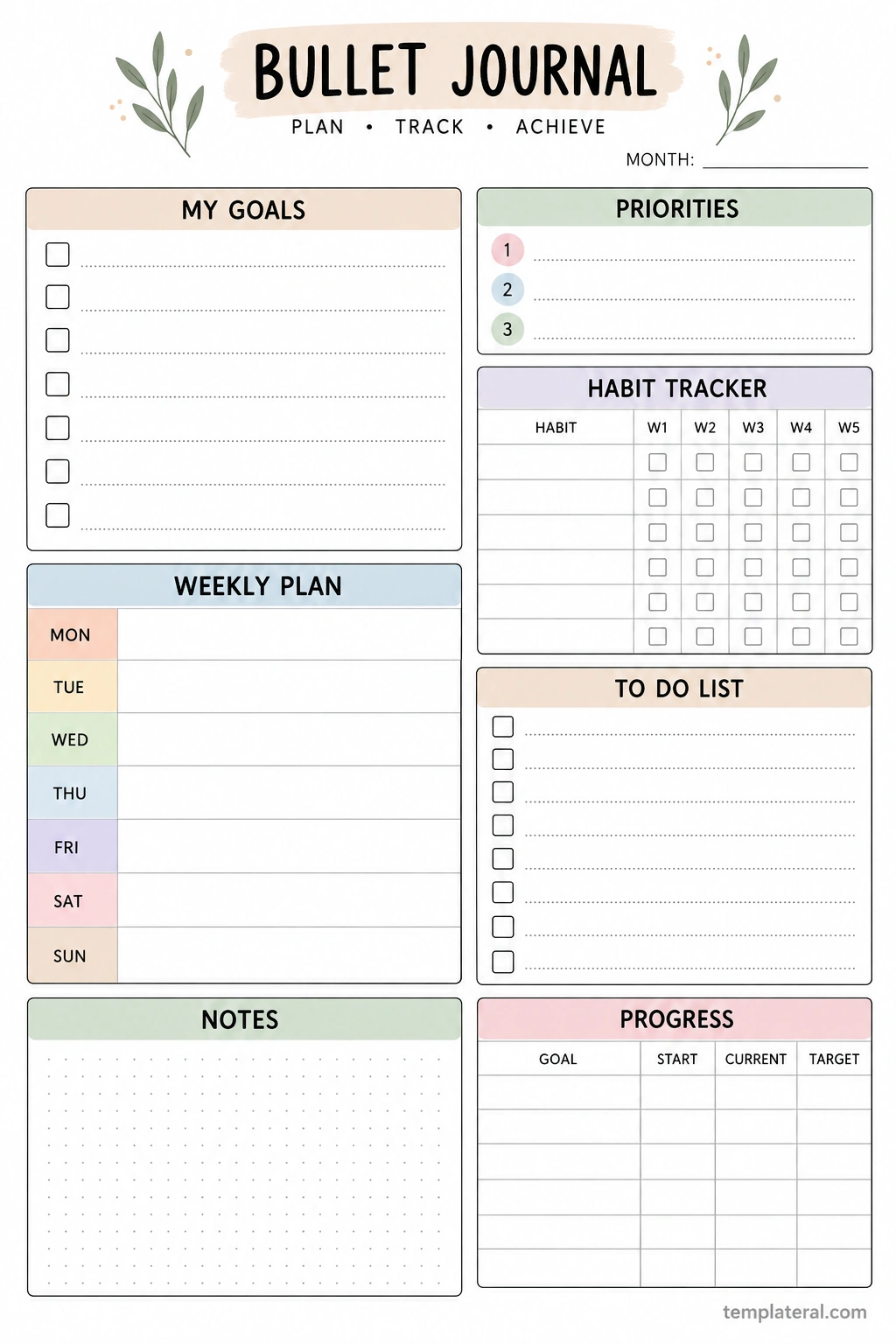
A flexible template can also help prevent your journal from becoming cluttered. Instead of adding unnecessary pages, keep the sections that support your goals and simplify those you rarely use.
Tips for Maintaining an Effective Bullet Journal
The best bullet journal is not necessarily the most decorative one. It is the one you use consistently. These tips can help you keep your planning system practical and manageable.
Keep Your Layout Simple
Use clear headings, checkboxes, and enough writing space. You can add colors or decorative elements if they make your journal more enjoyable, but avoid spending so much time decorating that you neglect the actual planning.
Focus on a Few Priorities Each Day
Choose two or three important tasks to complete each day. A long task list can make it difficult to identify what deserves your attention first.
Be Flexible With Unfinished Tasks
Not every task will be completed as planned. Review unfinished items and decide whether to reschedule, simplify, delegate, or remove them. Avoid carrying unnecessary tasks from one week to the next.
Track Progress Instead of Perfection
Missing a habit once does not mean you have failed. Look at your overall consistency and identify what helps you maintain the behavior. A useful journal supports improvement rather than creating unrealistic expectations.
Make Time for Weekly Reviews
Set aside 10 to 15 minutes each week to review your schedule, celebrate completed tasks, and prepare for the next week. Regular reviews help your journal remain relevant as your responsibilities change.
Common Bullet Journal Mistakes to Avoid
A bullet journal should make life easier, not create another responsibility that feels difficult to manage. Avoid these common mistakes:
- Tracking too many habits: Begin with a small number of habits and add more only when your routine is established.
- Setting vague goals: Replace general intentions with specific actions and measurable outcomes.
- Creating overly complicated layouts: Use a simple structure that is quick to update and easy to read.
- Skipping reviews: Check your journal regularly so unfinished tasks and outdated goals do not accumulate.
- Expecting perfect consistency: Treat missed days as opportunities to adjust your approach rather than reasons to abandon your plan.
Frequently Asked Questions About Bullet Journals
What should I write in a bullet journal?
You can write goals, daily tasks, weekly schedules, habit trackers, reminders, project plans, personal notes, and progress updates. Choose sections based on your current responsibilities and priorities.
Can I use one bullet journal for all my goals?
Yes. A bullet journal can combine several areas of your life, including studying, fitness, personal projects, habit building, and household chores. Organize each area into a clearly labeled section so your information remains easy to find.
Is a bullet journal better than a traditional planner?
It depends on your preferences. A traditional planner provides a predefined layout, while a bullet journal offers more flexibility to customize pages and track different types of goals. A printable bullet journal template combines some of the convenience of a traditional planner with the flexibility of a customizable system.
How often should I update my bullet journal?
Update your task list daily when possible, review your weekly plan at the end of each week, and reassess your larger goals monthly. You can adjust this schedule to match your workload and personal routine.
Do I need an artistic bullet journal?
No. A bullet journal can be plain and functional. Simple lists, checkboxes, and tables are enough to organize your goals and track your progress. Decorative elements are optional.
Can beginners use a printable bullet journal template?
Absolutely. A printable template gives beginners a ready-made structure for planning and tracking without having to design every page themselves. It is also useful for experienced journal users who prefer a clean, consistent layout.
Conclusion
A bullet journal is a practical way to bring your goals, daily responsibilities, and personal habits together in one organized place. It allows you to plan your schedule, track recurring activities, record ideas, and measure progress without maintaining several separate planners.
Start with a simple layout that includes goals, priorities, a weekly plan, a habit tracker, a to-do list, and a progress section. Review your journal regularly and adjust it whenever your needs change.
Whether you use a notebook or a printable bullet journal template, consistency matters more than perfection. Choose a system that works for you, take small steps toward your goals, and use your journal to make progress easier to see and maintain.
Download: Bullet Journal Template
