Writing an autobiographical example can be challenging because every person’s life contains different experiences, memories, relationships, achievements, and challenges. There is no single story that can represent everyone, and that is what makes autobiographical writing unique.
The difficulty is often not finding something to write about, but deciding which experiences are important enough to include. A person’s life may contain hundreds of memorable moments, yet an effective autobiographical essay needs to focus on the events that reveal something meaningful about the writer.
A strong autobiography does more than describe what happened. It explains how important experiences shaped your personality, influenced your choices, changed your perspective, or taught you valuable lessons. With the right structure, you can turn a collection of memories into a clear and engaging personal story.
What Is an Autobiographical Example?
An autobiographical example is a sample of writing that tells the story of the author’s own life. Unlike a biography, which is generally written by another person, an autobiography is written from the perspective of the person whose life is being described.
An autobiographical essay can cover an entire life or focus on a particular period, experience, challenge, relationship, achievement, or turning point. The appropriate focus depends on the purpose of the assignment.
A personal autobiography may include:
- Early childhood experiences
- Family and personal background
- Education and school experiences
- Important friendships and relationships
- Major challenges or obstacles
- Significant achievements
- Important decisions
- Turning points
- Personal lessons
- Future goals
The best topics are not necessarily the most dramatic events. Sometimes an ordinary experience can become meaningful when it reveals an important lesson or explains how the writer changed.
What Makes an Autobiographical Essay Stand Out?
A memorable autobiographical essay combines personal experiences with reflection. The reader should understand not only what happened but also why the experience mattered to you.
A Personal Voice
An autobiography should sound like the person who lived the story. Use a natural first-person voice and describe experiences from your own perspective.
Your thoughts, feelings, observations, and reflections can make the writing more personal than a simple chronological list of events.
Meaningful Topics
Choose experiences that contributed to your development. You do not need to document every birthday, school year, vacation, or ordinary day.
Instead, focus on moments that changed something about you or helped shape your values, interests, relationships, or goals.
Specific Details
Specific details can make a personal story easier to understand and remember. Rather than saying that an experience was difficult, explain what happened and how you responded.
Personal Reflection
Reflection is one of the most important parts of autobiographical writing. After describing an event, explain what you learned from it and whether it changed the way you think or act.
Essential Topics for an Autobiographical Example
Choosing the right topics can be one of the hardest parts of writing an autobiography. The following areas can help you identify experiences worth exploring.
1. Early Life and Childhood
Your early years can provide important background for the rest of your story. Consider the place where you grew up, your family environment, childhood interests, friendships, traditions, and memorable experiences.
You do not need to describe your entire childhood. Select details that help explain your personality or later development.
2. Family and Personal Influences
Think about the people, environments, and experiences that influenced your development. A family member, teacher, friend, coach, or community may have played an important role in shaping your perspective.
When writing about another person, focus on how that relationship affected you rather than turning the essay into someone else’s biography.
3. Education
Education can be an important part of an autobiographical essay. Think about teachers who influenced you, subjects you enjoyed, academic difficulties, school activities, important friendships, or experiences that changed your career interests.
The most useful educational experiences are those that reveal something about your growth or future direction.
4. Important Experiences
Identify events that changed your perspective or influenced your decisions. These can include both positive and difficult experiences.
- Moving to a new city or school
- Learning a new skill
- Meeting an influential person
- Starting a new activity
- Overcoming a difficult situation
- Experiencing failure
- Achieving an important goal
- Taking on a new responsibility
5. Challenges and Obstacles
Challenges can reveal character and personal growth. If you include a difficult experience, focus on the journey rather than simply describing the problem.
Explain what happened, how you responded, what you learned, and whether the experience changed your behavior or perspective.
6. Achievements
Achievements can include academic accomplishments, personal milestones, creative projects, sports experiences, professional accomplishments, or goals that required significant effort.
Rather than creating a simple list of achievements, explain why each selected accomplishment was meaningful to you.
7. Lessons Learned
Consider the lessons that have stayed with you. An experience might have taught you about patience, responsibility, persistence, independence, communication, leadership, friendship, or resilience.
These reflections can provide the deeper meaning behind your life story.
8. Future Goals
Some autobiographical essays benefit from ending with a discussion of future goals. Explain what you hope to accomplish and how your past experiences have influenced those aspirations.
How to Choose the Best Experiences to Include
One of the biggest challenges in writing an autobiographical essay is deciding which memories deserve attention. Start by creating a simple timeline of your life.
Write down important events without worrying about grammar or organization. Once you have a list, look for experiences that had a lasting effect on you.
Ask yourself these questions:
- Which memory do I remember most clearly?
- Which experience changed me?
- What challenge taught me an important lesson?
- Who had a meaningful influence on my life?
- What achievement am I proud of?
- Which mistake helped me grow?
- When did my goals change?
- What experience best represents who I am?
The answers can help you identify the central experiences for your autobiographical essay.
How to Structure an Autobiographical Essay
A clear structure makes an autobiographical essay easier to write and easier for readers to follow. You can organize your story chronologically or arrange it around a central theme.
Introduction
Introduce yourself and establish the main focus of your story. Instead of attempting to summarize your entire life, introduce the experiences or theme that will guide the essay.
Early Life
Provide relevant background information about your childhood, family, community, and early influences.
Education and Development
Describe educational experiences and other events that contributed to your personal development.
Important Experiences
Focus on the major events, challenges, decisions, or turning points that shaped your perspective.
Achievements and Growth
Discuss meaningful accomplishments and explain what you learned while working toward them.
Reflection
Connect the experiences together and explain how they influenced the person you are today.
Conclusion
Summarize the main idea of your life story and, when appropriate, connect your past experiences to your future goals.
How to Start an Autobiographical Essay
The opening paragraph should introduce your story without overwhelming the reader with too many details. A strong opening can begin with a meaningful memory, an important realization, a significant challenge, or a central idea about your life.
For example, instead of beginning with a long list of dates and locations, you might describe a moment when you realized that your goals had changed. You can then provide the background needed to explain how you reached that moment.
A useful introduction should:
- Introduce the writer
- Establish the subject or theme
- Provide relevant context
- Create interest in the story
How to Write an Autobiographical Example Step by Step
Step 1: Brainstorm Your Memories
Write down important events, people, achievements, challenges, and lessons without trying to organize them immediately.
Step 2: Select the Most Meaningful Topics
Review your list and remove experiences that do not contribute to the main story. Look for events that reveal growth, change, or an important part of your identity.
Step 3: Identify a Central Theme
A central theme can help connect separate memories. Your theme might involve personal growth, overcoming challenges, discovering a passion, becoming independent, or learning from failure.
Step 4: Create an Outline
Arrange your selected experiences into a logical order. Decide whether chronological order or a thematic structure will work better for your story.
Step 5: Write the First Draft
Focus on getting your ideas onto the page. Do not spend too much time trying to make every sentence perfect during the first draft.
Step 6: Add Reflection
After describing important events, explain what they meant to you. This is where your personal perspective becomes especially important.
Step 7: Edit and Revise
Read your essay again and remove unnecessary details, repeated ideas, unclear sentences, and sections that do not support your central theme.
Autobiographical Example Topics for Students
Students can choose from many different topics when writing an autobiographical essay. The best topic depends on the assignment and the writer’s experiences.
- The experience that changed my perspective
- A person who influenced my life
- My most important childhood memory
- A challenge I learned to overcome
- How I discovered my passion
- An achievement I am proud of
- A mistake that taught me an important lesson
- My transition to a new school
- An experience that changed my future goals
- What I have learned about myself
Autobiographical Writing Tips
Be Honest and Authentic
Your story does not need to sound dramatic to be interesting. Authentic experiences and genuine reflection are often more effective than exaggerated storytelling.
Show Rather Than Simply Tell
Whenever possible, use specific details to demonstrate your experiences. Describe what happened and how you responded instead of relying only on general statements.
Keep the Story Focused
Trying to include every important event can make an autobiography feel like a list. Select the experiences that support your central message.
Balance Events With Reflection
Give readers enough information to understand what happened, but also explain why the event mattered. The combination of storytelling and reflection creates a stronger personal narrative.
Use Transitions
Connect different stages of your story with clear transitions. This helps readers understand how one experience relates to another.
Common Mistakes to Avoid
Even a well-chosen topic can become difficult to follow if the essay lacks organization. Avoid these common problems:
- Trying to include every event from your life
- Listing events without explaining their significance
- Including too many unrelated memories
- Using vague descriptions
- Focusing only on achievements
- Ignoring personal reflection
- Repeating the same ideas
- Changing the point of view unnecessarily
- Ending without a meaningful conclusion
How to Use an Autobiographical Example Template
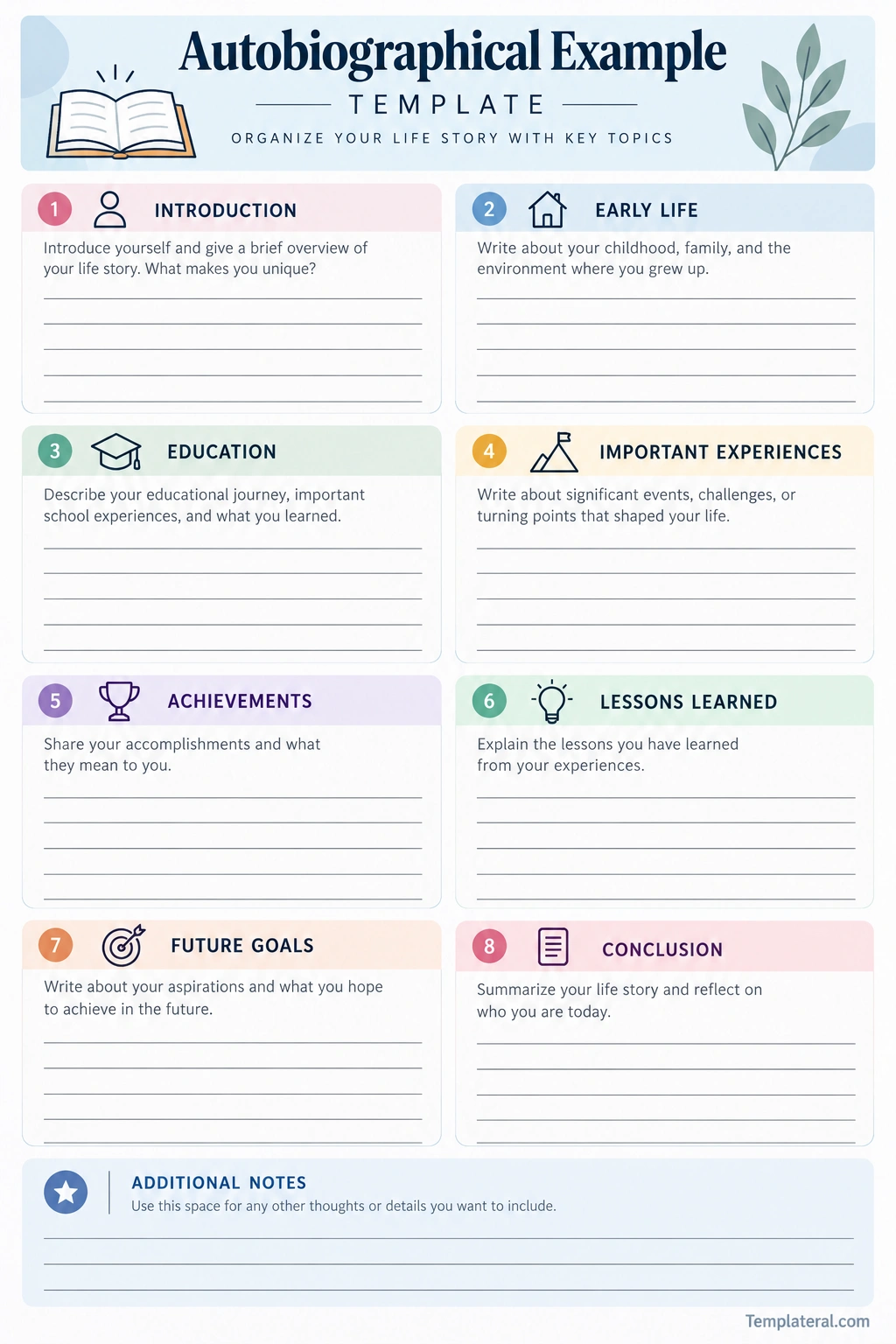
An Autobiographical Example Template can help you organize your ideas before writing the full essay. Instead of staring at a blank page, you can begin by filling in short notes under several essential topics.
Start with your introduction and early life. Then record important educational experiences, significant events, achievements, lessons learned, and future goals. Use the conclusion section to identify the main idea you want readers to remember.
The template can be used as a brainstorming worksheet, an essay planning tool, or a guide for organizing a first draft. Once your ideas are complete, turn the strongest points into full paragraphs.
Autobiographical Essay Checklist
Before submitting your autobiographical essay, review your work using this simple checklist.
- Does the introduction clearly introduce the story?
- Have I selected meaningful experiences?
- Does each major event contribute to the main theme?
- Have I included specific details?
- Have I explained what I learned from important experiences?
- Is the essay organized logically?
- Does my writing sound personal and authentic?
- Have I removed unnecessary repetition?
- Does the conclusion provide meaningful reflection?
- Have I checked grammar, spelling, and punctuation?
Frequently Asked Questions About Autobiographical Examples
What is an autobiographical example?
An autobiographical example is a sample personal life story written by the person whose experiences are being described. It may cover an entire life or focus on selected experiences, challenges, achievements, and lessons.
What should an autobiographical essay include?
An autobiographical essay can include early life, family influences, education, important experiences, challenges, achievements, personal growth, lessons learned, and future goals. The exact content depends on the purpose of the essay.
How do you start an autobiographical essay?
Start by introducing yourself and establishing the central idea or experience that will guide your story. A meaningful memory, turning point, or personal realization can provide an engaging opening.
How do I choose topics for an autobiography?
Begin by listing important memories, people, achievements, challenges, and turning points. Then choose the experiences that best explain your development or support the central theme of your story.
What is the difference between an autobiography and a biography?
An autobiography is written by the person whose life is being described, while a biography is generally written by another person about someone’s life.
Can I use an autobiographical example template?
Yes. An autobiographical example template can help organize important life events and ideas before you begin writing the complete essay. It can also make it easier to identify gaps in your story and arrange topics in a logical order.
Conclusion
Writing an autobiographical example is not about documenting every event in your life. It is about selecting the experiences that reveal who you are, how you have changed, and what you have learned.
Start by brainstorming important memories, identify the events that had the greatest influence on you, and organize them around a clear theme. Add specific details and personal reflection to show why those experiences matter.
With a structured outline or an Autobiographical Example Template, the process becomes easier because you can organize your ideas before turning them into a complete personal narrative. Your experiences do not need to be identical to anyone else’s. Their uniqueness is precisely what can make your autobiographical essay meaningful.
