An audit result is the outcome of an audit that communicates what the auditor found after reviewing financial records, processes, controls, or other areas within an organization. Clear audit results help management understand whether requirements were met, what problems were identified, and what actions may be needed.
A well-prepared audit result should be factual, organized, and supported by sufficient audit evidence. It should not simply list problems. Instead, it should explain important findings, their potential impact, and the recommended actions for improvement.
Whether you are preparing an internal audit report, financial audit report, compliance review, or operational audit, using a consistent format can make the final document easier to understand and act upon.
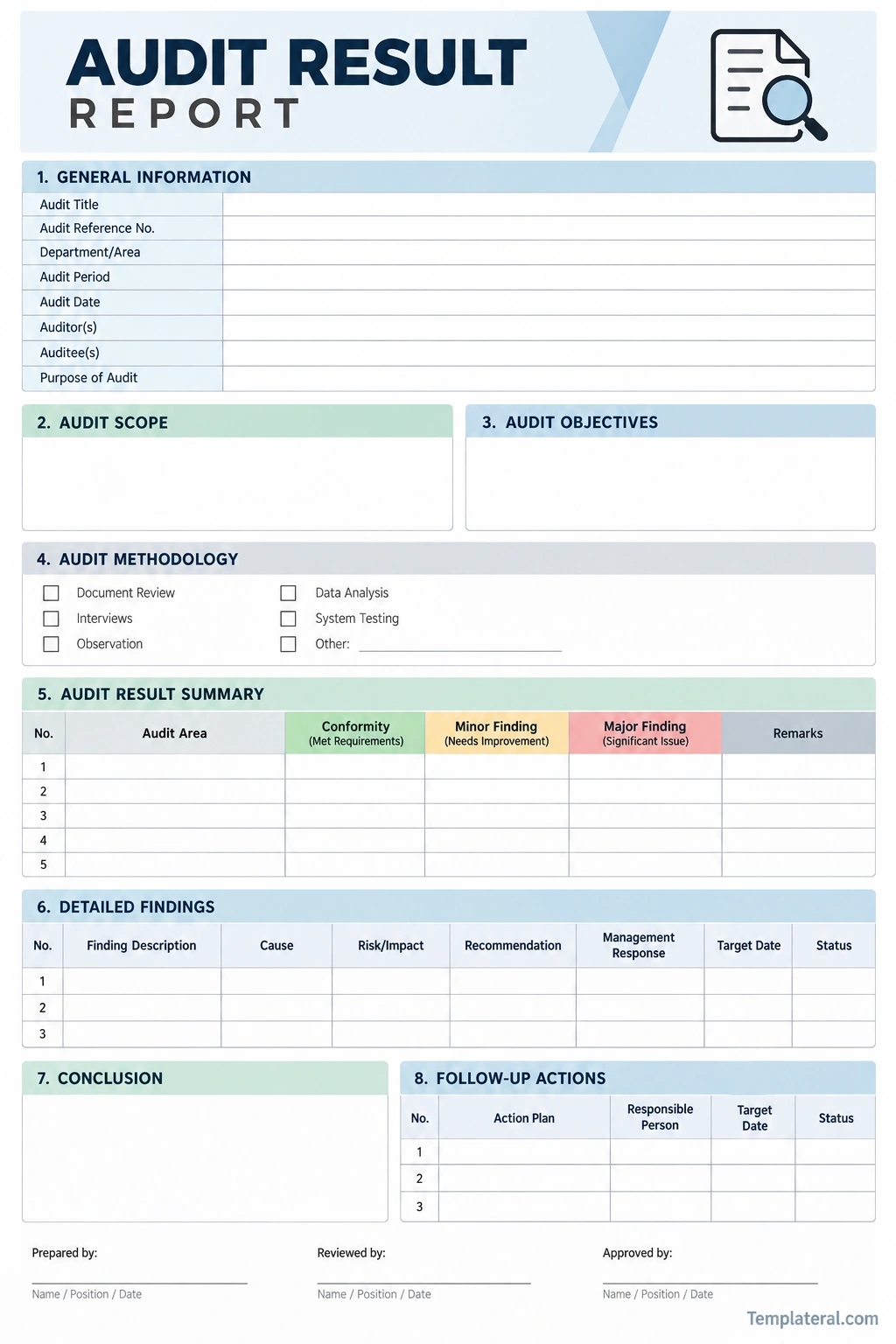
What Is an Audit Result?
An audit result is a summary of the conclusions and findings reached during an audit. It communicates the outcome of the auditor’s examination and provides relevant information to the people responsible for reviewing or addressing the results.
Depending on the type of audit, the result may indicate that an area is operating as expected, that improvements are needed, or that significant issues require corrective action.
An audit result may include information such as:
- Audit objectives and scope
- Audit procedures performed
- Areas reviewed
- Audit evidence examined
- Findings and observations
- Risks or potential impacts
- Recommendations
- Management responses
- Corrective actions
- Final conclusions
The exact contents depend on the purpose, scope, and reporting requirements of the audit.
Why Are Audit Results Important?
Audit results provide a structured way to communicate what an audit discovered. Without a clear presentation, even useful audit evidence can be difficult for management or other stakeholders to interpret.
They Communicate Important Findings
A good audit result identifies significant observations and explains why they matter. This allows management to focus attention on areas that may require improvement.
They Support Better Decisions
Audit findings can provide useful information for management when reviewing controls, processes, compliance, financial reporting, and operational performance.
They Encourage Corrective Action
When findings include practical recommendations and responsible parties, an audit result can become a useful starting point for corrective action and follow-up.
They Create a Record of the Audit
A documented audit result provides a record of what was reviewed, what was identified, and how the organization responded. This can be useful for future audits and internal monitoring.
Key Components of an Audit Result
A professional audit result should contain enough information for the reader to understand the work performed and the significance of the findings. The following sections can be adapted to the requirements of your organization.
1. General Audit Information
Start the report with basic information that identifies the audit. This section provides context before the reader reviews the findings.
- Audit title
- Audit reference number
- Department or business area
- Audit period
- Audit date
- Auditor or audit team
- Auditee or responsible department
- Purpose of the audit
2. Audit Scope
The audit scope explains what was included in the review. It may identify specific departments, processes, transactions, systems, locations, or periods covered by the audit.
A clearly defined scope helps readers understand the boundaries of the audit result. It also prevents readers from assuming that the audit covered areas that were outside the agreed scope.
3. Audit Objectives
The audit objectives explain what the audit was intended to determine. Objectives should be specific enough to connect the audit procedures with the final results.
For example, an audit objective may be to assess whether selected procedures are being followed, determine whether controls are operating as designed, or identify opportunities for process improvement.
4. Audit Methodology
The methodology describes the general procedures used to obtain and evaluate audit evidence. Depending on the engagement, this may include document review, interviews, observation, data analysis, sampling, or testing.
Explaining the methodology helps readers understand how the audit team reached its conclusions.
How to Present Audit Findings
Audit findings are among the most important parts of an audit result. Each finding should be presented clearly and supported by appropriate evidence.
Finding Description
Describe what was identified during the audit. Use specific and objective language rather than vague statements.
Audit Criteria
Where applicable, explain the requirement, policy, procedure, regulation, standard, or other criteria used to evaluate the condition.
Condition
The condition describes what the auditor actually observed. It should be based on evidence obtained during the audit.
Cause
When the cause can be reasonably determined, explain why the condition occurred. Identifying the underlying cause can help management develop a more effective corrective action.
Risk or Impact
Explain the potential consequence of the finding. Depending on the audit, the impact may relate to financial reporting, compliance, operations, data accuracy, security, efficiency, or other business risks.
Recommendation
A recommendation should describe a practical action that could address the finding or reduce the associated risk. Recommendations should be clear enough for management to evaluate and implement.
Audit Result Categories
Organizations may use different classifications for audit results. The categories should be defined clearly so that readers understand what each classification means.
Conformity
A conformity result generally indicates that the area reviewed met the applicable requirements or criteria within the scope of the audit.
Minor Finding
A minor finding may identify a limited issue that requires attention but does not represent the same level of concern as a significant deficiency. The exact definition should follow the organization’s audit methodology.
Major Finding
A major finding generally represents a more significant issue that may require timely management attention and corrective action. The classification should be based on defined audit criteria rather than personal judgment.
Observation or Improvement Opportunity
Some audit programs also record observations or opportunities for improvement. These may highlight areas where processes could become more effective even when a formal nonconformity has not been identified.
How to Write an Effective Audit Result
Writing an audit result requires a balance between accuracy, clarity, and useful detail. The report should provide enough information to support the conclusion without overwhelming the reader with unnecessary information.
Use Objective Language
Write what the evidence demonstrates. Avoid emotional, accusatory, or speculative language. An audit report should communicate facts and conclusions in a professional manner.
Be Specific
Instead of writing that a process is “not working properly,” identify the specific condition, requirement, evidence, and impact involved.
Connect Findings to Evidence
Each significant finding should be supported by relevant audit evidence. Readers should be able to understand how the audit team arrived at the stated result.
Focus on Material Issues
Not every observation needs the same level of attention. Organize findings according to the significance established by the audit methodology and reporting criteria.
Make Recommendations Practical
A recommendation should be realistic and relevant to the finding. Whenever appropriate, identify the responsible person or department and establish a target completion date.
Audit Result Summary Example
An audit result summary provides a concise overview of the main outcomes. A simple table can make several findings easier to review.
- Audit Area: Accounts payable
- Result: Minor finding
- Finding: Supporting documentation was incomplete for selected transactions.
- Risk: Incomplete documentation may reduce the ability to verify transaction approval and accuracy.
- Recommendation: Establish a documented review step to confirm required supporting documents before payment processing.
- Management Response: Management agrees to implement an additional documentation review.
- Target Date: Assigned by management
This type of summary gives decision-makers a quick overview while allowing the detailed audit findings section to provide additional information.
Audit Result vs. Audit Report
The terms audit result and audit report are related, but they are not necessarily interchangeable.
An audit result refers to the outcome or findings produced by the audit. An audit report is the formal document used to communicate those results and other relevant information about the engagement.
An audit report may therefore contain the audit results together with the audit scope, objectives, methodology, findings, conclusions, recommendations, and management responses.
Internal Audit Result vs. Financial Audit Result
The format and emphasis of an audit result can vary depending on the type of audit.
Internal Audit Result
An internal audit result often focuses on internal controls, risk management, governance, operational processes, compliance, and opportunities for improvement.
Financial Audit Result
A financial audit result focuses on financial statements and the applicable financial reporting framework. The auditor’s formal reporting requirements depend on the nature of the engagement and the applicable professional standards.
Compliance Audit Result
A compliance audit result focuses on whether activities, records, or processes conform to specified laws, regulations, policies, contracts, standards, or other requirements within the audit scope.
Common Mistakes When Writing an Audit Result
Even a well-planned audit can produce a difficult-to-use report if the findings are poorly presented. Avoid these common mistakes.
- Using vague descriptions instead of specific evidence
- Mixing facts with unsupported assumptions
- Failing to explain the significance of a finding
- Writing recommendations that are too general
- Using inconsistent finding classifications
- Including information outside the audit scope
- Repeating the same information throughout the report
- Failing to document management responses
- Leaving corrective actions without responsible owners or target dates
Tips for Using an Audit Result Template
An audit result template can make reporting more consistent, especially when an organization performs audits regularly. A standardized template also helps ensure that important sections are not accidentally omitted.
Customize the Template
Adapt the template to your audit methodology, organization, industry, and reporting requirements. Not every audit requires the same fields or classifications.
Keep the Format Consistent
Use consistent headings, finding classifications, terminology, and reporting conventions across similar audits. Consistency makes reports easier to review and compare.
Review Before Issuing the Report
Before finalizing the audit result, check that findings are supported by evidence, conclusions are consistent with the work performed, and recommendations address the identified issues.
Audit Result Follow-Up
The audit process should not necessarily end when the report is issued. Follow-up activities can determine whether agreed corrective actions have been completed and whether identified issues have been addressed appropriately.
A follow-up section can include:
- Finding reference number
- Agreed corrective action
- Responsible person or department
- Target completion date
- Implementation status
- Follow-up date
- Verification notes
Tracking these details can turn an audit report from a static document into a practical tool for monitoring improvements.
Final Thoughts on Audit Results
A clear audit result should help readers understand what was examined, what the audit found, why the findings matter, and what should happen next. The strongest reports are factual, organized, evidence-based, and easy for management to act upon.
Using a structured audit result template can simplify the reporting process by organizing general information, audit scope, objectives, methodology, findings, recommendations, conclusions, and follow-up actions in one document.
Before using any template for a formal engagement, make sure its contents and reporting approach are appropriate for the applicable professional standards, organizational policies, and requirements of the specific audit.
Download: Audit Result Template
