A puzzle piece is a small part of a larger picture that connects with other pieces to create a complete image. Beyond traditional jigsaw puzzles, puzzle pieces can be used for classroom activities, crafts, games, decorations, learning exercises, and creative projects.
A printable puzzle piece template makes these activities easier because you can print the shapes, color them, cut them out, and use them in different ways. Teachers, parents, students, and crafters can adapt a simple puzzle piece outline to create activities that match their needs.
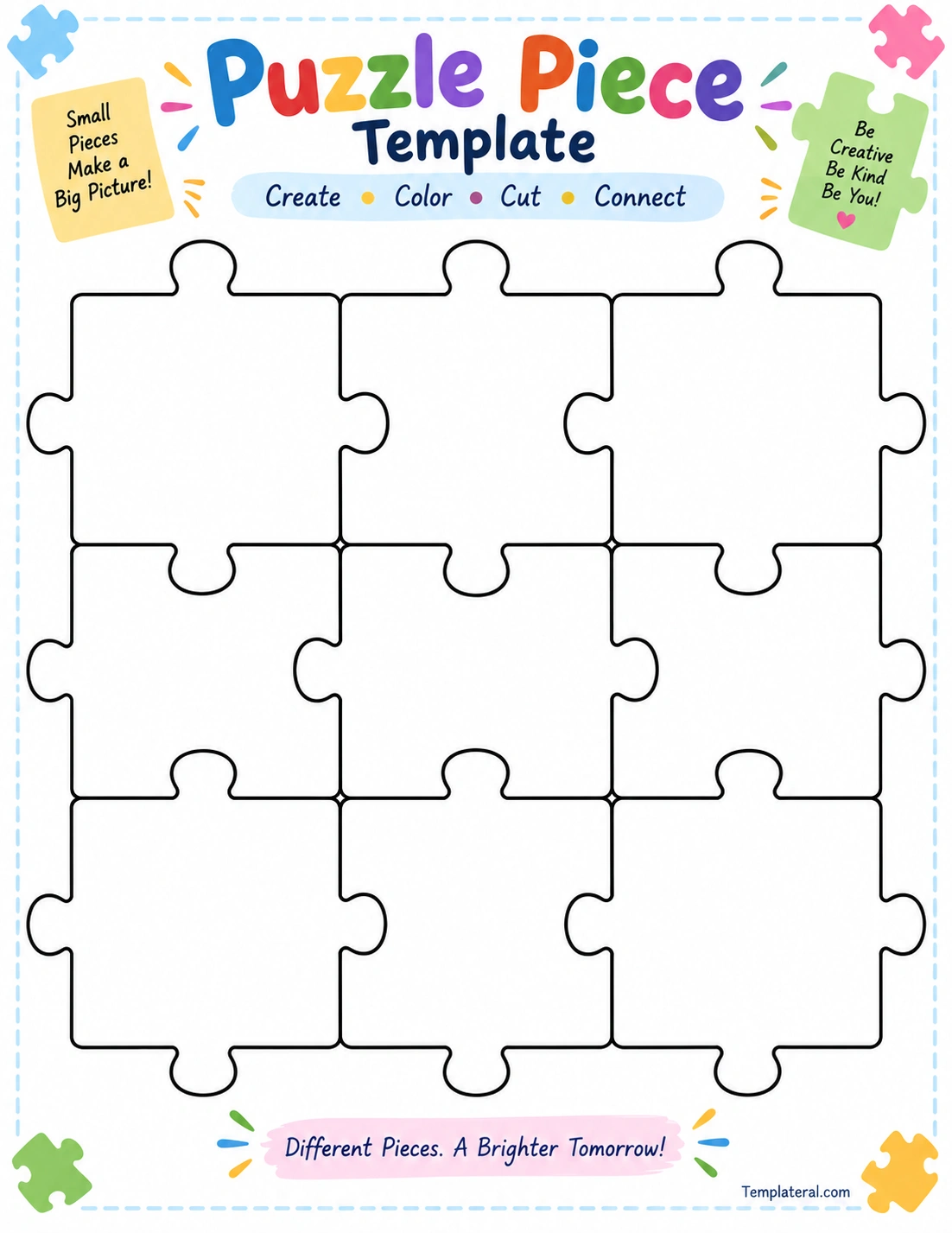
The printable template below provides a cheerful, kid-friendly puzzle design with blank pieces that can be colored, decorated, labeled, or cut apart for creative activities.
What Is a Puzzle Piece?
A puzzle piece is an individual section of a puzzle that connects with neighboring pieces. Traditional jigsaw puzzles use many uniquely shaped pieces that fit together to form a larger picture.
The familiar interlocking shape makes puzzle pieces useful beyond ordinary puzzles. A blank puzzle piece can become a creative space for writing, drawing, labeling, matching, or organizing information.
Because each piece represents only part of a larger design, puzzle activities can also encourage children to think about how individual parts work together to create a complete result.
What Is a Puzzle Piece Template?
A puzzle piece template is a printable outline or pattern that shows the shape of a puzzle piece. Depending on the design, the template may contain one large piece, several individual pieces, or a complete puzzle grid.
Blank puzzle piece templates are particularly useful because they can be customized for different activities. Children can add colors, pictures, words, numbers, names, or other information before cutting out the pieces.
A printable puzzle template can also be used as a simple starting point for creating handmade puzzles without having to draw every piece from scratch.
How to Use a Printable Puzzle Piece
There are many simple ways to use a printable puzzle piece template. The best activity depends on the age of the children and the purpose of the project.
Coloring Activity
Print the puzzle pieces on paper or cardstock and let children color each piece. They can use different colors, patterns, shapes, or drawings to create a unique puzzle design.
This activity can be used as a simple art project or as part of a classroom lesson.
Cut and Assemble Activity
Print the template and carefully cut along the puzzle outlines. Children can then mix up the pieces and try to assemble them again.
For younger children, use larger pieces and simple designs. Older children can work with smaller or more complex arrangements.
Matching Game
Puzzle pieces can be used to create matching activities. Write a question on one piece and its answer on another, or place related words and pictures on pieces that should connect.
For example, a teacher could place an animal name on one piece and the corresponding habitat on another.
Writing Activity
Blank puzzle pieces can provide small writing spaces. Children can write a word, sentence, fact, goal, or idea on each piece.
The pieces can then be connected to create a larger visual display.
Puzzle Piece Activities for Kids
Puzzle activities can be adapted for different subjects and age groups. A simple printable puzzle piece can become a flexible learning tool.
Alphabet Puzzle
Use one puzzle piece for each letter of the alphabet. Children can write a letter on each piece and decorate it with a corresponding object.
For example, the letter A could be paired with an apple illustration, while B could be paired with a ball.
Number Puzzle
Write numbers on puzzle pieces and ask children to arrange them in numerical order. You can also create simple addition, subtraction, multiplication, or division matching activities.
Vocabulary Puzzle
Use puzzle pieces to practice vocabulary words. One piece can contain a vocabulary term while another contains its definition, picture, or example.
Story Sequencing Puzzle
Write different parts of a story on separate puzzle pieces. Children can arrange the pieces in the correct order to practice sequencing and reading comprehension.
Science Puzzle
Use puzzle pieces to organize science concepts. For example, pieces could represent parts of a plant, stages of a life cycle, planets, animal classifications, or steps in a scientific process.
Puzzle Piece Crafts
A blank puzzle piece template can also be used for simple craft projects. Paper, cardstock, crayons, markers, colored pencils, and washable paints can all be used to decorate the pieces.
Children can create a large collaborative puzzle by decorating one piece each. When the pieces are connected, they create one shared classroom or group artwork.
Classroom Puzzle Display
Give each student a puzzle piece and ask them to decorate it around a common theme. Afterward, connect the pieces and display the completed puzzle on a classroom wall or bulletin board.
Friendship Puzzle
Each child can write a positive word, compliment, or kind message on a puzzle piece. The pieces can then be combined to create a visual reminder of cooperation and kindness.
Seasonal Craft
Puzzle pieces can be adapted for holidays and seasonal classroom projects. Children can decorate them with seasonal colors, symbols, patterns, or drawings.
Educational Benefits of Puzzle Activities
Puzzle activities can provide opportunities to practice several skills while keeping children engaged. The specific benefits depend on the activity and how it is used.
- Fine motor skills: Cutting, coloring, drawing, and handling paper pieces can encourage controlled hand movements.
- Problem-solving: Children can practice figuring out how pieces fit together.
- Visual recognition: Matching shapes, colors, patterns, and images can support visual discrimination.
- Creativity: Blank pieces provide space for children to draw and decorate.
- Organization: Sequencing and categorizing puzzle pieces can introduce basic organizational skills.
- Communication: Collaborative puzzle activities can encourage children to discuss ideas and work together.
How to Make a Puzzle From a Template
Creating a simple paper puzzle does not require complicated equipment. A printable puzzle piece template provides the basic shape.
Step 1: Choose Your Design
Decide whether you want a single puzzle piece, a small puzzle, or a larger grid of interconnected pieces.
Step 2: Print the Template
Print the puzzle template on standard paper for simple activities or cardstock for a sturdier project.
Step 3: Add Your Artwork
Color or decorate the puzzle before cutting it apart. You can also add a picture, educational information, words, or numbers.
Step 4: Cut the Pieces
Carefully cut around the outlines. Younger children should have adult assistance when using scissors.
Step 5: Mix and Assemble
Separate the pieces, mix them together, and challenge children to reconstruct the complete puzzle.
Using Puzzle Pieces in the Classroom
Teachers can use puzzle pieces as both learning materials and visual displays. Their interlocking design naturally supports activities involving relationships, sequences, categories, and teamwork.
A teacher might give each student a piece containing part of a larger assignment. Once students complete their individual tasks, the pieces can be connected to demonstrate how the individual contributions create a larger result.
Puzzle pieces can also be used as reusable classroom manipulatives when printed on durable cardstock and laminated.
Puzzle Piece Template for Group Activities
One of the most useful applications of a blank puzzle piece template is collaborative work. Each participant can receive a piece and contribute something to the overall project.
For example, a class could create a large puzzle where each student writes one thing they learned during a lesson. Once all pieces are completed, they can be connected and displayed together.
This approach works for educational projects, team activities, classroom decorations, and creative group exercises.
Tips for Printing Puzzle Templates
The quality of the printed template can affect how easy it is to cut, color, and assemble. A few simple choices can make the activity more practical.
- Use standard US Letter paper for convenient printing.
- Use cardstock when you want stronger pieces.
- Print at actual size when the template needs to maintain its intended dimensions.
- Use thicker paper for reusable classroom activities.
- Allow children to decorate the pieces before cutting them.
- Keep cut pieces in an envelope or container to prevent them from getting lost.
- For young children, provide age-appropriate scissors and supervision.
How to Create a Personalized Puzzle Piece
A blank puzzle piece can easily be personalized for a specific activity. Start by deciding what information should appear on each piece.
You could add a child’s name, favorite color, vocabulary word, math problem, drawing, classroom rule, or learning objective. The pieces can then be connected according to a particular pattern or simply displayed as a group.
For a larger project, consider assigning each child a different color or category. This can make the completed puzzle visually interesting while also helping organize the information.
Common Uses for Puzzle Piece Templates
Printable puzzle pieces are versatile and can be adapted for many purposes.
- Kids’ coloring activities.
- Preschool and kindergarten crafts.
- Classroom bulletin boards.
- Matching games.
- Alphabet and number activities.
- Vocabulary practice.
- Story sequencing.
- Science learning activities.
- Team-building exercises.
- Group art projects.
- Party and event crafts.
- Homeschool activities.
Choosing the Right Puzzle Piece Template
The best template depends on the intended activity. Consider the age of the children, the size of the pieces, the number of pieces needed, and whether the template will be colored, cut, written on, or reused.
For younger children, large and simple puzzle pieces are generally easier to handle. Older students can work with more pieces and more detailed activities.
If the template is intended for a group project, make sure there are enough pieces for everyone and that the final arrangement provides sufficient writing or drawing space.
Printable Puzzle Piece Template
A printable puzzle piece template provides a convenient starting point for crafts, games, and educational activities. The blank design allows children and teachers to customize the pieces instead of being limited to a predetermined picture.
You can print the template, decorate the pieces, cut them out, and connect them to create a larger puzzle. The same basic template can be reused for different lessons and creative projects.
For repeated use, consider printing the template on cardstock and laminating the finished pieces. This can make them easier to handle and store for future activities.
Puzzle Piece Activity Checklist
Before starting a puzzle piece activity, use this simple checklist:
- Choose an age-appropriate puzzle design.
- Decide whether children will color, write, cut, or assemble the pieces.
- Prepare paper or cardstock.
- Provide appropriate coloring and craft supplies.
- Use child-safe scissors when appropriate.
- Explain the activity before cutting begins.
- Keep completed pieces organized.
- Display or store the finished puzzle when the activity is complete.
Conclusion
A puzzle piece can be much more than one part of a traditional jigsaw puzzle. Its familiar interlocking shape makes it a useful foundation for crafts, educational worksheets, matching games, classroom displays, and collaborative activities.
A printable puzzle piece template gives children and educators an easy starting point for creating customized projects. Pieces can be colored, labeled, decorated, cut out, matched, and assembled in countless ways.
Whether you are planning a classroom activity, homeschool lesson, creative craft, or simple kids’ project, a blank puzzle piece template offers a fun and flexible way to turn individual ideas into one larger picture.
Download: Puzzle Piece Template
