A unit of circle chart is a useful reference for understanding the relationship between angles, radians, degrees, sine, cosine, and coordinates. It is one of the most important visual tools in trigonometry because it allows students to quickly identify exact trigonometric values without relying on a calculator.
The unit circle has a radius of 1 and is centered at the origin of a coordinate plane. As an angle moves around the circle, each point on the circle represents a pair of coordinates that can be used to determine the values of cosine and sine. Learning how these values work makes many trigonometry problems easier to solve.
Whether you are studying basic trigonometry, precalculus, or calculus, a well-organized unit of circle chart can serve as a convenient reference for common angles and their corresponding values.
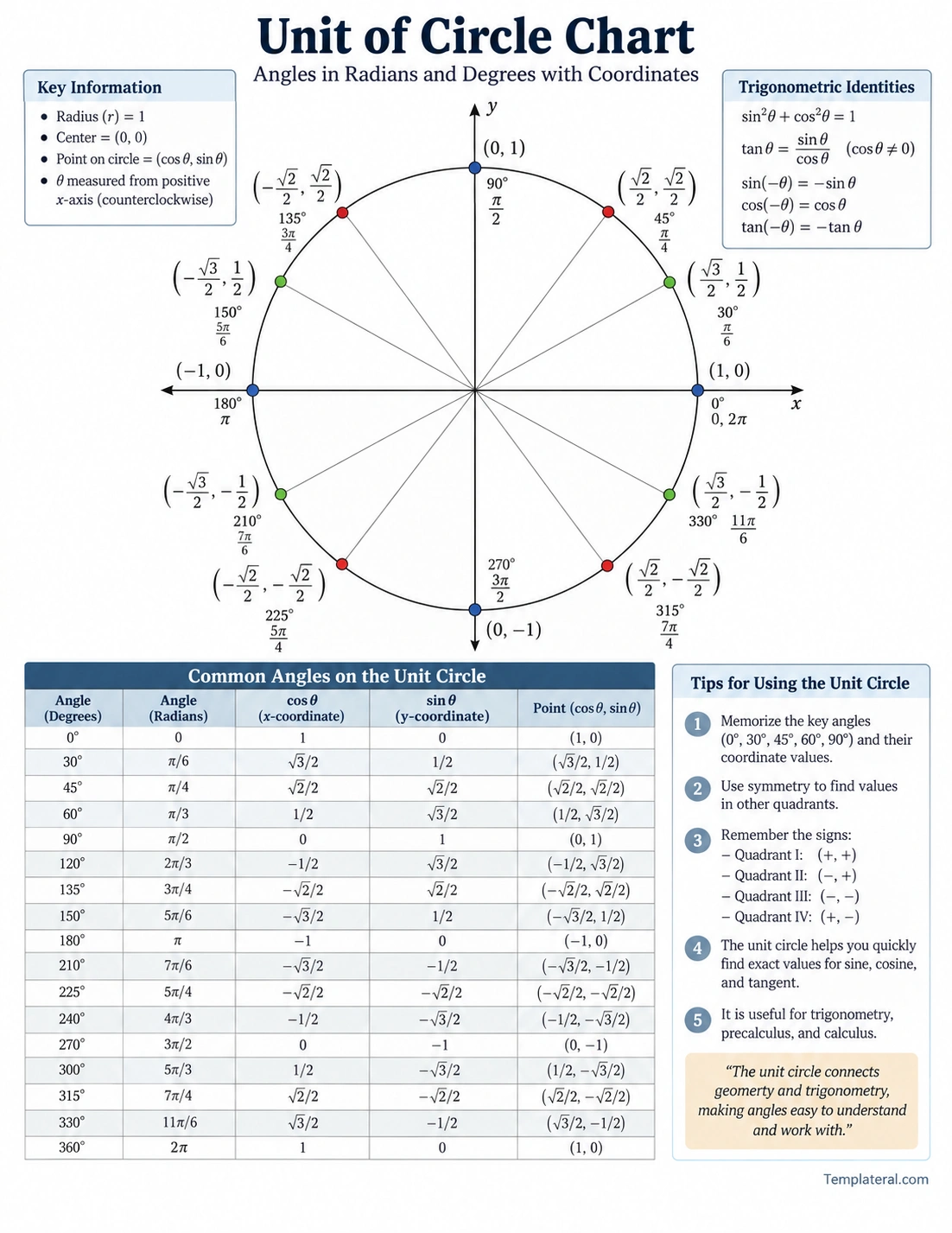
What Is a Unit Circle?
A unit circle is a circle with a radius of exactly 1 unit. On a standard coordinate plane, its center is located at (0, 0). Because the radius is 1, the circle provides a simple way to represent trigonometric functions geometrically.
For an angle θ measured from the positive x-axis, the point where the angle intersects the unit circle has coordinates:
(cos θ, sin θ)
This relationship is the foundation of the unit circle. The x-coordinate represents the cosine of the angle, while the y-coordinate represents the sine of the angle.
For example, at 0 degrees, the point on the unit circle is (1, 0). Therefore:
- cos(0°) = 1
- sin(0°) = 0
At 90 degrees, the point is (0, 1), so:
- cos(90°) = 0
- sin(90°) = 1
Why Use a Unit of Circle Chart?
A unit of circle chart puts the most important trigonometric information in one visual reference. Instead of calculating each value from scratch, you can look at the angle and identify its corresponding coordinates.
A useful chart can help you:
- Convert common angles between degrees and radians.
- Find exact values of sine and cosine.
- Determine the signs of trigonometric functions in each quadrant.
- Identify coordinates on the unit circle.
- Understand symmetry between related angles.
- Work through trigonometry problems more quickly.
- Review important values before a test or assignment.
A printable unit circle reference is particularly useful for students who want to keep a visual study aid beside their notes, textbook, or homework.
Understanding Degrees and Radians
Angles on the unit circle can be measured using either degrees or radians. Both systems describe the same angles, but radians are especially important in higher-level mathematics.
Common Degree Measurements
The most familiar way to measure an angle is in degrees. One complete rotation around a circle equals 360°.
- 0° = starting position
- 90° = one-quarter rotation
- 180° = one-half rotation
- 270° = three-quarter rotation
- 360° = one complete rotation
Common Radian Measurements
A complete rotation around the unit circle equals 2π radians. This gives the basic relationship:
180° = π radians
From this relationship, common angle conversions can be derived:
- 30° = π/6
- 45° = π/4
- 60° = π/3
- 90° = π/2
- 180° = π
- 270° = 3π/2
- 360° = 2π
Knowing these conversions is essential when working with trigonometric equations, graphs, derivatives, and integrals.
Important Unit Circle Coordinates
The most commonly used points on the unit circle come from the angles 0°, 30°, 45°, 60°, and 90°. These values can then be applied to the other quadrants using symmetry and sign patterns.
0 Degrees
At 0°, the point is (1, 0). Therefore, cosine is 1 and sine is 0.
30 Degrees
At 30°, the coordinate is:
(√3/2, 1/2)
This means:
- cos(30°) = √3/2
- sin(30°) = 1/2
45 Degrees
At 45°, both coordinates have the same magnitude:
(√2/2, √2/2)
Therefore:
- cos(45°) = √2/2
- sin(45°) = √2/2
60 Degrees
At 60°, the coordinate is:
(1/2, √3/2)
Therefore:
- cos(60°) = 1/2
- sin(60°) = √3/2
90 Degrees
At 90°, the point is (0, 1). Thus:
- cos(90°) = 0
- sin(90°) = 1
Unit Circle Quadrants and Sign Patterns
The coordinate plane is divided into four quadrants. The signs of the x- and y-coordinates change depending on the quadrant, which means the signs of cosine and sine also change.
Quadrant I
In Quadrant I, both x and y coordinates are positive.
- cos θ is positive
- sin θ is positive
- tan θ is positive
Quadrant II
In Quadrant II, x is negative while y remains positive.
- cos θ is negative
- sin θ is positive
- tan θ is negative
Quadrant III
In Quadrant III, both x and y are negative.
- cos θ is negative
- sin θ is negative
- tan θ is positive
Quadrant IV
In Quadrant IV, x is positive while y is negative.
- cos θ is positive
- sin θ is negative
- tan θ is negative
Remembering these sign patterns can make it much easier to determine trigonometric values for angles outside the first quadrant.
How to Read a Unit of Circle Chart
A unit of circle chart may initially look complicated because it contains several types of information. However, most charts follow the same basic structure.
- Find the angle you need.
- Identify whether the angle is given in degrees or radians.
- Locate the corresponding point on the circle.
- Read the x-coordinate to find cosine.
- Read the y-coordinate to find sine.
- Use sine and cosine to determine tangent when needed.
For example, suppose you need to find sin(150°). The reference angle is 30°, and 150° is located in Quadrant II. Sine is positive in Quadrant II, so:
sin(150°) = sin(30°) = 1/2
Similarly, cos(150°) is negative because cosine is negative in Quadrant II:
cos(150°) = -√3/2
Using Reference Angles
Reference angles are one of the easiest ways to work with angles that are not among the basic 30°, 45°, or 60° values.
A reference angle is the positive acute angle between the terminal side of an angle and the x-axis. Once you know the reference angle, you can use the familiar unit circle values and then apply the correct sign based on the quadrant.
For example, 210° has a reference angle of 30°. Since 210° lies in Quadrant III, both sine and cosine are negative.
Therefore:
- sin(210°) = -1/2
- cos(210°) = -√3/2
This method reduces the amount of information you need to memorize.
Unit Circle and Tangent
The unit circle also makes tangent values easier to understand. The basic identity is:
tan θ = sin θ / cos θ
Because sine is represented by the y-coordinate and cosine by the x-coordinate, tangent can be calculated from the coordinates of a point on the circle.
For example, at 45°:
tan(45°) = (√2/2) / (√2/2) = 1
At 90°, cosine equals zero. Because division by zero is undefined, tan(90°) is undefined.
Tips for Memorizing the Unit Circle
You do not necessarily need to memorize every single entry on a unit circle chart. A better approach is to memorize the core values and use symmetry to find the rest.
- Memorize the coordinates for 0°, 30°, 45°, 60°, and 90°.
- Learn the radian equivalents of those angles.
- Memorize the positive and negative signs in each quadrant.
- Practice identifying reference angles.
- Use the coordinate pair (cos θ, sin θ) as a constant reminder.
- Practice without a calculator until the common values become familiar.
A printable unit of circle chart can be especially helpful during practice because you can keep the same reference sheet next to your mathematics work.
Common Mistakes to Avoid
Students often make a few predictable mistakes when learning the unit circle. Recognizing them can help you check your work more effectively.
Confusing Sine and Cosine
Remember that the x-coordinate is cosine and the y-coordinate is sine. The coordinate order is:
(cos θ, sin θ)
Forgetting the Quadrant Sign
The reference angle provides the magnitude of the trigonometric value, but the quadrant determines whether that value is positive or negative.
Mixing Up Degrees and Radians
Always check the unit of the angle before solving. For example, 90° and π/2 represent the same angle, but they use different measurement systems.
Using a Decimal Instead of an Exact Value
When an exact answer is required, use values such as 1/2, √2/2, or √3/2 rather than rounded decimal approximations.
When Is a Unit Circle Chart Useful?
A unit circle reference chart can be useful in many areas of mathematics. It is commonly used when studying introductory trigonometry and becomes even more valuable in precalculus and calculus.
You can use a unit circle chart when working on:
- Exact trigonometric values
- Trigonometric identities
- Radians and degree conversions
- Trigonometric equations
- Sine and cosine graphs
- Reference angles
- Precalculus exercises
- Calculus problems involving trigonometric functions
How to Use a Printable Unit Circle Reference
A printable chart can be more useful when it is organized as a quick-reference worksheet rather than simply a list of numbers. Look for a chart that clearly displays the circle, coordinate axes, common angles, radian measurements, and coordinate values.
For study sessions, you can use the chart in several ways. First, cover the coordinate values and try to recall them from memory. Next, cover the angle measurements and identify the angles from their coordinates. Finally, practice determining the correct signs based on the quadrant.
Repeated short practice sessions are generally more useful than trying to memorize the entire chart in one sitting.
Conclusion
A unit of circle chart provides a simple visual way to connect angles with radians, coordinates, sine, cosine, and tangent. The most important concept to remember is that every point on the unit circle can be written as (cos θ, sin θ).
Start by learning the key angles in the first quadrant, then use reference angles, symmetry, and quadrant signs to determine the remaining values. With regular practice, the unit circle becomes a quick reference tool rather than something that needs to be memorized line by line.
Keeping a clear printable unit circle chart nearby can make homework, test preparation, and trigonometry practice much easier. It is a simple resource that can continue to be useful as you move from basic trigonometry into precalculus and calculus.
