A Radian Circle Chart is a helpful visual reference for learning how radians relate to angles on the unit circle. It can be used to practice common radian measurements, identify points around the circle, understand quadrants, and connect angle measurements with sine, cosine, and tangent.
Radians are especially important in trigonometry and calculus. While degrees are familiar from everyday angle measurements, radians provide a mathematical way to describe angles based on the relationship between an angle and the radius of a circle. Once the basic radian values become familiar, many trigonometric concepts become easier to understand.
A printable radian circle chart gives students a convenient way to study these relationships visually. It can be used as a classroom worksheet, homework reference, study guide, or practice sheet for filling in common angles and trigonometric values.
What Is a Radian Circle Chart?
A Radian Circle Chart is a diagram or worksheet that displays angle measurements around a circle using radians. It is commonly based on the unit circle, which has a radius of 1 and is centered at the origin, (0, 0).
One complete rotation around a circle is equal to 2π radians. This is equivalent to 360 degrees. Because the full circle is divided into equal angular relationships, common radian measurements can be placed around the circle in a predictable pattern.
A radian chart can include angle measurements, coordinates, sine values, cosine values, tangent values, or blank spaces for students to complete themselves.
What Is a Radian?
A radian is a unit used to measure angles. It is based on the relationship between the length of an arc and the radius of the circle.
When the length of an arc is equal to the radius of the circle, the angle formed at the center is 1 radian.
This definition provides the foundation for understanding why a full circle contains 2π radians. The circumference of a circle is 2πr, and when the arc length is compared with a radius of r, the complete angular measurement is 2π radians.
Radians vs. Degrees
Degrees and radians are two different ways of measuring the same angles. Knowing how to convert between them is an essential trigonometry skill.
A complete rotation is:
- 360° = 2π radians
- 180° = π radians
- 90° = π/2 radians
- 270° = 3π/2 radians
From the relationship between 180° and π radians, you can convert between the two systems using standard conversion factors.
To convert degrees to radians, multiply the degree measurement by π/180. To convert radians to degrees, multiply the radian measurement by 180/π.
Common Radian Measurements
Several radian measurements appear repeatedly in trigonometry. Learning these values makes it easier to locate angles on the unit circle and solve trigonometric equations.
- 0
- π/6
- π/4
- π/3
- π/2
- 2π/3
- 3π/4
- 5π/6
- π
- 7π/6
- 5π/4
- 4π/3
- 3π/2
- 5π/3
- 7π/4
- 11π/6
- 2π
These values correspond to commonly used angles around the unit circle. Practicing them repeatedly can help students recognize the position of an angle without needing to convert from degrees every time.
Radian Circle Chart Template
A Radian Circle Chart Template provides a structured way to practice radian measurements and their relationships to the unit circle. A blank template is particularly useful when the goal is to test recall rather than simply read a completed chart.
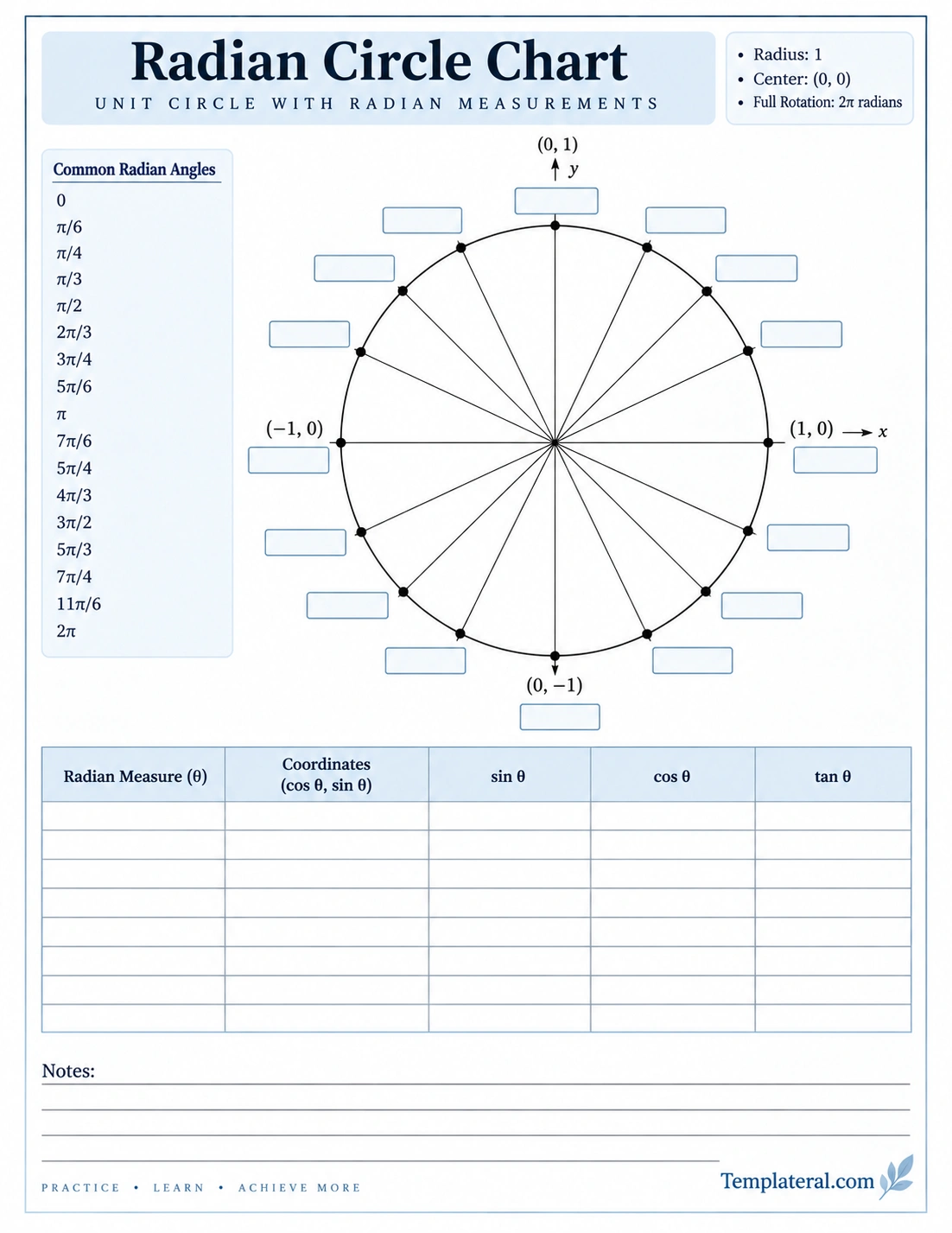
The printable worksheet includes a large circle with marked points and spaces for entering radian measurements. A reference table provides additional space to record coordinates and trigonometric values.
How to Use a Radian Circle Chart
A blank radian chart can be used in several ways depending on what you are studying.
Start With the Four Main Points
Begin with the four points where the unit circle intersects the coordinate axes. These positions correspond to 0, π/2, π, and 3π/2 radians.
Once these four locations are familiar, the remaining common angles can be placed between them.
Add the Intermediate Angles
Next, fill in the angles between the primary axis points. Common measurements include π/6, π/4, π/3, 2π/3, 3π/4, and 5π/6.
Continue around the circle until all of the standard angles have been identified.
Practice Coordinates
For a unit circle, the point associated with an angle θ is represented by (cos θ, sin θ). Use the chart to practice writing the corresponding coordinates beside each angle.
Add Trigonometric Values
After labeling the angles and coordinates, use the chart to practice the corresponding sine, cosine, and tangent values.
This method allows you to connect the radian measurement with the geometric position and the associated trigonometric functions.
Understanding the Unit Circle in Radians
The unit circle provides a particularly useful visual model for radians. Because the circle has a radius of 1, the numerical relationship between arc length and radian measure becomes especially straightforward.
As you move counterclockwise from the positive x-axis, the radian measurement increases. A complete counterclockwise rotation reaches 2π radians.
This means that an angle can be described by both its location around the circle and its radian measurement. The chart makes this relationship easier to visualize.
Radian Measurements by Quadrant
Organizing radian values by quadrant can make the unit circle easier to study.
First Quadrant
The first quadrant extends from 0 to π/2 radians. Common angles include π/6, π/4, and π/3.
Second Quadrant
The second quadrant extends from π/2 to π radians. Common values include 2π/3, 3π/4, and 5π/6.
Third Quadrant
The third quadrant extends from π to 3π/2 radians. Common angles include 7π/6, 5π/4, and 4π/3.
Fourth Quadrant
The fourth quadrant extends from 3π/2 to 2π radians. Common angles include 5π/3, 7π/4, and 11π/6.
Learning the radian ranges of the four quadrants helps students quickly estimate where an angle should appear on a circle.
Using Radians With Sine and Cosine
Radians are commonly used when working with trigonometric functions. On the unit circle, the coordinates of the point corresponding to angle θ are (cos θ, sin θ).
This means the horizontal coordinate represents cosine, while the vertical coordinate represents sine.
For example, when an angle reaches the top of the unit circle, the corresponding point is (0, 1). Therefore, the cosine value is 0 and the sine value is 1.
Understanding this relationship allows students to derive trigonometric values directly from the geometry of the circle.
Using Radians With Tangent
Tangent is related to sine and cosine through the equation:
tan θ = sin θ / cos θ
This relationship is useful when completing a radian circle chart because the sine and cosine values can be used to determine tangent.
At positions where cosine equals zero, the tangent ratio is undefined. These positions occur at π/2 and 3π/2 radians.
Benefits of a Blank Radian Circle Chart
A completed reference chart can be helpful when learning the unit circle, but a blank chart can provide an additional learning benefit by encouraging active recall.
- Improves memorization: Repeatedly writing common radian values reinforces recall.
- Builds visual understanding: Students can connect numbers with positions around the circle.
- Supports practice: Blank spaces can be used for repeated exercises.
- Connects concepts: Angles, coordinates, and trigonometric values can be studied together.
- Helps with test preparation: Students can practice recreating the chart without looking at notes.
Common Mistakes When Learning Radians
Radians can be confusing at first, especially for students who are more familiar with degrees. Several common mistakes are worth watching for.
Confusing π With 180°
Remember that π radians is equivalent to 180°, not 1°. The symbol π represents a numerical value of approximately 3.14159, while its use in an angle measurement indicates radians.
Mixing Up π/2 and π
π/2 represents a quarter turn, while π represents a half turn. Visualizing the circle can help distinguish these measurements.
Forgetting the Direction of Rotation
Positive angles are conventionally measured counterclockwise from the positive x-axis. Understanding this direction helps when locating radian values around the circle.
Ignoring Quadrant Signs
The signs of sine and cosine depend on the quadrant. Even when two angles have related reference angles, their coordinate signs may be different.
Tips for Memorizing Radian Values
Rather than attempting to memorize every value at once, break the unit circle into smaller sections.
- Memorize 0, π/2, π, 3π/2, and 2π first.
- Learn the first-quadrant special angles.
- Use symmetry to identify related angles.
- Practice converting common degrees into radians.
- Complete a blank chart from memory.
- Review the signs associated with each quadrant.
- Practice both angle measurements and coordinates together.
Regular short practice sessions can be more manageable than trying to memorize the entire circle in one sitting.
Radian Circle Chart for Students and Teachers
A printable radian chart can be useful in many educational settings. Students can use it as a study worksheet, while teachers can use it as an activity for introducing or reviewing radians.
For example, a teacher might provide a blank chart and ask students to fill in all of the standard radian measurements. A second exercise could ask them to add coordinates, while another could focus on sine, cosine, and tangent.
The same worksheet can therefore support several levels of practice without requiring students to work from a completed answer sheet.
How to Practice With a Radian Circle Chart
For effective practice, begin with a blank chart and fill in as much information as you can remember. Start with the four major axis positions before adding the intermediate angles.
After completing the exercise, compare your work with a reliable reference. Pay particular attention to mistakes involving fractions, quadrant placement, and positive or negative signs.
As your understanding improves, try completing the chart under a time limit. This can help develop the ability to recall common radian values quickly during quizzes and exams.
Conclusion
A Radian Circle Chart is a practical visual aid for learning and reviewing radian measurements on the unit circle. It helps connect angles with their positions, coordinates, and trigonometric values while providing an organized reference for study.
A printable Radian Circle Chart Template can be particularly useful for active practice. By repeatedly labeling common radian angles, identifying quadrants, recording coordinates, and connecting those coordinates to sine and cosine, students can develop a stronger understanding of the unit circle.
With consistent practice, radians become less about memorizing isolated fractions and more about recognizing the predictable structure of the circle. That understanding can provide a useful foundation for trigonometry, calculus, and other areas of mathematics.
Download: Radian Circle Chart Template
