A Circle Unit Chart is a useful visual tool for studying angles, radians, degrees, coordinates, and trigonometric relationships on the unit circle. By organizing important points and angles around a circle, students can more easily recognize patterns and connect geometric concepts with sine, cosine, and tangent.
The unit circle is especially important in trigonometry because every point on a circle with a radius of 1 can be represented using coordinates. These coordinates provide a convenient way to understand the values of sine and cosine for common angles.
Whether you are learning trigonometry for the first time, reviewing before an exam, or looking for a simple worksheet for classroom practice, a printable circle unit chart can provide a convenient space for labeling angles and recording important information.
What Is a Circle Unit Chart?
A circle unit chart is a visual worksheet based on the unit circle. A unit circle is a circle centered at the origin of a coordinate plane with a radius of exactly 1.
The standard unit circle is represented using the equation:
x² + y² = 1
Points on the circle can be written as coordinates in the form (x, y). When an angle is measured from the positive x-axis, the corresponding point on the unit circle can be used to identify the cosine and sine of that angle.
A blank circle unit chart gives students a place to draw, label, or practice these relationships rather than simply memorizing a completed diagram.
Why Use a Circle Unit Chart?
Learning the unit circle can initially seem difficult because it combines several concepts at once. Students may need to remember angle measurements in both degrees and radians, identify quadrants, and recognize coordinate patterns.
A printable chart can make this process more manageable by providing a consistent visual reference.
- Practice labeling common angles.
- Convert between degrees and radians.
- Identify the four quadrants.
- Record coordinates for important points.
- Practice sine and cosine values.
- Review reference angles.
- Recognize symmetry around the circle.
- Prepare for trigonometry tests and assignments.
Repeatedly filling in a blank chart can also encourage active recall, which is often more useful for studying than simply looking at a completed unit circle.
Understanding the Basic Unit Circle
The unit circle has a radius of 1 and its center is located at (0, 0). The horizontal axis is the x-axis, while the vertical axis is the y-axis.
The Four Quadrants
The coordinate plane divides the unit circle into four quadrants. Starting from the upper-right section and moving counterclockwise, they are Quadrant I, Quadrant II, Quadrant III, and Quadrant IV.
The signs of the x- and y-coordinates change depending on the quadrant. Understanding these signs is important when determining the sine and cosine values associated with an angle.
- Quadrant I: x is positive and y is positive.
- Quadrant II: x is negative and y is positive.
- Quadrant III: x is negative and y is negative.
- Quadrant IV: x is positive and y is negative.
Degrees and Radians
Angles on a unit circle can be measured in degrees or radians. Degrees are commonly used in introductory geometry, while radians are particularly important in higher-level trigonometry and calculus.
A complete rotation around a circle is 360 degrees, which is equivalent to 2π radians. Therefore, a half rotation is 180 degrees or π radians, and a quarter rotation is 90 degrees or π/2 radians.
Being comfortable with both systems makes a circle unit chart much more useful for trigonometry practice.
Circle Unit Chart Template
A Circle Unit Chart Template can provide multiple blank unit-circle diagrams for repeated practice. Instead of writing directly on a reference chart, students can use each circle to practice a different set of concepts.
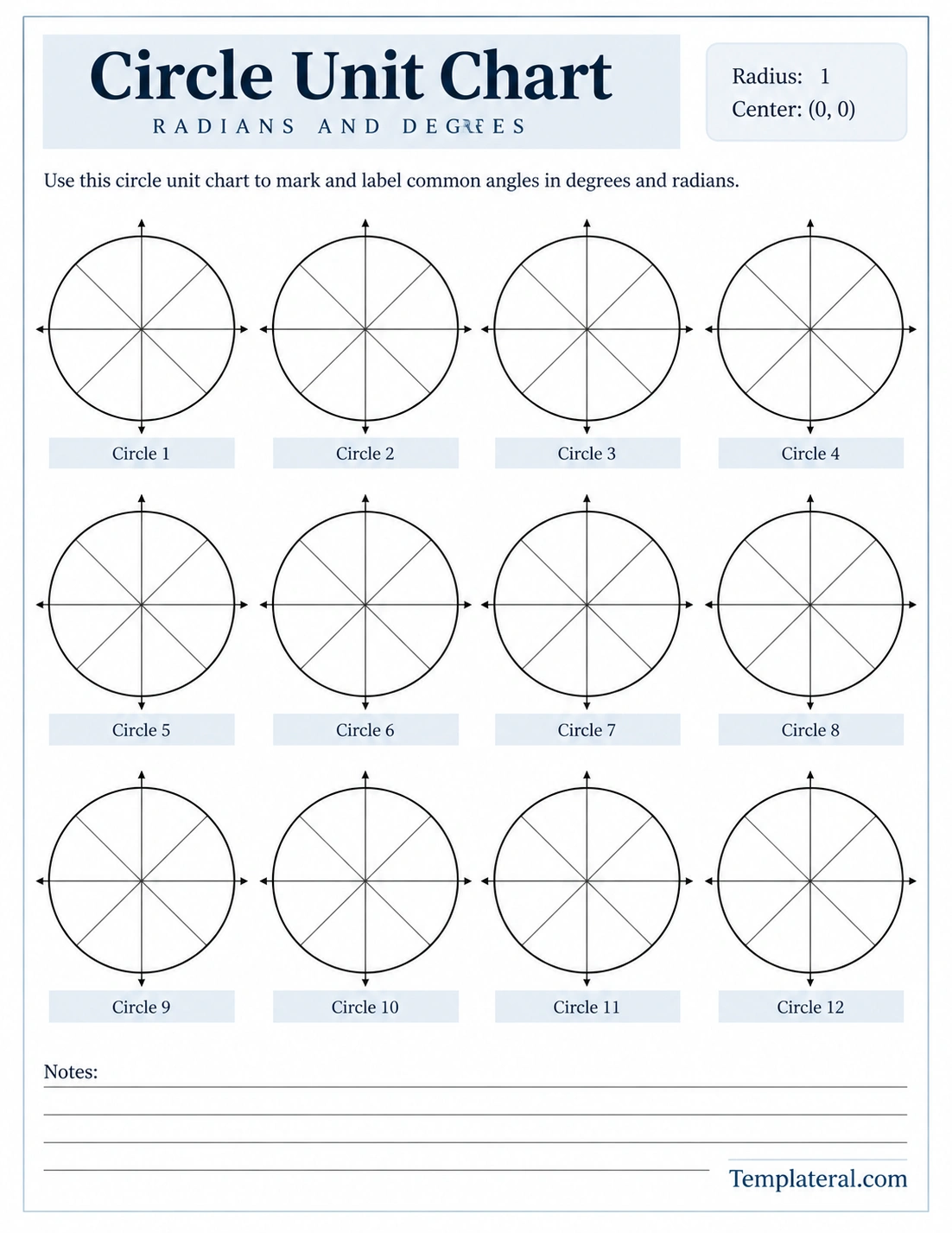
The printable layout can be used in different ways. For example, one circle can be used to practice degree measurements, another for radians, and another for coordinate values. Keeping several practice diagrams on one worksheet makes it easier to compare different exercises.
How to Use a Circle Unit Chart
There are several effective ways to use a blank unit circle worksheet. The best approach depends on what you are currently studying.
Practice Common Angles
Start by marking familiar angles around the circle. Common angles include 0°, 30°, 45°, 60°, 90°, and their corresponding positions in the other quadrants.
After becoming comfortable with these angles, practice identifying equivalent angles and their positions without looking at a completed chart.
Practice Radian Measurements
Next, label the same positions using radians. A useful starting point is to remember that 180° equals π radians and 360° equals 2π radians.
From there, common fractional relationships such as π/2, π/3, π/4, and π/6 can be connected to their degree equivalents.
Record Coordinates
Use the blank diagrams to write the coordinates of important points. Because the unit circle has a radius of 1, the coordinates have a direct relationship to trigonometric functions.
For an angle θ on the standard unit circle, the point can be represented as:
(cos θ, sin θ)
This relationship is one of the most important concepts to understand when working with the unit circle.
Using the Unit Circle for Trigonometry
The unit circle provides a visual foundation for several fundamental trigonometric functions. Once an angle is located, its position can help determine the signs and values associated with sine and cosine.
Sine
The sine of an angle corresponds to the y-coordinate of its point on the unit circle. This makes the vertical position of a point particularly important when practicing sine values.
Cosine
The cosine of an angle corresponds to the x-coordinate. Looking at the horizontal position of a point can therefore help students understand why cosine values change from positive to negative as an angle moves through different quadrants.
Tangent
Tangent can be expressed in terms of sine and cosine:
tan θ = sin θ / cos θ
This relationship explains why tangent is undefined at angles where the cosine value is zero.
Tips for Memorizing the Unit Circle
Memorizing every value on the unit circle can seem overwhelming at first. A structured approach can make the process easier.
- Learn one quadrant at a time: Start with the first quadrant before adding the remaining quadrants.
- Understand symmetry: Many coordinates repeat with changes to their signs.
- Connect degrees and radians: Practice both forms together rather than learning them separately.
- Learn the special angles: Focus on 30°, 45°, and 60° before trying to memorize every position.
- Use a blank worksheet: Repeatedly fill in the chart from memory.
- Check your work: Compare your completed chart with a reliable reference after practicing.
Understanding the patterns is generally more useful than attempting to memorize a collection of unrelated numbers.
Common Mistakes When Using a Unit Circle Chart
Students often make similar mistakes when learning the unit circle. Recognizing these errors can make practice more effective.
Confusing Degrees and Radians
One of the most common mistakes is mixing degree measurements with radian measurements. Always check which unit an exercise requires before labeling your chart.
Forgetting Coordinate Signs
The numerical values of many unit-circle coordinates may be similar, but their signs depend on the quadrant. Pay attention to whether the x-coordinate and y-coordinate should be positive or negative.
Mixing Up Sine and Cosine
Remember that the standard unit-circle point is written as (cos θ, sin θ). The first coordinate corresponds to cosine, while the second corresponds to sine.
Relying Only on Memorization
Memorization can be useful, but understanding how the circle, coordinates, and quadrants relate to one another makes the information easier to reconstruct when you forget a value.
Ways to Use a Printable Circle Unit Chart
A printable chart can be useful in many learning environments. Students can use it independently, while teachers can incorporate blank diagrams into classroom activities.
- Trigonometry homework practice
- Math review sessions
- Classroom worksheets
- Study guides
- Test preparation
- Independent learning
- Radian and degree conversion practice
- Coordinate and trigonometric function exercises
Teachers can also assign different tasks to individual circles. For example, students might label one diagram with degrees, another with radians, and another with sine and cosine values.
How to Get More From a Blank Circle Unit Chart
The greatest benefit of a blank chart comes from actively completing it. Rather than immediately copying all the answers from a reference, try filling in as much as possible from memory first.
After completing the exercise, compare your answers with a trusted reference and identify any patterns in your mistakes. Repeating this process can gradually improve familiarity with common angles, coordinates, and quadrant signs.
It can also help to say the information aloud while writing it. For example, identify the angle, its radian equivalent, its quadrant, and its coordinate values. Combining visual, written, and verbal practice can make review more engaging.
Conclusion
A Circle Unit Chart is a practical tool for learning and reviewing the unit circle, especially when studying degrees, radians, coordinates, sine, cosine, and tangent. A blank printable chart gives students space to practice these concepts actively instead of relying solely on a completed reference diagram.
For the best results, begin with the basic angles and first-quadrant values, then build your knowledge using quadrant signs and symmetry. With regular practice, a blank unit circle worksheet can become a simple and effective study aid for trigonometry.
Download: Circle Unit Chart Template
