A trig circle chart is a useful reference tool for learning the unit circle, common angles, radians, coordinates, and basic trigonometric values. It helps students connect angles with sine, cosine, and tangent values without having to repeatedly calculate each value from scratch.
The unit circle is one of the most important concepts in trigonometry. Once you understand how angles, coordinates, and trigonometric functions are connected, many problems involving sine, cosine, and tangent become much easier to solve.
A printable trig circle chart can be especially helpful for studying. You can keep it beside your notes, use it while practicing problems, or complete a blank version as a memory exercise. This guide explains how the chart works, what information it contains, and how to use it effectively.
What Is a Trig Circle Chart?
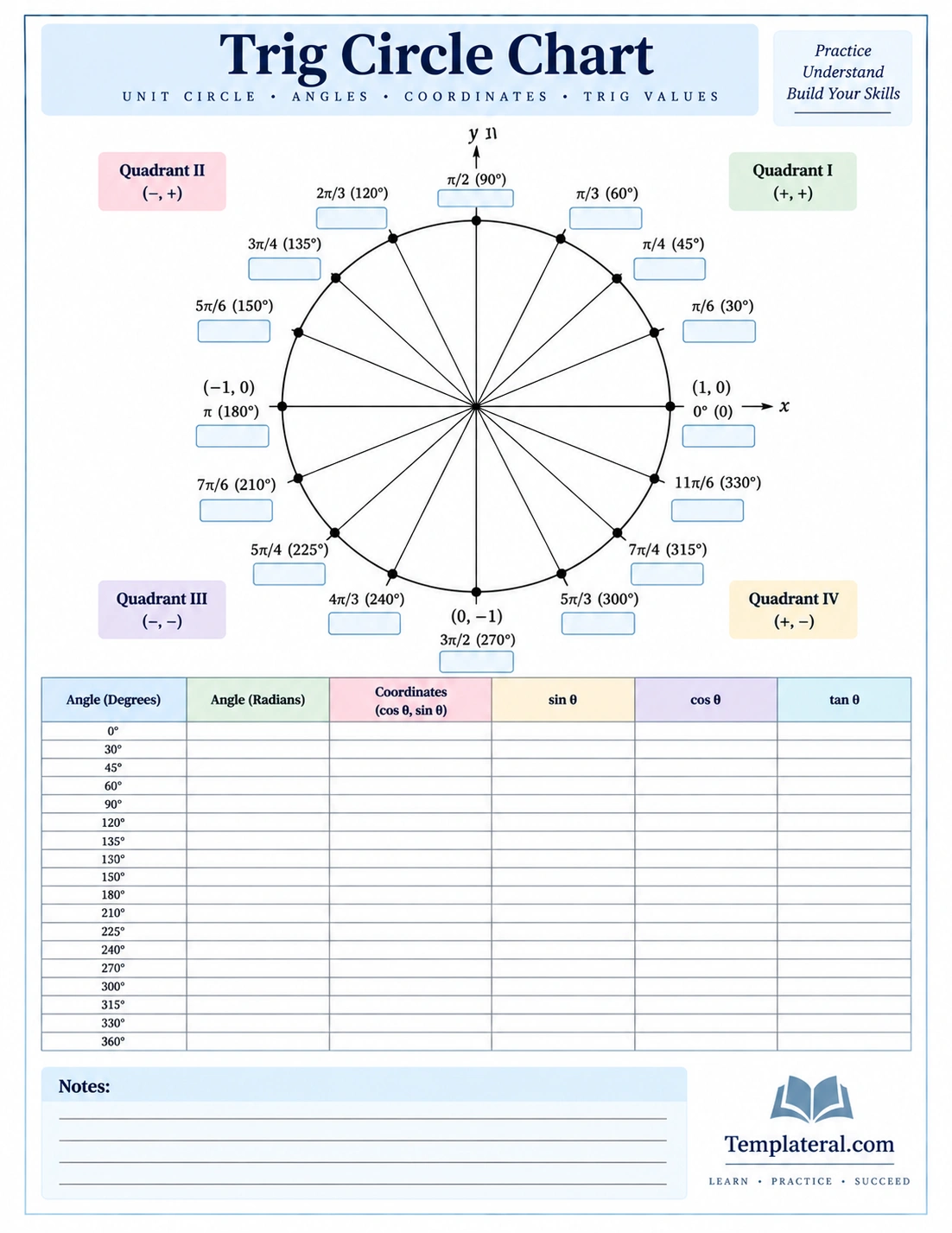
A trig circle chart is a visual reference based on the unit circle. It displays important angles around a circle along with their corresponding degree measures, radian measures, coordinates, and trigonometric values.
The unit circle has a radius of 1 and is centered at the origin of a coordinate plane. Every point on the circle can be represented by an ordered pair of coordinates. For an angle measured counterclockwise from the positive x-axis, the point on the unit circle is represented by (cos θ, sin θ).
This relationship is what makes the unit circle so useful in trigonometry. The x-coordinate gives the cosine value, while the y-coordinate gives the sine value.
Why Is a Trig Circle Chart Useful?
Many trigonometry problems involve special angles such as 30°, 45°, 60°, 90°, and their related angles in other quadrants. Memorizing every value individually can be difficult at first.
A trig circle chart organizes these relationships visually, making it easier to recognize patterns.
- Reference common angles: Quickly find important degree and radian measures.
- Review unit circle coordinates: Connect each angle to its corresponding point.
- Study sine and cosine: Use the coordinates to identify trigonometric values.
- Understand quadrants: See which trigonometric functions are positive or negative.
- Practice radians: Connect degree measurements with their equivalent radian values.
- Prepare for tests: Use the chart as a study and review tool.
Trig Circle Chart Template
A printable trig circle chart template provides a convenient way to practice the unit circle. A blank or partially completed chart allows students to fill in angles, coordinates, radians, sine, cosine, and tangent values as part of their study routine.
Understanding the Unit Circle
The unit circle is a circle with a radius of exactly 1. Its center is located at the origin, represented by the coordinate (0, 0).
The horizontal axis is the x-axis, and the vertical axis is the y-axis. The positive x-axis begins at 0°, while angles increase counterclockwise around the circle.
Some important points on the unit circle include:
- 0°: The point is (1, 0).
- 90°: The point is (0, 1).
- 180°: The point is (-1, 0).
- 270°: The point is (0, -1).
- 360°: The point returns to (1, 0).
These four axis points provide useful reference locations for understanding the rest of the unit circle.
Common Angles on the Trig Circle
A trig circle chart commonly includes a collection of special angles that appear frequently in algebra, trigonometry, calculus, and other mathematics courses.
30 Degrees
The 30° angle corresponds to π/6 radians. It is one of the fundamental special angles used to determine exact sine, cosine, and tangent values.
45 Degrees
The 45° angle corresponds to π/4 radians. Because its reference angle is the same for both the x- and y-coordinates, it has a particularly recognizable coordinate pattern.
60 Degrees
The 60° angle corresponds to π/3 radians. Along with 30° and 45°, it is one of the most important angles to learn when studying exact trigonometric values.
90 Degrees
The 90° angle corresponds to π/2 radians and lies directly on the positive y-axis. Its coordinate is (0, 1).
These angles are also reflected in other quadrants. For example, 150°, 225°, and 300° can be understood by combining a reference angle with the sign pattern of their respective quadrants.
Degrees and Radians
One of the most important skills when using a trig circle chart is understanding the relationship between degrees and radians.
A complete revolution around the circle is equal to 360° or 2π radians. Therefore, common conversions include:
- 0° = 0 radians
- 30° = π/6 radians
- 45° = π/4 radians
- 60° = π/3 radians
- 90° = π/2 radians
- 180° = π radians
- 270° = 3π/2 radians
- 360° = 2π radians
Knowing these conversions makes it easier to move between degree-based and radian-based trigonometry problems.
How Coordinates Work on the Unit Circle
Every point on the unit circle can be written as (cos θ, sin θ). This simple relationship provides the foundation for reading sine and cosine values directly from the chart.
The first coordinate represents cosine, while the second coordinate represents sine.
For example, the point at 0° is (1, 0). Therefore, cos 0° = 1 and sin 0° = 0.
At 90°, the point is (0, 1). Therefore, cos 90° = 0 and sin 90° = 1.
Once this relationship becomes familiar, the unit circle becomes more than a collection of values. It becomes a visual system for understanding how trigonometric functions behave as an angle moves around the circle.
Understanding the Four Quadrants
The coordinate plane is divided into four quadrants. Each quadrant has a different combination of positive and negative x- and y-values. Because cosine corresponds to x and sine corresponds to y, the signs of the coordinates determine the signs of the trigonometric functions.
Quadrant I
In Quadrant I, both x and y coordinates are positive. Therefore, sine and cosine are positive, and tangent is also positive.
Quadrant II
In Quadrant II, the x-coordinate is negative while the y-coordinate is positive. Therefore, cosine is negative while sine is positive. Tangent is negative.
Quadrant III
In Quadrant III, both x and y coordinates are negative. Sine and cosine are negative, while tangent is positive.
Quadrant IV
In Quadrant IV, the x-coordinate is positive and the y-coordinate is negative. Therefore, cosine is positive, sine is negative, and tangent is negative.
How to Find Sine, Cosine, and Tangent
The unit circle provides a straightforward way to find exact trigonometric values for common angles.
Finding Sine
To find sine, look at the y-coordinate of the point associated with the angle. Since the coordinate is written as (cos θ, sin θ), the second value represents sine.
Finding Cosine
To find cosine, use the x-coordinate of the point. The first coordinate in (cos θ, sin θ) represents cosine.
Finding Tangent
Tangent can be calculated using the relationship tan θ = sin θ / cos θ, provided that cosine is not zero.
For angles where the cosine value is zero, such as 90° and 270°, tangent is undefined because division by zero is not possible.
How to Read a Trig Circle Chart
When using a trig circle chart, begin by locating the angle. The chart may show the angle in both degrees and radians.
Next, identify the coordinate associated with the angle. Because the coordinate is written as (cos θ, sin θ), you can read cosine from the first value and sine from the second value.
If tangent is required, divide sine by cosine. Always pay attention to the quadrant because the signs of the values are essential.
With practice, you will begin to recognize common coordinate patterns without needing to calculate each value from scratch.
How to Memorize the Unit Circle
Memorizing the unit circle can initially seem difficult because there are many angles and values to remember. A better approach is to focus on patterns instead of trying to memorize every entry independently.
- Learn the first quadrant first: Start with 0°, 30°, 45°, 60°, and 90°.
- Learn the coordinate patterns: Notice how the same basic values appear in different quadrants.
- Learn the signs separately: Use the quadrant to determine whether each value is positive or negative.
- Practice degree-radian pairs: Associate each common degree measure with its radian equivalent.
- Use repetition: Complete a blank unit circle regularly until the values become familiar.
Using a Blank Trig Circle Chart for Practice
A blank trig circle chart can be more effective for learning than simply looking at a completed reference chart. When you fill in the information yourself, you actively recall the relationships between angles, coordinates, and trigonometric functions.
Start by filling in the four axis points. Then add the common angles in the first quadrant. Once those values are familiar, use symmetry to complete the remaining quadrants.
Finally, fill in the sine, cosine, and tangent columns. Check your answers against a completed reference chart after finishing the exercise.
Common Trig Circle Chart Mistakes
Confusing Sine and Cosine
Remember that the coordinate format is (cos θ, sin θ). The x-coordinate represents cosine and the y-coordinate represents sine.
Forgetting Negative Signs
The same reference angle can have different signs in different quadrants. Always identify the quadrant before writing the final value.
Mixing Up Degrees and Radians
Pay attention to whether a problem gives an angle in degrees or radians. A value such as π/3 represents 60°, not 3°.
Forgetting That Tangent Can Be Undefined
Tangent is the ratio of sine to cosine. When cosine equals zero, tangent is undefined.
Memorizing Values Without Understanding the Pattern
Memorization can help, but understanding the unit circle makes it easier to reconstruct values when you forget one. Focus on symmetry, reference angles, coordinates, and quadrant signs.
Trig Circle Chart for Students
A trig circle chart can be useful for students studying geometry, algebra, trigonometry, precalculus, and calculus. It can serve as a quick reference during practice sessions and as a worksheet for active recall.
Teachers can also use a printable chart for classroom exercises. Students can complete selected portions of the chart, identify missing values, or use the unit circle to solve trigonometric equations.
Tips for Studying With a Trig Circle Chart
Use the chart as an active learning tool rather than simply keeping it nearby as a reference.
- Practice writing the special angles from memory.
- Convert each common angle between degrees and radians.
- Fill in the first-quadrant coordinates before completing the other quadrants.
- Use quadrant signs to determine positive and negative values.
- Practice finding sine and cosine directly from coordinates.
- Calculate tangent from sine divided by cosine.
- Complete a blank chart regularly before a test or quiz.
Conclusion
A trig circle chart is a valuable reference and study tool for understanding the unit circle and common trigonometric values. By connecting angles with degrees, radians, coordinates, sine, cosine, and tangent, the chart provides a visual way to understand relationships that are central to trigonometry.
The key to mastering the unit circle is not simply memorizing a long list of values. Learn the common angles, understand the coordinate pattern, recognize the quadrant signs, and practice converting between degrees and radians. With regular practice, the information on a trig circle chart becomes much easier to recall.
A printable trig circle chart template can make that practice more convenient. Whether you use it as a quick reference, classroom worksheet, homework aid, or study exercise, a well-organized chart can help make trigonometry more understandable and manageable.
Download: Trig Circle Chart Template
