A successful business starts with a clear plan. Before launching a new company, business owners need to understand how their business will create value, attract customers, and generate revenue. A Business Model Canvas makes this process easier by organizing essential business information into one simple visual framework.
Whether you are starting a small business, developing a startup, or improving an existing company, a business model canvas template helps you turn your ideas into a practical business strategy. It allows you to identify your products or services, target customers, key resources, operating expenses, and potential revenue streams.
Instead of writing a lengthy business plan, you can use this one-page business model framework to understand how different parts of your business work together. In this guide, you will learn what a Business Model Canvas is, explore its nine essential building blocks, and discover how to create your own using a printable template.
What Is a Business Model Canvas?
A Business Model Canvas (BMC) is a visual business planning tool that helps entrepreneurs describe, design, and evaluate how a company creates, delivers, and captures value. It was developed by Alexander Osterwalder and Yves Pigneur as part of their work on business model innovation.
The framework uses nine interconnected sections to explain how a business operates. Each section represents an important part of the company’s strategy, from identifying customers to managing costs and generating income.
A business model canvas is particularly useful for startups and businesses that are still in development. It provides a clear overview of the business concept before owners invest significant time and money into launching their products or services.
Unlike a traditional business plan, which can require many pages of detailed information, the Business Model Canvas presents the essential elements on a single page. This makes it easier to review ideas, identify weaknesses, and make adjustments when business conditions change.
Why Should You Use a Business Model Canvas?
Creating a business model canvas helps business owners understand how their ideas can become sustainable and profitable operations. It also provides a practical way to communicate business strategies with partners, employees, and potential investors.
Here are some important benefits of using this business planning tool:
- Clarifies your business idea: It helps you define what your company offers, who your customers are, and how you plan to make money.
- Identifies your target market: You can describe your ideal customers and understand their needs, preferences, and purchasing behavior.
- Highlights potential expenses: It helps you identify the main costs involved in producing products, delivering services, and operating your business.
- Reveals business opportunities: Reviewing all nine sections can help you discover new revenue streams, partnerships, and customer segments.
- Improves strategic decisions: You can compare different business ideas and evaluate whether your current approach is practical.
- Saves planning time: A one-page framework makes it easier to organize your ideas without immediately creating a lengthy business plan.
Most importantly, the canvas is flexible. You can update individual sections whenever you discover new information about your customers, competitors, or market opportunities.
The 9 Building Blocks of a Business Model Canvas
A standard Business Model Canvas consists of nine building blocks. Each section answers a different question about how your company will operate and generate profits.
1. Customer Segments
Customer Segments identify the specific groups of people or organizations your business intends to serve. Understanding your target market is essential because your products, marketing strategy, and pricing should match customer needs.
Consider these questions when completing this section:
- Who are your ideal customers?
- What problems do they want to solve?
- What are their interests and purchasing habits?
- Are you targeting individuals, businesses, or both?
For example, an online stationery store might target college students, office workers, and professionals who regularly purchase planners and organizational products.
2. Value Propositions
Your Value Proposition explains why customers should choose your products or services instead of competing alternatives. It describes the benefits you provide and the problems your business solves.
Think about what makes your offer different. Your competitive advantage might include affordable pricing, premium quality, convenience, unique features, or excellent customer service.
For example, a meal delivery business might offer healthy meals prepared with fresh ingredients and delivered directly to customers’ homes.
3. Channels
Channels describe how your business communicates with customers and delivers its products or services. These channels cover both marketing and distribution activities.
Common examples include:
- Company websites and online stores.
- Social media platforms.
- Email marketing campaigns.
- Physical retail locations.
- Online marketplaces.
- Distributors and business partners.
Choose channels that allow you to reach your target customers effectively and provide a convenient purchasing experience.
4. Customer Relationships
Customer Relationships explain how your company attracts, supports, and retains customers. Building strong relationships can increase customer satisfaction and encourage repeat purchases.
Depending on your business model, customer relationships might include personal assistance, automated customer support, self-service platforms, loyalty programs, or online communities.
For example, a subscription-based software company might provide email support, online tutorials, and dedicated account assistance to help customers use its services.
5. Revenue Streams
Revenue Streams describe how your business earns money from its customers. This section identifies the different ways your company generates income.
Possible revenue sources include:
- Direct product sales.
- Subscription fees.
- Service charges.
- Licensing fees.
- Commission income.
- Advertising revenue.
For example, an online educational platform might generate revenue through monthly subscriptions, individual course purchases, and premium learning packages.
When estimating revenue, consider your pricing strategy, expected sales volume, and how frequently customers may purchase your products or services.
6. Key Resources
Key Resources are the essential assets your company needs to deliver its value proposition and operate successfully. These resources can be physical, financial, intellectual, or human.
Examples include:
- Employees and skilled professionals.
- Office space, equipment, and inventory.
- Business software and technology.
- Intellectual property and trademarks.
- Working capital and financial resources.
Identify the resources that are essential to your daily operations. This will help you understand what you need before launching your business.
7. Key Activities
Key Activities represent the most important tasks your company must perform to deliver its products or services and maintain its business operations.
These activities vary depending on the type of company. A manufacturing business may focus on production and quality control, while an online store may prioritize inventory management, marketing, order fulfillment, and customer service.
List the activities that directly support your value proposition and help your business generate revenue.
8. Key Partnerships
Key Partnerships identify the external businesses, suppliers, and organizations that help your company operate effectively. Strategic partnerships can provide resources, reduce costs, and improve business performance.
Potential partners include:
- Raw material suppliers.
- Manufacturers and distributors.
- Technology providers.
- Marketing agencies.
- Logistics and delivery companies.
- Professional service providers.
For example, an online clothing brand may work with manufacturers, packaging suppliers, and shipping companies to deliver products to customers.
9. Cost Structure
Cost Structure describes the major expenses associated with operating your business. Understanding these costs is important when determining whether your business model can generate sustainable profits.
Common business expenses include:
- Employee salaries and benefits.
- Rent and utilities.
- Raw materials and inventory.
- Marketing and advertising.
- Software subscriptions.
- Shipping and distribution.
- Maintenance and administrative expenses.
Separate fixed costs from variable costs whenever possible. Fixed costs generally remain relatively stable, while variable costs change depending on sales volume or business activity.
Compare your expected expenses with your revenue streams to evaluate the financial potential of your business model.
Free Business Model Canvas Template
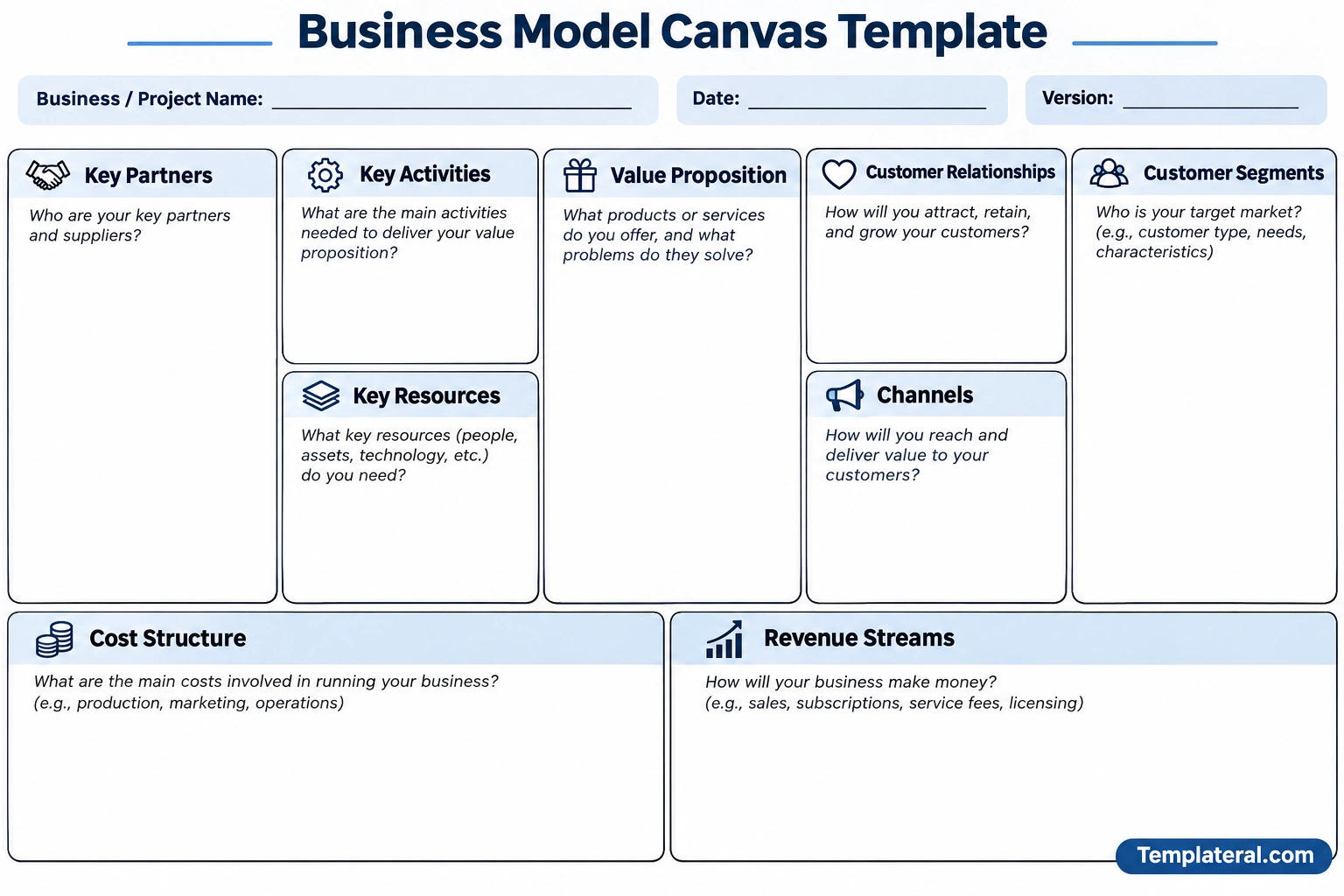
Using a printable business model canvas template makes it easier to organize all nine building blocks in one place. Instead of creating separate documents for each business planning section, you can write your ideas directly into a single worksheet.
The template below provides dedicated spaces for customer segments, value propositions, key activities, partnerships, revenue streams, and other essential business components. You can print it and complete each section by hand or use it as a reference when creating a digital business plan.
Download or print the Business Model Canvas Template to start organizing your business idea.
How to Fill Out a Business Model Canvas
Completing a business model canvas does not have to be complicated. You can start with a basic business idea and gradually add details to each section as you develop your strategy.
Step 1: Define Your Business Idea
Start by describing the product or service you want to offer. Identify the problem your business will solve and the value you intend to provide to customers.
Step 2: Identify Your Target Customers
Determine who is most likely to purchase your products or services. Consider customer demographics, interests, purchasing habits, and specific problems they need to solve.
Step 3: Describe Your Value Proposition
Explain what makes your business valuable. Identify the main benefits customers will receive and why they should choose your offer over competing alternatives.
Step 4: Plan Your Marketing and Distribution Channels
Choose how customers will discover your business, communicate with your company, and purchase your products or services. Consider both online and offline channels.
Step 5: Identify Resources, Activities, and Partners
List the essential resources you need, the activities required to operate your business, and the external partners who can support your operations.
Step 6: Estimate Costs and Revenue
Calculate your expected operating expenses and identify potential income sources. Make realistic assumptions about pricing, sales volume, and recurring expenses.
Step 7: Review and Improve Your Canvas
Once all nine sections are complete, review the entire business model. Look for missing information, unnecessary expenses, and opportunities to improve profitability. Update your canvas whenever new market information becomes available.
Business Model Canvas Example for a Small Business
To understand how the framework works in practice, consider a small online coffee shop that sells specialty coffee beans directly to consumers.
- Customer Segments: Coffee enthusiasts, home brewers, and specialty coffee buyers.
- Value Propositions: Fresh specialty coffee beans, carefully selected origins, and convenient online ordering.
- Channels: Business website, social media, email marketing, and online marketplaces.
- Customer Relationships: Personalized recommendations, customer support, and loyalty rewards.
- Revenue Streams: Coffee bean sales, subscription packages, and gift bundles.
- Key Resources: Coffee inventory, packaging equipment, website, and trained employees.
- Key Activities: Product sourcing, quality control, packaging, marketing, and order fulfillment.
- Key Partnerships: Coffee farmers, packaging suppliers, shipping companies, and payment providers.
- Cost Structure: Coffee purchases, packaging, website maintenance, marketing, employee wages, and shipping expenses.
This example shows how a simple business concept can be organized into nine connected sections. Business owners can use the same approach for restaurants, consulting services, online stores, software companies, and other business ideas.
Business Model Canvas vs. Traditional Business Plan
Although both tools support business planning, a Business Model Canvas and a traditional business plan serve slightly different purposes.
A Business Model Canvas focuses on the essential elements of how a company creates and earns value. It provides a quick visual overview that business owners can easily update and share.
A traditional business plan is generally more detailed. It may include market research, competitor analysis, financial projections, marketing strategies, operational plans, and management information.
Here are the main differences:
- Format: A Business Model Canvas usually fits on one page, while a traditional business plan may contain several sections and dozens of pages.
- Purpose: The canvas helps develop and evaluate a business model, while a traditional plan explains the broader business strategy and implementation.
- Flexibility: A canvas is easy to update as business ideas change. A traditional plan generally requires more extensive revisions.
- Level of detail: The canvas provides a high-level overview, while a business plan offers more comprehensive explanations and financial information.
These tools can complement each other. Many entrepreneurs begin with a Business Model Canvas and later use the completed framework as a foundation for developing a detailed business plan.
Tips for Creating an Effective Business Model Canvas
A useful business model canvas should be clear, realistic, and easy to understand. Keep these practical tips in mind when developing your own worksheet:
- Keep descriptions simple: Use short phrases rather than lengthy paragraphs to make each section easy to review.
- Focus on customer needs: Build your business model around real customer problems and expectations.
- Research your market: Validate your assumptions using customer feedback, competitor research, and industry information.
- Use realistic financial estimates: Avoid overestimating revenue or overlooking important operating expenses.
- Review regularly: Revisit your canvas when your products, target market, or business strategy changes.
- Collaborate with others: Ask business partners or team members to review your ideas and identify potential weaknesses.
Remember that a Business Model Canvas is a planning tool, not a guarantee of business success. You should continue testing your assumptions and adjusting your strategy based on actual business results.
Frequently Asked Questions About Business Model Canvas
What is the main purpose of a Business Model Canvas?
The main purpose of a Business Model Canvas is to provide a visual overview of how a company creates, delivers, and captures value. It helps business owners organize their ideas, identify customers, understand operating costs, and determine how the company will generate revenue.
What are the nine components of a Business Model Canvas?
The nine components are Customer Segments, Value Propositions, Channels, Customer Relationships, Revenue Streams, Key Resources, Key Activities, Key Partnerships, and Cost Structure. Together, these sections describe the essential elements of a business model.
Who should use a Business Model Canvas?
Entrepreneurs, startup founders, small business owners, established companies, and business students can all benefit from using this framework. It is especially useful for people developing a new business idea or evaluating an existing business model.
Is a Business Model Canvas the same as a business plan?
No. A Business Model Canvas provides a one-page overview of how a business operates and generates revenue. A traditional business plan contains more detailed information about market research, operations, marketing, management, and financial projections. Both tools can be used together.
Can I use a Business Model Canvas for a startup?
Yes. A Business Model Canvas is particularly useful for startups because it helps founders organize their ideas, identify potential customers, evaluate expenses, and explore revenue opportunities before launching their products or services.
How long does it take to complete a Business Model Canvas?
The time required depends on the complexity of your business idea and how much research you have completed. A simple business concept may take an hour or two to outline, while a more complex business model may require several planning sessions and additional research.
Can I edit a Business Model Canvas after completing it?
Yes. The canvas is designed to be flexible. You can revise any section as your business develops, customer needs change, or new opportunities become available. Regular updates help keep your business strategy relevant.
Is a Business Model Canvas suitable for small businesses?
Absolutely. Small business owners can use the framework to identify their target customers, plan their products or services, organize operating expenses, and determine how they will earn money. It is a practical starting point for businesses of different sizes.
Conclusion
A Business Model Canvas is a practical tool for turning a business idea into a structured plan. By organizing nine essential building blocks, you can understand how your company will serve customers, deliver value, manage resources, and generate revenue.
Whether you are developing a startup, launching a small business, or improving an existing company, this framework can help you make more informed business decisions. Start with a printable business model canvas template, complete each section, and refine your ideas as you learn more about your market.
A clear business model is an important first step toward building a sustainable and profitable company.
Download: Business Model Canvas Template
