A business contract for partnership helps business owners establish clear expectations, define responsibilities, and protect their shared interests. Whether you are starting a new company with a friend, collaborating with another entrepreneur, or expanding an existing business, a written partnership agreement can help prevent misunderstandings before they become costly disputes.
Although free business contract templates can provide a useful starting point, a basic document may not address every situation. The right agreement should reflect your business structure, financial contributions, decision-making process, and plans for the future. Understanding these essential elements makes it easier to create a practical business partnership contract that meets your needs.
In this guide, you will learn what a partnership contract should include, how to customize a template, and which common mistakes to avoid when preparing an agreement with your business partner.
What Is a Business Contract for Partnership?
A business contract for partnership is a written agreement between two or more parties who agree to operate a business together under specified terms and conditions. It establishes how the partners will contribute to the business, share profits and losses, manage daily operations, and handle important decisions.
This document is commonly called a business partnership agreement or partnership contract. Depending on the business structure and jurisdiction, it may serve as a foundational document that complements other legal and registration documents.
A written agreement is especially valuable when partners have different financial contributions, professional responsibilities, or expectations about the company’s future. Rather than relying on verbal promises, each partner can refer to the same written terms.
Why Do You Need a Business Partnership Agreement?
Starting a business together often involves trust and shared enthusiasm. However, even partners with similar goals can disagree about money, responsibilities, or business direction. A written contract helps establish consistent rules before these disagreements arise.
Here are several reasons to prepare a business partnership agreement:
- Clarifies responsibilities: Each partner understands their duties, authority, and expected contributions.
- Defines financial arrangements: The agreement explains how profits, losses, expenses, and additional investments will be handled.
- Establishes decision-making rules: Partners know how major business decisions will be approved.
- Reduces misunderstandings: Written terms provide a shared reference when disagreements occur.
- Plans for unexpected events: The contract can address a partner’s departure, incapacity, or the closure of the business.
- Supports business continuity: Clear procedures can make it easier to manage changes in ownership or responsibilities.
A contract cannot eliminate every business risk, but a carefully drafted agreement can help partners understand their obligations and prepare for situations that might otherwise be difficult to resolve.
What Should a Business Contract for Partnership Include?
A useful partnership contract should cover the essential terms of the business relationship. The specific provisions will depend on the type of business, the applicable law, and the partners’ individual circumstances.
1. Names and Details of the Partners
Begin by identifying every partner who will be bound by the agreement. Include each person’s full legal name, address, and other identifying information appropriate for the document.
If a partner is a company or another legal entity, identify that entity correctly and confirm that its representative has authority to sign the contract. Accurate information helps establish who is entering into the agreement.
2. Business Name and Purpose
State the business’s legal name, principal address, and primary activities. Explain what the partnership intends to accomplish and identify the products or services it will provide.
You should also specify the effective date of the agreement and, when appropriate, whether the arrangement will continue indefinitely or operate for a defined period.
3. Capital Contributions and Ownership Percentages
Explain what each partner will contribute to establish and operate the business. Contributions may include cash, equipment, property, intellectual property, or agreed services, depending on the arrangement and applicable law.
Record each contribution clearly and distinguish it from any loan a partner makes to the business. If ownership percentages differ from contribution amounts, explain how those percentages are determined.
For example, two partners might contribute different amounts of startup capital while agreeing to equal ownership. The contract should document that arrangement explicitly rather than leaving the details open to interpretation.
4. Profit and Loss Distribution
Specify how the business will allocate profits and losses among the partners. Distribution may follow ownership percentages or another arrangement permitted by the applicable law and business structure.
Also explain when profits may be distributed, how much money should remain in the business for operating expenses, and how unexpected losses will be addressed. Partners should understand that accounting profit, available cash, and money distributed to owners are not necessarily the same thing.
5. Roles, Duties, and Responsibilities
Describe each partner’s role in managing the business. One partner might oversee operations, while another handles marketing, finance, customer relationships, or product development.
Include expectations for time commitments, reporting, expense approvals, and access to business records when relevant. Clear responsibilities help prevent duplicated work and reduce the risk that important tasks will be overlooked.
6. Decision-Making and Dispute Resolution
Explain how the partners will make routine and significant decisions. You might allow each partner to manage ordinary matters within an agreed budget while requiring mutual approval for major purchases, borrowing, new ownership arrangements, or changes to the business.
The contract should also establish a process for resolving disagreements. Depending on the circumstances, this process might include direct negotiation, mediation, or another legally appropriate dispute-resolution method.
7. Withdrawal, Termination, and Business Closure
Partnerships can change when a partner decides to leave, becomes unable to participate, or no longer agrees with the business’s direction. Your agreement should explain how a partner may withdraw and what happens to their ownership interest.
Consider including provisions covering notice periods, valuation of the departing partner’s interest, payment terms, outstanding obligations, and the circumstances under which the business may be dissolved.
These provisions should be consistent with the business’s legal structure and applicable law. A simple termination clause may not be sufficient when the business has significant assets, debts, employees, or ongoing contractual commitments.
How to Use a Business Contract Template
A business partnership contract template provides a starting framework for documenting the relationship. It can save time and help you identify important topics, but it should not be treated as a complete legal solution for every business.
Follow these steps when customizing a template:
- Step 1: Identify the parties. Enter the correct legal names and contact details for all partners.
- Step 2: Describe the business. Add the business name, address, purpose, and effective date.
- Step 3: Record contributions. Specify each partner’s financial or nonfinancial contributions and ownership interest.
- Step 4: Define financial terms. Document profit allocation, loss allocation, expense responsibilities, and distribution schedules.
- Step 5: Assign responsibilities. Establish management duties, authority limits, and approval requirements.
- Step 6: Add protective provisions. Address confidentiality, dispute resolution, withdrawal, and termination where appropriate.
- Step 7: Review before signing. Check every provision for accuracy, consistency, and compliance with applicable law.
Do not leave important terms ambiguous simply because the template does not provide enough space. Add appropriate provisions or obtain professional assistance when your arrangement requires more detailed language.
Business Contract for Partnership Template
The following printable business contract for partnership template illustrates how the essential terms can be organized in one document. Use it as a planning worksheet to discuss the arrangement with your prospective partner before preparing the final agreement.
It includes spaces for partner information, business details, capital contributions, profit and loss distribution, responsibilities, decision-making, termination, and signatures.
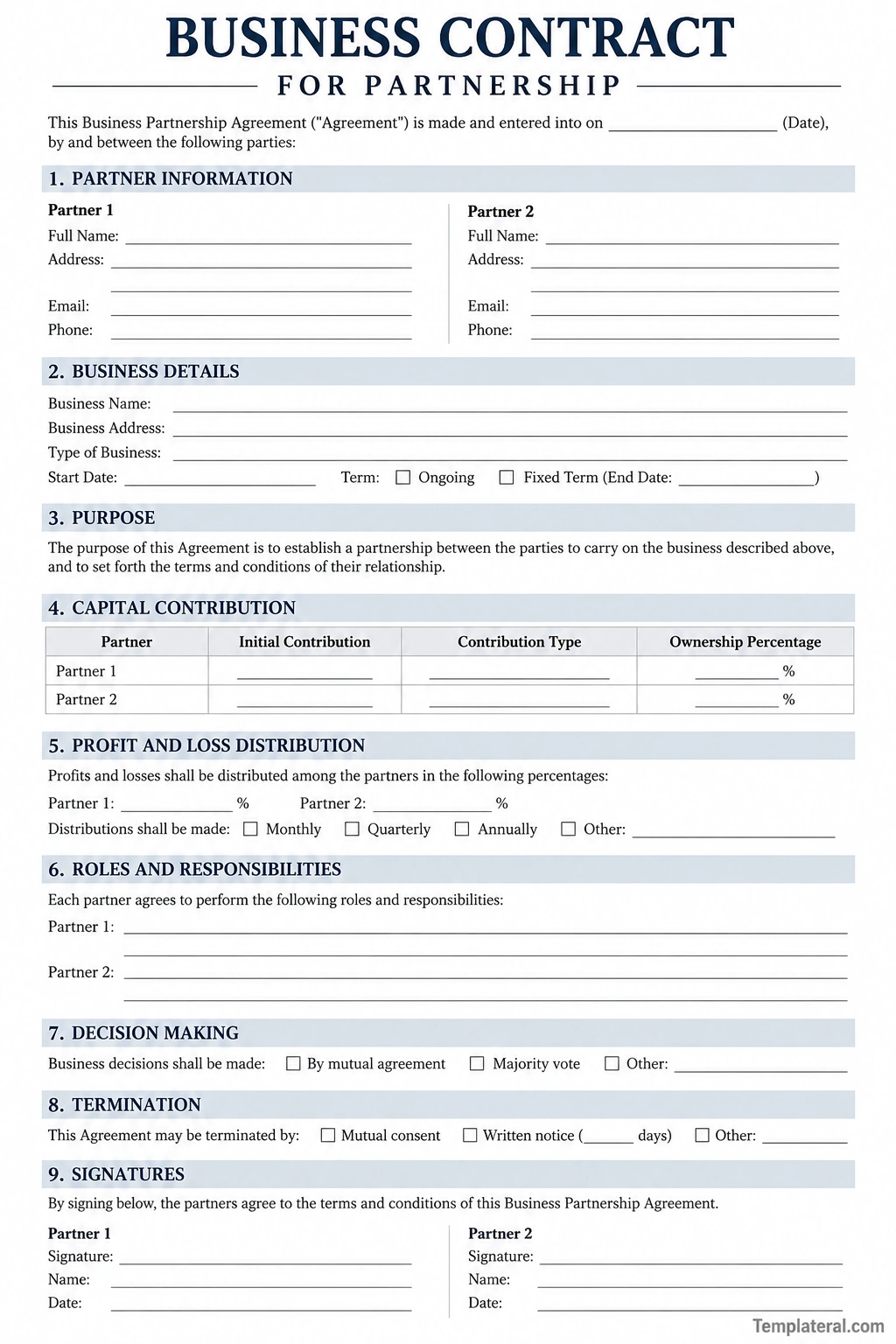
Before signing, replace the blank fields with the agreed terms and remove or revise any provisions that do not fit your arrangement. The worksheet is a general starting point, not a substitute for a complete, legally reviewed contract.
Common Mistakes to Avoid When Writing a Partnership Contract
Even a well-intentioned agreement can create problems when important details are missing. Avoid these common mistakes when preparing your business contract.
Using Vague Language
Terms such as “fair profit sharing” or “shared responsibility” may mean different things to different partners. Define percentages, payment schedules, decision-making authority, and specific duties wherever possible.
Ignoring Future Changes
Your original agreement may not account for new investors, additional funding, changes in ownership, or a partner’s departure. Include a process for amending the agreement and addressing significant changes in the business.
Overlooking Liabilities and Legal Requirements
A partnership agreement does not automatically protect partners from every business debt or personal liability. The level of protection depends on the legal structure, applicable law, and circumstances of the business. Confirm any registration, tax, licensing, and reporting requirements that apply.
Signing Without Reviewing the Terms
Partners should read the entire document before signing. Confirm that financial terms, responsibilities, termination provisions, and dispute-resolution procedures accurately reflect the arrangement. For complex or high-value partnerships, seek advice from a qualified attorney in the relevant jurisdiction.
Frequently Asked Questions
Can I use a free business contract for partnership template?
Yes. A free template can help you organize the essential terms of a partnership and identify topics to discuss with your partner. However, you should customize it to reflect your business structure, jurisdiction, and specific agreement. Professional legal review may be appropriate before signing.
Is a written partnership agreement legally required?
The requirements vary by jurisdiction and business structure. Some partnerships may exist through conduct or oral agreements under applicable law, but relying on informal arrangements can create uncertainty. A written agreement is generally a practical way to document the partners’ intentions and responsibilities.
What is the difference between a partnership contract and a business contract?
A business contract is a broad term for an agreement involving commercial activities, such as providing services or selling products. A partnership contract specifically establishes the terms of a business relationship between partners, including ownership, management, contributions, and profit allocation.
Should a partnership contract include profit-sharing percentages?
Yes, it is generally advisable to document how profits and losses will be allocated. State the agreed percentages or calculation method and explain when distributions may occur. Make sure the terms are consistent with applicable law and the partnership’s tax and accounting arrangements.
Can I modify a partnership contract after signing?
Partners can often amend an agreement if they follow the amendment procedure specified in the contract and comply with applicable law. Record changes in writing, obtain the required approvals, and ensure that every relevant party receives the updated document.
Does a partnership contract need to be notarized?
Notarization requirements depend on the jurisdiction, the type of agreement, and the transactions involved. Some agreements may not require notarization, while particular documents or related transactions may have additional formalities. Check the applicable requirements before signing.
What happens if a partner wants to leave the business?
The outcome depends on the partnership agreement and applicable law. A well-prepared contract should explain the notice process, valuation and transfer of the departing partner’s interest, outstanding obligations, and whether the business can continue with the remaining partners.
Conclusion
A well-prepared business contract for partnership provides a practical foundation for a successful business relationship. By documenting ownership, capital contributions, profit sharing, responsibilities, decision-making, and exit procedures, partners can establish clear expectations and prepare for potential disagreements.
A free business partnership contract template can help you get started, but the final agreement should reflect your actual business arrangements and comply with the law that applies to your partnership. Review the terms carefully, discuss any uncertainties with your partner, and seek qualified legal advice when necessary.
Taking the time to prepare a clear written agreement can help both partners move forward with greater confidence and a shared understanding of how the business will operate.
Download: Business Contract for Partnership Template
