A behavior plan for students provides a clear and practical way to help children understand expectations, build positive habits, and improve challenging behaviors at school or at home. Instead of simply reacting when a behavior occurs, a behavior plan identifies specific goals, supportive strategies, positive reinforcement, and ways to track progress.
A well-designed student behavior plan should be simple enough for teachers, parents, and students to understand and use consistently. It can be especially helpful when a student struggles with classroom routines, staying focused, following directions, managing emotions, interacting with classmates, or completing schoolwork.
This guide explains what a behavior plan is, what to include, how to create one, and how to use a behavior plan for students template to make the process easier.
What Is a Behavior Plan for Students?
A behavior plan for students is a written plan that describes a student’s target behaviors, expected behaviors, support strategies, positive reinforcement, and methods for monitoring progress. The purpose is to create a consistent approach that helps the student develop more appropriate and successful behaviors.
Rather than focusing only on what a student is doing wrong, an effective behavior plan also identifies what the student should do instead. This makes expectations more concrete and gives the student opportunities to experience success.
Depending on the student’s needs, a behavior plan may be used by a classroom teacher, special education team, school counselor, school administrator, parent, or other support professional.
Why Use a Student Behavior Plan?
Students often respond better to clear expectations and consistent support than to unpredictable consequences. A behavior plan creates a shared framework so the adults supporting the student can respond in a consistent way.
A student behavior plan can help with:
- Improving classroom behavior
- Increasing attention and participation
- Encouraging positive social interactions
- Supporting emotional regulation
- Reducing disruptive or unsafe behaviors
- Improving task completion
- Building positive classroom routines
- Tracking behavioral progress over time
- Communicating expectations between school and home
The plan should not be viewed as a punishment document. Its main purpose is to provide structure, support positive behavior, and help the student understand how to succeed.
What Should Be Included in a Behavior Plan?
A useful behavior plan for students does not need to be complicated. The most important information should be easy to identify and understand.
1. Student Information
Begin with basic information such as the student’s name, grade or class, date, and the adults responsible for implementing the plan. This makes it easier to keep the plan organized and updated.
2. Behavior Goals
Identify one or more specific behaviors that the student needs to develop or improve. Goals should be observable and measurable whenever possible.
For example, instead of writing “behave better,” a more specific goal might be “remain seated during independent work for 15 minutes” or “raise a hand before speaking during group instruction.”
3. Expected Behaviors
Clearly describe what the student is expected to do. Positive language can make expectations easier to understand.
For example:
- Use an appropriate voice during classroom activities.
- Follow the teacher’s directions within a reasonable amount of time.
- Keep hands and objects to oneself.
- Ask for help when a task becomes difficult.
- Use a designated strategy when feeling frustrated.
4. Behaviors to Reduce
Describe the challenging behaviors that the plan is intended to address. Be specific rather than using broad descriptions.
For example, “leaves the assigned area during independent work” provides more useful information than simply saying “disruptive behavior.”
5. Strategies and Supports
List the strategies that adults will use to help the student succeed. These may include visual reminders, clear instructions, scheduled breaks, task modifications, check-ins, seating adjustments, or other appropriate supports.
Support strategies should be practical and consistent with the student’s needs and school environment.
6. Rewards and Positive Reinforcement
Positive reinforcement can encourage students to repeat appropriate behaviors. The reinforcement should be meaningful to the student and connected to clearly defined behaviors.
Examples may include specific praise, points, tokens, preferred classroom activities, extra choice time, or another age-appropriate incentive. The goal is to recognize progress rather than simply focus on mistakes.
7. Progress Monitoring
Include a simple way to record progress. Depending on the goal, progress can be tracked by frequency, duration, percentage, completed tasks, or another measurable indicator.
Regular monitoring helps teachers and families determine whether the current strategies are working or need to be adjusted.
8. Review and Next Steps
A behavior plan should be reviewed periodically. Record what is working, what remains challenging, and what changes may be appropriate for the next review period.
Free Behavior Plan for Students Template
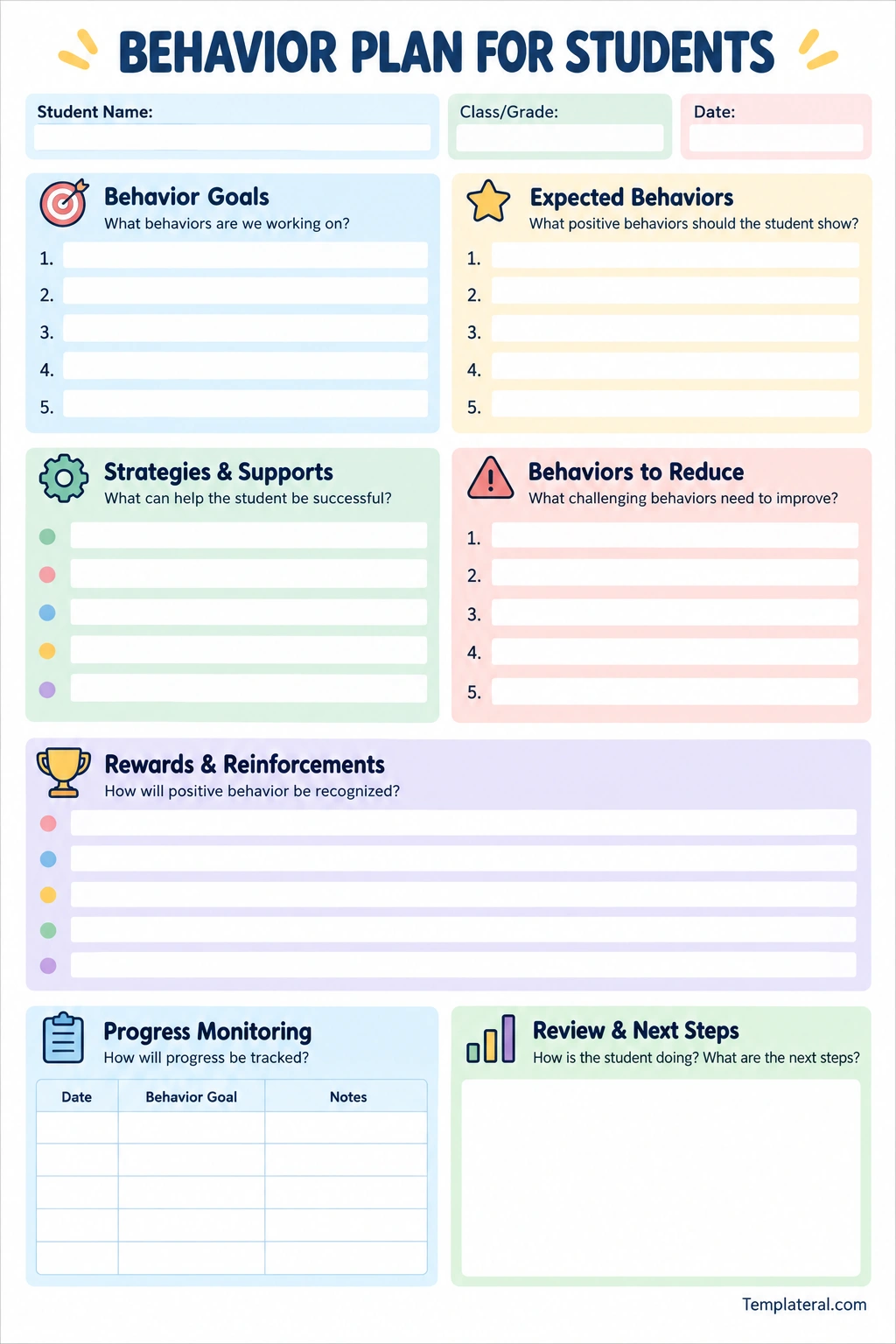
A printable template can make it easier to organize the information needed for a student behavior plan. The template below includes sections for behavior goals, expected behaviors, behaviors to reduce, strategies and supports, positive reinforcement, progress monitoring, and next steps.
It can be printed and completed by hand or used as a reference when creating a more detailed school behavior support plan.
How to Create a Behavior Plan for a Student
Creating a behavior plan is easier when the process is broken into clear steps. The plan should be based on observable information rather than assumptions about why a student behaves a certain way.
Step 1: Identify the Target Behavior
Start by identifying the behavior that needs attention. Describe what happens in observable terms. Consider when the behavior occurs, where it happens, and how often it occurs.
Step 2: Define the Desired Behavior
Determine what behavior you want the student to demonstrate instead. A replacement behavior gives the student a practical alternative rather than simply telling them what not to do.
Step 3: Set a Realistic Goal
Create a goal that can be measured. Avoid trying to change too many behaviors at once. A focused goal makes it easier to monitor progress and recognize improvement.
Step 4: Choose Appropriate Supports
Identify strategies that can help the student meet the goal. Consider classroom routines, instructional demands, communication needs, transitions, and other factors that may affect behavior.
Step 5: Decide How Progress Will Be Measured
Choose a simple measurement method. For example, you might record the number of successful transitions, completed assignments, appropriate responses, or instances of a target behavior during a specific period.
Step 6: Review the Plan Regularly
Set a reasonable review schedule and use the collected information to determine whether the plan needs adjustment. A plan should remain flexible as the student’s needs and circumstances change.
Examples of Student Behavior Goals
Behavior goals should be specific enough that both the student and adults can recognize success. Here are several examples that can be adapted to different situations:
- The student will follow classroom directions after the first or second prompt.
- The student will remain in the assigned area during independent work.
- The student will use an appropriate strategy when feeling frustrated.
- The student will raise a hand before speaking during group instruction.
- The student will begin assigned work within an agreed-upon time.
- The student will use respectful language when communicating with peers.
- The student will transition between activities using the established classroom routine.
These examples should be adjusted to match the student’s age, abilities, classroom expectations, and individual circumstances.
Tips for Making a Behavior Plan Effective
Keep the Language Simple
Use language that the student can understand. Short, concrete statements are generally easier to remember than lengthy explanations.
Focus on Positive Expectations
Whenever possible, describe what the student should do rather than focusing exclusively on what the student should stop doing. Positive expectations make the desired behavior easier to identify.
Use Consistent Expectations
Adults implementing the plan should understand their roles and use the agreed-upon strategies consistently. Inconsistent responses can make expectations difficult for a student to understand.
Make Goals Measurable
Vague goals make progress difficult to evaluate. Use observable behaviors and clear measurements whenever practical.
Recognize Small Improvements
Behavior change can take time. Recognizing incremental progress can help maintain motivation and reinforce appropriate behavior.
Involve the Student When Appropriate
Depending on the student’s age and abilities, invite the student to participate in setting goals and identifying strategies that feel helpful. Student involvement can make the plan more understandable and meaningful.
Behavior Plan vs. Behavior Intervention Plan
The terms behavior plan and behavior intervention plan are sometimes used interchangeably, but they can refer to different levels of planning depending on the school or educational setting.
A simple behavior plan may be a practical classroom or home document that outlines expectations, supports, reinforcement, and progress tracking. A formal behavior intervention plan may be part of a broader educational process and may involve more detailed assessment, documentation, and professional collaboration.
If a student has significant or persistent behavioral needs, educators and families may need to work with appropriate school professionals to determine what type of support and documentation is appropriate.
Common Mistakes to Avoid
A behavior plan is more useful when it avoids common planning problems.
- Using vague goals: “Be good” is difficult to measure or interpret.
- Focusing only on consequences: A plan should also teach and support appropriate replacement behaviors.
- Choosing too many goals: A smaller number of focused goals can make implementation easier.
- Ignoring student strengths: Consider existing skills and successful situations when creating the plan.
- Failing to monitor progress: Without tracking, it can be difficult to determine whether strategies are effective.
- Never reviewing the plan: Student needs can change, so the plan should be adjusted when appropriate.
How Teachers and Parents Can Work Together
Consistency between school and home can be helpful when the same behavioral goals are relevant in both environments. Teachers and parents can communicate about successful strategies, progress, and situations that may require additional support.
However, the plan should remain realistic for each environment. A strategy that works in a classroom may need to be adapted for home, and vice versa.
When multiple adults support the same student, clear communication can help everyone understand the student’s goals and the strategies being used.
Frequently Asked Questions About Behavior Plans for Students
What is the purpose of a behavior plan for students?
The purpose of a behavior plan is to provide clear behavioral goals, expected behaviors, support strategies, positive reinforcement, and a method for monitoring progress. It helps adults respond consistently and gives students clear expectations.
What should a behavior plan include?
A behavior plan commonly includes student information, target behavior goals, expected behaviors, behaviors to reduce, support strategies, positive reinforcement, progress monitoring, and review or next steps.
How do you write a behavior goal for a student?
Write a behavior goal using specific and observable language. Describe what the student will do, when or where the behavior should occur, and how success can be measured.
Can parents use a behavior plan at home?
Yes. Parents can adapt a behavior plan to establish clear routines, expectations, positive reinforcement, and progress tracking at home. The strategies should be appropriate for the child’s age and individual needs.
How often should a student behavior plan be reviewed?
The review schedule depends on the student’s needs and the setting. A plan should be reviewed regularly enough to determine whether the strategies are helping and whether adjustments are necessary.
Is a behavior plan the same as a behavior intervention plan?
Not always. The terminology can vary by school and educational setting. A simple behavior plan may be used as a classroom or home support tool, while a formal behavior intervention plan may involve a more structured educational process.
Conclusion
A behavior plan for students can provide a practical framework for setting clear expectations, encouraging positive behavior, and monitoring progress. The most effective plans are specific, realistic, measurable, and focused on helping students understand what successful behavior looks like.
Using a printable behavior plan for students template can simplify the process by putting important information into one organized document. Whether the plan is used in a classroom, at home, or as part of a broader support process, regular communication and thoughtful review can help ensure that the strategies remain appropriate for the student’s needs.
Download: Behavior Plan for Students
