When a problem keeps happening, fixing the visible symptom may not be enough. The same issue can return because the real cause has not been identified. The 5 Why method is a simple problem-solving technique that helps you look beyond the immediate problem and uncover the root cause.
The method is straightforward: identify a problem, ask “Why?” about what happened, then continue asking “Why?” about each answer until you reach a deeper cause. Although the technique is commonly associated with Toyota’s approach to problem solving, it can be used in many situations, including business, manufacturing, project management, quality control, education, and everyday decision-making.
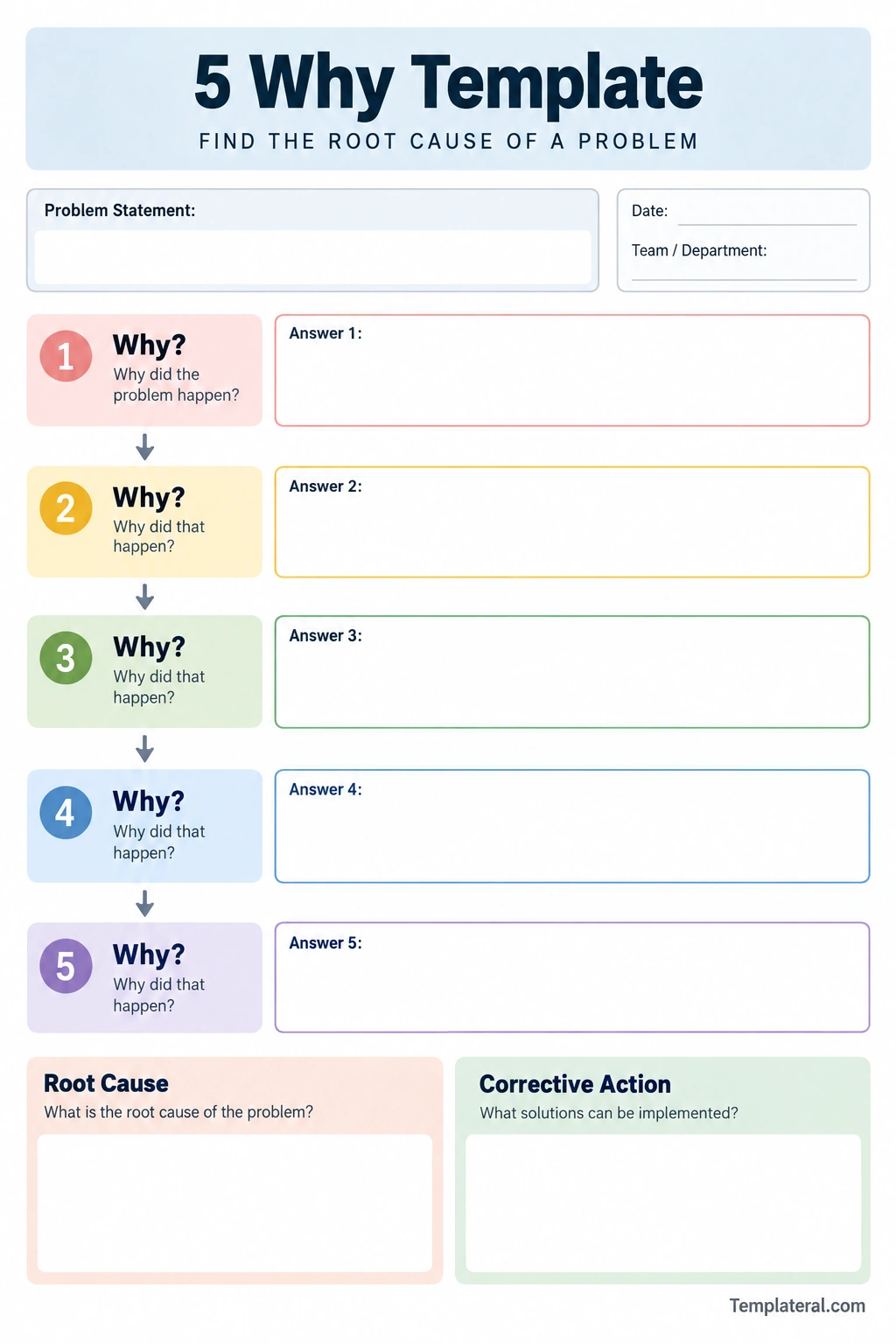
A 5 Why template makes the process easier by providing a structured space to record the original problem, each answer, the root cause, and the corrective action. Instead of trying to remember each step, you can work through the questions in a clear and organized format.
What Is the 5 Why Method?
The 5 Why method is a root cause analysis technique that uses repeated “Why?” questions to investigate the underlying cause of a problem. The goal is not necessarily to ask exactly five questions every time. Instead, five is a practical guideline for encouraging deeper investigation.
For example, imagine that a company ships an order late. Simply saying “the order was late” describes the problem but does not explain why it happened. By repeatedly asking why, you may discover that the order was delayed because the required component was unavailable, which itself may have resulted from an inaccurate inventory record.
The process can be summarized as:
- Identify the problem clearly.
- Ask why the problem occurred.
- Record the answer.
- Ask why that answer occurred.
- Continue until the underlying cause becomes clear.
- Identify the root cause.
- Determine an appropriate corrective action.
The value of the technique comes from following the chain of causes rather than immediately jumping to a solution.
Why Use a 5 Why Analysis?
Many problems have multiple layers. The first explanation is often only a symptom or an immediate cause. A 5 Why analysis encourages you to keep investigating before deciding what needs to be changed.
This approach can help organizations and individuals:
- Identify the underlying cause of recurring problems.
- Separate symptoms from root causes.
- Understand how one problem can lead to another.
- Develop more targeted corrective actions.
- Improve processes and workflows.
- Document the reasoning behind a solution.
- Encourage structured problem-solving discussions.
Because the technique is simple, it does not require complicated software or specialized analysis tools. A piece of paper or a printable 5 Why worksheet can be enough to begin.
How Does the 5 Why Process Work?
A successful 5 Why analysis starts with a specific problem statement. Once the problem has been clearly defined, you investigate the cause by repeatedly asking why.
Step 1: Define the Problem
Begin with a problem that is specific enough to investigate. Avoid vague statements such as “the project went badly” or “customers are unhappy.” Instead, describe what actually happened.
For example, a better problem statement might be: “The customer order was shipped two days later than the promised delivery date.”
A precise problem statement gives the analysis a clear starting point and prevents the discussion from becoming too broad.
Step 2: Ask the First Why
Ask why the problem occurred and write down the most factual answer you can identify.
For example:
- Problem: The customer order was shipped two days late.
- Why? The order could not be completed on the scheduled production day.
The answer becomes the starting point for the next question.
Step 3: Ask Why Again
Now ask why the previous answer happened. Continue to follow the chain instead of returning to the original problem.
For example:
- Why 1: The order could not be completed on the scheduled production day.
- Why 2: A required component was not available.
At this stage, the analysis is moving beyond the visible symptom and identifying a contributing cause.
Step 4: Continue Asking Why
Continue the same process for the third, fourth, and fifth questions. Each answer should logically connect to the previous answer.
A simplified example might look like this:
- Problem: The order was shipped late.
- Why 1: Production could not be completed on schedule.
- Why 2: A required component was unavailable.
- Why 3: The inventory system showed an incorrect quantity.
- Why 4: Inventory updates were not recorded consistently.
- Why 5: There was no standardized inventory update procedure.
The fifth answer suggests a process-level issue that may be more useful to address than simply expediting the delayed order.
Step 5: Identify the Root Cause
After asking why several times, review the chain of answers. Look for the point where addressing the cause could prevent the original problem from recurring.
In the example above, the root cause may be related to the lack of a standardized inventory update procedure. The exact root cause should be supported by evidence rather than selected simply because it appears at the fifth level.
Step 6: Determine Corrective Action
Once the root cause has been identified, determine what action can address it. A good corrective action should target the cause rather than only treating the symptom.
For example, if inconsistent inventory updates contributed to the problem, a corrective action might include creating a standardized inventory recording process, assigning responsibility for updates, and establishing a regular verification procedure.
5 Why Example
Consider a workplace where an important report was submitted late.
Problem
The monthly report was submitted two days after the deadline.
Why 1
Why was the report submitted late? Because the final data was not available when the report needed to be completed.
Why 2
Why was the final data not available? Because one department had not submitted its data.
Why 3
Why had the department not submitted its data? Because the department was unclear about the reporting deadline.
Why 4
Why was the reporting deadline unclear? Because the deadline was communicated informally through individual messages.
Why 5
Why was the deadline communicated informally? Because there was no standardized reporting calendar or formal notification process.
In this example, simply reminding the department to submit its data earlier may solve one instance of the problem. However, creating a standardized reporting calendar could address the process issue that contributed to the delay.
How to Use a 5 Why Template
A 5 Why template provides a simple structure for documenting the analysis. It is particularly useful when several people are working together because everyone can see the problem, reasoning, root cause, and proposed action in one place.
A typical template includes the following sections:
- Problem Statement: Describe the issue being investigated.
- Why 1: Record the first explanation.
- Why 2: Investigate the cause of the first answer.
- Why 3: Continue the cause-and-effect chain.
- Why 4: Investigate the deeper contributing factor.
- Why 5: Identify a potential underlying cause.
- Root Cause: Summarize the cause that should be addressed.
- Corrective Action: Document the action that can help prevent recurrence.
When using a printable worksheet, write concise answers rather than long explanations. The purpose of the worksheet is to make the cause-and-effect relationship easy to follow.
Tips for a More Effective 5 Why Analysis
Start With Facts
Use observable information whenever possible. Avoid assumptions, blame, or unsupported opinions. A factual answer creates a stronger foundation for the next question.
Ask “Why?” About the Previous Answer
Each question should build directly on the previous answer. Do not simply ask five unrelated questions about the original problem. The strength of the technique comes from following the causal chain.
Avoid Blaming Individuals
The purpose of root cause analysis is to improve understanding and processes. If an answer is simply “someone made a mistake,” continue investigating why the mistake happened. Training, unclear instructions, workload, communication, system design, or missing controls may be contributing factors.
Do Not Force Exactly Five Questions
The name of the technique can make it seem as though every problem must have exactly five answers. That is not necessary. Some problems may require fewer questions, while complex problems may require additional investigation.
Verify the Root Cause
A plausible explanation is not automatically the true root cause. Review available evidence and determine whether addressing the suspected cause would reasonably prevent the problem from happening again.
Focus on Actionable Causes
A useful root cause should lead to an opportunity for improvement. If the final answer is too broad or vague, continue investigating until you reach a cause that can be addressed through a realistic change.
When Should You Use the 5 Why Technique?
The 5 Why technique can be useful whenever you need to understand why an issue occurred. It is especially practical for recurring or process-related problems.
Common applications include:
- Quality control and manufacturing problems.
- Customer service issues.
- Project delays.
- Missed deadlines.
- Workplace process problems.
- Product defects.
- Equipment or operational issues.
- Communication failures.
- Workflow inefficiencies.
- Repeated errors.
For more complex problems involving several interacting causes, a different root cause analysis method may be more appropriate. The 5 Why method works particularly well when the problem has a relatively clear cause-and-effect path.
5 Why vs. Other Root Cause Analysis Tools
The 5 Why method is only one approach to root cause analysis. Other techniques can be useful depending on the type and complexity of the problem.
- 5 Why: Useful for following a simple chain of cause and effect.
- Fishbone Diagram: Useful for organizing multiple possible causes into categories.
- Fault Tree Analysis: Useful for analyzing complex systems and combinations of causes.
- Pareto Analysis: Useful for identifying the causes that contribute most significantly to a problem.
These methods can also complement one another. For example, a team might use a fishbone diagram to identify possible causes and then use the 5 Why technique to investigate one specific cause in greater depth.
Benefits of Using a Printable 5 Why Worksheet
A printable 5 Why worksheet can turn an informal discussion into a documented problem-solving exercise. Writing each answer down makes it easier to review the logic and identify gaps in the analysis.
A worksheet can also help teams:
- Keep the investigation focused.
- Record each stage of the analysis.
- Make discussions easier to follow.
- Document the identified root cause.
- Connect the root cause to corrective action.
- Create a record for future reference.
For individual use, the worksheet can be printed and completed by hand. For teams, it can also serve as a starting point for a group discussion before the final findings are documented digitally.
Final Thoughts on the 5 Why Method
The 5 Why method is a straightforward way to move from a visible problem toward a deeper understanding of its cause. By repeatedly asking why and documenting each answer, you can avoid stopping at the first explanation and instead investigate what may be driving the issue.
A 5 Why template makes this process even easier by organizing the problem statement, five levels of questioning, root cause, and corrective action in one structured worksheet. The key is not to mechanically ask “Why?” exactly five times, but to keep investigating until you have enough evidence to identify a meaningful and actionable cause.
Whether you are analyzing a workplace delay, recurring quality issue, process failure, or everyday problem, a simple 5 Why worksheet can provide a practical starting point for structured root cause analysis and continuous improvement.
Download: 5 Why Root Cause Worksheet Template
