A tap drill chart is a practical reference tool used to determine the appropriate drill size before cutting internal threads with a tap. Choosing the correct drill size is an important part of successful tapping because the hole must provide enough material for the threads while still leaving sufficient clearance for the tap.
Whether you work with metric threads, UNC threads, UNF threads, or other thread standards, a tap drill chart can make the preparation process faster and more consistent. Instead of estimating the drill size, you can use the thread designation and pitch or threads per inch (TPI) as a starting point for selecting a suitable drill.
However, a chart should be treated as a reference rather than an absolute rule. The appropriate hole size can depend on the thread standard, desired thread percentage, material, tapping method, tap type, and manufacturer’s recommendations. For critical applications, always verify the required dimensions against a reliable engineering reference or the tap manufacturer’s specifications.
What Is a Tap Drill Chart?
A tap drill chart is a reference table that matches thread sizes with recommended drill sizes for creating holes that will be tapped. It commonly includes information such as thread designation, pitch, threads per inch, tap drill diameter, and equivalent measurements.
Tap drill charts are commonly divided into different thread systems. Two frequently encountered categories are metric and inch-based threads.
- Metric threads: Typically identified by an M designation and a thread pitch measured in millimeters.
- UNC threads: Unified National Coarse threads, identified by diameter and threads per inch.
- UNF threads: Unified National Fine threads, also identified by diameter and threads per inch.
- Other thread standards: Depending on the application, additional standards may require their own reference data.
The main purpose of the chart is to help you select an appropriate starting drill size before using a tap.
Why Is the Correct Tap Drill Size Important?
The drill size directly affects the amount of material available for the internal thread. Using an unsuitable drill can create problems during tapping or result in a finished thread that does not meet the intended requirements.
Drilling Too Small a Hole
If the drilled hole is too small, the tap has to remove more material. This can increase cutting forces and make tapping more difficult. Depending on the material and application, an undersized hole can increase the risk of tap breakage or poor thread quality.
Drilling Too Large a Hole
If the hole is too large, there may not be enough material remaining to form the desired thread profile. The resulting thread may have reduced engagement and may not provide the intended mechanical performance.
Getting Consistent Results
Using an appropriate tap drill size helps create more predictable threads. Consistent hole preparation is particularly important when multiple threaded holes need to meet the same specification.
How to Read a Tap Drill Chart
Although different charts can have different layouts, the basic information is usually straightforward once you understand the terminology.
Thread Size
The thread size identifies the nominal thread specification. In a metric system, it may be represented by an M designation. In an inch-based system, it may be represented by a fractional diameter or a numbered screw size followed by the thread count.
Thread Pitch
Metric threads commonly use pitch, which describes the distance between adjacent thread peaks. The measurement is normally expressed in millimeters.
Threads Per Inch
For many inch-based thread systems, thread density is expressed as threads per inch, or TPI. A higher TPI indicates more threads within one inch of thread length.
Tap Drill Size
The tap drill size indicates the drill diameter used to prepare the hole before tapping. Depending on the chart, this dimension may be shown in inches, millimeters, or both.
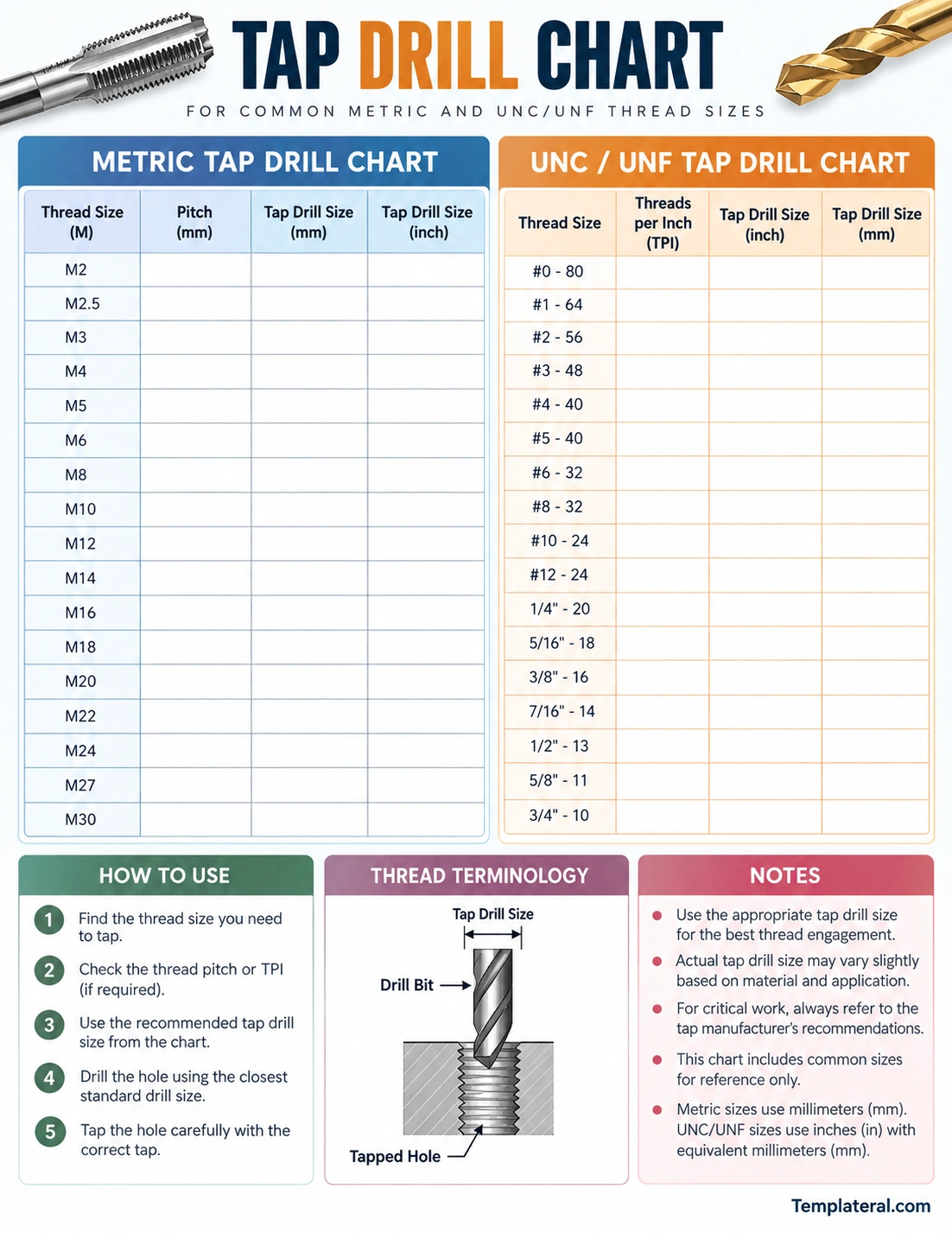
Metric Tap Drill Charts
Metric tapping uses a thread designation and pitch to describe the thread. For example, a metric specification may identify the nominal diameter together with its pitch.
When using a metric tap drill chart, first identify the required metric thread size. Then check the corresponding pitch and recommended drill diameter.
Metric thread specifications can have different pitches for the same nominal diameter, so selecting the correct pitch is important. Do not assume that every thread with the same M designation uses the same drill size.
Metric Coarse and Fine Threads
Some metric thread sizes are available with different pitches. A coarse thread and a fine thread can therefore have the same nominal diameter but different thread spacing.
Always match the tap, thread specification, pitch, and drill size before beginning the operation.
UNC and UNF Tap Drill Charts
UNC and UNF are part of the Unified Thread Standard used for inch-based threads. The main distinction is the thread series.
UNC generally refers to Unified National Coarse threads, while UNF refers to Unified National Fine threads.
When reading an inch thread specification, pay attention to both the nominal thread size and the TPI. A similar nominal diameter can have different thread counts, so the corresponding tap drill requirement can also differ.
Numbered Screw Threads
Smaller inch-based screw threads may use numbered sizes rather than fractional diameters. These specifications are commonly accompanied by a TPI value.
Because numbered thread sizes can be unfamiliar to beginners, a dedicated tap drill chart can be especially useful when selecting the correct drill.
How to Use a Tap Drill Chart Step by Step
Using a chart is relatively simple when you follow a consistent process.
1. Identify the Required Thread
Start with the thread specification shown on the engineering drawing, fastener specification, repair requirement, or project instructions.
Identify whether the thread is metric, UNC, UNF, or another standard.
2. Confirm the Pitch or TPI
For metric threads, verify the pitch. For inch-based threads, verify the threads per inch.
This step is important because the same nominal diameter may be available with multiple thread pitches or thread counts.
3. Find the Corresponding Drill Size
Locate the thread specification in the appropriate section of the chart. Then identify the recommended tap drill diameter.
4. Verify the Reference
Before drilling, confirm that the chart applies to your thread standard and tapping application. For precision or safety-critical work, consult the relevant engineering standard, tooling documentation, or tap manufacturer.
5. Drill the Hole
Prepare the hole using the selected drill while maintaining proper alignment and drilling conditions for the material.
6. Tap the Hole
After preparing the hole, use the appropriate tap and tapping method for the thread specification and material. Maintain proper alignment and use suitable cutting conditions.
Tap Drill Size and Thread Percentage
One reason different references can sometimes show different recommended drill sizes is that tap drill selection is related to the desired thread percentage.
The theoretical thread percentage describes how much of the available thread profile is engaged by the internal thread. A larger tap drill generally produces a lower percentage of thread engagement, while a smaller tap drill generally produces a higher percentage.
However, maximum theoretical thread engagement is not automatically the best choice for every application. Material properties, tapping forces, tool life, hole quality, and the requirements of the finished assembly all need to be considered.
For this reason, a machinist should not automatically choose the smallest possible drill simply to maximize thread engagement.
Factors That Can Affect Tap Drill Selection
A basic chart provides a useful starting point, but several factors can influence the final selection.
Material
Different materials behave differently during drilling and tapping. Soft materials, tough materials, ductile materials, and abrasive materials can require different cutting approaches.
Tap Type
The type of tap being used can affect the recommended hole preparation. Different tap geometries and applications may have different requirements.
Blind or Through Hole
A through hole and a blind hole can require different considerations during tapping. A blind hole needs sufficient depth and chip-management considerations so the tap can reach the required thread depth without bottoming out.
Required Thread Engagement
The intended mechanical requirements of the connection can influence the desired thread engagement. Always follow the specification for the particular application rather than relying solely on a generic chart.
Hole-Making Method
The actual hole diameter can also be influenced by drilling accuracy, tool condition, machine setup, material behavior, and other manufacturing variables.
Common Tap Drilling Mistakes to Avoid
Even when using a tap drill chart, several common mistakes can lead to poor results.
- Choosing the wrong thread standard: Confirm whether the specification is metric, UNC, UNF, or another standard.
- Ignoring pitch or TPI: The nominal diameter alone may not identify the correct drill requirement.
- Using an outdated reference: For precision work, verify dimensions against an authoritative current reference.
- Confusing drill diameter with tap diameter: The tap drill is used to prepare the hole; it is not simply the same diameter as the nominal thread.
- Ignoring the material: Tapping conditions can vary significantly between materials.
- Failing to verify the tool manufacturer’s guidance: Tool-specific recommendations can be important for demanding applications.
Tap Drill Chart for Machining and Workshop Use
A printed tap drill chart can be particularly useful in a workshop because it provides quick access to common thread information without requiring a computer or phone.
A good printable chart should be easy to read, organized by thread standard, and large enough that the drill-size information can be located quickly.
For a personal workshop, you may want to keep a printed chart near the drill press, milling machine, tool cabinet, or tapping station. For production environments, the chart should be treated as a reference alongside the applicable engineering drawings, standards, tooling information, and quality requirements.
How to Choose a Reliable Tap Drill Reference
Not every chart found online should automatically be treated as an authoritative engineering specification. Before using a tap drill chart for important work, check where the information comes from and whether it matches the required thread standard.
For routine workshop tasks, a reputable reference chart can be a convenient starting point. For critical components, verify the dimensions using the applicable standard or the manufacturer’s technical documentation.
It is also useful to confirm whether a chart is describing a general-purpose recommendation, a particular thread percentage, or a specific tooling application. Those details can explain why two references may not always show identical recommendations.
Final Thoughts on Tap Drill Charts
A tap drill chart is a convenient reference for selecting a suitable drill size before creating internal threads. By matching the thread size with the correct pitch or TPI and then checking the corresponding drill recommendation, you can prepare holes more consistently for tapping.
However, the chart should be used as part of a broader machining process. Material, tap design, thread percentage, hole depth, application requirements, and manufacturer recommendations can all affect the final choice.
For everyday workshop use, keeping a clear printable tap drill chart nearby can save time and reduce guesswork. For precision or safety-critical work, always verify the selected dimensions against the applicable engineering standard and tooling documentation before machining.
Download: Tap Drill Chart Template
