The periodic table of elements is one of the most useful tools in chemistry. It organizes chemical elements according to their atomic numbers and groups elements with similar properties together. From hydrogen and oxygen to iron, gold, and uranium, every known chemical element has a place on the periodic table.
For students, teachers, science enthusiasts, and anyone learning chemistry, understanding how to read the periodic table can make many chemistry concepts easier to understand. The table provides information about atomic numbers, chemical symbols, element names, atomic masses, groups, periods, and element categories.
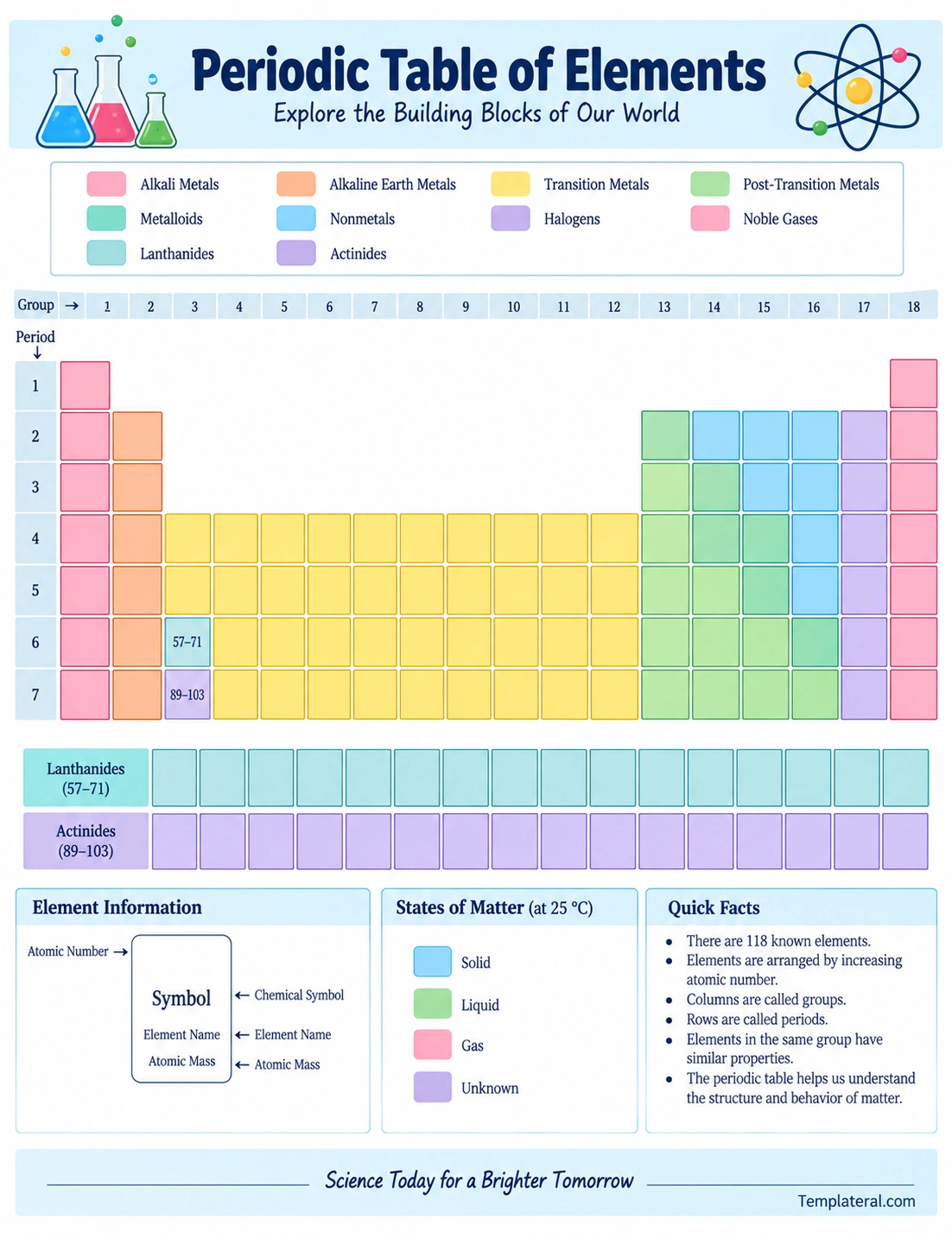
The printable template below provides a colorful visual reference that can be used for studying, classroom activities, homework, or general chemistry reference.
What Is the Periodic Table of Elements?
The periodic table of elements is a systematic arrangement of chemical elements. Elements are organized primarily by increasing atomic number, which represents the number of protons in an atom’s nucleus.
The layout of the table also reveals patterns in the properties of elements. Elements located in the same vertical column often have similar chemical characteristics because they have related electron configurations.
The modern periodic table contains 118 known elements, ranging from hydrogen, atomic number 1, to oganesson, atomic number 118.
How the Periodic Table Is Organized
At first glance, the periodic table may look like a complicated collection of boxes. However, its structure follows a logical system based on atomic number and electron arrangement.
Atomic Number
The atomic number identifies an element by the number of protons found in its nucleus. Hydrogen has an atomic number of 1, while helium has an atomic number of 2.
As you move through the periodic table from left to right, the atomic number generally increases by one. This sequence continues from one period to the next.
Element Symbol
Each element has a unique chemical symbol. Most symbols contain one or two letters. The first letter is capitalized, while a second letter, when present, is lowercase.
For example, H represents hydrogen, O represents oxygen, Na represents sodium, and Fe represents iron.
Element Name
The full name of the element is usually displayed alongside or beneath its chemical symbol in a detailed periodic table. Learning both the name and symbol is useful because chemical formulas commonly use symbols rather than full element names.
Atomic Mass
Many periodic tables also display the element’s average atomic mass. This value is related to the masses and natural abundances of the element’s isotopes and is commonly expressed in atomic mass units.
Groups and Periods
Two important concepts for reading a periodic table are groups and periods.
What Are Groups?
Groups are the vertical columns of the periodic table. The modern periodic table contains 18 groups.
Elements within the same group often show related chemical behavior. For example, the alkali metals in Group 1 share several characteristic properties, while the noble gases in Group 18 are known for their relatively low chemical reactivity.
What Are Periods?
Periods are the horizontal rows of the periodic table. There are seven periods in the modern table.
As you move across a period, the atomic number increases. The electron structure also changes systematically, which contributes to the changing properties of elements across the row.
Major Categories of Elements
The periodic table is often divided into broad categories to make it easier to understand general chemical properties. Different educational periodic tables may use slightly different color schemes or category boundaries.
Alkali Metals
Alkali metals are found in Group 1, excluding hydrogen when discussing the metallic category. They are highly reactive metals and include lithium, sodium, and potassium.
Alkaline Earth Metals
Alkaline earth metals occupy Group 2. Examples include magnesium, calcium, and barium. They are reactive metals with properties distinct from those of the alkali metals.
Transition Metals
Transition metals occupy much of the central portion of the periodic table. Iron, copper, silver, gold, and many other familiar metals belong to this broad category.
Post-Transition Metals
Post-transition metals are generally located to the right of the transition metals. Examples include aluminum, tin, and lead.
Metalloids
Metalloids have properties that fall between those typically associated with metals and nonmetals. Silicon and boron are commonly classified as metalloids.
Nonmetals
Nonmetals occupy much of the upper-right region of the periodic table, along with hydrogen. Oxygen, carbon, nitrogen, and sulfur are examples of nonmetal elements.
Halogens
Halogens are found in Group 17. Fluorine, chlorine, bromine, and iodine are familiar examples. These elements are generally reactive nonmetals.
Noble Gases
Noble gases occupy Group 18. Helium, neon, argon, krypton, xenon, and radon are examples. They are characterized by electron configurations that make them relatively unreactive under many ordinary conditions.
Lanthanides and Actinides
The lanthanides and actinides are commonly displayed in two separate rows below the main body of the periodic table. This arrangement keeps the main table compact while maintaining the correct sequence of atomic numbers.
The lanthanide series includes elements 57 through 71, while the actinide series includes elements 89 through 103.
How to Read an Element Box
A typical element box contains several pieces of information. The exact arrangement depends on the periodic table design, but a detailed element tile commonly includes:
- Atomic number: The number of protons in the element’s nucleus.
- Chemical symbol: The abbreviated representation of the element.
- Element name: The full name of the element.
- Atomic mass: The average atomic mass shown on many periodic tables.
For example, an element tile for carbon typically identifies carbon with the symbol C and atomic number 6. This means every carbon atom contains six protons.
Why Is the Periodic Table Important?
The periodic table does more than list chemical elements. Its structure helps scientists and students identify patterns and predict general chemical behavior.
It can help you understand relationships between elements, compare their properties, interpret chemical formulas, and study chemical reactions.
The periodic table is used throughout chemistry and also has applications in fields such as materials science, biology, environmental science, medicine, engineering, geology, and physics.
How to Study the Periodic Table
Memorizing all 118 elements at once can be overwhelming. A more practical approach is to learn the table gradually and focus on its organization.
Start With Common Elements
Begin with elements that frequently appear in introductory chemistry, such as hydrogen, carbon, nitrogen, oxygen, sodium, magnesium, aluminum, silicon, chlorine, potassium, calcium, iron, copper, and zinc.
Learn Symbols Alongside Names
Do not memorize element names separately from their symbols. Learning the pair together makes it easier to recognize chemical formulas later.
Study Groups
Learning the major groups can help you recognize patterns. Focus on the characteristics of alkali metals, alkaline earth metals, transition metals, halogens, and noble gases.
Use Color Coding
A color-coded periodic table can make different element categories easier to distinguish visually. When studying, use the colors as a visual cue rather than relying on color alone.
Practice With Blank Templates
A blank periodic table can be particularly useful for practice. Try filling in atomic numbers, symbols, element names, or group names from memory. Repeating this exercise can help reinforce the table’s structure.
Periodic Table for Students
The periodic table is commonly introduced in middle school, high school, and college chemistry courses. Students may use it when learning about atoms, electron configurations, chemical bonding, reactions, acids and bases, and other chemistry topics.
A printable periodic table can be kept in a binder, notebook, study folder, or classroom. A blank version can also be used for quizzes, review exercises, and classroom worksheets.
When studying, focus not only on memorizing individual elements but also on understanding why the elements are arranged in their particular positions.
Tips for Using a Printable Periodic Table
A printable periodic table can serve several purposes beyond simply looking up an element.
- Use it as a quick chemistry reference.
- Highlight different element groups with notes or colors.
- Practice writing chemical symbols from memory.
- Mark elements commonly used in chemistry exercises.
- Use a blank version for classroom quizzes or study sessions.
- Write important properties next to selected elements.
- Keep a copy in your chemistry notebook for quick reference.
Common Mistakes When Learning the Periodic Table
Students sometimes focus too heavily on memorization and overlook the patterns that make the periodic table useful. Understanding the structure can make memorization easier.
Another common mistake is confusing atomic number with atomic mass. Atomic number represents the number of protons, while atomic mass shown on a standard periodic table is generally an average value based on naturally occurring isotopes.
It is also important to distinguish groups from periods. Groups are vertical columns, while periods are horizontal rows.
Periodic Table of Elements Template
A periodic table of elements template can provide a convenient visual learning tool. A blank or partially labeled table allows students to practice identifying element positions without relying on a fully completed reference chart.
The printable template can be used for homework, science projects, classroom activities, revision, or independent study. Because the layout is organized by groups and periods, it can also help learners become familiar with the overall structure of the periodic table.
For repeated practice, print several copies and use each one for a different exercise. For example, one worksheet can focus on element symbols, another on element names, and another on element categories.
Quick Periodic Table Study Checklist
Use this checklist when reviewing the periodic table:
- Know what atomic number represents.
- Understand the difference between groups and periods.
- Recognize common chemical symbols.
- Identify major element categories.
- Understand where transition metals are located.
- Recognize the halogen and noble gas groups.
- Know why lanthanides and actinides are displayed separately.
- Practice reading information from an element tile.
- Use a blank periodic table for active recall.
Conclusion
The periodic table of elements is a structured map of the chemical elements and one of the most important reference tools in chemistry. By organizing elements according to atomic number and grouping elements with related properties, it reveals useful patterns in the behavior and structure of matter.
Learning the table becomes easier when you understand its groups, periods, element symbols, atomic numbers, and major categories. A printable periodic table or blank periodic table template can also provide a practical way to review and reinforce these concepts.
Whether you are beginning chemistry or reviewing familiar concepts, keeping a clear periodic table available can make studying elements, chemical formulas, and reactions much easier.
Download: Printable Periodic Table of Elements Template
