A well-organized business letter can make your message easier to understand and give your communication a professional appearance. Whether you are writing to a company, customer, manager, client, supplier, or other professional contact, using the correct business letter format helps you present your information clearly.
A standard business letter usually includes the sender’s information, date, recipient’s information, salutation, body, closing, and signature. The exact layout can vary depending on the purpose of the letter, but following a consistent structure makes the document easier to read and use.
The printable template below provides a simple visual guide to the main parts of a professional business letter.
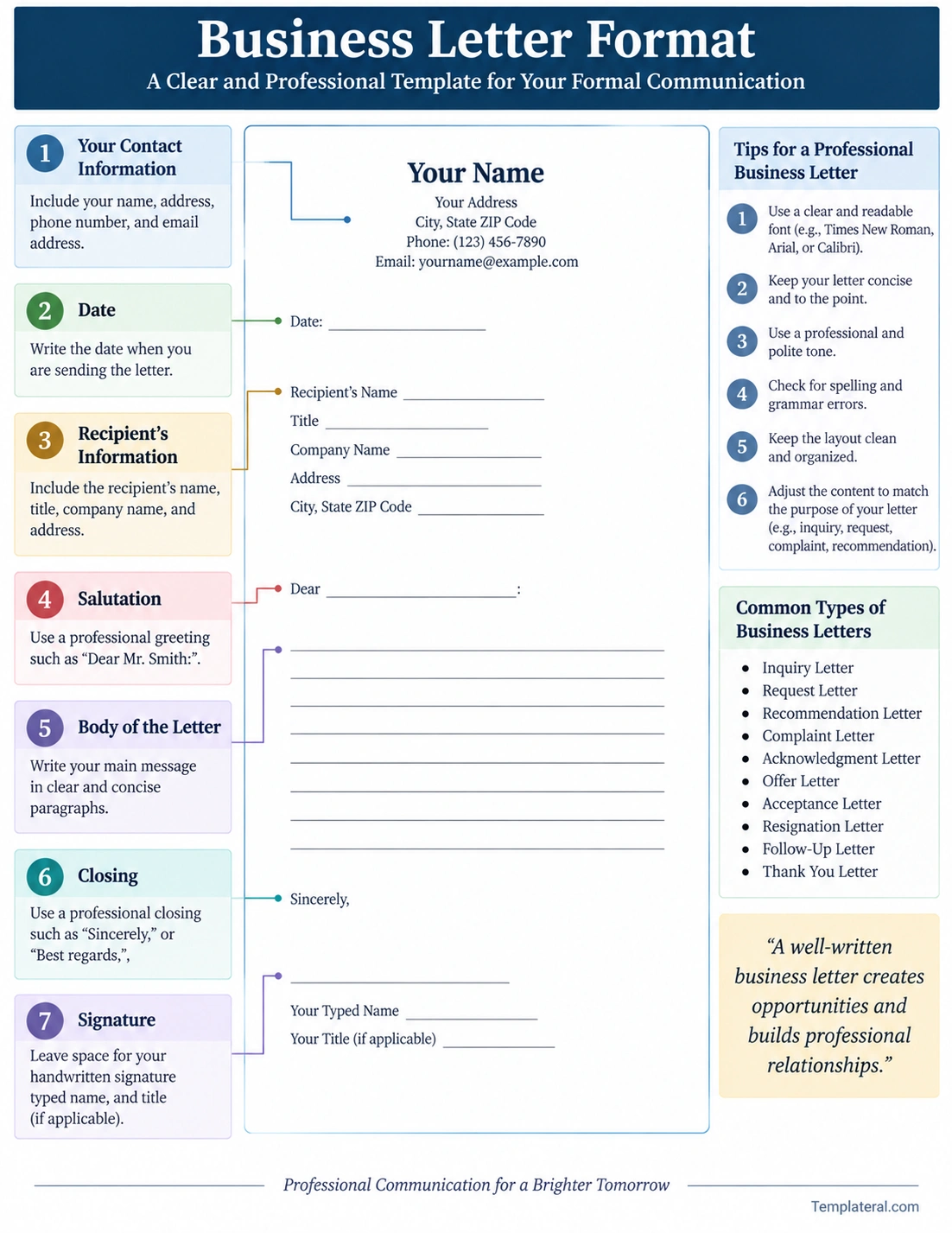
What Is a Business Letter Format?
A business letter format is the standard structure used to organize a formal letter for professional communication. It determines where important details such as contact information, the date, recipient information, greeting, message, and signature should appear.
Unlike an informal personal letter, a business letter generally uses a clean layout, professional language, and a clear purpose. The format helps the reader quickly identify who sent the letter, who should receive it, and what action or response may be required.
Business letters are commonly used for inquiries, requests, complaints, recommendations, applications, offers, acknowledgments, thank-you messages, and other professional communications.
Standard Parts of a Business Letter
Understanding the main components is the first step to creating a properly formatted business letter. Most traditional business letters contain several essential sections.
1. Sender’s Contact Information
Begin with your contact information when the letter format requires it. This section may include your full name, address, phone number, and email address.
For business correspondence, you may also include your job title or company name. If you are using official company letterhead, some of this information may already appear at the top of the page.
2. Date
Place the date below the sender’s information. Use a clear and consistent date format that is appropriate for your audience.
For example, a professional letter might use a format such as September 19, 2026. Writing the month in full can help avoid confusion between different numerical date conventions.
3. Recipient’s Information
The recipient section identifies the person or organization receiving the letter. Include the recipient’s name, professional title if applicable, company or organization, and mailing address.
If you know the recipient’s name, using it is generally more personal and precise than addressing the letter only to a department or company.
4. Salutation
The salutation is the formal greeting that begins the letter. A common example is Dear Mr. Smith: or Dear Ms. Johnson:.
When you do not know the recipient’s name, you can use a role or department when appropriate, such as Dear Hiring Manager: or Dear Customer Service Manager:.
5. Body of the Letter
The body contains the main message. Organize the information into short, focused paragraphs so the reader can easily follow your purpose.
The first paragraph should normally explain why you are writing. The following paragraphs can provide supporting information, details, requests, or explanations. The final paragraph can summarize the desired next step or response.
6. Closing
End the letter with a professional complimentary closing. Common choices include Sincerely, Best regards, Respectfully, and similar expressions.
Choose a closing that matches the level of formality and your relationship with the recipient.
7. Signature
Leave enough space for a handwritten signature when the letter will be printed. Below the signature, type your full name and include your professional title when relevant.
Common Business Letter Formats
There are several commonly used business letter layouts. The best choice depends on the organization’s standards and the purpose of your correspondence.
Block Format
Block format is one of the simplest business letter styles. All sections are aligned with the left margin, and paragraphs are usually separated by blank spaces rather than indentation.
This layout creates a clean and modern appearance and is easy to format in most word-processing programs.
Modified Block Format
Modified block format keeps most content aligned to the left but places certain elements, such as the date and closing, toward the center or right side of the page.
This style can provide a more traditional appearance while maintaining a straightforward structure.
Semi-Block Format
Semi-block format is similar to modified block format, but the paragraphs in the body are typically indented. It has a more traditional letter-writing appearance and may still be used for certain formal communications.
How to Format a Business Letter
Creating a professional business letter does not have to be complicated. Start with a clean document and organize the information in a logical order.
- Use a standard page size such as US Letter when appropriate.
- Choose a readable professional font.
- Maintain consistent margins throughout the document.
- Place contact and recipient information in logical positions.
- Use clear paragraph spacing.
- Keep the main message focused on one primary purpose.
- Use a professional greeting and closing.
- Leave sufficient space for a signature.
- Proofread the document before sending or printing it.
Choosing the Right Business Letter Layout
The purpose of your letter should influence how you organize the content. A short inquiry may require only a few paragraphs, while a formal complaint or recommendation may need additional supporting information.
Regardless of the purpose, the reader should be able to understand the reason for the letter quickly. Avoid adding unnecessary information simply to make the letter longer.
For most everyday professional correspondence, a simple block-style business letter provides an easy starting point. Organizations with established stationery or communication standards should follow those requirements instead.
Business Letter Format for Different Purposes
The same basic structure can be adapted for many types of professional correspondence.
Business Inquiry Letter
An inquiry letter is used to request information about a product, service, opportunity, policy, or other business matter. Clearly state what information you need and, when appropriate, explain why you are requesting it.
Business Request Letter
A request letter asks the recipient to take a specific action. State the request directly, provide necessary background information, and explain any relevant deadline or next step.
Business Complaint Letter
A complaint letter should describe the problem accurately and professionally. Include important dates, transaction details, or other relevant information and clearly explain the resolution you are requesting.
Business Recommendation Letter
A recommendation letter generally explains your relationship with the person being recommended, describes relevant qualifications or qualities, and provides specific examples that support the recommendation.
Business Thank-You Letter
A professional thank-you letter can acknowledge assistance, a meeting, an opportunity, a referral, or another business interaction. Keep the message sincere, specific, and appropriately concise.
Tips for Writing a Professional Business Letter
Good formatting is important, but the quality of the writing matters just as much. A polished business letter should communicate its message without making the reader work to understand it.
Be Clear and Direct
State your purpose early in the letter. Instead of beginning with several unrelated details, tell the reader why you are writing and then provide the information needed to support your message.
Keep the Tone Professional
Use respectful and professional language. Avoid slang, overly casual expressions, excessive abbreviations, or emotional wording that could distract from your main point.
Use Short Paragraphs
Large blocks of text can make a formal letter difficult to scan. Breaking the body into logical paragraphs improves readability and helps separate different ideas.
Proofread Carefully
Check names, addresses, dates, company names, spelling, grammar, punctuation, and formatting before sending your letter. A small error in important information can create unnecessary confusion.
Match the Format to the Situation
A formal printed letter may require a more traditional structure, while a business letter sent electronically can use a simpler layout. Always consider the expectations of the recipient and organization.
Common Business Letter Formatting Mistakes
Even a well-written message can look unprofessional when the formatting is inconsistent. Avoid these common problems:
- Using too many fonts or decorative typefaces.
- Leaving inconsistent spacing between sections.
- Forgetting the date or recipient information.
- Using an inappropriate or overly casual greeting.
- Writing extremely long paragraphs.
- Leaving out a professional closing.
- Failing to include contact information when it is necessary.
- Sending the letter without proofreading it.
- Including unnecessary details that do not support the purpose of the letter.
Using a Business Letter Format Template
A business letter template can save time by providing a ready-made structure for your correspondence. Instead of deciding where every section should go, you can fill in the appropriate information and focus on writing the message.
A printable business letter format template can also be useful when planning a letter by hand or checking the structure of an existing document. The template can serve as a visual reference for the order of the major sections.
When using a template, customize the content for your specific situation. Replace placeholder information, adjust the wording, and make sure the final document accurately represents your purpose and professional relationship with the recipient.
Business Letter Format Checklist
Before sending your letter, use this quick checklist to review the document:
- Sender information: Is your contact information correct?
- Date: Is the date accurate and clearly written?
- Recipient: Are the recipient’s name and address correct?
- Salutation: Is the greeting appropriate?
- Purpose: Is the reason for writing clear?
- Body: Is the information organized and concise?
- Closing: Is the closing professional?
- Signature: Is your name and title included when appropriate?
- Proofreading: Have you checked spelling, grammar, names, and dates?
Conclusion
Using the correct business letter format gives professional correspondence a clear and organized structure. A standard letter typically includes sender information, the date, recipient details, a salutation, body paragraphs, a professional closing, and a signature.
Whether you are writing an inquiry, request, complaint, recommendation, thank-you letter, or another type of business communication, a consistent format makes your message easier to read and understand. A printable business letter template can provide a useful starting point while allowing you to customize the content for your specific purpose.
