A trigonometric circle chart is a practical reference for understanding angles, radians, coordinates, and the values of sine, cosine, tangent, and other trigonometric functions. By organizing these values around the unit circle, the chart makes it easier to recognize patterns and solve common trigonometry problems without repeatedly using a calculator.
The unit circle is especially useful because every point on the circle represents an angle and a corresponding coordinate pair. Once you understand how the coordinates relate to sine and cosine, you can use the circle to find exact trigonometric values for many common angles.
Whether you are learning introductory trigonometry, reviewing for a math test, or studying precalculus, a printable trigonometric circle chart can be a convenient study tool. It provides a visual reference that brings common angles, degree and radian measurements, coordinates, and trigonometric functions together in one place.
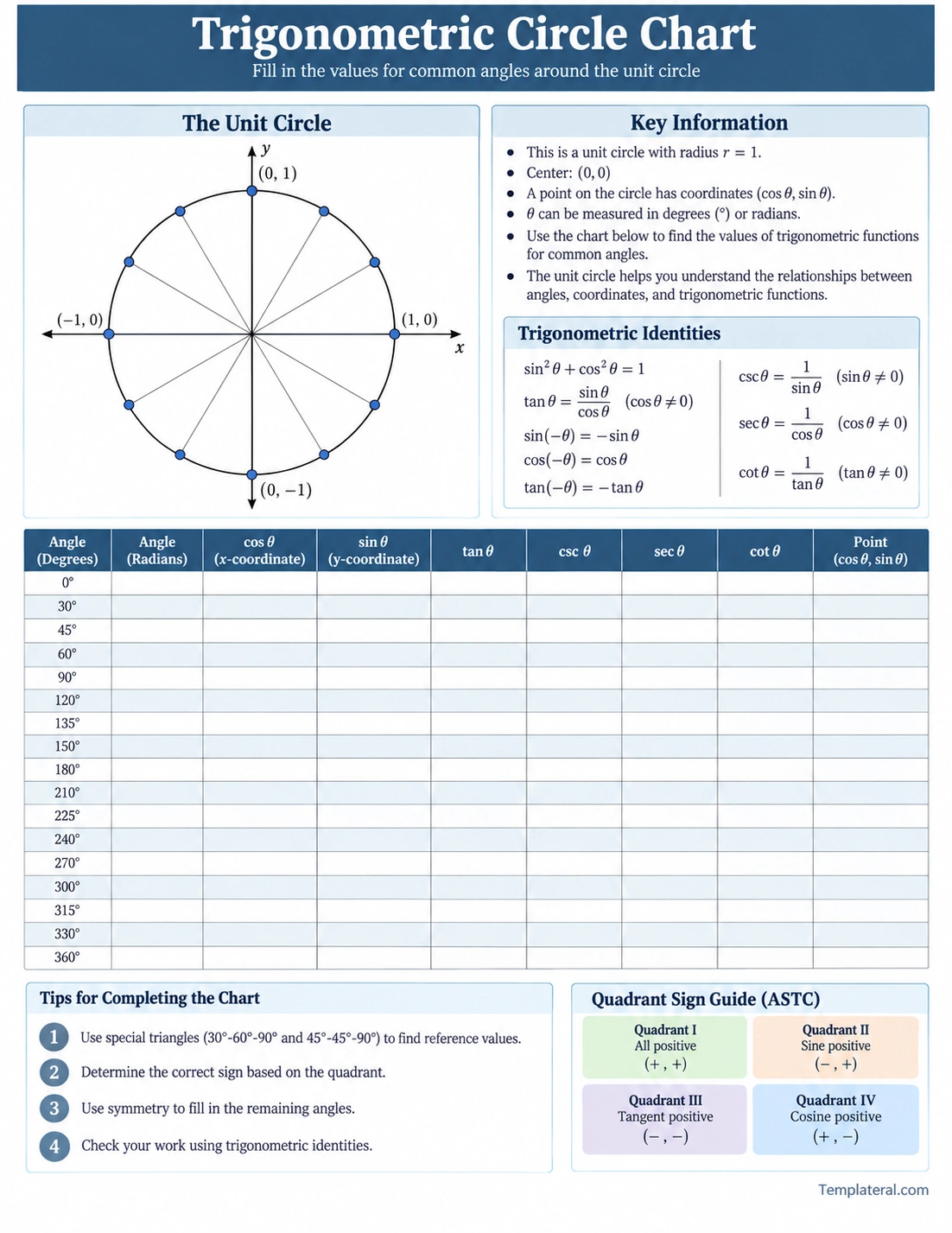
What Is a Trigonometric Circle Chart?
A trigonometric circle chart is a visual reference based on the unit circle. A unit circle is a circle with a radius of 1 and a center at the origin, written as (0, 0).
For an angle represented by θ, the point where the terminal side of the angle meets the unit circle has coordinates:
(cos θ, sin θ)
This simple relationship is one of the most important concepts in trigonometry. The x-coordinate gives the cosine value, while the y-coordinate gives the sine value.
For example, the point at 0° is (1, 0). Therefore:
- cos(0°) = 1
- sin(0°) = 0
At 90°, the point becomes (0, 1), giving:
- cos(90°) = 0
- sin(90°) = 1
Why Is a Trigonometric Circle Chart Useful?
Trigonometry involves many angles and exact values, which can be difficult to remember at first. A trigonometric circle chart provides a visual way to organize this information and recognize relationships between different angles.
A chart can help you:
- Find exact sine and cosine values.
- Determine tangent values for common angles.
- Convert angles between degrees and radians.
- Identify coordinates on the unit circle.
- Understand positive and negative signs in each quadrant.
- Practice reference angles.
- Review important trigonometric identities.
- Study for quizzes, tests, and exams.
A printable chart can also be used as a worksheet. Instead of simply looking at completed values, students can fill in blank cells and test their knowledge of common angles.
Understanding the Unit Circle
The unit circle is the foundation of most trigonometric circle charts. Its radius is always 1, which makes the relationship between coordinates and trigonometric functions particularly convenient.
The equation of the unit circle is:
x2 + y2 = 1
When an angle is measured counterclockwise from the positive x-axis, its terminal point on the unit circle provides the coordinates needed to determine sine and cosine.
The X-Coordinate and Cosine
The x-coordinate represents the cosine of the angle:
x = cos θ
For example, at 60°, the x-coordinate is 1/2, so:
cos(60°) = 1/2
The Y-Coordinate and Sine
The y-coordinate represents the sine of the angle:
y = sin θ
At 60°, the y-coordinate is √3/2, so:
sin(60°) = √3/2
Common Angles on a Trigonometric Circle Chart
The most important angles to learn are usually the special angles found in the first quadrant. These include 0°, 30°, 45°, 60°, and 90°. Their values can then be used to determine values in the other quadrants.
0 Degrees
The point at 0° is (1, 0).
- cos(0°) = 1
- sin(0°) = 0
- tan(0°) = 0
30 Degrees
The point at 30° is (√3/2, 1/2).
- cos(30°) = √3/2
- sin(30°) = 1/2
- tan(30°) = √3/3
45 Degrees
The point at 45° is (√2/2, √2/2).
- cos(45°) = √2/2
- sin(45°) = √2/2
- tan(45°) = 1
60 Degrees
The point at 60° is (1/2, √3/2).
- cos(60°) = 1/2
- sin(60°) = √3/2
- tan(60°) = √3
90 Degrees
The point at 90° is (0, 1).
- cos(90°) = 0
- sin(90°) = 1
- tan(90°) is undefined
Degrees and Radians
A trigonometric circle chart commonly shows angles using both degrees and radians. Understanding both systems is important because different mathematics courses and formulas may use either one.
One complete revolution around the unit circle is equal to 360° or 2π radians. Therefore:
180° = π radians
Some of the most important conversions are:
- 0° = 0
- 30° = π/6
- 45° = π/4
- 60° = π/3
- 90° = π/2
- 180° = π
- 270° = 3π/2
- 360° = 2π
When reading a trigonometric circle chart, always check whether the angle is expressed in degrees or radians before applying a value.
Quadrants and Trigonometric Signs
The unit circle is divided into four quadrants. The signs of sine, cosine, and tangent depend on the quadrant where the terminal side of the angle is located.
Quadrant I
Both coordinates are positive. Therefore, sine, cosine, and tangent are positive.
(+, +)
Quadrant II
The x-coordinate is negative while the y-coordinate is positive. Cosine is negative, while sine is positive.
(-, +)
Quadrant III
Both coordinates are negative. Sine and cosine are negative, while tangent is positive.
(-, -)
Quadrant IV
The x-coordinate is positive and the y-coordinate is negative. Cosine is positive while sine is negative.
(+, -)
Remembering the quadrant sign pattern is essential when finding exact values for angles such as 120°, 150°, 210°, 225°, 300°, and 315°.
How to Use a Trigonometric Circle Chart
Using a trigonometric circle chart becomes straightforward once you understand the relationship between angles and coordinates.
- Step 1: Identify the given angle.
- Step 2: Determine whether the angle is measured in degrees or radians.
- Step 3: Locate the angle on the unit circle.
- Step 4: Identify the quadrant.
- Step 5: Find the corresponding coordinate pair.
- Step 6: Use the x-coordinate for cosine and the y-coordinate for sine.
- Step 7: Calculate tangent using sine divided by cosine when necessary.
For example, consider 150°. Its reference angle is 30°, and it is located in Quadrant II. The 30° values are:
sin(30°) = 1/2
cos(30°) = √3/2
Because sine is positive and cosine is negative in Quadrant II:
sin(150°) = 1/2
cos(150°) = -√3/2
Reference Angles and Symmetry
You do not need to memorize every angle independently. Reference angles and symmetry allow you to use a smaller set of known values.
For example, 210° has a reference angle of 30°. Since 210° is in Quadrant III, both coordinates are negative.
Therefore:
sin(210°) = -1/2
cos(210°) = -√3/2
This approach is much more efficient than trying to memorize every entry individually.
Trigonometric Functions on the Circle
A complete trigonometric circle chart may include more than sine and cosine. It can also provide tangent, cosecant, secant, and cotangent values.
Sine
Sine corresponds to the y-coordinate:
sin θ = y
Cosine
Cosine corresponds to the x-coordinate:
cos θ = x
Tangent
Tangent is calculated using:
tan θ = sin θ / cos θ
Reciprocal Functions
The reciprocal trigonometric functions are:
- csc θ = 1 / sin θ
- sec θ = 1 / cos θ
- cot θ = 1 / tan θ
These functions are useful when solving more advanced trigonometry problems.
Using a Blank Trigonometric Circle Chart as a Worksheet
A blank trigonometric circle chart can turn memorization into an active practice exercise. Instead of simply reading the answers, you can fill in the missing values yourself.
Start by completing the degree and radian columns. Then fill in the sine and cosine values for the first quadrant. Once those values are familiar, use symmetry to complete the remaining quadrants.
You can also practice filling in:
- Reference angles
- Coordinate pairs
- Sine values
- Cosine values
- Tangent values
- Reciprocal functions
- Quadrant signs
This makes a printable chart useful both as a reference sheet and as a reusable study worksheet.
Tips for Memorizing Trigonometric Values
Memorizing the unit circle does not have to involve learning dozens of unrelated numbers. Focus on patterns and relationships.
- Learn the five key angles in the first quadrant.
- Memorize their radian equivalents.
- Understand the coordinate pattern for sine and cosine.
- Learn which functions are positive in each quadrant.
- Use reference angles to solve unfamiliar angles.
- Practice writing the values from memory.
- Use a blank chart to check your progress.
One useful pattern is the sequence of sine values in the first quadrant:
1/2, √2/2, √3/2, 1
The cosine values follow the same pattern in reverse:
1, √3/2, √2/2, 1/2
Recognizing these patterns can make the unit circle much easier to remember.
Common Mistakes When Reading a Trigonometric Circle Chart
Several common mistakes can lead to incorrect answers even when the chart itself is understood.
Mixing Up Sine and Cosine
Remember that cosine is the x-coordinate and sine is the y-coordinate. The coordinate order is always:
(cos θ, sin θ)
Ignoring the Quadrant
A reference angle tells you the basic magnitude of a value, but the quadrant determines its sign.
Confusing Degrees and Radians
Always verify the angle measurement system. For example, 180° and π describe the same angle, but they are written using different units.
Rounding Exact Values Too Early
When an exact answer is requested, keep values in radical or fractional form instead of converting them to rounded decimals.
Who Can Benefit From a Trigonometric Circle Chart?
A trigonometric circle chart can be useful for students at several levels of mathematics. Beginners can use it to learn the basic relationship between angles and coordinates, while more advanced students can use it as a quick reference when solving complex problems.
It can be useful for:
- Middle and high school mathematics students
- Trigonometry students
- Precalculus students
- Calculus students
- Teachers preparing classroom worksheets
- Students reviewing for mathematics exams
- Anyone practicing exact trigonometric values
Conclusion
A trigonometric circle chart provides a convenient visual reference for learning angles, radians, coordinates, and trigonometric functions. Its foundation is the unit circle, where every point can be represented as (cos θ, sin θ).
By learning the common first-quadrant angles, understanding quadrant signs, and using reference angles and symmetry, you can determine many trigonometric values without memorizing every angle separately.
A printable trigonometric circle chart can also be used as a blank worksheet for active practice. Fill in the angles, radians, coordinates, and function values repeatedly until the relationships become familiar. With consistent practice, the unit circle becomes a practical tool for solving problems in trigonometry, precalculus, and calculus.
Download: Trigonometric Circle Chart Template
