A Trigonometry Circle Chart is a useful study tool for understanding the unit circle, common angles, radians, degrees, coordinates, and basic trigonometric functions. By organizing important information around a circle, students can see how angles and their corresponding sine, cosine, and tangent values are connected.
The unit circle is one of the most important visual references in trigonometry. Instead of treating trigonometric values as isolated numbers to memorize, a circle chart helps students understand their relationship to the coordinate plane. It can also make it easier to identify quadrants, reference angles, positive and negative values, and equivalent measurements in degrees and radians.
Whether you are studying introductory trigonometry, preparing for a math exam, completing homework, or teaching a trigonometry lesson, a printable circle chart can provide a convenient way to practice and review these concepts.
What Is a Trigonometry Circle Chart?
A Trigonometry Circle Chart is a visual chart based on the unit circle. The unit circle has a radius of 1 and is centered at the origin, which is represented by the coordinate (0, 0).
The standard equation of the unit circle is:
x² + y² = 1
Points on the circle can be represented by coordinates. For an angle θ measured from the positive x-axis, the corresponding point on the unit circle can be written as:
(cos θ, sin θ)
This relationship makes the unit circle particularly useful for understanding trigonometric functions. A circle chart brings these concepts together in one visual reference.
Why Is the Unit Circle Important in Trigonometry?
The unit circle provides a consistent way to understand trigonometric functions for angles beyond the basic right-triangle examples. It connects geometry, coordinates, angles, and trigonometry in a single diagram.
Using a trigonometry circle chart, students can practice:
- Common angles in degrees.
- Common angles in radians.
- Coordinates on the unit circle.
- Sine values.
- Cosine values.
- Tangent values.
- Positive and negative trigonometric values.
- Quadrants and reference angles.
- Symmetry between related angles.
Once the structure of the unit circle becomes familiar, many trigonometric problems become easier to solve without relying entirely on memorization.
Understanding the Four Quadrants
The coordinate plane divides the unit circle into four quadrants. Each quadrant has a different combination of positive and negative x- and y-coordinates.
Quadrant I
In Quadrant I, both the x-coordinate and y-coordinate are positive. Therefore, cosine and sine are both positive in this quadrant, and tangent is also positive.
Quadrant II
In Quadrant II, the x-coordinate is negative while the y-coordinate is positive. This means cosine is negative and sine is positive.
Quadrant III
In Quadrant III, both coordinates are negative. As a result, sine and cosine are negative, while tangent is positive.
Quadrant IV
In Quadrant IV, the x-coordinate is positive and the y-coordinate is negative. Therefore, cosine is positive and sine is negative.
Understanding these sign patterns is an important part of using a trigonometry circle chart correctly.
Degrees and Radians on a Trigonometry Circle Chart
Angles can be measured using degrees or radians. A complete rotation around a circle is 360°, which is equivalent to 2π radians.
Some of the most frequently used angle conversions include:
- 0° = 0 radians
- 90° = π/2 radians
- 180° = π radians
- 270° = 3π/2 radians
- 360° = 2π radians
Students should become comfortable moving between the two systems because trigonometry problems may use either degrees or radians. A printable chart provides a useful place to practice writing both measurements together.
Trigonometry Circle Chart Template
A Trigonometry Circle Chart Template can provide a structured worksheet for practicing the information associated with the unit circle. Instead of using a completed reference chart, students can fill in missing values and test their knowledge.
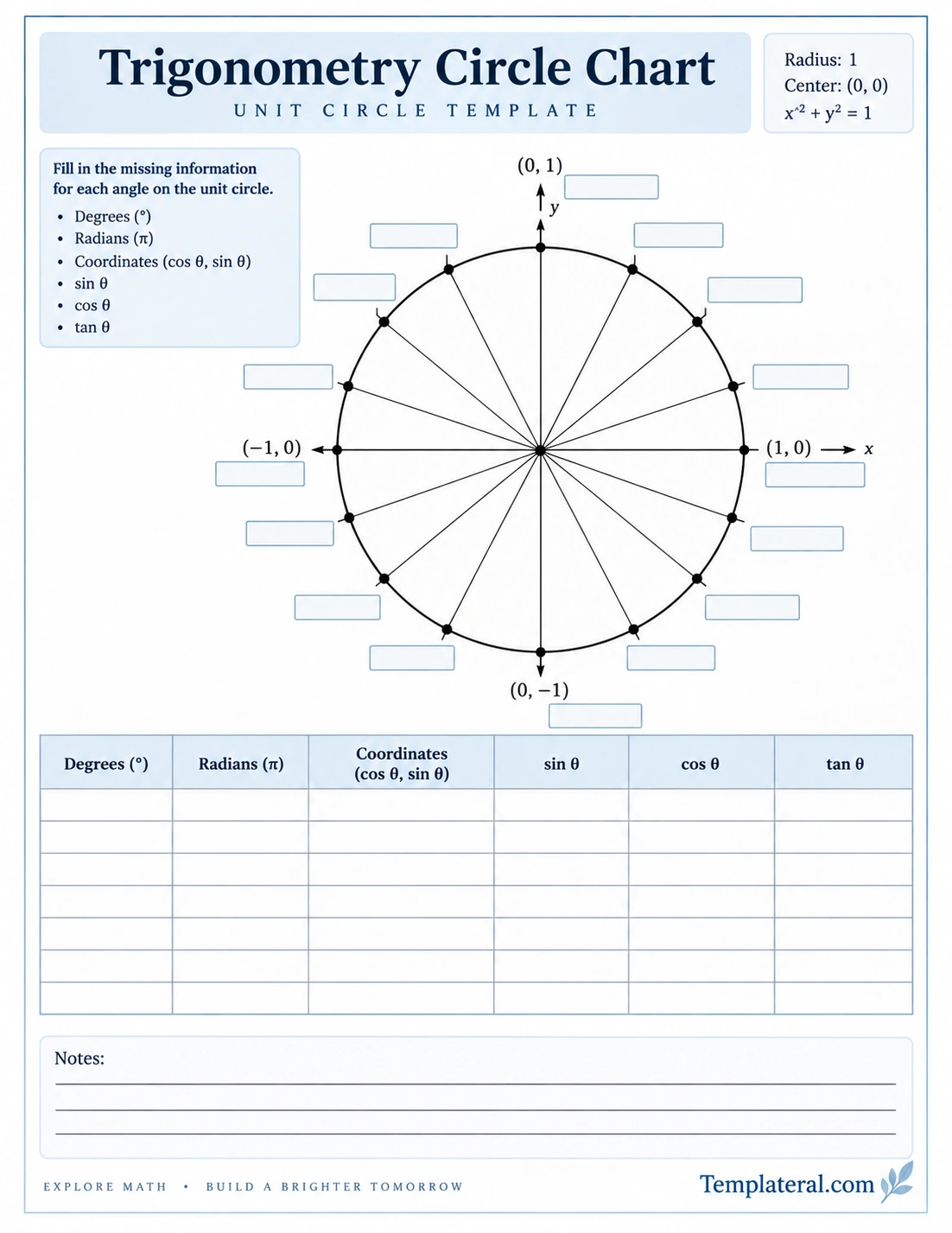
The template includes a large unit-circle diagram with space for labeling angles and related information. It also provides a reference table where students can organize degrees, radians, coordinates, sine, cosine, and tangent values.
How to Use a Trigonometry Circle Chart
A blank chart can be used in several different ways depending on the student’s current level of understanding.
Start With the Main Axes
Begin by identifying the positive and negative x-axis and y-axis. These four points correspond to 0°, 90°, 180°, and 270°, or 0, π/2, π, and 3π/2 radians.
Learning these four positions first creates a framework for adding the remaining common angles.
Add the Common Special Angles
Next, practice placing the common special angles around the circle. Angles such as 30°, 45°, and 60° appear frequently in trigonometry exercises.
Their corresponding radian measurements include π/6, π/4, and π/3. Learning these relationships helps connect familiar degree measurements with the radian system.
Fill in the Coordinates
After identifying the angles, write the corresponding coordinates. Remember that a point on the unit circle is represented as (cos θ, sin θ).
The coordinate values provide a direct visual explanation of why the sine and cosine functions have different values at different angles.
Identify Sine, Cosine, and Tangent
Once the coordinates are familiar, use them to identify the basic trigonometric values. The x-coordinate represents cosine, while the y-coordinate represents sine.
Tangent can then be found using the relationship:
tan θ = sin θ / cos θ
This approach allows students to derive many values from the structure of the circle instead of attempting to memorize every value independently.
Important Unit Circle Values to Practice
A useful trigonometry circle chart should provide practice with the angles that appear most often in mathematics courses. These include angles associated with 30°, 45°, and 60° as well as their positions in the other quadrants.
For example, the first-quadrant angles can serve as a starting point because their sine and cosine values are positive. Once these values are understood, the same numerical patterns can be applied to other quadrants by changing the appropriate signs.
This pattern-based approach can make unit-circle review much easier than memorizing a large list of values without understanding their relationships.
How Sine and Cosine Relate to the Circle
One of the most useful features of the unit circle is the relationship between coordinates and trigonometric functions.
Cosine as the x-Coordinate
For an angle θ, the x-coordinate of the corresponding point on the unit circle represents cos θ. Moving around the circle changes the horizontal position of the point, which explains why cosine values range between -1 and 1.
Sine as the y-Coordinate
The y-coordinate represents sin θ. The vertical position of a point changes as the angle moves around the circle, allowing the unit circle to visually demonstrate the range and sign of sine.
Tangent as a Ratio
Tangent is related to both coordinates because it can be calculated as sine divided by cosine. When cosine equals zero, this ratio is undefined, which corresponds to specific positions on the unit circle.
Benefits of Using a Blank Trigonometry Chart
A completed unit circle can be useful as a reference, but a blank chart has an additional advantage: it encourages active practice.
- Improves recall: Filling in information from memory helps reinforce important concepts.
- Reveals patterns: Repeated practice makes symmetry and quadrant relationships easier to recognize.
- Supports test preparation: Students can practice recreating the chart without looking at their notes.
- Organizes information: Degrees, radians, coordinates, and trigonometric functions can be studied together.
- Provides reusable practice: Multiple copies can be printed for repeated exercises.
Common Mistakes When Studying the Unit Circle
Several mistakes can make unit-circle problems more difficult than they need to be. Being aware of them can improve accuracy.
Mixing Up Degrees and Radians
Always check whether an angle is expressed in degrees or radians. A value such as π/4 represents an angle in radians, while 45° represents the same angle in degrees.
Forgetting Quadrant Signs
The numerical values of related angles may be the same, but the signs can change depending on the quadrant. Always determine the quadrant before assigning positive or negative values.
Reversing Sine and Cosine
Remember the coordinate relationship (cos θ, sin θ). The first coordinate is cosine and the second coordinate is sine.
Ignoring the Reference Angle
Reference angles can simplify the process of finding values in different quadrants. Once the corresponding first-quadrant value is known, the appropriate sign can be determined from the quadrant.
Tips for Memorizing the Trigonometry Circle Chart
Memorizing the unit circle becomes easier when students focus on patterns instead of trying to memorize every entry independently.
- Learn the first-quadrant values first.
- Memorize the basic degree-to-radian conversions.
- Practice identifying the four quadrants.
- Use symmetry to derive related coordinates.
- Pay attention to the signs of x and y.
- Practice completing a blank chart regularly.
- Check your answers against a reliable reference after practicing.
Another useful technique is to recreate the chart from memory on paper. Start with the axes, add the common angles, and then fill in the coordinates and trigonometric values.
Using a Trigonometry Circle Chart for Study and Teaching
A printable circle chart can be useful for both students and teachers. Students can keep a completed version in their math notes or use blank copies for review.
Teachers can also use blank charts as classroom exercises. For example, students can be asked to complete only the degree measurements during one exercise and then complete the radian measurements during another. A later exercise can focus on coordinates and trigonometric functions.
The same printable can therefore support several different stages of learning without requiring a completely different worksheet for every activity.
How to Practice With a Blank Chart
For effective practice, avoid immediately looking at a completed unit circle. Begin by filling in everything you remember.
Then check your answers and identify the areas where you made mistakes. If you consistently confuse certain angles or signs, focus on those relationships during your next practice session.
Over time, repeatedly completing the chart can make common angles, coordinates, and trigonometric relationships much more familiar.
Conclusion
A Trigonometry Circle Chart is a practical visual aid for studying the unit circle and understanding the relationships between angles, radians, degrees, coordinates, sine, cosine, and tangent. Rather than viewing these concepts as separate formulas, the chart shows how they fit together around the coordinate plane.
A printable Trigonometry Circle Chart Template can be especially useful for active practice. By repeatedly labeling the circle, identifying quadrants, converting degrees to radians, and connecting coordinates to trigonometric functions, students can build a stronger understanding of the unit circle.
Whether used for homework, classroom instruction, independent study, or exam preparation, a clean blank circle chart provides a simple and reusable way to practice essential trigonometry concepts.
Download: Trigonometry Circle Chart Template
