To whomsoever it may concern is a formal letter opening used when the specific recipient is unknown or when a document is intended for any appropriate person who may need to review it. It is commonly found in verification letters, character references, employment documents, recommendation letters, and other formal correspondence.
Although the phrase may sound formal or traditional, it can still be appropriate when you genuinely do not know who will receive the letter. Understanding when to use it, how to format the letter, and what information to include can help you create a professional document that is clear and useful.
What Does “To Whomsoever It May Concern” Mean?
The phrase “To whomsoever it may concern” essentially means that the letter is addressed to any person or organization that has a legitimate interest in the information provided.
The phrase is particularly useful when the identity of the eventual reader is uncertain. For example, an employee may request an employment verification letter without knowing whether it will be reviewed by a future employer, government office, school, landlord, or another organization.
In simple terms, the opening communicates that the letter is not directed toward one named individual. Instead, it is intended for the appropriate recipient who needs the information.
When Should You Use “To Whomsoever It May Concern”?
This formal salutation can be appropriate when you do not know the recipient’s name and cannot reasonably determine it before sending the document.
Common situations include:
- Employment verification letters
- Character reference letters
- Proof of employment documents
- General recommendation letters
- Volunteer verification letters
- Internship verification letters
- Official confirmation letters
- General-purpose business correspondence
- Documents submitted to an unspecified department
Before using a general salutation, consider whether the recipient can be identified. If you know the person’s name, using their name will usually make the letter more direct and personalized.
When a General Salutation Makes Sense
A general greeting can be useful when the letter may be given to multiple organizations or when the person requesting it does not know which department or employee will ultimately receive the document.
For example, an employment confirmation letter may be presented to different organizations during a job application or administrative process. A general salutation allows the document to remain useful without having to create a new version for each recipient.
“To Whomsoever It May Concern” vs. “To Whom It May Concern”
“To whom it may concern” is the more common form of this traditional business salutation. “To whomsoever it may concern” is a variation that emphasizes the indefinite nature of the recipient.
Both expressions communicate a similar basic idea: the letter is intended for whoever is responsible for reviewing or handling the matter. However, wording preferences can vary depending on the organization, country, industry, and level of formality.
If you are creating a general-purpose professional letter, consider the conventions used by the organization receiving the document. When possible, addressing a specific person or department can make the letter more direct.
How to Format a “To Whomsoever It May Concern” Letter
A formal letter using this opening should follow a clear business-letter structure. The exact format can vary depending on the purpose, but most letters include several essential components.
1. Sender Information
Begin with the sender’s contact information when appropriate. This can include your name, address, email address, and phone number.
Providing contact details allows the recipient to verify the information or request clarification if necessary.
2. Date
Include the date on which the letter is written. A clear date helps establish when the information was provided and can be important for employment or administrative records.
3. Salutation
Place the formal greeting below the contact information and date. If you are using the phrase, write it consistently and follow it with a comma or other appropriate business-letter punctuation.
4. Purpose of the Letter
The opening paragraph should immediately explain why you are writing. Avoid making the reader search through several paragraphs to determine the purpose of the document.
For example, you might explain that the letter confirms a person’s employment, verifies participation in a program, or provides a professional reference.
5. Supporting Information
The body of the letter should contain the relevant facts. Include only information that supports the purpose of the document and that you are authorized to provide.
6. Closing and Signature
Finish with a professional closing such as “Sincerely,” followed by your name, title, and organization when applicable. A signature can be added if the letter will be printed or formally submitted.
What to Include in a To Whomsoever It May Concern Letter
The information required depends on the purpose of the letter. A useful document should give the recipient enough context to understand and verify the statement.
Consider including:
- Full name: Clearly identify the person the letter concerns.
- Purpose: Explain why the letter has been prepared.
- Relevant dates: Include employment, participation, service, or other dates when applicable.
- Position or relationship: Explain your relationship with the person.
- Relevant facts: Provide information directly related to the purpose.
- Contact information: Give the recipient a way to request additional information.
- Signature: Identify the person responsible for issuing the letter.
Avoid adding unnecessary personal information. A focused letter is generally easier for the recipient to review and verify.
How to Write a To Whomsoever It May Concern Letter
Writing the letter becomes easier when you organize the content into a logical sequence. Start with the purpose, provide the necessary details, and finish with contact information or a professional closing.
Start With a Clear Opening
The first paragraph should explain the reason for writing. For example, an employment verification letter might state that the writer is confirming an individual’s employment with an organization.
Provide Specific Details
The second paragraph can provide relevant information such as the person’s position, dates of service, responsibilities, or relationship with the writer.
Specific information makes a letter more useful than vague statements. However, only include details that are necessary and appropriate for the intended purpose.
Offer Additional Assistance
If appropriate, conclude the main body by explaining how the recipient can contact you if additional information or clarification is required.
Close Professionally
Use a conventional closing followed by your name and professional details. If the letter is printed, leave enough space for a handwritten signature.
To Whomsoever It May Concern Template
A reusable to whomsoever it may concern template can make it easier to prepare formal correspondence for different situations. The template should contain placeholders that can be customized without changing the overall structure.
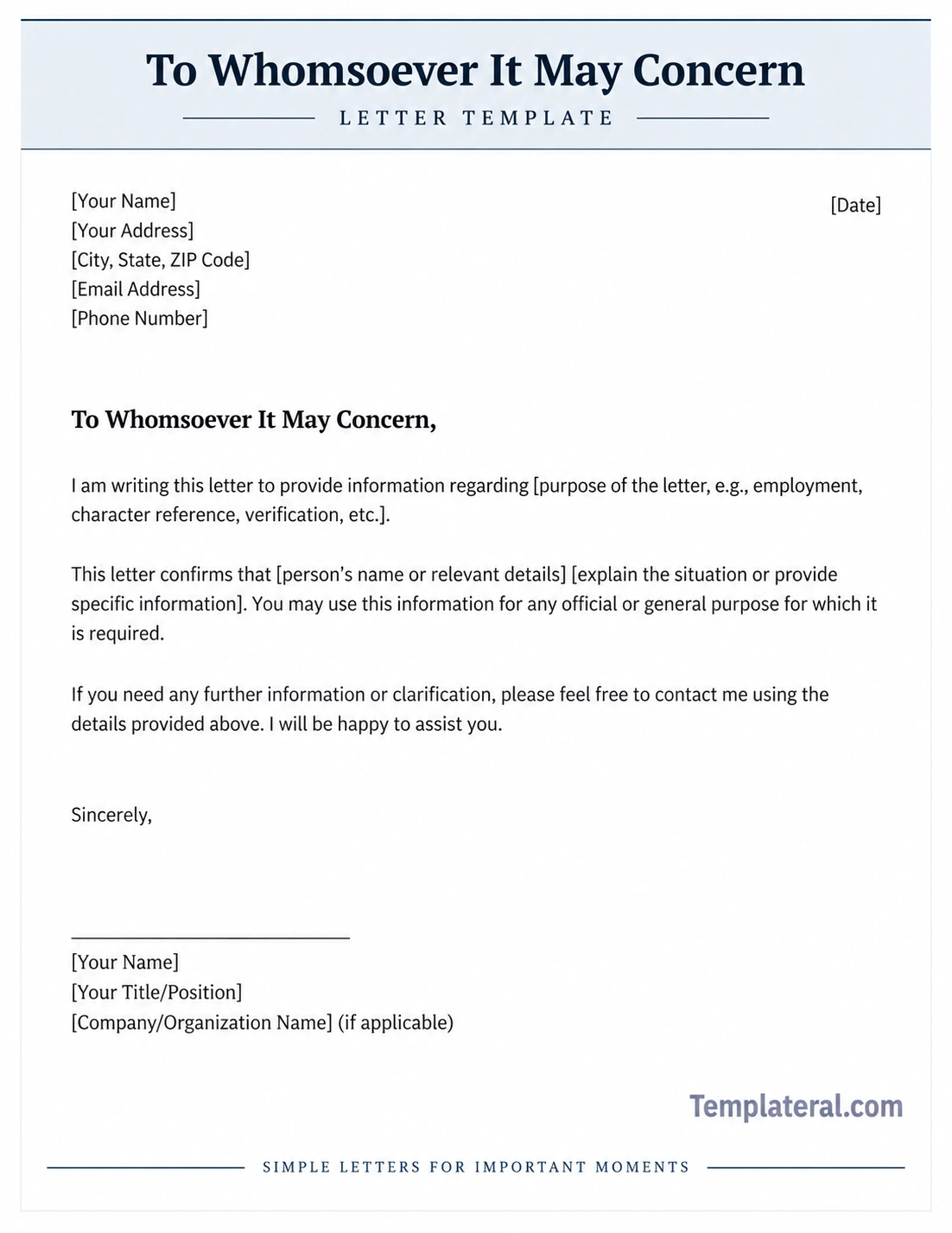
When using a template, replace every placeholder with accurate information before submitting the document. Review names, dates, job titles, contact information, and other details carefully.
Examples of Situations for This Type of Letter
Employment Verification
An employer may prepare a general letter confirming that an individual works or worked for the organization. The letter might include the employee’s position and employment dates.
Character Reference
A person may write a general character reference when the recipient is not known in advance. The writer can describe their relationship with the individual and provide relevant observations about their character or conduct.
Volunteer Verification
An organization may issue a letter confirming that someone volunteered for a particular period or participated in specific activities. This can be useful when the document will be submitted to an unspecified organization.
General Confirmation Letter
A general confirmation letter can document a fact or relationship when the eventual recipient is unknown. The writer should clearly state what is being confirmed and provide enough information for verification.
Alternatives to “To Whomsoever It May Concern”
Although the phrase can be appropriate, it is not always the best choice. If you can identify the recipient or department, a more specific greeting may make the letter more professional and easier to direct.
Possible alternatives include:
- Dear Hiring Manager: Useful for certain employment-related documents when the specific hiring manager is unknown.
- Dear Admissions Committee: Appropriate when writing to an admissions committee.
- Dear Human Resources Manager: Useful when the document is intended for an HR department.
- Dear [Recipient’s Name]: The most direct option when you know the recipient.
- Dear [Department Name] Team: Useful when the department is known but the individual recipient is not.
Choose the greeting based on the actual audience rather than using a general salutation automatically.
Common Mistakes to Avoid
A formal letter can lose effectiveness if the content is unclear or incomplete. Pay attention to the following common issues.
Using the Phrase When the Recipient Is Known
If you know exactly who will receive the letter, addressing that person directly can make the correspondence more specific.
Leaving Placeholders in the Final Letter
Templates often contain placeholders such as “[Your Name]” or “[Date].” Make sure every placeholder has been replaced before the document is submitted.
Providing Too Much Information
A letter should focus on its purpose. Unnecessary details can make it harder for the recipient to identify the information that matters.
Using Vague Statements
Whenever appropriate, provide specific facts instead of general statements. Dates, positions, responsibilities, and relevant relationships can give the letter greater practical value.
Forgetting Contact Information
If verification may be required, provide an appropriate email address or phone number. This gives the recipient a clear way to request additional information.
Tips for Making the Letter Professional
- Use a clean and consistent business-letter format.
- Keep the purpose clear from the beginning.
- Use concise paragraphs.
- Check spelling and grammar carefully.
- Verify all names and dates.
- Use professional language appropriate for the situation.
- Include relevant contact information.
- Sign the letter when a formal signature is required.
- Save a copy of the completed document for your records when appropriate.
Frequently Asked Questions
Is “To Whomsoever It May Concern” formal?
Yes. It is a formal, traditional salutation intended for situations where the specific recipient is unknown. The more commonly used variation is “To whom it may concern.”
Can I use this phrase for an employment letter?
Yes. It can be used for a general employment verification or reference letter when the eventual recipient is not known. If the recipient is known, a more specific greeting may be preferable.
Should every word be capitalized?
Capitalization can vary according to the style of the letter. A common presentation is “To Whomsoever It May Concern,” with the main words capitalized.
Can I use a template for an official letter?
Yes. A template provides a useful structure, but you should customize it for the specific situation and verify that all information is accurate before submitting it.
Conclusion
To whomsoever it may concern is a formal salutation used when a letter is intended for an unspecified recipient or when the identity of the person reviewing the document is unknown. It can be useful for employment verification, references, confirmation letters, volunteer documentation, and other formal correspondence.
A well-written letter should clearly explain its purpose, provide relevant information, identify the writer, and include appropriate contact details. Whenever possible, consider addressing a known recipient or department directly. When the recipient genuinely cannot be identified, a general salutation and a clear letter structure can provide a practical solution.
Using a professional to whomsoever it may concern template can simplify the writing process while providing a consistent format that is easy to customize, review, print, and submit.
Download: To Whomsoever It May Concern Template
