A SWOT Chart is a simple but powerful tool for organizing information about a business, project, product, organization, or personal goal. By dividing important factors into four categories—Strengths, Weaknesses, Opportunities, and Threats—a SWOT analysis makes it easier to understand the current situation and identify practical next steps.
Whether you are developing a business strategy, planning a new project, evaluating a product, or reviewing your personal goals, a well-structured SWOT Chart can turn scattered ideas into a clear visual overview. It provides a framework for looking at both internal factors and external conditions before making important decisions.
What Is a SWOT Chart?
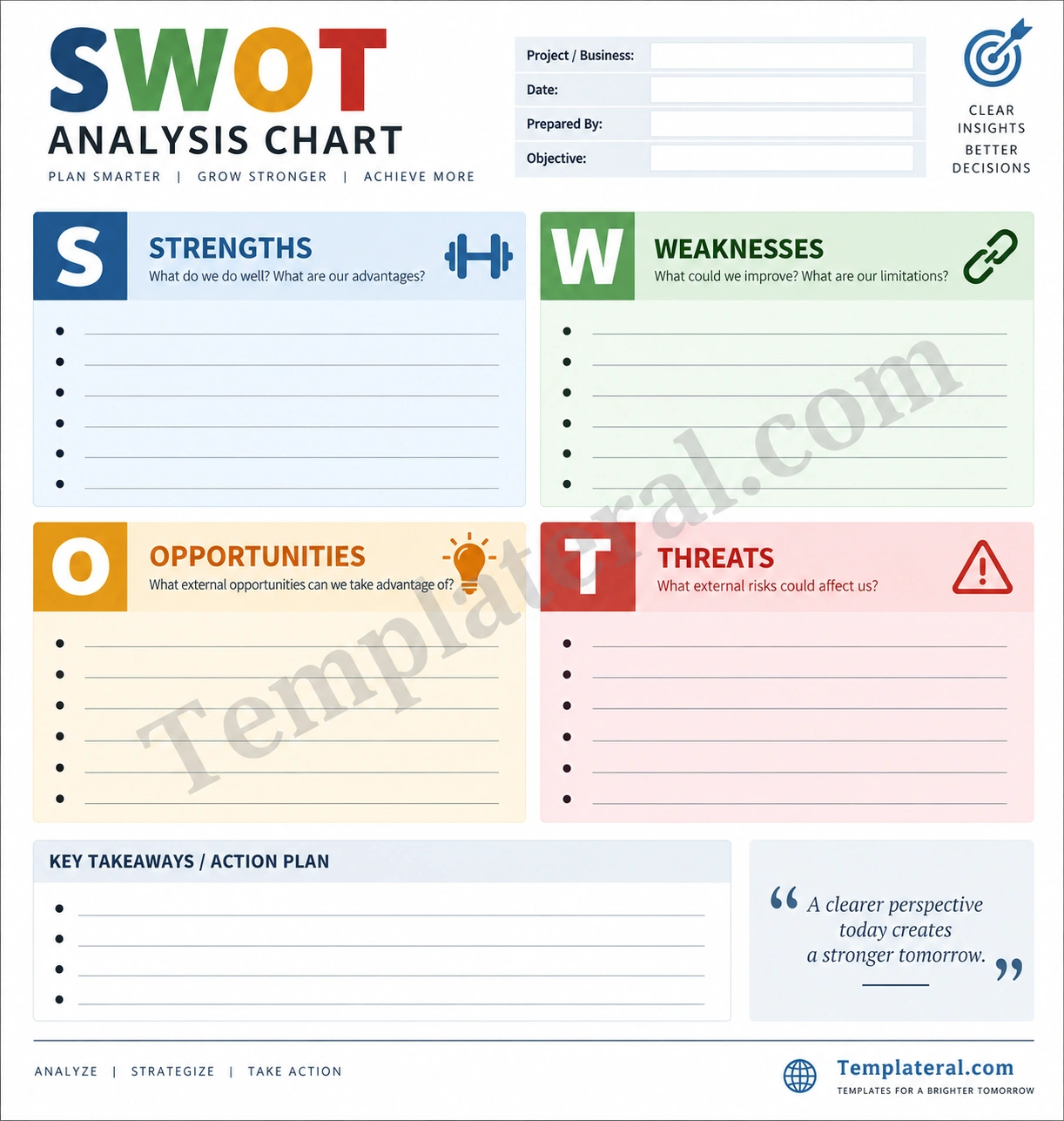
A SWOT Chart is a visual framework used to organize the four major elements of a SWOT analysis. The four sections are Strengths, Weaknesses, Opportunities, and Threats. Each section helps users examine a different aspect of a situation.
Strengths and weaknesses generally focus on internal factors that an organization, project, or individual can influence. Opportunities and threats focus on external factors that may create advantages or challenges.
The basic structure of a SWOT Chart includes:
- Strengths: Internal advantages, resources, capabilities, or positive qualities.
- Weaknesses: Internal limitations, gaps, or areas that need improvement.
- Opportunities: External circumstances that could create growth or improvement.
- Threats: External risks, obstacles, or changes that could cause problems.
Why Use a SWOT Chart?
A SWOT Chart helps simplify strategic thinking. Instead of considering many factors without a clear structure, users can place relevant information into four defined categories.
This approach can be useful when teams need to understand their current position before creating an action plan. It can also encourage balanced thinking because the analysis considers both positive and negative factors.
Common benefits of using a SWOT analysis chart include:
- Organizing complex information in one place.
- Identifying competitive advantages and internal capabilities.
- Recognizing weaknesses that may require attention.
- Finding potential opportunities for growth.
- Highlighting external risks before they become larger problems.
- Supporting business and project planning.
- Encouraging productive team discussions.
- Creating a foundation for strategic decision-making.
Understanding the Four Parts of a SWOT Chart
Strengths
The Strengths section identifies things that provide an advantage. These factors are usually internal and may include skills, resources, expertise, processes, assets, or strong relationships.
For a business, strengths might include an established brand, experienced employees, loyal customers, efficient operations, proprietary technology, or strong customer service.
When completing this section, ask questions such as: What do we do particularly well? What resources do we have? What makes our product or service valuable? What advantages do competitors find difficult to replicate?
Weaknesses
Weaknesses are internal factors that may limit performance or create challenges. Identifying weaknesses honestly is important because it can reveal areas where resources, processes, skills, or systems need improvement.
Examples might include limited staffing, outdated technology, inconsistent processes, insufficient resources, weak brand awareness, or gaps in employee expertise.
Try to make weaknesses specific rather than using vague statements. A clear weakness is easier to address than a general observation such as “the business needs improvement.”
Opportunities
Opportunities are external conditions that could benefit a business, project, or individual. They may come from changes in customer behavior, emerging technologies, new markets, industry trends, partnerships, or changes in demand.
For example, a company may identify an opportunity to introduce a new product because customers are increasingly searching for a particular solution.
Consider asking: What trends could benefit us? Are there underserved customers? Are new technologies creating possibilities? Could a partnership or new market create additional growth?
Threats
Threats are external factors that could negatively affect performance or create future risks. They may include increased competition, changing regulations, economic conditions, supply issues, shifting customer preferences, technological disruption, or new market entrants.
Identifying threats does not mean that every risk will happen. Instead, the purpose is to recognize potential challenges early enough to consider appropriate responses.
How to Create an Effective SWOT Chart
Creating a useful SWOT Chart does not require complicated software. You can use a printable worksheet, a digital document, or a dedicated planning tool. The important part is using a consistent process.
1. Define the Objective
Start by clearly defining what you want to analyze. A SWOT analysis can focus on an entire business, a specific product, a marketing campaign, a project, a department, or an individual goal.
A specific objective keeps the discussion focused. For example, instead of creating a general SWOT analysis for a company, you might analyze the company’s plan to launch a new service.
2. Gather Relevant Information
Collect information before filling in the chart. Depending on the purpose of the analysis, useful information may include customer feedback, sales data, market research, competitor observations, financial information, employee feedback, or industry trends.
Using evidence can make the analysis more useful than relying entirely on assumptions.
3. Brainstorm Each Category
Work through Strengths, Weaknesses, Opportunities, and Threats separately. Encourage participants to provide specific observations rather than broad statements.
For team-based analysis, allowing several people to contribute can reveal factors that one person might overlook.
4. Prioritize the Most Important Factors
A long list is not necessarily a useful list. After brainstorming, review the items and identify the factors that are most relevant to the objective.
Consider which strengths provide the greatest advantage, which weaknesses require immediate attention, which opportunities have meaningful potential, and which threats could have the largest impact.
5. Turn Findings Into Actions
The SWOT Chart should not be the final step. Use the findings to create an action plan. Determine how strengths can be used, how weaknesses can be improved, how opportunities can be pursued, and how threats can be addressed.
SWOT Chart Examples
A SWOT Chart can be adapted to many different situations. The categories remain the same, but the questions and information will change depending on the objective.
Business SWOT Analysis
A business may use a SWOT Chart to evaluate its overall position. Strengths could include customer loyalty or specialized expertise, while weaknesses might include limited resources or inefficient processes. Opportunities could involve new customer segments, while threats might include stronger competition.
Product SWOT Analysis
A product-focused SWOT analysis can help teams evaluate whether a product is positioned effectively. The analysis might examine product features, pricing, customer satisfaction, market demand, competing products, and emerging trends.
Project SWOT Analysis
Project managers can use a SWOT Chart before beginning an important initiative. The analysis can identify available resources, project limitations, external opportunities, and potential risks that may affect timelines or outcomes.
Personal SWOT Analysis
Individuals can also use a SWOT Chart for career planning, education, professional development, or personal goals. Strengths might include skills and experience, while weaknesses could include areas where additional training is needed. Opportunities may include new roles or courses, while threats could include changes in the job market.
Tips for Making a SWOT Chart More Useful
A SWOT analysis becomes more valuable when the information is specific, relevant, and connected to an objective.
- Keep the objective specific: Analyze one meaningful question or decision at a time.
- Use evidence: Support important observations with data or reliable information whenever possible.
- Be honest about weaknesses: Avoid creating a chart that only highlights positive information.
- Separate internal and external factors: Strengths and weaknesses generally relate to internal conditions, while opportunities and threats usually come from outside.
- Prioritize: Focus on the factors that could have the greatest effect.
- Involve multiple perspectives: Different participants may identify different risks and opportunities.
- Review the chart regularly: Business conditions, customer needs, and market trends can change over time.
- Connect the analysis to action: Convert important findings into specific next steps.
Common Mistakes When Creating a SWOT Chart
Although SWOT analysis is straightforward, several common mistakes can reduce its value. One mistake is listing too many items without determining which ones matter most. A crowded chart can make it difficult to identify priorities.
Another mistake is confusing internal and external factors. For example, employee expertise is generally an internal factor, while a change in industry regulations is an external factor.
It is also easy to make statements that are too general. Instead of writing “strong marketing,” describe the specific capability or evidence behind that strength. Specific information makes the chart easier to use when developing an action plan.
Finally, avoid treating the SWOT analysis as a prediction. A SWOT Chart is a framework for organizing information and thinking about possible strategic responses. It does not guarantee that an opportunity will succeed or that a threat will occur.
Using a SWOT Chart Template
A SWOT Chart Template can make the analysis process faster by providing a ready-made structure for recording information. Instead of creating four sections from scratch, users can immediately begin brainstorming and organizing their findings.
A printable SWOT worksheet is particularly useful during meetings, workshops, classroom activities, planning sessions, and individual strategy exercises. A digital version can also be shared with team members and updated as new information becomes available.
Look for a template that provides enough writing space in each quadrant and clearly separates the four categories. Additional fields for the project name, date, objective, key takeaways, and action items can make the document even more practical.
How to Turn SWOT Findings Into a Strategy
The real value of SWOT analysis comes from connecting the four categories. After completing the chart, look for relationships between the findings.
For example, a strong internal capability could be used to take advantage of an external opportunity. Similarly, an identified weakness may need to be addressed before the organization can pursue a particular opportunity.
You can organize follow-up questions around four strategic directions:
- Strengths and Opportunities: How can existing strengths be used to take advantage of available opportunities?
- Strengths and Threats: How can existing capabilities help reduce exposure to external threats?
- Weaknesses and Opportunities: What improvements are needed to take advantage of promising opportunities?
- Weaknesses and Threats: What actions can reduce vulnerabilities and prepare for external risks?
This approach moves the discussion beyond simply listing factors. It helps transform observations into practical strategic questions and potential actions.
Frequently Asked Questions About SWOT Charts
What does SWOT stand for?
SWOT stands for Strengths, Weaknesses, Opportunities, and Threats. These four categories provide a structured framework for analyzing internal capabilities and limitations alongside external possibilities and risks.
What is the purpose of a SWOT Chart?
The purpose of a SWOT Chart is to organize important information visually so that individuals or teams can better understand a situation, identify priorities, and develop potential strategies or action plans.
Can I use a SWOT Chart for personal goals?
Yes. SWOT analysis can be used for career planning, education, professional development, personal projects, and other goals. The same four categories can help you identify personal advantages, limitations, opportunities, and external challenges.
How often should a SWOT analysis be updated?
There is no universal schedule. A SWOT analysis can be reviewed whenever significant circumstances change, such as entering a new market, launching a product, changing strategy, facing new competition, or beginning a major project.
Conclusion
A SWOT Chart provides a practical way to organize strategic information and examine a situation from multiple perspectives. By separating Strengths, Weaknesses, Opportunities, and Threats, it becomes easier to identify important factors that may influence a decision or goal.
The most effective SWOT analysis goes beyond filling in four boxes. It uses relevant information, prioritizes meaningful findings, encourages different perspectives, and converts observations into concrete actions. Whether you are analyzing a business, product, project, or personal objective, a well-designed SWOT Chart can provide a clear starting point for structured planning and strategic thinking.
