A certificate of conformance is an important document used by manufacturers, suppliers, and businesses to confirm that a product, material, or delivered batch meets specific quality, technical, safety, or contractual requirements. It provides written evidence that the supplied goods have been checked against the applicable specifications before delivery.
Whether you work in manufacturing, construction, procurement, quality control, or product distribution, understanding how a Certificate of Conformance (CoC) works can help you maintain accurate records and build trust with customers. A properly prepared certificate also makes it easier to verify product compliance and resolve potential quality concerns.
In this guide, you will learn what a certificate of conformance is, what information it should contain, when it is required, and how to create one. You will also find practical certificate of conformance templates that you can use as a starting point for your business documentation.
What Is a Certificate of Conformance?
A Certificate of Conformance (CoC), also known as a Certificate of Conformity or C of C, is a formal document issued by a manufacturer, supplier, or authorized testing organization. It confirms that a specific product, material, component, or batch meets identified requirements.
These requirements may come from customer specifications, purchase orders, industry standards, technical drawings, or applicable regulatory requirements. The certificate serves as documented confirmation that the supplied product has been manufactured, inspected, or tested according to the stated criteria.
For example, a manufacturer supplying metal components to an automotive company may provide a certificate confirming that the materials meet the required dimensions, composition, and quality specifications.
A certificate of conformance typically includes:
- Manufacturer or supplier identification.
- Product name, description, and identification number.
- Batch, lot, or serial number.
- Applicable standards and specifications.
- Inspection or testing information, when relevant.
- A declaration confirming product conformity.
- Name, signature, and date of the authorized representative.
The exact information depends on the product, industry, customer requirements, and purpose of the certificate.
What Is the Purpose of a Certificate of Conformance?
The primary purpose of a certificate of conformance is to provide documented evidence that a delivered product meets the requirements agreed upon by the supplier and customer. It supports quality assurance and helps businesses maintain consistent product standards.
1. Verify Product Quality
A CoC helps confirm that products have been checked against established quality criteria. Depending on the manufacturing process, this may include dimensional measurements, material composition, functional performance, or visual inspection.
2. Meet Customer Requirements
Many customers require suppliers to submit a certificate of conformance as part of their purchasing or delivery documentation. Providing the certificate helps demonstrate that the supplied products satisfy the agreed specifications.
3. Support Regulatory Compliance
In certain industries, products must meet specific legal, technical, or safety requirements. A certificate can support compliance documentation, although it does not automatically replace mandatory regulatory approvals, testing reports, or other required certifications.
4. Improve Traceability
Including batch numbers, serial numbers, production dates, and supplier information makes it easier to identify the products covered by a certificate. This information is particularly useful when investigating defects, handling customer complaints, or managing product recalls.
5. Build Customer Confidence
Providing clear and accurate conformity documentation demonstrates that a business takes product quality seriously. It also gives customers a reference they can use when reviewing incoming shipments.
What Should a Certificate of Conformance Include?
A professional certificate of conformance should contain enough information to identify the product and explain which requirements it has been confirmed to meet. Although formats vary between industries, several essential sections are commonly included.
1. Certificate and Supplier Information
Start with the certificate identification details and the company issuing the document. Include the following information:
- Certificate number or reference number.
- Company or manufacturer name.
- Business address and contact details.
- Customer or recipient name, when applicable.
- Date of issue.
2. Product Identification
This section identifies the specific product or material covered by the certificate. Accurate identification is essential because a CoC should clearly establish which goods are being declared compliant.
- Product name and description.
- Product code or part number.
- Batch or lot number.
- Serial number, if applicable.
- Quantity supplied.
- Manufacturing date, when relevant.
3. Applicable Standards and Requirements
List the technical specifications, industry standards, customer requirements, or purchase order conditions used to evaluate conformity. Avoid using vague statements such as “meets all requirements” without identifying the relevant criteria.
4. Inspection and Testing Details
If inspection or testing was performed, include relevant information such as the inspection date, test method, inspection reference, and results. The certificate should accurately reflect the verification activities that actually took place.
5. Declaration of Conformity
This section contains the formal statement confirming that the identified products meet the specified requirements. The declaration should be clear, specific, and consistent with the supporting quality records.
6. Authorization and Signature
Complete the document with the name and position of the authorized representative, signature, and issue date. This establishes who is responsible for issuing the conformity statement on behalf of the organization.
Free Certificate of Conformance Templates
Creating a certificate of conformance from scratch can take time, especially when your business needs consistent documentation for multiple products or shipments. Using a ready-made template provides a convenient starting point and helps organize the required information.
Below are three certificate of conformance template designs for different documentation needs. Each layout can be adapted to suit your company, product type, and customer requirements.
Certificate of Conformance Template
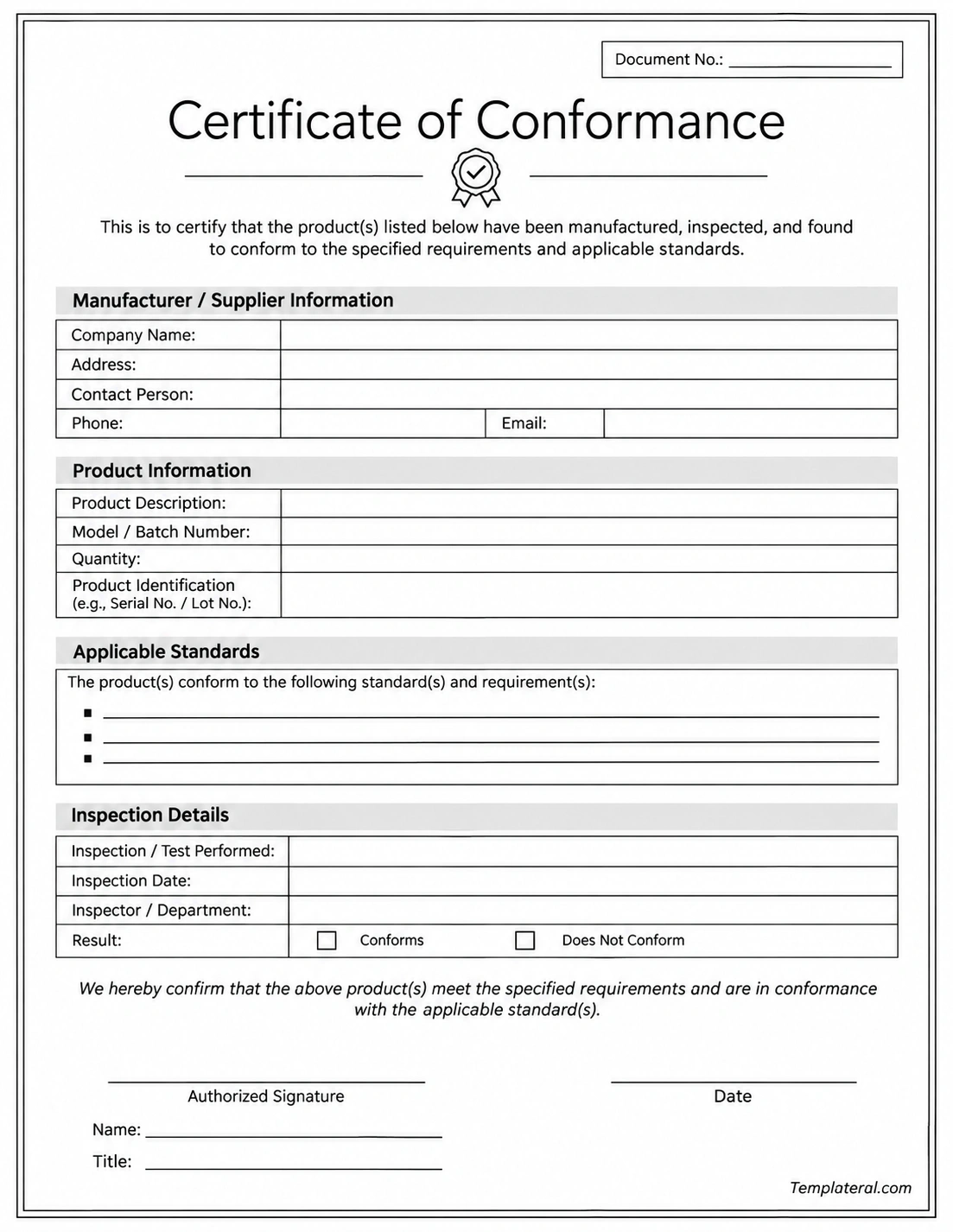
This general-purpose template is suitable for manufacturers, suppliers, and businesses that need a straightforward conformity document. It includes sections for company information, product identification, applicable standards, inspection details, and authorization.
Product Compliance Certificate Template
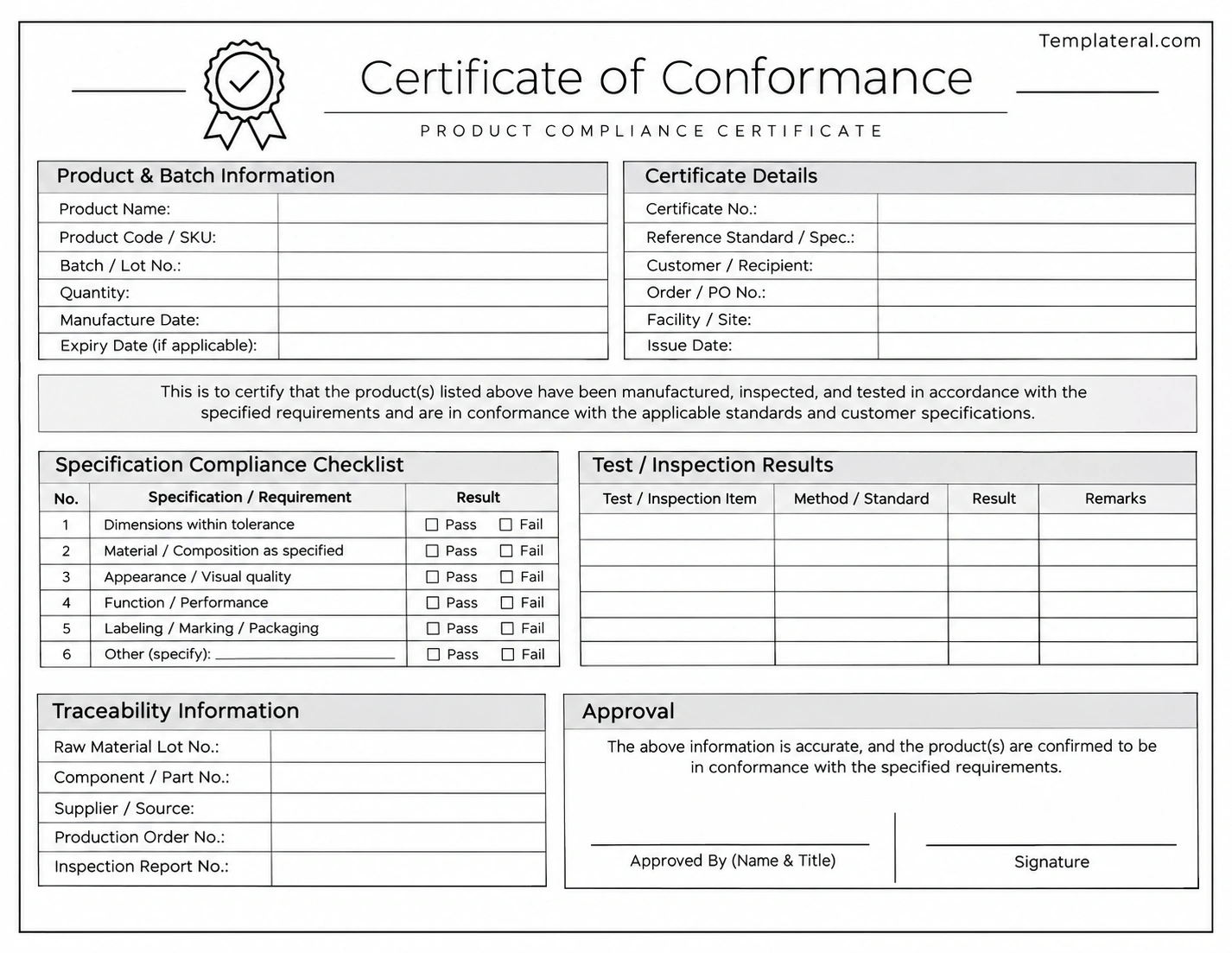
This layout is particularly useful for businesses that need to document product specifications and inspection outcomes. Its structured tables make it easier to record individual compliance checks and identify whether each requirement has been satisfied.
Supplier Declaration of Conformity Template
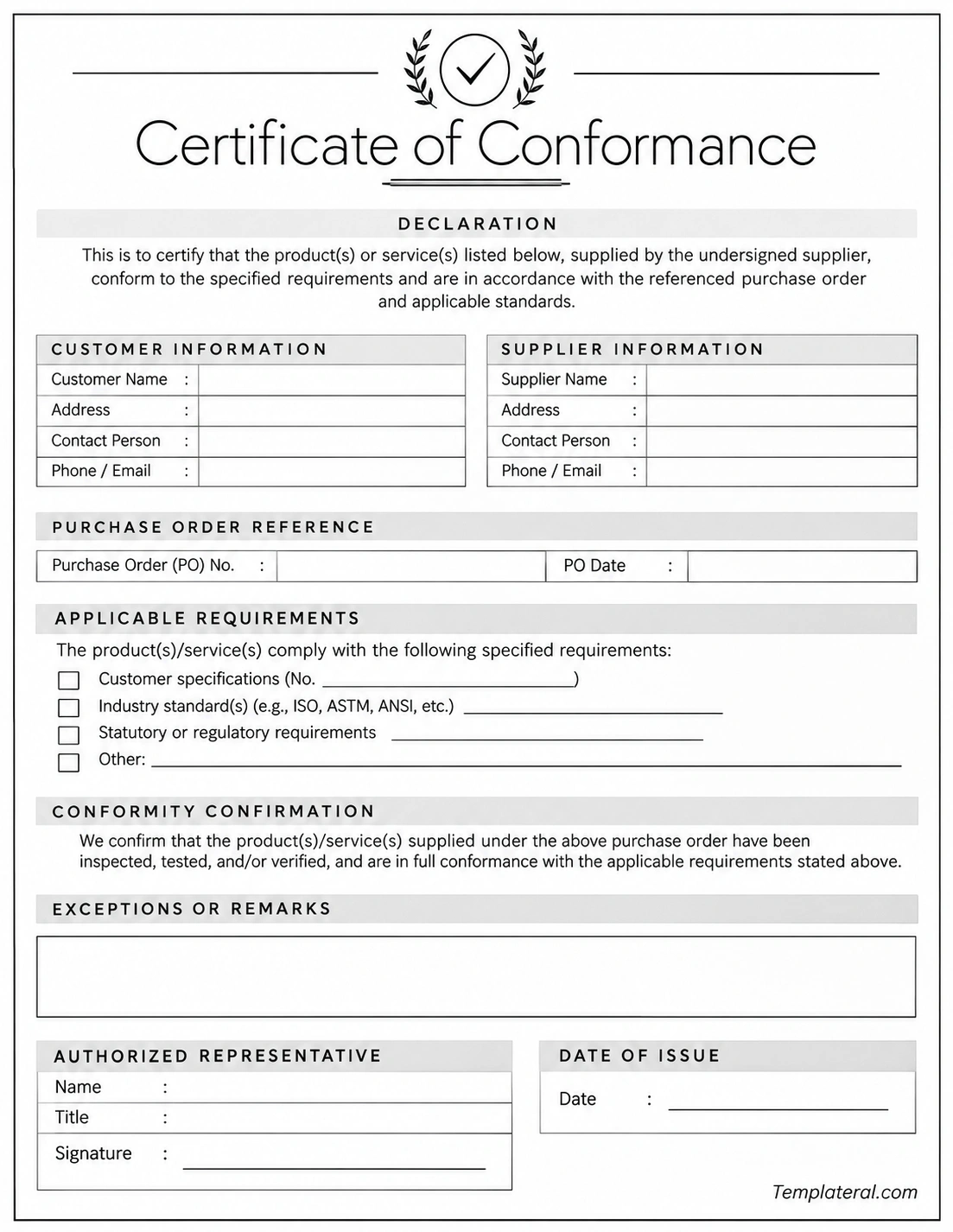
This template is designed for suppliers who need to provide customers with a formal statement of conformity. It includes customer and supplier details, purchase order references, applicable requirements, remarks, and an authorized representative section.
Before using any template, review its contents and adjust the fields to match your business requirements. A template is a documentation aid and does not independently establish product compliance.
How to Create a Certificate of Conformance
Creating a reliable certificate of conformance involves more than filling in company and product details. The information must be accurate, supported by appropriate records, and consistent with the requirements being referenced.
Step 1: Identify the Applicable Requirements
Review the customer purchase order, product specifications, technical drawings, and relevant standards. Determine exactly which requirements the product must satisfy before preparing the certificate.
Step 2: Identify the Product or Batch
Record the product description, part number, quantity, batch number, or serial number. Make sure the identification details match the actual shipment and supporting production records.
Step 3: Review Inspection and Testing Records
Check the available inspection reports, test results, material records, and quality documentation. Only declare conformity when the available evidence supports the statement.
Step 4: Complete the Certificate
Enter the supplier details, product information, applicable requirements, inspection references, and conformity declaration. Use clear language and avoid unnecessary information that could make the document difficult to understand.
Step 5: Obtain Authorized Approval
Have the certificate reviewed and approved by an authorized employee or representative. Include the person’s name, job title, signature, and issue date.
Step 6: Save and Distribute the Document
Keep a copy of the completed certificate with the relevant production, inspection, and shipping records. Send the document to the customer according to the agreed delivery or documentation process.
Certificate of Conformance vs. Certificate of Conformity
The terms Certificate of Conformance and Certificate of Conformity are frequently used interchangeably. Both generally describe a document stating that a product or material meets specified requirements.
However, terminology and documentation expectations can differ depending on the industry, country, customer, and regulatory framework.
A useful distinction is that some organizations use a Certificate of Conformance primarily for contractual or quality assurance purposes, while Certificate of Conformity may be used in contexts involving product standards or regulatory conformity.
These distinctions are not universal. Always check the terminology and documentation requirements specified by the customer or applicable authority rather than assuming that the two documents have identical legal status.
Certificate of Conformance vs. Certificate of Analysis
A certificate of conformance and a certificate of analysis serve related but different purposes. Understanding the distinction helps businesses provide the correct documentation to customers.
A Certificate of Conformance confirms that a product meets specified requirements. It may refer to inspection records, manufacturing specifications, or customer requirements.
A Certificate of Analysis (CoA), on the other hand, generally provides actual analytical or laboratory test results for a product, material, or batch. It may include measurements such as chemical composition, purity, concentration, or other test values.
For example, a chemical supplier may issue a CoA showing the measured purity of a particular batch, while a CoC may confirm that the supplied batch meets the customer’s specified acceptance criteria.
Some customers or industries may require both documents as part of their quality documentation package.
Common Mistakes to Avoid When Preparing a CoC
Even a professionally designed certificate can create problems if its information is incomplete or inaccurate. Pay attention to these common mistakes:
- Missing product identification: Always include the correct product code, batch number, or serial number.
- Unclear requirements: Identify the actual specifications or standards used to evaluate conformity.
- Unsupported declarations: Do not confirm compliance without appropriate inspection, testing, or other supporting evidence.
- Incorrect shipment details: Check quantities and product descriptions against the delivery documents.
- Missing authorization: Include the name and signature of an authorized representative when required.
- Poor document control: Use certificate reference numbers and maintain organized records to prevent confusion.
Reviewing these details before issuing a certificate can reduce documentation errors and improve communication between suppliers and customers.
Best Practices for Managing Certificates of Conformance
Businesses that regularly issue conformity certificates should establish a consistent documentation process. The following practices can make certificate management more reliable:
- Use a standardized certificate format across relevant product categories.
- Assign a unique reference number to each certificate.
- Keep supporting inspection and testing records.
- Ensure product identification matches the associated shipment.
- Limit certificate approval to authorized personnel.
- Store digital copies in an organized document management system.
- Review templates periodically to reflect updated customer requirements.
These practices help maintain traceability, simplify document retrieval, and support internal quality management activities.
Frequently Asked Questions (FAQ)
1. Is a certificate of conformance the same as a certificate of conformity?
Generally, yes. Both terms refer to documents confirming that a product, material, or batch meets specified requirements. However, their exact meaning and acceptance may depend on the industry, customer, and applicable regulations.
2. Who can issue a certificate of conformance?
A manufacturer or supplier commonly issues a CoC for products they supply. An authorized laboratory or other qualified organization may also issue conformity-related documentation within its scope of authority and applicable requirements.
3. Is a certificate of conformance legally required?
Not for every product or transaction. Some customers, contracts, industries, or regulatory frameworks require specific conformity documentation. Check the relevant purchase order and applicable regulations to determine whether a certificate is mandatory.
4. Does a certificate of conformance need to be signed?
A signature is commonly included to identify the person authorized to issue the declaration. Whether a handwritten, electronic, or other form of approval is acceptable depends on the customer’s documentation requirements and applicable rules.
5. What is the difference between a CoC and a CoA?
A CoC confirms that a product meets specified requirements, while a Certificate of Analysis (CoA) generally reports actual analytical or laboratory test results for a material or batch.
6. Can I create my own certificate of conformance?
Yes. Manufacturers and suppliers can prepare their own certificates when permitted by the applicable requirements. The document should contain accurate product details, relevant specifications, a clear conformity statement, and appropriate authorization.
7. What information is needed to complete a CoC?
Common information includes the manufacturer or supplier name, product description, batch or serial number, quantity, applicable standards, inspection details, conformity declaration, and authorized signature.
8. Can a certificate of conformance replace a product certification?
Not necessarily. A supplier-issued CoC is generally a declaration made by the issuing organization. It does not automatically replace independent product certification, regulatory approval, laboratory testing, or other mandatory documentation.
Conclusion
A certificate of conformance is an essential quality document for businesses that manufacture, supply, or distribute products. It provides written confirmation that identified goods meet specified technical, quality, safety, or contractual requirements.
By including accurate product information, applicable standards, inspection details, and proper authorization, businesses can create more reliable conformity documentation. A standardized certificate of conformance template can also simplify the preparation process and improve consistency across shipments.
Whether you are a manufacturer, supplier, or quality control professional, choosing an appropriate template and maintaining accurate supporting records can help make product documentation more organized, transparent, and professional.
