A Certificate of Incumbency is an important corporate document used to verify the identities and positions of a company’s current officers, directors, and, when required, key shareholders or members. It provides official confirmation of who holds specific roles within a business and who may have the authority to act on its behalf.
Businesses are often asked to provide a certificate of incumbency when opening corporate bank accounts, entering into business agreements, completing international transactions, or undergoing legal and financial reviews. The document helps banks, financial institutions, government agencies, and business partners verify that the individuals representing a company are properly authorized.
Whether you operate a corporation or a limited liability company (LLC), understanding how this document works can make corporate administration easier. In this guide, you will learn what a Certificate of Incumbency is, what information it contains, when it is needed, and how to prepare one using a practical template.
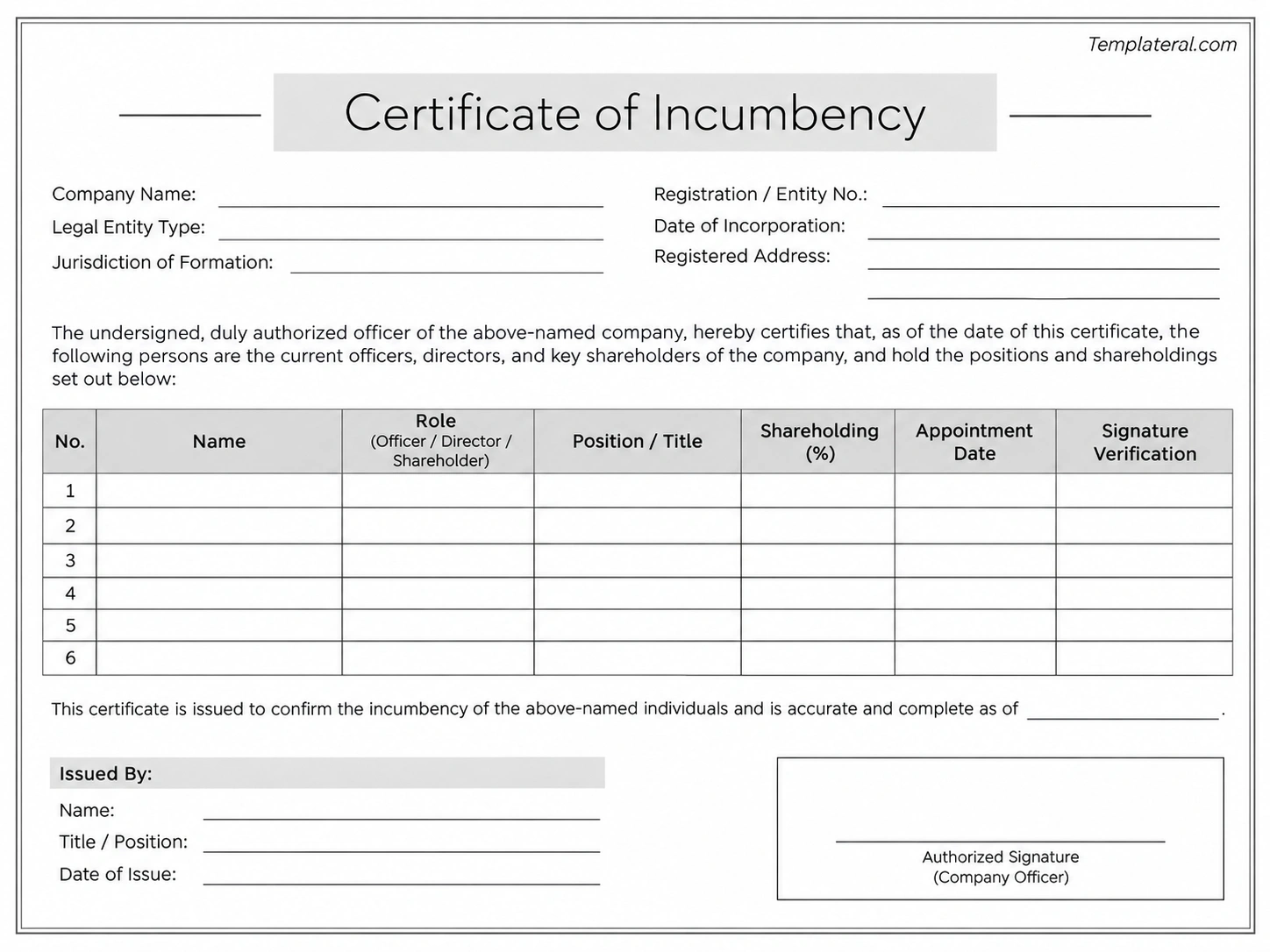
What Is a Certificate of Incumbency?
A Certificate of Incumbency is a formal corporate document that identifies the individuals currently serving in designated positions within a company. It typically lists officers, directors, and sometimes shareholders or LLC members, together with their respective titles and other relevant details.
The certificate is generally prepared or certified by an authorized company representative, such as a corporate secretary, director, manager, or another person permitted under the company’s governing documents and applicable law.
Its main purpose is to establish a reliable record of who currently holds specific corporate positions. It may also identify individuals who are authorized to sign contracts, execute financial documents, or represent the company in particular transactions.
Unlike a general company profile, a certificate of incumbency focuses specifically on the current leadership and authority structure of a legal entity.
What Information Does a Certificate of Incumbency Include?
The exact format depends on the company’s legal structure, jurisdiction, and the requirements of the organization requesting the document. However, most certificates contain several standard sections.
1. Company Information
The first section identifies the legal entity to which the certificate relates. It commonly includes:
- Full legal name of the company.
- Type of business entity, such as a corporation or LLC.
- Company registration or identification number.
- Jurisdiction or state of incorporation.
- Registered business address.
- Date of incorporation or formation, when requested.
2. Names of Current Officers
This section identifies the individuals currently holding executive or administrative positions within the company. Depending on the corporate structure, common positions include:
- President
- Chief Executive Officer (CEO)
- Chief Financial Officer (CFO)
- Secretary
- Treasurer
- Vice President
The document may include each officer’s full legal name, official title, and appointment date or term of service.
3. Names of Current Directors
For corporations, the certificate may also identify the current members of the board of directors. Directors are generally responsible for overseeing corporate management and making important business decisions.
Including their names and positions helps external parties understand the company’s governance structure and identify its current board representatives.
4. Shareholders or LLC Members
Some certificates include information about key shareholders or LLC members. This section may contain their names, ownership percentages, membership interests, or share classes.
However, shareholder information is not required in every certificate. Some institutions request a separate shareholder register, ownership statement, or beneficial ownership declaration instead.
5. Authorized Signatory Information
This section identifies the individual or individuals authorized to sign documents on behalf of the company. It may include their names, corporate titles, and the scope of their signing authority.
This information is particularly useful when a bank, lender, or business partner needs to confirm that a person has the authority to enter into a specific transaction.
6. Certification and Signature
The final section contains a statement confirming that the information is accurate and current as of a specified date. It generally includes:
- Name of the person certifying the document.
- Official position or title.
- Authorized signature.
- Date of certification.
- Company seal, if applicable or required.
- Notarial acknowledgment, if requested.
When Do You Need a Certificate of Incumbency?
A Certificate of Incumbency is commonly requested when an external organization needs to verify a company’s current leadership or authorized representatives.
Opening a Business Bank Account
Banks may request a certificate of incumbency as part of their corporate account opening and customer verification procedures. It helps establish who the company’s officers are and which individuals may be authorized to manage the account.
Additional documents, such as formation certificates, operating agreements, corporate resolutions, and beneficial ownership information, may also be required.
Signing Business Agreements
When entering into significant commercial agreements, a business partner may request proof that the person signing the contract has the necessary corporate authority.
The certificate can help establish the signatory’s position and support the verification process before an agreement is executed.
International Business Transactions
Companies involved in international transactions may need to provide a certificate of incumbency to overseas banks, financial institutions, legal professionals, or business partners.
Depending on the destination country and the receiving institution, the document may also require notarization, an apostille, or another form of authentication.
Corporate Due Diligence
During mergers, acquisitions, investments, and other corporate transactions, legal and financial professionals may request this certificate to verify the company’s current officers and directors.
It provides supporting evidence of the company’s management structure and helps identify the individuals responsible for corporate decisions.
Certificate of Incumbency Template
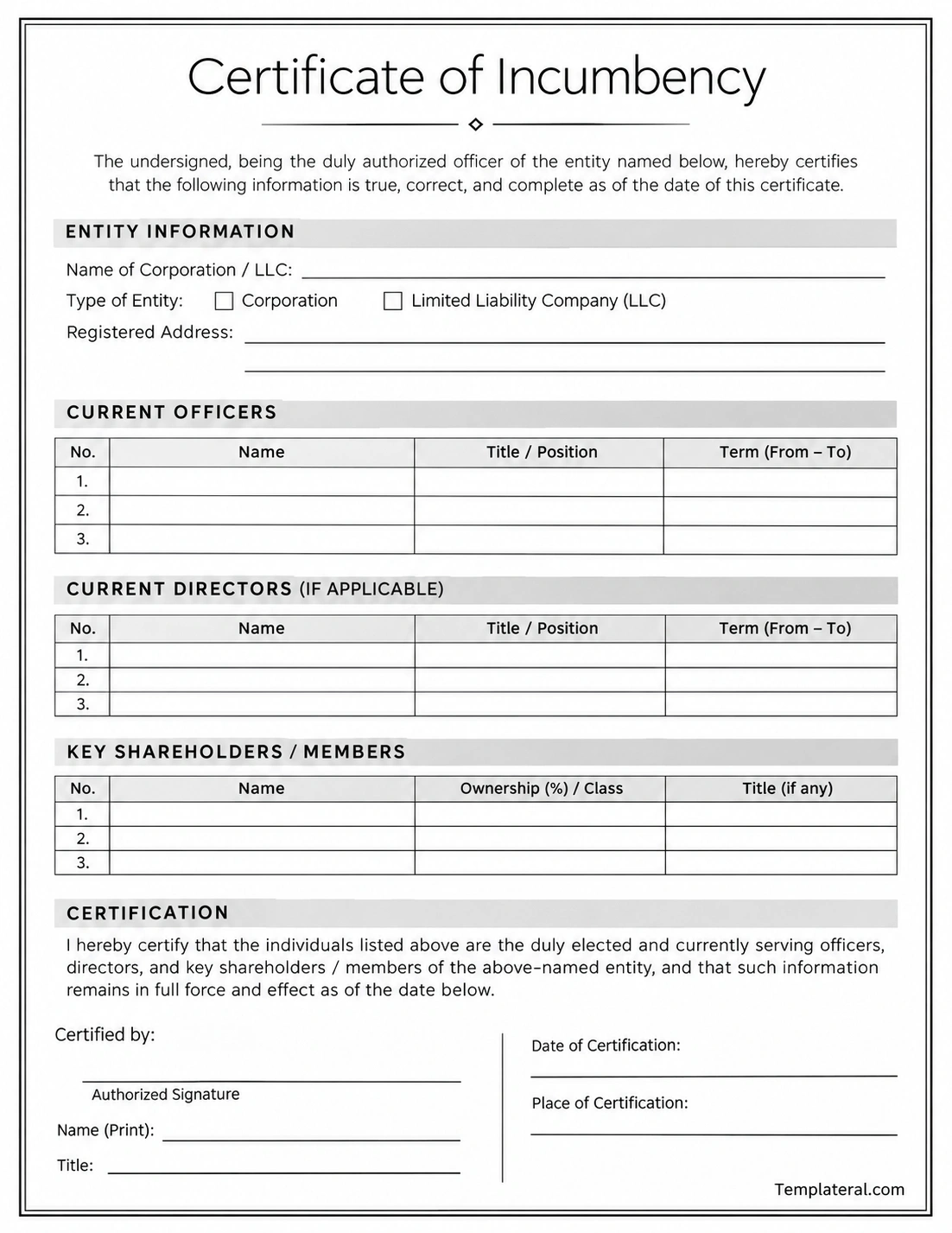
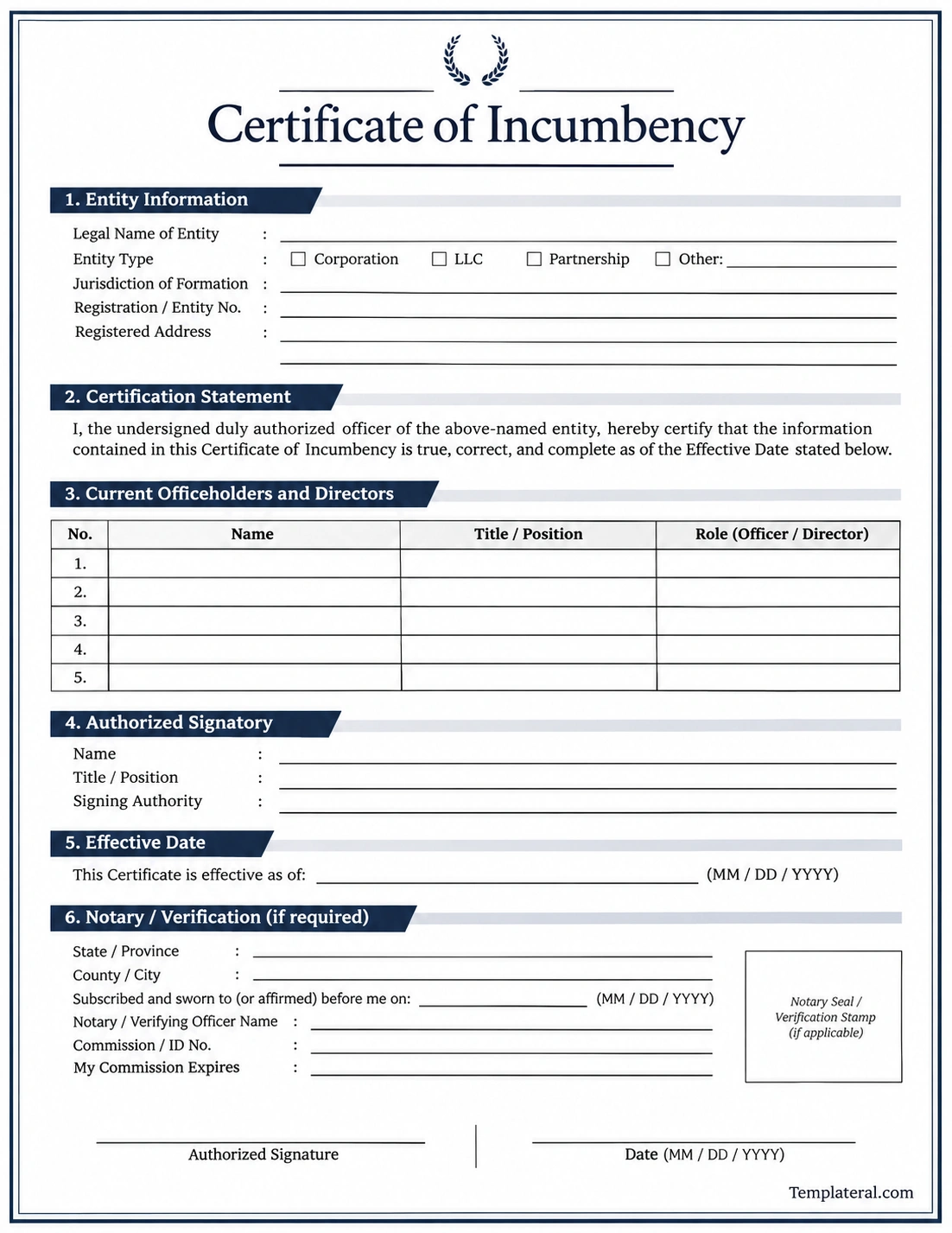
Using a structured template can make preparing a certificate of incumbency easier and more consistent. A good template should provide sufficient space for company details, officer information, director records, certification language, and authorized signatures.
The following printable designs offer different approaches depending on the purpose of the document.
How to Complete the Template
Before using a certificate of incumbency template, make sure the information matches the company’s official records. Follow these practical steps:
- Step 1: Enter company details. Provide the legal business name, entity type, registration number, and jurisdiction of formation.
- Step 2: List current officers. Record each officer’s full legal name and current corporate title.
- Step 3: Identify directors. Include the current board members when applicable.
- Step 4: Add ownership details. Include key shareholders or LLC members if the receiving institution requests them.
- Step 5: Identify authorized signatories. Specify the individuals permitted to sign on behalf of the company and any relevant limitations.
- Step 6: Complete the certification. Add the certification date and the name and title of the authorized person.
- Step 7: Sign and authenticate. Obtain the required signature, company seal, notarization, or other authentication when necessary.
Always review the completed document before submitting it. Incorrect names, outdated positions, or missing signatures may cause delays during verification.
Who Can Issue a Certificate of Incumbency?
A certificate of incumbency is usually issued or certified by an individual authorized to confirm the company’s official records.
Depending on the company’s structure and governing documents, this may include:
- Corporate Secretary: Often responsible for maintaining corporate records and confirming officer and director appointments.
- Company Director: May certify the information when authorized under applicable corporate procedures.
- President or CEO: May sign the certificate if permitted by the company’s governing documents.
- LLC Manager: May certify the current management structure of a limited liability company.
- Registered Agent or Corporate Service Provider: May assist with preparing or certifying the document when legally authorized.
Not every person listed in the certificate is automatically authorized to issue or sign it. The certifying individual’s authority should be confirmed before the document is executed.
Certificate of Incumbency vs. Certificate of Good Standing
Although these documents are sometimes requested together, they serve different purposes.
A Certificate of Incumbency identifies the individuals currently holding positions within a company. A Certificate of Good Standing, on the other hand, is generally issued by a government authority or business registry to confirm that an entity meets applicable registration and compliance requirements.
The main differences include:
- Certificate of Incumbency: Confirms current officers, directors, managers, and sometimes shareholders or members.
- Certificate of Good Standing: Confirms the company’s legal status and compliance standing according to the relevant registry.
- Issuing authority: An incumbency certificate is commonly certified by an authorized company representative, while a good standing certificate is typically issued by a government authority.
- Primary purpose: One verifies corporate leadership and authority; the other verifies the entity’s registration status.
Therefore, one document cannot automatically replace the other. If an institution requests both, you should prepare and submit them separately.
Tips for Preparing an Accurate Certificate of Incumbency
A properly prepared certificate should be clear, accurate, and consistent with the company’s official records. Consider the following recommendations:
- Use current information. Verify officer and director appointments before preparing the document.
- Use complete legal names. Avoid nicknames, abbreviations, or inconsistent spelling.
- Identify positions clearly. Make sure every person’s corporate title is accurate.
- Include an effective date. State the date as of which the information is being certified.
- Check signing authority. Confirm that the person signing the document is authorized to do so.
- Follow recipient requirements. Ask the requesting institution whether it has a preferred format or additional certification requirements.
- Keep a company copy. Store the signed certificate with the company’s corporate records for future reference.
For international use, check whether translation, notarization, apostille, or consular legalization is required. These requirements vary by country and receiving institution.
Frequently Asked Questions (FAQ)
Is a Certificate of Incumbency a legal document?
Yes. A Certificate of Incumbency is a formal corporate document used to verify the current officers, directors, and other relevant representatives of a business entity. Its legal effect and acceptance depend on the applicable jurisdiction, company records, and requirements of the receiving institution.
Is a Certificate of Incumbency the same as a corporate resolution?
No. A certificate of incumbency identifies current corporate officers, directors, and sometimes other individuals associated with the company. A corporate resolution records a decision or authorization formally adopted by the board of directors, shareholders, or another authorized governing body.
Does an LLC need a Certificate of Incumbency?
An LLC may need a certificate of incumbency when requested by a bank, financial institution, business partner, or legal professional. The document can identify its current managers, members, and authorized representatives. However, not every LLC is legally required to maintain or issue one.
Does a Certificate of Incumbency need to be notarized?
Not always. Many certificates can be certified through an authorized company representative without notarization. However, certain banks, foreign institutions, and government authorities may require notarization or additional authentication.
How long is a Certificate of Incumbency valid?
There is no universal expiration period for every certificate of incumbency. Its usefulness depends on the date of certification, changes in company leadership, applicable requirements, and the policies of the receiving institution. Some organizations request a recently issued certificate.
Can I create my own Certificate of Incumbency?
Yes. A company can generally prepare its own certificate using a suitable template, provided the document is completed with accurate information and certified by an authorized individual. Always check the recipient’s requirements before using a self-prepared document.
Does a Certificate of Incumbency include shareholders?
It can. Some certificates include key shareholders, ownership percentages, or LLC members. However, shareholder information is not mandatory in every format. The required details depend on the purpose of the certificate and the institution requesting it.
Conclusion
A Certificate of Incumbency is a useful corporate document that confirms who currently holds important positions within a company and helps establish the authority of its representatives. It is commonly used for business banking, corporate transactions, international dealings, and due diligence procedures.
Preparing an accurate certificate requires up-to-date company information, clearly identified officers and directors, appropriate certification language, and an authorized signature. A well-organized template can simplify this process and help maintain consistent corporate records.
Before submitting your completed certificate, always review the specific requirements of the receiving institution and applicable jurisdiction to ensure the document contains everything needed for acceptance.
Download: Certificate of Incumbency Template Word
