A drill size chart is a handy reference for identifying drill bit sizes and comparing measurements in inches, fractions, decimals, and millimeters. Choosing the correct drill bit size is important when drilling holes for screws, bolts, anchors, fasteners, woodworking projects, metalworking, and general repairs.
Drill bits are available in several sizing systems, and the same approximate diameter can be expressed in different ways. For example, a drill bit may be identified by a fractional inch measurement, a decimal measurement, a number size, or a metric measurement in millimeters. A reliable chart makes these comparisons much easier.
Whether you are working with wood, metal, plastic, or another material, understanding drill bit sizes can help you select an appropriate bit and produce a hole with the required diameter. A printable drill size chart can also serve as a convenient workshop reference or study worksheet.
What Is a Drill Size Chart?
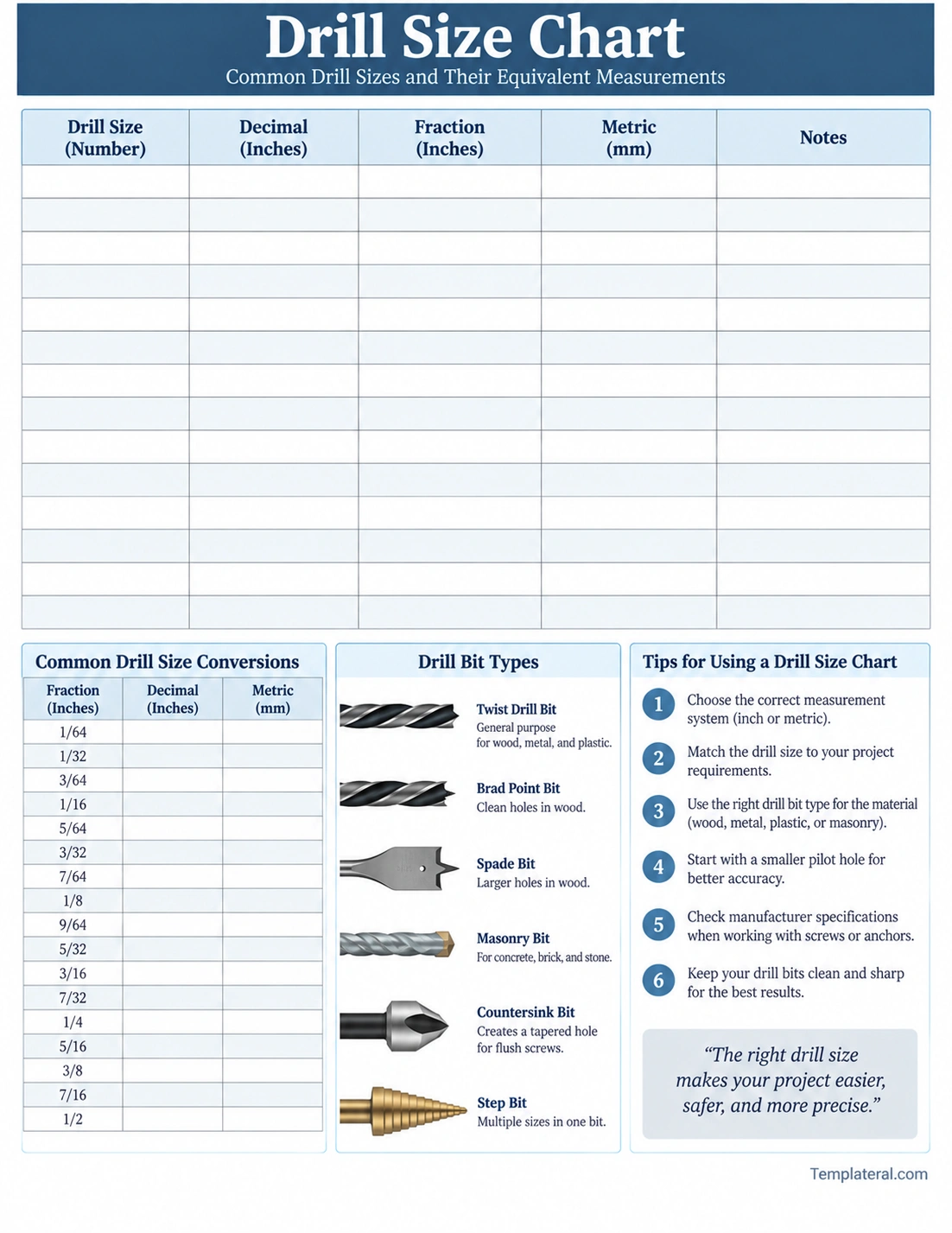
A drill size chart is a reference table that organizes drill bit diameters according to different measurement systems. Depending on the chart, it may include fractional sizes, decimal inch equivalents, number and letter sizes, and metric measurements.
The main purpose is to make it easier to identify the approximate diameter of a drill bit without having to convert every measurement manually.
A typical drill size reference may contain columns such as:
- Drill Size: The number, letter, fractional, or metric designation.
- Decimal: The approximate diameter expressed in inches.
- Fraction: The diameter expressed as a fraction of an inch.
- Metric: The approximate diameter expressed in millimeters.
- Notes: Additional information about the application or bit.
Not every drill chart uses the same columns, so it is important to check the measurement system before selecting a bit.
Why Drill Bit Size Matters
The diameter of a drilled hole affects how a screw, bolt, anchor, or other fastener fits into the material. Using a drill bit that is too small can make installation difficult, while a hole that is too large may not provide the intended fit.
The correct drill size can depend on several factors:
- The type of fastener being used.
- The material being drilled.
- Whether the hole is a clearance hole or pilot hole.
- The required depth and diameter.
- The manufacturer’s recommended specifications.
- The type of drill bit being used.
For this reason, a drill size chart should be used as a reference rather than as the only source of information. When a manufacturer provides a specific hole-size recommendation, follow that specification.
Common Drill Bit Measurement Systems
Drill bits are commonly identified using several different sizing systems. Understanding the differences makes a drill size conversion chart much easier to use.
Fractional Inch Drill Sizes
Fractional drill bits are identified using fractions of an inch. Common examples include 1/16 inch, 1/8 inch, 1/4 inch, 3/8 inch, and 1/2 inch.
Fractional sizing is particularly familiar in general-purpose drilling and many household or workshop applications.
Number Drill Sizes
Number drill bits use numerical designations rather than conventional fractions. Number sizes generally cover relatively small diameters and are commonly used in machining, metalworking, and other precision applications.
Examples include sizes such as #1, #10, #21, #30, and #60. The exact decimal diameter associated with each number should be checked against a drill size reference chart.
Letter Drill Sizes
Letter drill bits use letters to identify their diameters. Depending on the sizing system, the letters progress through a range of different drill diameters.
Letter drill sizes are frequently encountered in machining and metalworking applications where a specific hole diameter is required.
Metric Drill Sizes
Metric drill bits are measured directly in millimeters. Examples include 2 mm, 3 mm, 5 mm, 6 mm, 8 mm, and 10 mm.
Metric sizing is convenient when project specifications, fasteners, or engineering drawings use the metric system.
Fractional Drill Size to Decimal Conversion
Converting a fractional drill size into a decimal is straightforward. Divide the numerator by the denominator.
For example:
1/4 = 1 ÷ 4 = 0.250 inches
Similarly:
3/8 = 3 ÷ 8 = 0.375 inches
And:
5/16 = 5 ÷ 16 = 0.3125 inches
Although these calculations are simple, a drill size chart saves time when you need to compare many sizes quickly.
Converting Drill Sizes Between Inches and Millimeters
Metric and inch measurements can also be converted using a standard relationship:
1 inch = 25.4 millimeters
To convert inches to millimeters, multiply the inch measurement by 25.4.
For example:
1/4 inch × 25.4 = 6.35 mm
To convert millimeters to inches, divide the millimeter measurement by 25.4.
For example:
10 mm ÷ 25.4 ≈ 0.3937 inches
Because drill bits are manufactured in specific standard sizes, the closest available bit may not exactly match a converted measurement. For precision work, select the size specified by the project or manufacturer rather than simply choosing the nearest value.
How to Read a Drill Size Chart
Reading a drill size chart is relatively simple once you know which measurement you need.
- Step 1: Identify the required hole diameter.
- Step 2: Determine whether the specification uses inches, fractions, numbers, letters, or millimeters.
- Step 3: Locate the corresponding size in the chart.
- Step 4: Compare the decimal and metric equivalents if necessary.
- Step 5: Confirm that the selected drill bit is appropriate for the material and application.
For example, if a project calls for a 1/4-inch drill bit, you can locate 1/4 in the fractional column and then use the corresponding decimal and metric measurements as references.
Drill Bit Size for Pilot Holes
A pilot hole is a smaller hole drilled before installing a screw or another fastener. The appropriate pilot hole diameter depends on the fastener, material, thread design, and manufacturer’s recommendations.
A common mistake is assuming that one pilot hole size works for every screw of the same nominal diameter. In reality, different screws and materials can require different hole sizes.
Before drilling a pilot hole, consider:
- The screw or fastener diameter.
- The screw’s thread design.
- The material being drilled.
- The desired holding strength.
- The manufacturer’s recommended pilot hole size.
For critical applications, use the fastener manufacturer’s specifications rather than relying solely on a general drill size chart.
Drill Bit Types and Their Applications
Drill size is only one part of choosing the correct drill bit. Different materials require different bit designs and cutting materials.
Twist Drill Bits
Twist drill bits are general-purpose bits commonly used for drilling holes in materials such as metal, plastic, and wood. They are among the most recognizable drill bit designs.
Brad Point Bits
Brad point bits are designed primarily for woodworking. Their pointed tip helps position the bit accurately and can produce clean holes in wood.
Spade Bits
Spade bits have a broad, flat cutting surface and are commonly used for making larger holes in wood.
Masonry Bits
Masonry bits are designed for materials such as concrete, brick, and stone. They typically use a specialized carbide cutting tip.
Step Drill Bits
Step drill bits contain multiple cutting diameters along one bit. They are useful when several hole sizes are needed in relatively thin materials.
Choosing the Correct Drill Size
The correct drill size depends on what you are trying to accomplish. A hole intended for a screw may require a different diameter from a hole designed to allow a bolt to pass freely.
Before selecting a drill bit, determine whether you need:
- A pilot hole.
- A clearance hole.
- A threaded hole.
- A hole for an anchor.
- A hole for a dowel or similar component.
- A larger opening for cable or pipe passage.
Once the purpose is clear, consult the relevant project specifications and use the drill size chart to compare available bit sizes.
Drill Size Chart for Woodworking
Woodworking often requires accurate pilot holes and clean openings. A drill size chart can help you compare available bit diameters, but the appropriate size also depends on the type of wood and fastener.
For softwood, hardwood, plywood, and engineered wood products, the ideal pilot hole may differ. When installing screws, consider the screw’s core diameter and thread design rather than relying only on its outside diameter.
For visible woodworking projects, choosing an appropriate drill bit can also help reduce splitting and improve the appearance of the finished work.
Drill Size Chart for Metalworking
Metalworking often requires more precise hole dimensions than general-purpose drilling. Number and letter drill sizes are frequently encountered in machining, while fractional and metric sizes are also widely used.
When drilling metal, the drill diameter is only one consideration. Material type, drill speed, cutting fluid, bit material, and required tolerance can all affect the drilling process.
For precision holes, always use the dimensions specified by the engineering drawing, manufacturer, or machining procedure.
Tips for Using a Drill Size Chart
A drill size chart becomes more useful when you use it together with good measurement and drilling practices.
- Check the measurement system: Make sure you are comparing inches and millimeters correctly.
- Measure when necessary: Use an appropriate measuring tool when identifying an unknown drill bit.
- Verify the application: A general conversion does not automatically mean the size is correct for your fastener.
- Check manufacturer specifications: Follow recommended hole sizes for screws, anchors, and other products.
- Consider material: Wood, metal, plastic, masonry, and composite materials can require different drilling approaches.
- Keep bits organized: Store drill bits according to size so they are easy to identify.
- Use sharp bits: A worn or damaged bit can affect hole quality and drilling accuracy.
Blank Drill Size Chart for Practice and Organization
A blank drill size chart can be useful when creating a customized workshop reference. You can enter the drill sizes you use most frequently and record their decimal, fractional, and metric equivalents.
This format is particularly useful for workshops, classrooms, technical training, and personal project organization. Instead of keeping an extensive list of measurements that you rarely use, you can create a reference focused on the sizes relevant to your work.
You can also use a blank worksheet to practice drill size conversions. Fill in one measurement column first, calculate the equivalent value, and then check your result against a trusted reference.
Common Drill Size Mistakes to Avoid
Even a simple drill size conversion can lead to problems if the measurement is misunderstood.
Confusing Decimal and Fractional Sizes
Always convert the fraction correctly. For example, 3/16 inch equals approximately 0.1875 inch, not 0.316 inch.
Assuming the Closest Size Is Always Correct
A nearby drill size may not be suitable for a precision application. When a specific diameter is required, use the exact recommended drill size whenever available.
Ignoring Hole Type
A pilot hole, clearance hole, and threaded hole have different purposes. The appropriate drill diameter depends on the intended function of the hole.
Ignoring Material
The same drill diameter may be appropriate in one application but unsuitable in another. Consider the material and the fastener together when selecting a bit.
Frequently Useful Drill Size Conversions
Some fractional sizes appear frequently in general workshop tasks. A quick reference can help you recognize their approximate decimal and metric equivalents.
- 1/16 inch = 0.0625 inch = approximately 1.59 mm
- 1/8 inch = 0.125 inch = approximately 3.18 mm
- 3/16 inch = 0.1875 inch = approximately 4.76 mm
- 1/4 inch = 0.250 inch = approximately 6.35 mm
- 5/16 inch = 0.3125 inch = approximately 7.94 mm
- 3/8 inch = 0.375 inch = approximately 9.53 mm
- 7/16 inch = 0.4375 inch = approximately 11.11 mm
- 1/2 inch = 0.500 inch = approximately 12.70 mm
These conversions are mathematical equivalents. They do not necessarily indicate that a metric or fractional drill bit is interchangeable for every application.
Conclusion
A drill size chart is a useful reference for comparing drill bit diameters across fractional, decimal, number, letter, and metric sizing systems. It can make it easier to identify the correct bit and understand the relationship between different measurements.
For everyday projects, use the chart to compare sizes and conversions, but also consider the material, fastener, hole type, and manufacturer’s specifications. Precision applications may require a specific drill size rather than the closest available equivalent.
A printable drill size chart can be especially convenient in a workshop, classroom, or project area. By keeping common measurements organized in one place, you can spend less time searching for conversions and more time focusing on accurate, properly sized holes.
Download: Drill Size Chart Template
